
C Preprocessor Directives: Macros and Header Files
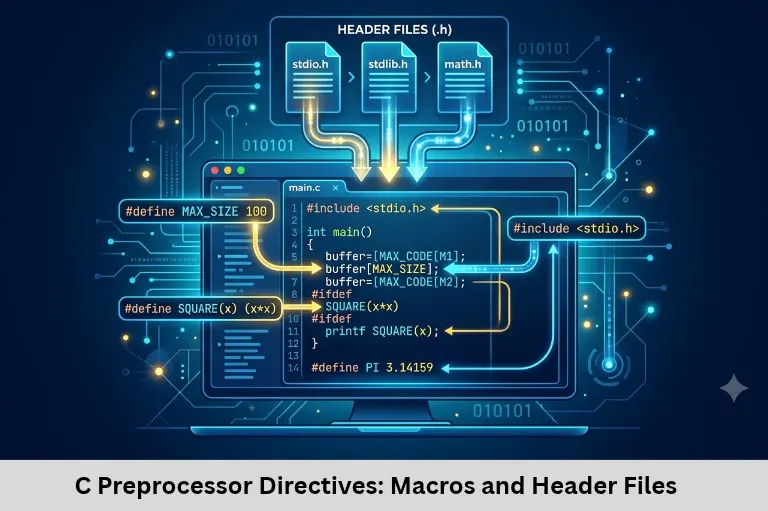
Learn C preprocessor directives, macros, header files, conditional compilation, include guards, and practical Embedded C programming examples. Embedded Tech Development Academy (ETDA).
- C Preprocessor Directives: Macros and Header Files
-
C Preprocessor Directives: Macros, Header Files and Conditional Compilation
- Introduction
- What Are C Preprocessor Directives?
- Macros in C Programming
- Header Files and the #include Directive
- Conditional Compilation in C
- Practical Applications in Embedded Systems and IoT
- Learn Embedded C Programming at ETDA
-
Frequently Asked Questions
- What are preprocessor directives in C?
- What is the difference between a macro and a function?
- Why are header guards used in C?
- What is conditional compilation in Embedded C?
- Where are C preprocessor directives used in embedded systems?
- Should embedded engineering students learn macros and header files?
- Conclusion
C Preprocessor Directives: Macros, Header Files and Conditional Compilation
Introduction
C preprocessor directives are an essential part of C programming because they help developers organize source code, define reusable constants, include library files, and control compilation. Before the compiler translates C code into machine instructions, the preprocessor processes special instructions beginning with the # symbol.
Understanding macros, header files, and conditional compilation is particularly important for Embedded C developers. These features are widely used in microcontroller firmware, device drivers, RTOS applications, and Internet of Things (IoT) projects to improve code maintainability and support different hardware configurations.
Students looking for a Top Embedded Training Institute in Bangalore can strengthen their programming fundamentals at Embedded Tech Development Academy (ETDA), where practical C programming connects with microcontroller development, Embedded Systems projects, and assured placement support.
What Are C Preprocessor Directives?
Preprocessor directives are instructions processed before the actual compilation stage. They begin with the # symbol and generally do not require a semicolon at the end.
The C preprocessor performs tasks such as textual macro substitution, header file inclusion, and conditional compilation. These operations help developers create reusable code and manage application-specific configurations without modifying the main program repeatedly.
Common Types of Preprocessor Directives
The commonly used directives include:
#define– Defines macros and symbolic constants.#include– Includes header file contents.#ifdef– Checks whether a macro is defined.#ifndef– Checks whether a macro is not defined.#if– Evaluates a preprocessing condition.#else– Provides an alternative compilation branch.#elif– Checks another condition.#endif– Ends a conditional preprocessing block.#undef– Removes an existing macro definition.
Macros in C Programming
A macro is a name defined using the #define directive. The preprocessor replaces macro occurrences with their corresponding replacement text before compilation.
Macros are useful for defining constants, creating short reusable expressions, and selecting configuration values. However, because macros perform textual substitution, developers must understand operator precedence, parentheses, and possible side effects.
Object-Like Macros
Object-like macros represent constants or replacement text without parameters.
#define LED_PIN 2
#define MAX_COUNT 100
#define CPU_FREQUENCY 12000000UL
In this example, the preprocessor replaces occurrences of these names with their defined values. In embedded firmware, such macros can represent pin numbers, buffer sizes, register masks, and configuration settings.
Function-Like Macros
Function-like macros accept arguments and are frequently used for compact expressions.
#define SQUARE(x) ((x) * (x))

int result = SQUARE(5);
The expression becomes ((5) * (5)), producing 25. Parentheses around parameters and the complete expression help prevent precedence errors.
Common Macro Mistake
Consider this unsafe definition:
#define SQUARE(x) x * xUsing SQUARE(2 + 3) expands to 2 + 3 * 2 + 3, which evaluates to 11 instead of 25. Correct parentheses ensure predictable expansion and improve program reliability.
Header Files and the #include Directive
Header files contain declarations, macro definitions, function prototypes, structures, and other shared information. They generally use the .h extension and allow multiple source files to share interfaces without duplicating declarations.
The #include directive inserts the contents of a specified header file into the source file during preprocessing.
Standard and User-Defined Header Files
Standard headers provide library functionality. For example, stdio.h contains declarations for standard input and output functions, while string.h provides string manipulation declarations.
User-defined headers contain application-specific declarations. Embedded projects often use headers such as gpio.h, uart.h, timer.h, and sensor.h to organize hardware interfaces and firmware modules.
Header Guards and Multiple Inclusion
A header guard prevents the same header from being processed repeatedly within a translation unit.
#ifndef UART_H
#define UART_H

void UART_Init(void);
void UART_SendChar(char ch);

#endif
When UART_H is not defined, the declarations are processed and the macro is defined. Subsequent inclusions skip the guarded contents, preventing duplicate structure definitions or declarations that could otherwise cause compilation problems.
Conditional Compilation in C
Conditional compilation allows developers to include or exclude portions of source code depending on preprocessing conditions. It is particularly useful when developing firmware for multiple microcontrollers, testing different configurations, or enabling debugging features.
Using #ifdef and #ifndef
#define DEBUG_MODE

#ifdef DEBUG_MODE
    printf("Debug enabled\n");
#endif
The code inside the conditional block is included only when DEBUG_MODE has been defined. This technique allows developers to enable diagnostic messages during development and remove them from production builds.
Using #if, #elif and #else
#define MCU_VERSION 2

#if MCU_VERSION == 1
    #define CLOCK_SPEED 8000000UL
#elif MCU_VERSION == 2
    #define CLOCK_SPEED 16000000UL
#else
    #define CLOCK_SPEED 12000000UL
#endif
This example selects a clock configuration based on the defined microcontroller version. Conditional compilation helps maintain a single codebase for multiple hardware configurations, reducing unnecessary duplication.
Practical Applications in Embedded Systems and IoT
Preprocessor directives are widely used in embedded firmware because hardware configurations and development requirements frequently change. Developers can define GPIO mappings, communication settings, feature options, and debugging conditions through macros.
For example, an Internet of Things (IoT) device may support different sensor models or communication modules. Conditional compilation allows developers to build firmware for selected hardware without including unnecessary drivers, reducing code complexity and potentially saving memory.
In device driver development, header files provide clean interfaces between modules, while macros can define register masks and configuration values. These techniques help firmware teams maintain organized, reusable, and scalable code.
Learn Embedded C Programming at ETDA
Embedded Tech Development Academy (ETDA) helps engineering students build programming fundamentals required for embedded firmware development. Understanding C preprocessor directives is an important step toward writing modular applications, reusable drivers, and maintainable microcontroller code.
Students can progress from C programming and pointers to Embedded C, 8051 programming, ARM Cortex-M development, peripheral interfacing, RTOS, and Internet of Things (IoT) projects. Practical exercises help learners understand how software concepts translate into real hardware behavior.
Students searching for a Top Embedded Training Institute in Bangalore should evaluate technical curriculum, programming practice, debugging exposure, and project-based learning. Embedded Tech Development Academy (ETDA) combines hands-on technical training with assured placement support to help learners prepare for embedded engineering opportunities.
Frequently Asked Questions
What are preprocessor directives in C?
Preprocessor directives are instructions beginning with # that are processed before compilation. They support macro definitions, header inclusion, and conditional compilation.
What is the difference between a macro and a function?
A macro performs textual substitution before compilation, whereas a function executes through normal function-call mechanisms. Functions provide type checking for parameters and generally avoid macro-related side effects.
Why are header guards used in C?
Header guards prevent repeated inclusion of the same header contents within a translation unit, helping avoid duplicate definitions and compilation errors.
What is conditional compilation in Embedded C?
Conditional compilation allows selected code sections to be included or excluded based on predefined macros or preprocessing conditions. It is useful for hardware configuration and debugging.
Where are C preprocessor directives used in embedded systems?
They are used in device drivers, register definitions, hardware configuration, debugging, RTOS applications, and Internet of Things (IoT) firmware development.
Should embedded engineering students learn macros and header files?
Yes. These concepts are essential for modular programming, reusable firmware, hardware abstraction, and professional Embedded C development.
Conclusion
C preprocessor directives make programming more flexible and organized by supporting macros, header files, and conditional compilation. These features help developers reuse code, maintain shared interfaces, and configure applications for different hardware platforms.
For aspiring embedded developers, mastering these concepts creates a foundation for Embedded C, firmware development, device drivers, and Internet of Things (IoT) applications. Choosing a Top Embedded Training Institute in Bangalore such as Embedded Tech Development Academy (ETDA) can help students develop practical programming skills through structured Embedded Systems training, projects, and assured placement support.
Author: ETDA Trainers
Experience: 10+ Years of Industry Experience in Embedded Systems, IoT, and Embedded C Programming