
Python Memory Management and Garbage Collection Guide
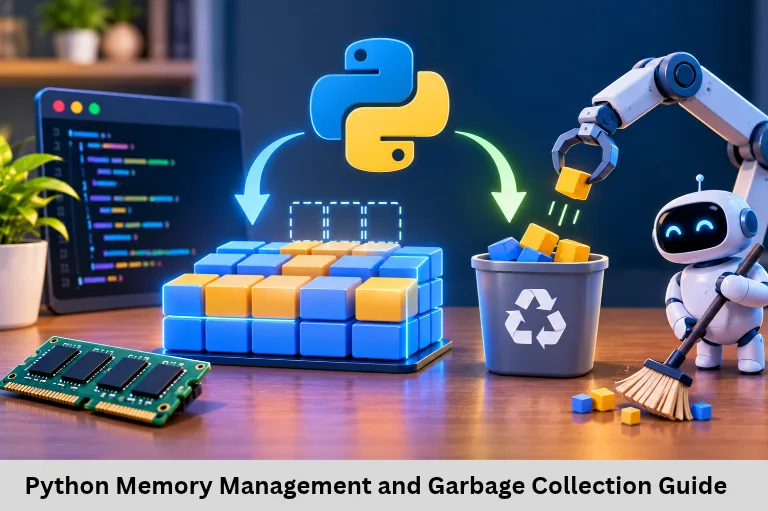
Learn Python memory management, garbage collection, reference counting, memory leaks, gc module, and memory optimization with practical examples. Embedded Tech Development Academy (ETDA).
- Python Memory Management and Garbage Collection Guide
-
Memory Management and Garbage Collection in Python
- Introduction
- What Is Memory Management in Python?
- How Python Allocates Memory
- What Is Garbage Collection in Python?
- Cyclic Garbage Collection in Python
- Python GC Module and Garbage Collection Control
- Generational Garbage Collection in Python
- Memory Leaks and Memory Optimization in Python
- Practical Example – Memory-Efficient Python Programming
- Memory Management in Embedded Systems and IoT
- Learn Python Programming at Embedded Tech Development Academy
- Frequently Asked Questions
- Conclusion
Memory Management and Garbage Collection in Python
Introduction
Memory management and garbage collection in Python are important concepts for students learning Python programming, software development, embedded systems, and Internet of Things (IoT) applications. Every Python program uses memory to store variables, objects, lists, dictionaries, and other data structures. Understanding how Python allocates memory and automatically releases unused objects helps developers write efficient, reliable, and maintainable applications.
Python provides automatic memory management, reducing the need for programmers to manually allocate and deallocate memory. However, understanding reference counting, garbage collection, object lifetime, and memory optimization is essential when developing applications that process large datasets or operate with limited resources. Students looking for practical technical training can explore Embedded Tech Development Academy (ETDA), a Top Embedded Training Institute in Bangalore, where programming fundamentals, practical learning, and assured placement support help learners prepare for technical careers.
What Is Memory Management in Python?
Memory management is the process of allocating, organizing, using, and releasing memory during program execution. Python manages memory automatically through its runtime environment, allowing developers to focus on application logic instead of manually handling every memory allocation.
When a Python program creates an object, such as an integer, string, list, or dictionary, memory is allocated to store that object. Python keeps track of objects and determines when their memory can be released.
How Python Allocates Memory
Python uses a private memory management system to manage objects and their storage requirements. In CPython, memory allocation involves several components, including object allocation mechanisms and specialized allocators.
Small objects may be handled efficiently through Python’s allocator, while larger allocations can involve underlying system memory allocation mechanisms.
Understanding Python Objects
Everything in Python is an object, including numbers, strings, functions, and classes. Each object contains information about its type, value, and other internal properties.
For example, when a programmer creates a list, Python allocates memory for the list object and manages references to its elements. This object-based architecture makes Python flexible but also introduces memory-management overhead.
What Is Garbage Collection in Python?
Garbage collection is a mechanism that identifies objects that are no longer needed and helps reclaim their memory.
Python uses reference counting as its primary memory-management mechanism in CPython. It also includes a cyclic garbage collector that handles reference cycles that reference counting alone cannot reclaim.
Understanding Reference Counting
Reference counting tracks how many references point to an object.
When a variable refers to an object, its reference count generally increases. When a reference is removed, the reference count decreases.
When the object’s reference count reaches zero, CPython can generally release the object immediately, subject to implementation details and object finalization behavior.
Example of Reference Counting
import sys

data = [10, 20, 30]

print(sys.getrefcount(data))

another = data

print(sys.getrefcount(data))

del another

print(sys.getrefcount(data))
The sys.getrefcount() function displays the reference count of an object in CPython. Its returned value includes a temporary reference created when the function is called, so the displayed count should not be interpreted as the exact number of variables referencing the object.
This example helps students understand how Python tracks object references during program execution.
Cyclic Garbage Collection in Python
Reference counting works effectively for most objects, but it cannot independently reclaim objects involved in reference cycles.
A reference cycle occurs when two or more objects reference each other, directly or indirectly, even though the application no longer needs them.
Example of a Reference Cycle
class Node:
    pass

a = Node()
b = Node()

a.other = b
b.other = a

del a
del b
In this example, the two objects reference each other. After deleting the external references, the objects may still have references within the cycle.
Python’s cyclic garbage collector can identify eligible unreachable cycles and reclaim them.
Why Cyclic Garbage Collection Matters
Cyclic garbage collection prevents certain objects from remaining in memory indefinitely merely because they reference one another.
This mechanism is particularly useful in applications involving linked objects, complex data structures, object graphs, and classes that maintain relationships between other objects.
Python GC Module and Garbage Collection Control
Python provides the gc module for inspecting and controlling aspects of cyclic garbage collection.
Checking Garbage Collector Status
import gc

print(gc.isenabled())
print(gc.get_threshold())
print(gc.get_count())
These functions help developers understand the garbage collector’s current configuration and collection counters.
Manually Triggering Garbage Collection
import gc

collected = gc.collect()

print("Collected objects:", collected)
The gc.collect() function requests a garbage collection cycle and returns the number of objects collected in that cycle.
Manual collection can be useful during debugging, experimentation, or controlled memory-management scenarios. However, calling it repeatedly without a clear reason may introduce unnecessary performance overhead.
Generational Garbage Collection in Python
CPython traditionally uses a generational approach to cyclic garbage collection. The idea is that objects surviving multiple collection cycles are more likely to remain alive.
Understanding Object Generations
Generational garbage collection groups tracked objects according to their age or survival through collection cycles.
Younger objects are generally collected more frequently, while older objects may be examined less frequently because they are more likely to remain in use.
Important: Garbage collector implementation details and generation behavior vary between Python versions. Developers should consult the documentation for the specific Python release they are using.
Memory Leaks and Memory Optimization in Python
Although Python manages memory automatically, applications can still experience memory growth and inefficient memory usage.
Common Causes of Memory Problems
Memory problems can occur when applications maintain unnecessary references to objects, store large collections indefinitely, or repeatedly create objects without removing them from long-lived data structures.
Global variables, caches, retained log data, circular references involving finalizers, and unmanaged external resources can contribute to memory-related problems.
Practical Memory Optimization Techniques
Developers can improve Python memory efficiency by following these practices:
Remove unnecessary references to large objects.
Avoid retaining unused data in global variables.
Use generators for large sequences when appropriate.
Process files incrementally instead of loading everything into memory.
Use suitable data structures for the application.
Monitor memory usage during testing.
Release external resources using context managers.
For example, generators allow applications to process data one element at a time rather than storing an entire sequence in memory.
Practical Example – Memory-Efficient Python Programming
Consider an application that processes sensor readings collected from an Internet of Things (IoT) device.
Using a Generator for Sensor Data
def sensor_readings():
    for value in range(1000000):
        yield value

for reading in sensor_readings():
    process = reading * 2
The generator produces values progressively instead of constructing a complete list of one million elements.
This approach can reduce memory consumption when processing large datasets, especially in monitoring applications and data-processing pipelines.
Memory Management in Embedded Systems and IoT
Python memory management is relevant to embedded systems and Internet of Things (IoT) applications that use Python-based environments.
Embedded Python Applications
MicroPython and CircuitPython provide Python-based programming environments for supported microcontrollers. Their memory resources are generally more limited than desktop systems, making efficient memory usage especially important.
Developers must consider object allocation, buffer sizes, fragmentation, and available RAM when building microcontroller applications.
IoT Data Processing
Python is widely used in Internet of Things (IoT) gateways, edge computing applications, sensor data analysis, and automation tools.
Efficient memory management helps applications process sensor data, communicate with devices, and handle continuous monitoring tasks without unnecessary memory consumption.
Learn Python Programming at Embedded Tech Development Academy
Understanding Python memory management helps students develop stronger programming fundamentals and prepare for advanced technical learning.
At Embedded Tech Development Academy (ETDA), students can strengthen their programming knowledge through technical training, practical exercises, and project-oriented learning. Python programming, embedded C, C++, microcontroller interfacing, communication protocols, and debugging are valuable skills for aspiring embedded engineers.
Choosing a Top Embedded Training Institute in Bangalore helps students develop practical technical confidence and understand how programming concepts apply to real-world engineering projects.
Embedded Tech Development Academy (ETDA) focuses on industry-oriented learning and provides assured placement support to help learners prepare for technical employment opportunities.
Students searching for a Top Embedded Training Institute in Bangalore can explore Embedded Tech Development Academy (ETDA) to strengthen their programming foundations and build skills relevant to embedded systems and Internet of Things (IoT) development.
Frequently Asked Questions
What is memory management in Python?
Memory management in Python is the process of allocating, tracking, and releasing memory used by objects during program execution.
Does Python use garbage collection?
Yes. CPython primarily uses reference counting and also includes a cyclic garbage collector to handle unreachable reference cycles.
What is reference counting in Python?
Reference counting tracks the number of references associated with an object. When an object’s reference count reaches zero, CPython can generally release its memory.
What is the gc module in Python?
The gc module provides functions to inspect and control cyclic garbage collection, including gc.collect(), gc.get_count(), and gc.isenabled().
Can Python have memory leaks?
Yes. Memory growth can occur because of retained references, unbounded caches, resource-management problems, or other application-level issues, even when automatic garbage collection is available.
Why is Python memory management important for IoT?
Efficient memory management helps Internet of Things (IoT) applications process sensor data, maintain stable operation, and work within limited memory resources, particularly in embedded Python environments.
Conclusion
Memory management and garbage collection in Python are essential concepts for writing efficient and reliable applications. Understanding object allocation, reference counting, cyclic garbage collection, memory leaks, and optimization techniques helps developers manage memory usage more effectively.
These concepts are particularly valuable when working with data-processing applications, embedded systems, Internet of Things (IoT) gateways, and resource-constrained Python environments.
For students planning a technical career, Embedded Tech Development Academy (ETDA) offers practical learning opportunities to improve programming knowledge and project skills. Exploring a Top Embedded Training Institute in Bangalore like Embedded Tech Development Academy (ETDA) can help learners develop industry-oriented capabilities through structured technical training, hands-on practice, and assured placement support.
Author: ETDA Trainers
Experience: 10+ Years of Industry Experience in Embedded Systems, IoT, and Embedded C Programming