
Function Pointers in C: Callbacks and Practical Uses
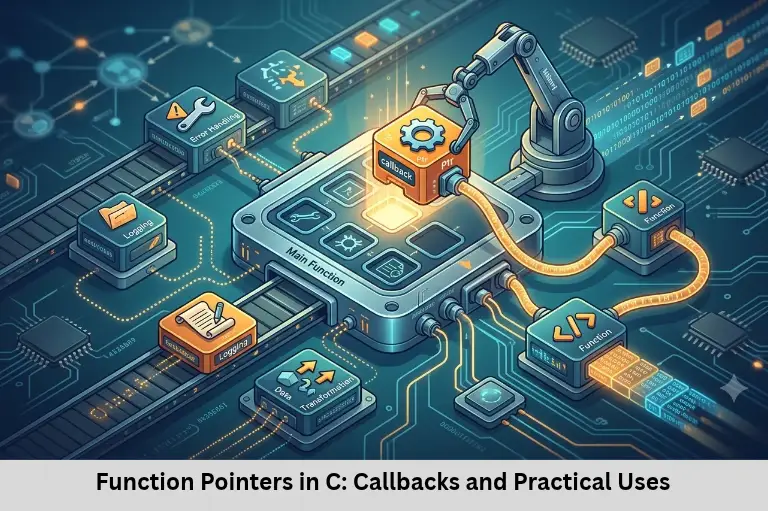
Learn function pointers in C with callback functions, syntax, practical examples, embedded systems applications, and programming techniques. Embedded Tech Development Academy (ETDA).
- Function Pointers in C: Callbacks and Practical Uses
-
Function Pointers in C: Callback Functions and Practical Applications
- Introduction
- What Are Function Pointers in C?
- Function Pointer Syntax in C
- Understanding Callback Functions in C
- Function Pointers with Multiple Callback Functions
- Practical Applications of Function Pointers
- Function Pointer Arrays in C
- Function Pointers in Embedded Systems
- Common Mistakes When Using Function Pointers
- Learn Advanced C Programming at ETDA
- Frequently Asked Questions
- Conclusion
Function Pointers in C: Callback Functions and Practical Applications
Introduction
Function pointers in C are an important programming concept for students learning advanced C programming, embedded systems development, and firmware engineering. They allow a program to store the address of a function and execute it indirectly, making code more flexible, reusable, and modular. Callback functions, interrupt-related programming techniques, and function-based interfaces frequently use this concept.
Understanding function pointers helps students move beyond basic C programming toward real-world embedded development. They are particularly useful in device drivers, communication protocols, event handling, and Internet of Things (IoT) applications. Embedded Tech Development Academy (ETDA), a Top Embedded Training Institute in Bangalore, helps students strengthen their C programming knowledge through technical training, practical exercises, and industry-oriented embedded projects. Its learning approach and assured placement support help students prepare for firmware development opportunities.
What Are Function Pointers in C?
A function pointer is a pointer variable that stores the address of a function. Unlike ordinary pointers that point to data variables, function pointers refer to executable code.
Using a function pointer, programmers can call different functions through the same interface. This makes it possible to select functions dynamically, implement callbacks, and design reusable programming structures.
Function Pointer Syntax in C
The basic syntax of a function pointer is:
return_type (*pointer_name)(parameter_types);For example:
int (*operation)(int, int);Here, operation is a function pointer that can point to any function returning an integer and accepting two integer arguments.
Declaring and Assigning a Function Pointer
Consider a simple addition function:
#include <stdio.h>

int add(int a, int b)
{
    return a + b;
}

int main(void)
{
    int (*operation)(int, int);

    operation = add;

    printf("%d\n", operation(10, 20));

    return 0;
}
The function pointer operation stores the address of add. Calling operation(10, 20) executes the addition function indirectly.
The expression operation = add; is equivalent to assigning operation = &add; because a function name converts to its function address in this context.
Understanding Callback Functions in C
A callback function is a function passed to another function as an argument so that it can be executed later. Callback mechanisms allow one function to control when another function is called without directly depending on its implementation.
Callbacks are widely used in event-driven programming, library interfaces, embedded firmware, and application frameworks.
Simple Callback Function Example
#include <stdio.h>

void display(int value)
{
    printf("Value: %d\n", value);
}

void process(int data, void (*callback)(int))
{
    callback(data);
}

int main(void)
{
    process(25, display);

    return 0;
}
In this example, process() accepts a function pointer as its second parameter. It calls the supplied callback after receiving the data.
This design allows process() to work with different callback functions without changing its internal implementation. Such flexibility is useful when designing reusable embedded software modules.
Why Callbacks Improve Software Design
Callbacks separate the main operation from the action performed afterward. This reduces code duplication and improves modularity.
For example, a sensor driver can notify an application when new data becomes available. The driver does not need to know whether the application displays the reading, stores it, or transmits it to an Internet of Things (IoT) gateway.
Function Pointers with Multiple Callback Functions
Function pointers become more powerful when multiple functions share the same signature.
#include <stdio.h>

int add(int a, int b)
{
    return a + b;
}

int subtract(int a, int b)
{
    return a - b;
}

int calculate(int a, int b,
              int (*operation)(int, int))
{
    return operation(a, b);
}

int main(void)
{
    printf("%d\n", calculate(10, 5, add));
    printf("%d\n", calculate(10, 5, subtract));

    return 0;
}
The calculate() function performs different operations depending on the callback provided by the caller. This approach is often called a strategy-style design because the operation can be selected without modifying the main calculation function.
Practical Applications of Function Pointers
Callback-Based Event Handling
Embedded applications frequently respond to events such as button presses, sensor updates, communication completion, and system notifications.
A callback allows the event-handling module to notify application code when an event occurs. This improves separation between hardware-specific logic and application-specific behavior.
Device Driver Interfaces
Function pointers can be used to define driver operations such as initialization, read, write, and control functions.
Different hardware devices can implement the same interface while providing different function implementations. This approach is useful for creating reusable driver frameworks in embedded systems.
Communication Protocol Handling
UART, SPI, I2C, and CAN communication modules can use callbacks to notify applications about transmitted data, received messages, or communication errors.
For example, a UART driver may call a receive callback after a complete message arrives. The application can then process the data without tightly coupling its logic to the driver.
Function Pointer Arrays in C
An array of function pointers can store multiple functions with compatible signatures. This is useful for implementing menus, command handlers, and state-based operations.
Command Handler Example
#include <stdio.h>

void command_start(void)
{
    printf("System Started\n");
}

void command_stop(void)
{
    printf("System Stopped\n");
}

void command_status(void)
{
    printf("System Status\n");
}

int main(void)
{
    void (*commands[3])(void);

    commands[0] = command_start;
    commands[1] = command_stop;
    commands[2] = command_status;

    commands[0]();
    commands[2]();

    return 0;
}
The program stores command functions in an array and executes them using their respective indexes. This method can reduce lengthy conditional statements in command-driven firmware.
Function Pointers in Embedded Systems
Function pointers are particularly valuable in embedded systems because they support modular firmware architectures.
State Machine Implementation
Finite State Machines (FSMs) are commonly used in embedded applications. Function pointers can associate each state with a specific processing function.
For example, an automotive controller may have initialization, idle, active, and fault states. Each state can execute a dedicated function, improving readability and simplifying state transitions.
IoT Application Development
Internet of Things (IoT) devices often process sensor readings, communication events, and network commands. Callback-based software allows these operations to remain independent.
A sensor module can notify an application when measurements are ready, while a communication module can notify it when data transmission completes. Function pointers help developers create flexible and maintainable firmware.
Common Mistakes When Using Function Pointers
Students should understand that function pointers must have compatible function signatures. Calling a function through an incompatible pointer type can result in undefined behavior.
Uninitialized function pointers should never be called because they may contain invalid addresses. Similarly, callback functions must remain valid for as long as the software may invoke them.
Debugging Function Pointer Errors
When debugging function pointer programs, verify the declaration, return type, parameter types, and assignment. Check whether the callback has been registered correctly before execution.
In embedded applications, debugging tools and compiler warnings can help identify incorrect function pointer usage. Good coding practices improve firmware reliability and maintainability.
Learn Advanced C Programming at ETDA
Students preparing for embedded engineering careers should understand pointers, structures, arrays, memory management, function pointers, and callback mechanisms.
Embedded Tech Development Academy (ETDA) provides technical learning opportunities in C programming, Embedded C, microcontroller programming, communication protocols, and hardware-based projects.
Choosing a Top Embedded Training Institute in Bangalore helps students strengthen their practical programming knowledge and develop industry-oriented skills. Embedded Tech Development Academy (ETDA) focuses on technical learning and project experience while providing assured placement support to help students prepare for engineering interviews.
Build a Callback-Based Mini Project
A useful beginner project is a callback-based sensor monitoring application. Create a sensor processing function and pass different callbacks for displaying readings, storing measurements, or transmitting information.
This exercise helps students understand function pointer declarations, callback registration, modular programming, and event handling. These skills become valuable when progressing toward advanced embedded systems and Internet of Things (IoT) projects.
Frequently Asked Questions
What is a function pointer in C?
A function pointer stores the address of a function and allows the function to be called indirectly through a pointer variable.
What is a callback function in C?
A callback is a function passed to another function through a function pointer so that it can be executed when required.
Why are function pointers used in embedded systems?
They support callbacks, device driver interfaces, state machines, event handling, and modular firmware design.
Can function pointers be stored in arrays?
Yes. Arrays of function pointers can store multiple functions with compatible signatures and support command handlers or state-based execution.
What is the difference between a function pointer and a normal pointer?
A normal pointer generally stores the address of a data object, whereas a function pointer stores the address of executable code.
Why should students learn function pointers in C?
Function pointers develop advanced C programming skills required for firmware development, embedded software architecture, device drivers, and callback-based applications.
Conclusion
Function pointers in C provide a powerful mechanism for implementing callbacks, reusable interfaces, event handling, and modular software architectures. Understanding their syntax and practical applications helps students develop maintainable programs for embedded systems, device drivers, and Internet of Things (IoT) applications.
Students searching for a Top Embedded Training Institute in Bangalore can explore Embedded Tech Development Academy (ETDA) to strengthen their C programming and embedded development knowledge through practical learning and technical projects. Embedded Tech Development Academy (ETDA) combines industry-oriented training with assured placement support, helping students prepare for embedded engineering career opportunities.
Author: ETDA Trainers
Experience: 10+ Years of Industry Experience in Embedded Systems, IoT, and Embedded C Programming