
Embedded System Design: Hardware & Software Integration
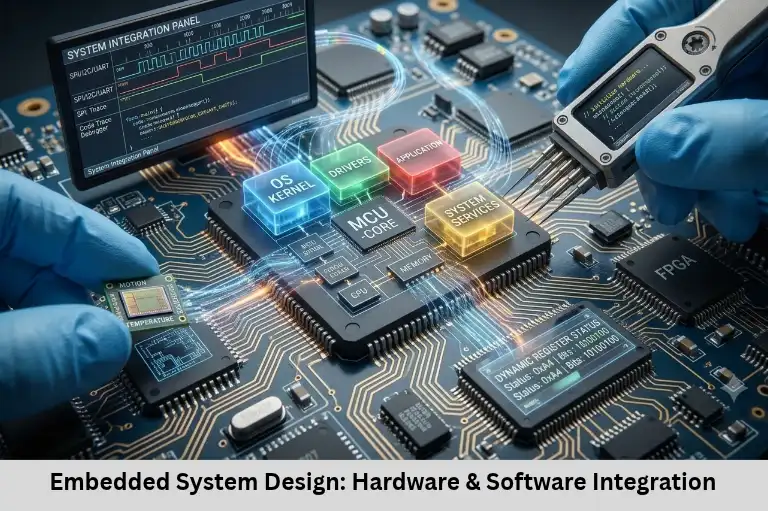
Learn embedded system design, hardware and software integration, microcontrollers, drivers, communication protocols, and practical skills with Embedded Tech Development Academy (ETDA).
- Embedded System Design: Hardware & Software Integration
-
Embedded System Design: Hardware and Software Integration
- Introduction
- What Is Embedded System Design?
- How Hardware and Software Integration Works
- Communication Protocols in Hardware and Software Integration
- Embedded System Design Challenges and Debugging
- Why Students Should Learn Embedded Hardware and Software Integration
- Learn Embedded System Design at Embedded Tech Development Academy
-
Frequently Asked Questions
- What is hardware and software integration in embedded systems?
- Which programming language is used for embedded system design?
- Which microcontrollers are suitable for learning embedded system design?
- What communication protocols should embedded students learn?
- Is embedded system design suitable for electrical engineering students?
- Does ETDA provide placement support for embedded training?
- Conclusion
Embedded System Design: Hardware and Software Integration
Introduction
Embedded system design is the process of combining electronic hardware and software to create intelligent devices that perform specific functions efficiently. From automotive control units and industrial machines to medical equipment and Internet of Things (IoT) products, embedded systems are responsible for monitoring inputs, processing information, and controlling outputs in real time. Understanding how hardware and software work together is an essential skill for students aspiring to become embedded engineers.
For students looking to enter this technical field, learning integration concepts is more valuable than studying programming alone. The Top Embedded Training Institute in Bangalore approach combines theoretical understanding with practical implementation, helping learners understand how firmware interacts with physical components. Embedded Tech Development Academy (ETDA) supports students through industry-oriented learning, hands-on projects, and assured placement support.
What Is Embedded System Design?
Embedded system design involves developing a dedicated computing system that integrates a microcontroller or processor, memory, peripherals, electronic components, and firmware. Unlike general-purpose computers, embedded devices are designed to perform specific tasks with predictable performance, limited resources, and controlled power consumption.
A typical embedded system contains sensors, a processing unit, communication interfaces, and output devices. Firmware controls these components by reading input signals, processing data, and generating suitable responses. This combination makes embedded systems essential in automotive electronics, robotics, consumer electronics, industrial automation, and Internet of Things (IoT) applications.
Hardware Components Used in Embedded Systems
Hardware provides the physical platform on which embedded software executes. Engineers select components according to processing requirements, memory capacity, power consumption, peripheral availability, and application constraints.
Common hardware components include:
Microcontrollers: STM32, LPC1768, ESP32, and 8051 for control and processing.
Memory: Flash for firmware storage and SRAM for temporary data.
Sensors: Temperature, pressure, accelerometers, and proximity sensors.
Actuators: Motors, relays, solenoids, and LEDs.
Communication interfaces: UART, SPI, I2C, CAN, and Ethernet.
Power circuits: Voltage regulators, protection circuits, and battery management.
Choosing appropriate hardware directly influences software complexity, system reliability, and overall performance.
Software Components Used in Embedded Systems
Embedded software converts hardware capabilities into useful functionality. It includes startup code, peripheral drivers, application logic, interrupt handlers, and sometimes an operating system.
Firmware initializes microcontroller peripherals, configures registers, processes sensor readings, and controls external devices. Depending on application complexity, engineers may use bare-metal programming or an RTOS such as FreeRTOS.
The Top Embedded Training Institute in Bangalore learning approach should help students understand both firmware development and its interaction with electronic hardware, rather than treating them as independent subjects.
How Hardware and Software Integration Works
Hardware and software integration ensures that firmware communicates correctly with physical components. The process begins with understanding system requirements, selecting suitable components, designing circuits, and developing firmware that operates the hardware.
For example, a temperature monitoring system may use an STM32 microcontroller connected to a temperature sensor through an I2C interface. Firmware configures the I2C peripheral, reads sensor registers, converts the received data into temperature values, and displays the result or transmits it to another device.
Register-Level Programming and Peripheral Configuration
Microcontrollers contain hardware registers that control peripherals such as GPIO, timers, ADCs, UARTs, and communication interfaces. Firmware configures these registers to determine how hardware behaves.
Consider configuring a GPIO pin as an output using register-level programming:
#define GPIO_DIR (*(volatile unsigned int *)0x50000000)
#define GPIO_OUT (*(volatile unsigned int *)0x50000004)

int main(void)
{
    GPIO_DIR |= (1U << 5);

    while (1)
    {
        GPIO_OUT ^= (1U << 5);
    }
}
This example illustrates direction configuration and output toggling using register access. The addresses are illustrative, not universal microcontroller addresses. Actual register definitions must come from the selected device’s reference manual or vendor header files.
Understanding registers helps students develop efficient firmware and troubleshoot hardware-level problems.
Device Drivers and Hardware Abstraction
Device drivers provide software interfaces for controlling hardware peripherals. Instead of repeatedly writing low-level register operations inside application code, engineers develop reusable functions for GPIO, UART, SPI, I2C, ADC, and timers.
A UART driver, for example, may include initialization, baud-rate configuration, transmit, receive, and error-handling functions. Application software can use these functions without directly managing every peripheral register.
This separation improves code readability, portability, maintainability, and debugging efficiency.
Communication Protocols in Hardware and Software Integration
Communication protocols enable microcontrollers to exchange information with sensors, modules, processors, and external systems. Selecting the correct protocol depends on data speed, wiring complexity, distance, reliability, and application requirements.
UART, SPI, and I2C Integration
UART provides asynchronous serial communication using transmit and receive signals. It is commonly used for debugging, GPS modules, Bluetooth modules, and serial communication between embedded devices.
SPI supports high-speed synchronous communication using clock, data, and chip-select signals. It is suitable for displays, memory devices, and high-speed sensors.
I2C uses two communication lines, SDA and SCL, allowing multiple devices to share a bus through addressing. It is frequently used in sensor interfacing and low-speed peripheral communication.
CAN Communication in Automotive Embedded Systems
Controller Area Network (CAN) enables reliable communication between electronic control units in automotive applications. It supports message-based communication, arbitration, error detection, and fault handling.
Automotive embedded engineers use CAN to exchange information between systems such as engine controllers, body control modules, instrument clusters, and diagnostic equipment. Students learning CAN should understand message identifiers, arbitration, bit timing, and hardware transceiver integration.
Practical Integration Example – Sensor-Based IoT System
Consider an Internet of Things (IoT) monitoring system using an STM32 microcontroller, an I2C temperature sensor, and a wireless communication module. The sensor provides environmental measurements, firmware processes the readings, and the communication module sends information to an Internet of Things (IoT) dashboard.
The project requires hardware connections, peripheral configuration, driver development, application programming, and communication testing. Students gain practical experience by observing how a software error or incorrect electrical connection affects the complete system.
Embedded System Design Challenges and Debugging
Hardware and software integration introduces challenges that cannot always be identified through code inspection alone. Electrical noise, incorrect voltage levels, timing issues, memory limitations, and peripheral configuration errors can affect system operation.
Engineers use oscilloscopes, logic analyzers, multimeters, serial terminals, and debugging tools to identify faults. JTAG and SWD interfaces support breakpoint debugging, register inspection, memory examination, and step-by-step execution.
Other important challenges include:
Timing constraints: Ensuring tasks and interrupts execute within required deadlines.
Memory limitations: Managing RAM, Flash, stack, and heap efficiently.
Power consumption: Optimizing sleep modes and peripheral activity.
Hardware compatibility: Checking voltage levels, pin configurations, and electrical specifications.
Reliability: Handling communication failures, unexpected inputs, and watchdog recovery.
Students who practise systematic debugging develop stronger problem-solving abilities and become more confident in real engineering environments.
Why Students Should Learn Embedded Hardware and Software Integration
Students from electrical, electronics, instrumentation, and related engineering backgrounds can build careers in embedded firmware development, automotive electronics, Internet of Things (IoT), robotics, and industrial automation.
A strong learning path includes C programming, digital electronics, microcontroller architecture, peripheral interfacing, communication protocols, RTOS fundamentals, and practical project development. Understanding datasheets, schematics, and debugging techniques is equally important for professional readiness.
Choosing the Top Embedded Training Institute in Bangalore can help students gain structured exposure to these subjects and improve their practical understanding. Embedded Tech Development Academy (ETDA) focuses on technical learning, hands-on implementation, and industry-oriented projects that connect classroom concepts with engineering applications.
Embedded Tech Development Academy (ETDA) also offers assured placement support, helping learners prepare for technical interviews and explore relevant embedded career opportunities.
Learn Embedded System Design at Embedded Tech Development Academy
Embedded Tech Development Academy (ETDA) provides an industry-oriented learning environment for students interested in embedded systems, firmware development, and hardware integration. Practical exposure helps learners understand how microcontrollers, electronic circuits, drivers, and application software operate together.
Students can strengthen their skills through microcontroller programming, peripheral interfacing, communication protocols, and project-based learning. These activities improve technical confidence and prepare learners to approach real-world embedded engineering challenges.
For aspiring engineers searching for the Top Embedded Training Institute in Bangalore, Embedded Tech Development Academy (ETDA) offers a learning pathway focused on practical knowledge, technical development, and assured placement support.
Frequently Asked Questions
What is hardware and software integration in embedded systems?
It is the process of connecting electronic hardware with firmware so that sensors, microcontrollers, peripherals, and output devices operate together to perform a specific application.
Which programming language is used for embedded system design?
C is widely used because it provides efficient memory management, direct hardware access, and predictable execution. C++ is also used in complex embedded applications.
Which microcontrollers are suitable for learning embedded system design?
Students can begin with 8051 and progress to STM32, LPC1768, or ESP32 platforms to explore advanced peripherals and communication interfaces.
What communication protocols should embedded students learn?
UART, SPI, I2C, and CAN are important protocols. Ethernet and wireless communication technologies are also useful for advanced IoT applications.
Is embedded system design suitable for electrical engineering students?
Yes. Electrical and electronics students can apply their knowledge of circuits, digital electronics, and microcontrollers while developing firmware and hardware integration skills.
Does ETDA provide placement support for embedded training?
Embedded Tech Development Academy (ETDA) provides assured placement support alongside technical training, helping students prepare for embedded development and related engineering opportunities
Conclusion
Embedded system design is the foundation of modern intelligent electronic products, combining hardware architecture, firmware development, communication protocols, and real-time processing. Students who understand the complete integration process can develop practical solutions for automotive electronics, robotics, industrial automation, and Internet of Things (IoT) applications.
For learners seeking the Top Embedded Training Institute in Bangalore, Embedded Tech Development Academy (ETDA) offers technical training, practical project exposure, and assured placement support. Building strong hardware and software integration skills can help students develop the confidence required to pursue rewarding careers in embedded engineering.
Author: ETDA Trainers
Experience: 10+ Years of Industry Experience in Embedded Systems, IoT, and Embedded C Programming