
Automotive Functional Safety: ISO 26262 Explained
Learn ISO 26262 automotive functional safety, ASIL classification, HARA, safety lifecycle, safety mechanisms, and embedded applications with Embedded Tech Development Academy (ETDA).
- Automotive Functional Safety: ISO 26262 Explained
-
Automotive Functional Safety: ISO 26262 Concepts & Applications
- Introduction to Automotive Functional Safety
- What Is ISO 26262?
- Understanding ASIL Classification
- Hazard Analysis and Risk Assessment (HARA)
- ISO 26262 Safety Lifecycle
- Functional Safety Mechanisms in Automotive Embedded Systems
- ISO 26262 Applications in Modern Automotive Technology
- Learn Automotive Embedded Systems at ETDA
- Frequently Asked Questions
- Conclusion
Automotive Functional Safety: ISO 26262 Concepts & Applications
Introduction to Automotive Functional Safety
Modern vehicles contain sophisticated electronic systems responsible for engine management, braking, steering, airbags, battery monitoring, and driver assistance. These functions depend on automotive embedded systems that process sensor inputs, execute control algorithms, and communicate with electronic control units (ECUs). When software or hardware failures affect safety-critical functions, they can create serious risks to vehicle occupants and other road users.
Automotive functional safety addresses these risks by systematically identifying hazards and reducing the possibility of dangerous system failures. The ISO 26262 standard provides a structured framework for developing safety-related electrical and electronic systems in road vehicles.
For engineering students interested in automotive embedded development, understanding functional safety is an important technical advantage. Choosing the Top Embedded Training Institute in Bangalore can help learners develop practical knowledge of microcontrollers, automotive protocols, and safety-oriented firmware. Embedded Tech Development Academy (ETDA) supports students through industry-oriented technical learning, practical projects, and assured placement support.
What Is ISO 26262?
ISO 26262 is an international functional safety standard for automotive electrical and electronic systems. It adapts functional safety principles to the automotive industry and addresses risks arising from malfunctioning system behavior.
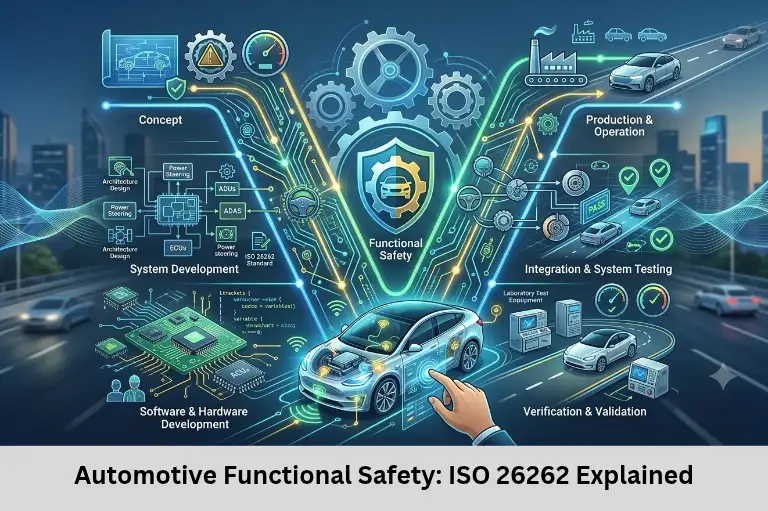
The standard follows a safety lifecycle covering concept development, system design, hardware development, software development, verification, validation, production, operation, and maintenance.
Why Automotive Functional Safety Matters
Automotive embedded systems must operate reliably under different environmental and operating conditions. A software error in a multimedia application may inconvenience a driver, whereas an incorrect braking command can create a hazardous situation.
Functional safety helps engineering teams establish safety requirements, identify failure modes, implement appropriate protection mechanisms, and verify that safety objectives are achieved.
Understanding ASIL Classification
Automotive Safety Integrity Level (ASIL) represents the risk classification used in ISO 26262. It determines the rigor of safety requirements and development activities necessary to address identified hazards.
Four ASIL Levels
ISO 26262 defines four ASIL levels:
ASIL A: Lowest safety integrity requirements among ASIL classifications.
ASIL B: Higher safety requirements than ASIL A.
ASIL C: Increased rigor in safety engineering and verification.
ASIL D: Highest ASIL classification and the most demanding safety requirements.
Systems that do not require ASIL classification may be assigned Quality Management (QM), indicating that appropriate quality management practices are required without additional ASIL-specific safety requirements.
Factors Used in ASIL Determination
ASIL classification is based on three factors considered during Hazard Analysis and Risk Assessment (HARA).
Severity (S): Potential consequences of harm.
Exposure (E): Probability of encountering the operational situation.
Controllability (C): Ability of people involved to avoid harm.
The combination of these factors determines the ASIL classification for a hazardous event.
Hazard Analysis and Risk Assessment (HARA)
HARA is an important activity during the concept phase of automotive safety development. Engineers identify hazardous events, evaluate their risks, and determine appropriate safety goals.
Example of HARA in an Electronic Braking System
Consider an electronic braking system that receives wheel-speed information and controls braking pressure.
If a sensor failure or software malfunction causes incorrect braking behavior, the vehicle may experience reduced braking performance. Engineers analyze the operational situation, potential severity, exposure, and controllability to determine the required safety classification.
Based on the analysis, safety goals may include preventing unintended braking commands or ensuring that braking remains controllable during specified failures.
From Safety Goals to Technical Requirements
Safety goals are translated into Functional Safety Requirements (FSRs). These requirements describe what the system must achieve to maintain safety.
Technical Safety Requirements (TSRs) further define how the architecture and components implement those functions. Hardware and software requirements are then developed to support implementation and verification.
ISO 26262 Safety Lifecycle
ISO 26262 defines activities throughout the automotive product lifecycle rather than focusing only on software testing.
Concept Phase
The concept phase includes item definition, HARA, and functional safety concept development. Engineers identify system boundaries, interfaces, operating conditions, hazards, and safety goals.
System Development
System development establishes architecture, safety requirements, and allocation of safety functions to hardware and software components.
Hardware and Software Development
Hardware engineers evaluate component failures, diagnostic coverage, and hardware safety mechanisms. Software engineers develop safety-related firmware using appropriate development practices, verification methods, and coding guidelines.
Verification and Validation
Verification checks whether engineering work products satisfy their specified requirements. Validation evaluates whether the integrated item achieves the intended safety objectives under relevant operating conditions.
Safety assessments and supporting documentation provide evidence that the development process meets applicable safety requirements.
Functional Safety Mechanisms in Automotive Embedded Systems
Safety mechanisms help detect, control, or mitigate failures in automotive electronic systems.
Watchdog Timers
A watchdog timer monitors software execution. If the application fails to service the watchdog within the expected interval, the system can initiate a recovery action such as resetting the processor.
Memory Protection
Memory protection mechanisms help prevent unintended access to critical memory regions. Memory Protection Units (MPUs), where available, can restrict access permissions and isolate software components.
Redundancy and Diagnostics
Redundant sensing, plausibility checks, and diagnostic routines help detect abnormal system behavior.
For example, comparing information from multiple wheel-speed sensors can help identify inconsistent readings. Diagnostic mechanisms may initiate warning signals or controlled fallback behavior when faults are detected.
Fault Detection and Safe State
A safety-related system may transition to a defined safe state when a fault occurs. The appropriate response depends on the function and operating conditions.
For an automotive controller, a safe response could involve disabling an unsafe output, activating a warning, or maintaining limited functionality through a fallback strategy.
Practical Embedded Safety Example
An automotive temperature monitoring controller may periodically read sensor data, validate measurement ranges, detect communication failures, and trigger protective actions when specified limits are exceeded.
This example demonstrates how Embedded C programming, diagnostics, watchdog configuration, and safety requirements work together in automotive embedded development.
ISO 26262 Applications in Modern Automotive Technology
Functional safety is relevant to several automotive electronic systems.
Engine control units use safety-related monitoring to manage combustion and control behavior. Electronic braking and steering systems require careful safety analysis because incorrect outputs can affect vehicle control.
Electric vehicles use battery management systems to monitor voltage, current, and temperature. Appropriate safety mechanisms help detect abnormal conditions and initiate protective responses.
Advanced driver assistance systems also depend on reliable embedded processing, sensor information, and safety-related control functions. Connected automotive platforms increasingly interact with Internet of Things (IoT) technologies, making secure communication and dependable software important considerations alongside functional safety.
Learn Automotive Embedded Systems at ETDA
Students interested in automotive software engineering should develop strong foundations in Embedded C, microcontroller architecture, communication protocols, debugging, and real-time programming.
Embedded Tech Development Academy (ETDA) provides industry-oriented technical learning opportunities that help engineering students strengthen their embedded development knowledge. Practical learning involving ARM microcontrollers, CAN communication, peripheral programming, and automotive-oriented projects can help learners understand real development workflows.
Students searching for the Top Embedded Training Institute in Bangalore should consider practical training, project experience, and technical preparation. Embedded Tech Development Academy (ETDA) supports learners through hands-on technical learning and assured placement support, helping them prepare for embedded software interviews and professional opportunities.
Developing knowledge of ISO 26262 alongside embedded programming can help students understand the importance of safety, reliability, and systematic engineering practices in automotive applications.
Frequently Asked Questions
What is ISO 26262 in automotive engineering?
ISO 26262 is an international functional safety standard that addresses risks caused by malfunctioning electrical and electronic systems in road vehicles.
What is ASIL in functional safety?
ASIL stands for Automotive Safety Integrity Level. It classifies risk and determines the rigor of safety requirements and development activities.
What are the four ASIL levels?
The four levels are ASIL A, ASIL B, ASIL C, and ASIL D. ASIL D represents the highest safety integrity classification.
What is HARA in ISO 26262?
Hazard Analysis and Risk Assessment identifies hazardous events and evaluates severity, exposure, and controllability to determine appropriate safety goals and ASIL classifications.
Is ISO 26262 useful for embedded software engineers?
Yes. It helps embedded engineers understand safety requirements, diagnostics, verification, fault handling, and reliable automotive firmware development.
Can engineering students learn automotive embedded systems at ETDA?
Students can strengthen embedded programming, microcontroller, communication protocol, and project development skills through industry-oriented technical learning at Embedded Tech Development Academy (ETDA).
Conclusion
Automotive functional safety is essential for developing reliable electronic systems in modern vehicles. ISO 26262 provides a structured approach to hazard analysis, ASIL classification, safety requirements, hardware and software development, and verification.
Understanding these concepts helps engineering students recognize how safety considerations influence automotive embedded systems, braking controllers, battery management systems, and advanced driver assistance technologies.
For students preparing for automotive embedded careers, choosing the Top Embedded Training Institute in Bangalore can support their technical learning journey. Embedded Tech Development Academy (ETDA) encourages practical learning through industry-oriented training, embedded projects, and assured placement support. Building knowledge of automotive functional safety alongside programming and microcontroller development can strengthen students’ preparation for engineering opportunities.
Author: ETDA Trainers
Experience: 10+ Years of Industry Experience in Embedded Systems, IoT, and Embedded C Programming