
Device Driver Development in Embedded Linux Guide
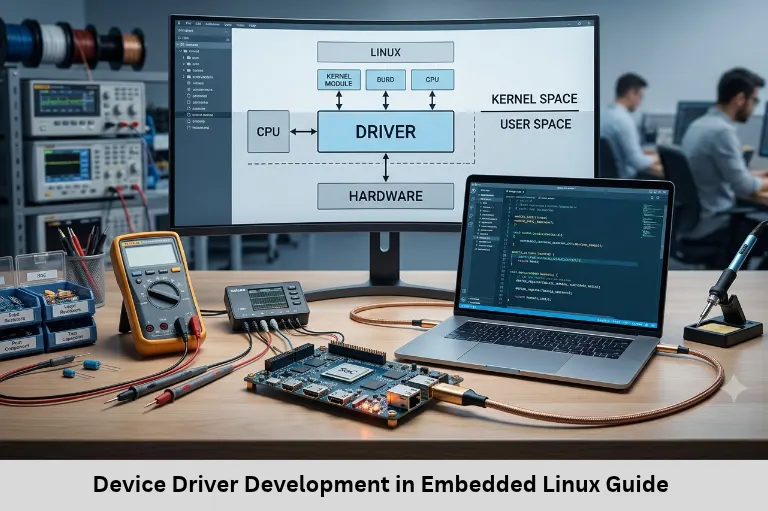
Learn Embedded Linux device driver development, kernel modules, character drivers, GPIO interfaces, debugging, and practical skills for embedded careers. Embedded Tech Development Academy (ETDA).
- Device Driver Development in Embedded Linux Guide
-
Device Driver Development in Embedded Linux
- Introduction to Device Driver Development
- What Is an Embedded Linux Device Driver?
- Types of Linux Device Drivers
- Writing a Basic Linux Kernel Module
- Character Driver Design and User-Space Access
- Hardware Interfacing, Interrupts, and Debugging
- Device Driver Development Skills at ETDA
-
Frequently Asked Questions
- What is device driver development in Embedded Linux?
- Which programming language is used for Linux drivers?
- What is the difference between a kernel module and a device driver?
- Why is Device Tree important?
- Can beginners learn Embedded Linux driver development?
- How does ETDA help students learn Embedded Linux?
- Conclusion
Device Driver Development in Embedded Linux
Introduction to Device Driver Development
Device driver development is an important skill for engineers working with Linux-based embedded systems. A device driver connects hardware peripherals with the Linux operating system, allowing applications to access devices through standard interfaces instead of controlling registers directly. Drivers are widely used in industrial controllers, automotive platforms, networking equipment, and Internet of Things (IoT) products.
Learning this subject helps students understand the relationship between hardware, kernel software, and applications. If you are searching for the Top Embedded Training Institute in Bangalore, practical Linux kernel and driver exercises are valuable because they turn operating-system concepts into real development experience.
What Is an Embedded Linux Device Driver?
Role of a Device Driver
A device driver is kernel software that manages hardware or exposes a software interface for it. It handles device initialization, data transfer, interrupts, configuration, and resource management according to the hardware requirements.
For example, an I2C driver communicates with sensors over the I2C bus, while a GPIO interface allows software to control pins. In embedded systems, drivers help applications use peripherals without knowing every hardware detail.
Linux Kernel and Driver Architecture
Linux separates user space from kernel space. Applications execute in user space, while the kernel manages memory, scheduling, hardware resources, and device interfaces. Drivers generally execute in kernel space and interact with hardware through kernel APIs.
User Space and Kernel Space
Applications access devices through files in /dev, interfaces in /sys, or libraries that communicate with kernel drivers. System calls such as open(), read(), write(), and ioctl() transfer requests between user space and kernel space.
Why This Separation Matters
Applications do not directly manipulate hardware registers; drivers validate requests and perform operations using kernel-managed resources. This separation improves organization and protection, although faulty kernel drivers can still affect system stability.
Types of Linux Device Drivers
Character Device Drivers
Character drivers handle data as a stream of bytes. Examples include serial interfaces and simple sensor interfaces. A character driver commonly provides operations such as open, read, write, and release.
Applications interact with these drivers through device nodes, making the interface familiar to Linux programmers.
Block and Network Drivers
Block drivers manage storage devices that transfer data in blocks, such as eMMC and SD cards. Network drivers connect hardware to the Linux networking stack and handle packet transmission and reception.
Using Existing Kernel Subsystems
Before writing a custom driver, check whether the hardware fits an existing subsystem such as IIO for sensors, input for buttons, SPI or I2C for bus-connected devices, or GPIO for pin control.
Framework-Based Development
Kernel frameworks provide standard callbacks, resource management, and interfaces. Learning to identify the correct subsystem helps students avoid unnecessary code and develop more maintainable drivers.
Writing a Basic Linux Kernel Module
A kernel module can be loaded into a running kernel when its configuration and version are compatible. The following example demonstrates module initialization and cleanup; it is not a hardware driver yet.
#include <linux/module.h>
#include <linux/kernel.h>

static int __init demo_init(void)
{
    pr_info("Demo module loaded\n");
    return 0;
}

static void __exit demo_exit(void)
{
    pr_info("Demo module unloaded\n");
}

module_init(demo_init);
module_exit(demo_exit);

MODULE_LICENSE("GPL");
MODULE_DESCRIPTION("Basic embedded Linux module");
Building the Module
A simple external-module Makefile can be written as:
obj-m += demo.o

all:
	make -C /lib/modules/$(shell uname -r)/build \
		M=$(PWD) modules

clean:
	make -C /lib/modules/$(shell uname -r)/build \
		M=$(PWD) clean
Build it using make, then load and inspect it with insmod, rmmod, and dmesg. Use a development machine or test board because kernel modules run with elevated privileges and may crash the system.
Module Lifecycle
The initialization function runs when the module is loaded, while the cleanup function runs during removal. Real drivers must also register with the relevant subsystem and release allocated resources correctly.
Safe Testing Practice
Test modules on a development system with recoverable storage. Keep a serial console available, record kernel logs, and avoid loading untested modules on production devices.
Character Driver Design and User-Space Access
Device Registration and File Operations
A character driver typically allocates a device number, registers a cdev, and associates file operations with the device. Modern drivers may use helper APIs to create device nodes automatically.
The file_operations structure connects system calls to driver callbacks. A read callback copies data from kernel memory to user space, while a write callback receives data from an application. Use copy_to_user() and copy_from_user() rather than directly dereferencing user pointers.
Error Handling and Resource Management
Drivers should validate input sizes, check return values, and handle invalid commands gracefully. Resource allocation must be paired with cleanup, including memory, GPIOs, interrupts, and device registrations.
Avoiding Common Driver Bugs
Typical mistakes include accessing invalid memory, forgetting to release resources, using incorrect pointers, and assuming hardware is always present. Kernel code should follow APIs documented for the target kernel version.
Robust Driver Behavior
A robust driver returns meaningful error codes, handles device removal, and protects shared state when concurrent operations are possible. This makes interfaces predictable and easier to debug.
Hardware Interfacing, Interrupts, and Debugging
GPIO, I2C, and SPI Integration
Embedded Linux boards frequently connect sensors through GPIO, I2C, and SPI. Device Tree describes hardware resources so the kernel can identify devices and associate them with drivers.
For an I2C sensor, the driver communicates through the I2C core instead of manually toggling bus signals. SPI drivers similarly use the SPI framework to configure transfers and communicate with peripherals.
Interrupt Handling in Drivers
Hardware interrupts notify the processor when a device needs attention. A driver can register an interrupt handler and process events according to hardware requirements. Lengthy operations should generally be deferred to a threaded handler or workqueue instead of being performed in a time-sensitive interrupt context.
Debugging Tools
Useful tools include dmesg for kernel logs, lsmod for loaded modules, /proc and /sys for system information, and ftrace or dynamic debug when enabled. Logic analyzers can help verify bus signals and electrical behavior.
A Practical Debugging Sequence
First verify power, wiring, and bus connections. Next confirm Device Tree and driver matching, inspect kernel logs, and test the user-space interface. Finally, measure communication signals when software logs cannot explain the problem.
Device Driver Development Skills at ETDA
At Embedded Tech Development Academy (ETDA), students can strengthen their embedded systems foundation through practical programming and hardware-oriented learning. Device driver development connects C programming, Linux commands, operating-system concepts, peripheral interfaces, and debugging into one engineering workflow.
Project-Based Learning for Students
A guided project might involve interfacing an I2C temperature sensor, studying an existing kernel subsystem, configuring Device Tree, and reading sensor values from user space. Students can document the driver architecture, test error conditions, and explain how data moves between hardware and applications.
Preparing for Embedded Linux Roles
The Top Embedded Training Institute in Bangalore should help learners develop practical confidence with Linux, C, microcontrollers, debugging, and project implementation. Embedded Tech Development Academy (ETDA) emphasizes hands-on technical learning and assured placement support, helping students prepare for embedded development opportunities.
Building a Demonstrable Portfolio
Students can showcase a driver project with source code, setup instructions, test results, and hardware integration documentation. Such a portfolio demonstrates problem-solving ability and supports technical interview discussions.
Frequently Asked Questions
What is device driver development in Embedded Linux?
It is the process of writing kernel software that enables Linux to communicate with hardware peripherals and provide interfaces for applications.
Which programming language is used for Linux drivers?
Most Linux kernel drivers are written in C, with supporting code and tools written in other languages.
What is the difference between a kernel module and a device driver?
A kernel module is code that can be loaded into the kernel. A device driver manages a device; many drivers are implemented as modules, but not every module is a driver.
Why is Device Tree important?
Device Tree describes hardware components and resources to the kernel, helping it configure devices without hard-coding board details into every driver.
Can beginners learn Embedded Linux driver development?
Yes. Beginners should first learn C, Linux commands, kernel basics, and hardware interfaces, then progress to modules and subsystem-based drivers with guided practice.
How does ETDA help students learn Embedded Linux?
Embedded Tech Development Academy (ETDA) supports practical learning through programming, hardware interfacing, debugging, and project-oriented training, along with assured placement support for career preparation.
Conclusion
Device driver development in Embedded Linux teaches students how hardware, kernel software, and applications interact. Learning modules, character drivers, subsystem frameworks, Device Tree, interrupts, and debugging provides a strong foundation for real embedded systems projects and Internet of Things (IoT) products.
For learners planning a technical career, the Top Embedded Training Institute in Bangalore can be a useful choice when it offers structured practice, real hardware exposure, and project guidance. At Embedded Tech Development Academy (ETDA), students can develop practical skills and receive assured placement support while building confidence in Embedded Linux and driver development.
Author: ETDA Trainers
Experience: 10+ Years of Industry Experience in Embedded Systems, IoT, and Embedded C Programming