
AUTOSAR Architecture: Components, Layers and Working
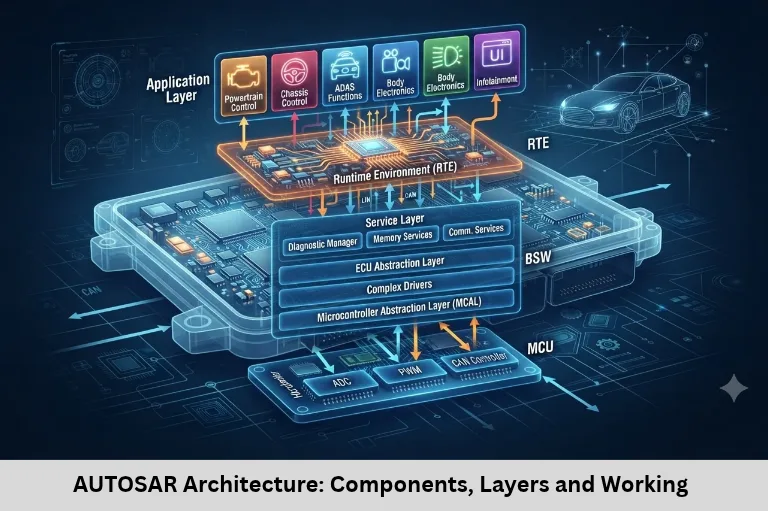
Explore AUTOSAR architecture, including Classic and Adaptive platforms, software layers, RTE, BSW, MCAL, and automotive ECU development with Embedded Tech Development Academy (ETDA).
- AUTOSAR Architecture: Components, Layers and Working
-
AUTOSAR Architecture: A Technical Overview of Automotive Software Development
- AUTOSAR Architecture: A Technical Overview
- What Is AUTOSAR Architecture?
- Types of AUTOSAR Platforms
- Understanding the AUTOSAR Classic Platform Architecture
- How AUTOSAR Architecture Works in Automotive ECUs
- Communication Protocols Used in AUTOSAR
- Role of Embedded C in AUTOSAR Development
- Career Opportunities in AUTOSAR Development
- Learn Automotive Embedded Skills at ETDA
- Frequently Asked Questions
- Conclusion
AUTOSAR Architecture: A Technical Overview of Automotive Software Development
AUTOSAR Architecture: A Technical Overview
Modern vehicles depend on sophisticated electronic control units (ECUs) to manage engine performance, braking, steering, airbags, and advanced driver assistance systems. As automotive technology becomes more complex, software developers need standardized methods to design, integrate, and maintain vehicle software. AUTOSAR architecture addresses this requirement by providing a standardized software framework for automotive embedded systems.
AUTOSAR stands for Automotive Open System Architecture. It defines standardized software components, interfaces, and development methodologies that help automotive manufacturers and suppliers develop reusable and scalable ECU software. Understanding AUTOSAR is valuable for engineering students interested in automotive embedded software, firmware development, and connected vehicle technologies. Embedded Tech Development Academy (ETDA) helps aspiring engineers build practical knowledge of Embedded C, microcontrollers, communication protocols, and automotive embedded systems. Students searching for a Top Embedded Training Institute in Bangalore can develop industry-oriented technical skills through practical training and assured placement support.
What Is AUTOSAR Architecture?
AUTOSAR is a global automotive software development partnership that provides standardized architectures and methodologies for automotive electronic systems. Its primary objective is to improve software reuse, portability, scalability, and interoperability between different automotive hardware platforms.
Traditionally, automotive software was closely connected to specific microcontroller hardware. This made software modification and reuse difficult when manufacturers changed ECU hardware or suppliers.
AUTOSAR introduces an abstraction-based architecture that separates application software from the underlying hardware. This allows developers to design software components independently and integrate them through standardized interfaces.
Main Objectives of AUTOSAR
Software reusability: Enables software components to be reused across compatible ECU platforms.
Hardware independence: Separates application software from microcontroller-specific implementation.
Standardization: Provides common interfaces and development guidelines.
Scalability: Supports different automotive applications and ECU configurations.
Maintainability: Simplifies software updates, integration, and debugging.
Interoperability: Improves compatibility between software components developed by different suppliers.
Types of AUTOSAR Platforms
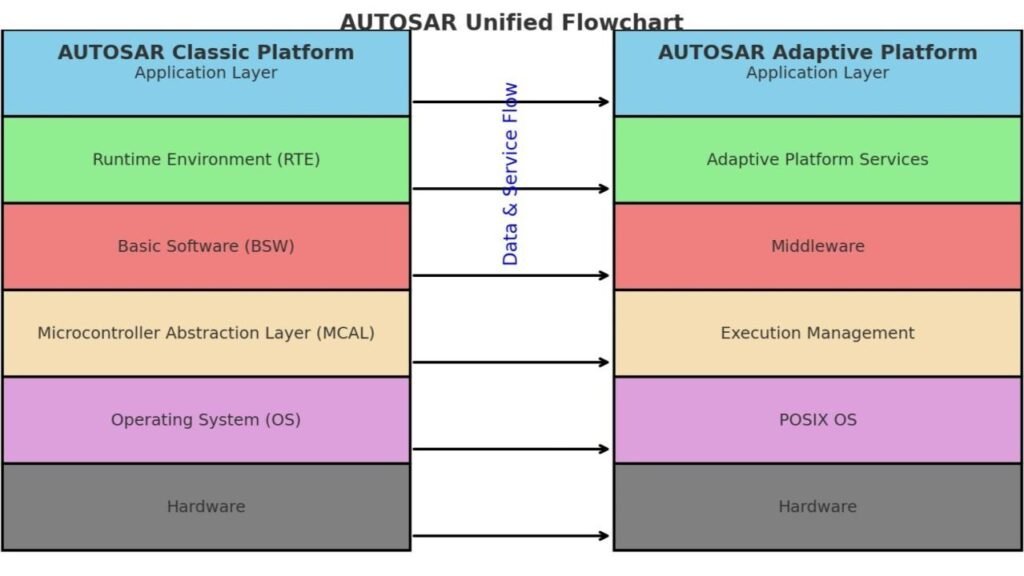
AUTOSAR provides two major platforms designed for different automotive application requirements.
AUTOSAR Classic Platform
The Classic Platform is designed for deeply embedded, real-time automotive applications that require predictable execution and resource-efficient operation.
It is commonly used in microcontroller-based ECUs such as engine controllers, transmission systems, braking systems, and body control modules.
The Classic Platform uses a layered architecture consisting of Application Software, Runtime Environment, and Basic Software.
AUTOSAR Adaptive Platform
The Adaptive Platform supports high-performance automotive applications requiring dynamic software deployment, service-oriented communication, and greater computational capabilities.
It is suitable for applications such as autonomous driving, advanced driver assistance systems (ADAS), vehicle connectivity, and high-performance computing.
Unlike the Classic Platform, the Adaptive Platform typically operates on high-performance processors using POSIX-based operating system environments.
Understanding the AUTOSAR Classic Platform Architecture
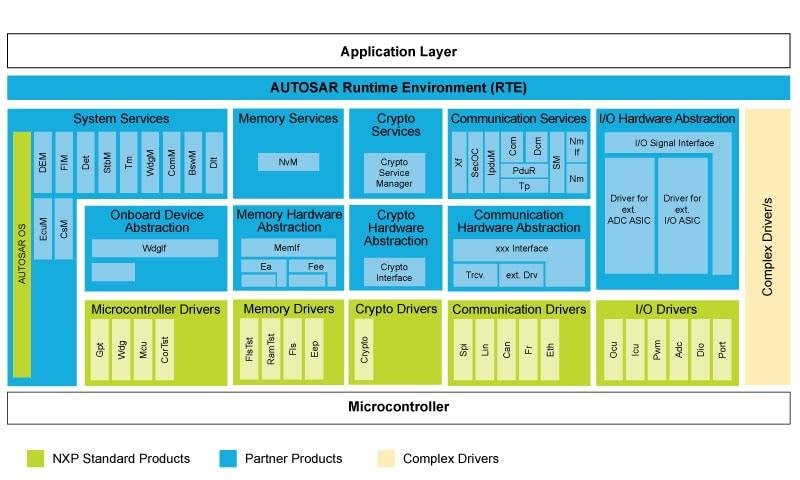
The Classic Platform is organized into three major architectural layers: Application Layer, Runtime Environment, and Basic Software.
Application Software Layer
The Application Software Layer contains software components responsible for implementing specific vehicle functions.
These components are called Software Components (SWCs). Each SWC performs a particular function and communicates with other components through standardized interfaces.
Examples include:
Engine control software.
Vehicle speed monitoring.
Electronic braking control.
Sensor data processing.
Body control applications.
Software components are designed to reduce direct dependencies on hardware-specific implementation.
Runtime Environment (RTE)
The Runtime Environment acts as a communication layer between application software components and the Basic Software.
It provides communication services using standardized interfaces, allowing software components to exchange data without directly accessing one another.
RTE is generated based on the system configuration and software component interfaces.
Important RTE Communication Mechanisms
RTE supports communication between software components through mechanisms such as:
Sender-Receiver communication for exchanging data.
Client-Server communication for requesting and providing services.
Inter-runnable variables for communication between runnable entities.
Mode-based communication for controlling application behaviour.
For example, a vehicle speed monitoring component can receive sensor information through the RTE and provide processed values to another application component.
Basic Software (BSW) Layer
The Basic Software layer provides essential software services required by application components. It handles communication, diagnostics, memory management, operating system services, and hardware abstraction.
The BSW layer is divided into several functional groups.
Services Layer
The Services Layer provides common system services, including operating system functionality, diagnostic services, communication management, and memory services.
Examples include AUTOSAR OS, diagnostic communication management, and non-volatile memory services.
ECU Abstraction Layer
The ECU Abstraction Layer separates hardware-dependent peripheral access from higher-level software.
It provides standardized interfaces to components such as sensors, actuators, and communication hardware.
Microcontroller Abstraction Layer (MCAL)
MCAL is the lowest standard Basic Software layer. It provides software drivers for microcontroller peripherals.
Common MCAL modules include:
Digital Input Output (DIO).
Analog-to-Digital Converter (ADC).
Pulse Width Modulation (PWM).
General Purpose Timer (GPT).
SPI, UART, and CAN drivers.
Microcontroller driver (MCU).
MCAL allows higher software layers to access microcontroller hardware through standardized interfaces.
How AUTOSAR Architecture Works in Automotive ECUs
AUTOSAR architecture organizes software components and hardware access into clearly defined layers. When an ECU receives sensor information, the corresponding hardware driver collects the data and makes it available through the appropriate software layers.
The application component processes the information through the RTE and executes the required control logic. The resulting output is transferred through the relevant Basic Software services and hardware drivers to control an actuator.
For example, in an electronic temperature monitoring system, a sensor provides temperature measurements. The software component processes these values and activates a cooling response when the temperature exceeds a defined threshold.
This structured architecture simplifies software integration and supports reusable automotive embedded systems.
Communication Protocols Used in AUTOSAR
Automotive ECUs communicate through standardized vehicle networks. AUTOSAR supports communication technologies required for exchanging information between electronic controllers.
CAN Communication
Controller Area Network (CAN) is widely used for communication between automotive ECUs. It supports message arbitration, error detection, and reliable data exchange.
AUTOSAR communication modules help manage CAN message transmission and reception through standardized software interfaces.
LIN Communication
Local Interconnect Network (LIN) is used for cost-effective communication between relatively simple automotive components, including window controls, mirrors, and seat adjustment systems.
Ethernet Communication
Automotive Ethernet supports high-bandwidth communication for advanced applications such as ADAS, cameras, and connected vehicle systems.
These communication technologies also contribute to connected automotive and Internet of Things (IoT) applications, where data exchange, diagnostics, and remote monitoring are important.
Role of Embedded C in AUTOSAR Development
Embedded C is widely used in automotive software development, particularly for microcontroller-based ECU applications and Classic Platform Basic Software modules.
Engineers use Embedded C to develop device drivers, configure registers, handle interrupts, and implement application-level control logic.
Students preparing for AUTOSAR development should understand:
Pointers, structures, and function pointers.
Bitwise operations and register-level programming.
Memory management and storage classes.
Interrupt handling and timer configuration.
CAN, SPI, UART, and I2C communication.
RTOS concepts and task scheduling.
Importance of RTOS Knowledge
AUTOSAR Classic includes an operating system based on the AUTOSAR OS specification. Understanding tasks, events, alarms, resources, and scheduling helps developers understand how automotive software executes in real time.
Knowledge of RTOS fundamentals also helps students understand the timing requirements of safety-critical embedded applications.
Career Opportunities in AUTOSAR Development
AUTOSAR knowledge is valuable for engineers interested in automotive software and ECU development. As vehicle electronics become more advanced, software standardization and integration skills are increasingly relevant.
Some career opportunities include:
Automotive Embedded Software Developer.
AUTOSAR Developer.
ECU Software Engineer.
Embedded C Programmer.
Automotive Integration Engineer.
Automotive Software Testing Engineer.
Students should first develop strong programming and microcontroller fundamentals before progressing toward advanced AUTOSAR concepts. Understanding Embedded C, communication protocols, RTOS, and hardware interfacing provides a useful starting point.
Learn Automotive Embedded Skills at ETDA
Embedded Tech Development Academy (ETDA) helps aspiring engineers develop the technical foundation required for embedded software development.
Students can strengthen their understanding of Embedded C, 8051, ARM Cortex-M microcontrollers, STM32, LPC1768, UART, SPI, I2C, CAN, RTOS, and embedded project development.
These subjects provide a foundation for understanding automotive ECUs, communication interfaces, and software architecture. Practical assignments and hardware-based projects help students connect theoretical concepts with real engineering applications.
For learners looking for a Top Embedded Training Institute in Bangalore, Embedded Tech Development Academy (ETDA) offers industry-oriented technical training and assured placement support. Building these fundamentals can help students prepare for opportunities in automotive embedded systems, industrial automation, robotics, and Internet of Things (IoT) development.
Frequently Asked Questions
What is AUTOSAR architecture in automotive embedded systems?
AUTOSAR is a standardized automotive software architecture that separates application software from hardware-dependent implementation. It improves software reuse, scalability, and interoperability between automotive ECUs.
What are the two main types of AUTOSAR platforms?
The two main platforms are AUTOSAR Classic and AUTOSAR Adaptive. Classic supports resource-constrained, real-time microcontroller applications, while Adaptive supports high-performance and dynamically deployable automotive applications.
What is the role of RTE in AUTOSAR?
The Runtime Environment provides communication between application software components and Basic Software. It supports standardized interfaces and helps separate application logic from hardware-specific implementation.
What is MCAL in AUTOSAR?
Microcontroller Abstraction Layer is the lowest standard layer of Basic Software. It provides drivers for microcontroller peripherals such as ADC, PWM, DIO, SPI, and CAN.
Is Embedded C required for AUTOSAR development?
Embedded C is widely used in AUTOSAR Classic development, particularly for application software and Basic Software modules. Strong C programming knowledge is an important foundation for automotive embedded development.
Can beginners learn AUTOSAR after Embedded C?
Yes. Beginners should first understand C programming, microcontroller architecture, communication protocols, and RTOS fundamentals. These skills make it easier to progress toward AUTOSAR architecture and ECU software development.
Conclusion
AUTOSAR architecture plays an important role in modern automotive software development by providing standardized layers, interfaces, and communication mechanisms. Understanding the Classic Platform, Adaptive Platform, Application Software, RTE, BSW, and MCAL helps engineers understand how complex automotive ECUs are designed and integrated.
For students interested in automotive software careers, learning Embedded C, microcontrollers, CAN communication, and RTOS concepts is an important first step. Embedded Tech Development Academy (ETDA) supports aspiring engineers through practical training, project-based learning, and assured placement support. Students searching for a Top Embedded Training Institute in Bangalore can strengthen their technical foundation at Embedded Tech Development Academy (ETDA) and prepare for opportunities in automotive embedded systems and connected vehicle technologies.
Author: ETDA Trainers
Experience: 10+ Years of Industry Experience in Embedded Systems, IoT, and Embedded C Programming