
Industry-Oriented Projects for ECE and EEE Students
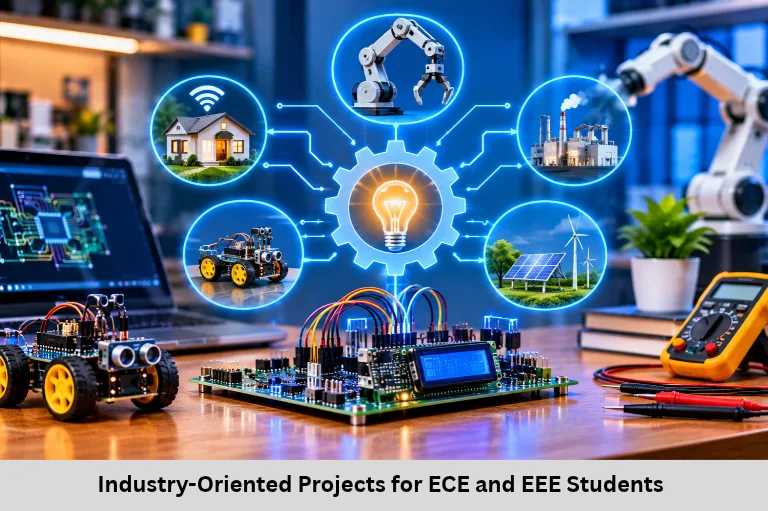
Explore industry-oriented academic projects for ECE and EEE students, including embedded systems, Internet of Things (IoT), automation and renewable energy projects. Embedded Tech Development Academy (ETDA).
- Industry-Oriented Projects for ECE and EEE Students
-
Industry-Oriented Academic Projects for ECE and EEE Students
- Introduction
- What Are Industry-Oriented Academic Projects?
- Best Industry-Oriented Project Ideas for ECE and EEE Students
- Technical Skills Students Gain from Academic Projects
- How to Make an Academic Project Industry-Ready
- Build Practical Engineering Skills with ETDA
-
Frequently Asked Questions
- Which academic projects are best for ECE students?
- Which projects are suitable for EEE students?
- Which programming language is useful for embedded projects?
- Are industry-oriented projects important for placements?
- Which microcontrollers can students use for academic projects?
- Does ETDA provide practical project training and placement support?
- Conclusion
Industry-Oriented Academic Projects for ECE and EEE Students
Introduction
Academic projects play an important role in helping Electronics and Communication Engineering (ECE) and Electrical and Electronics Engineering (EEE) students apply classroom knowledge to practical engineering problems. Instead of developing projects that demonstrate only basic concepts, students can work on industry-oriented applications involving microcontrollers, embedded systems, automation, communication networks and renewable energy.
These projects help learners understand hardware design, programming, testing and troubleshooting. They also provide useful experience when preparing for technical interviews and entry-level engineering roles. Students searching for the Top Embedded Training Institute in Bangalore should look for practical project guidance and industry-focused technical learning. Embedded Tech Development Academy (ETDA) helps students strengthen their engineering skills through hands-on training and assured placement support.
What Are Industry-Oriented Academic Projects?
Industry-oriented academic projects are practical engineering solutions designed around technologies and challenges found in real workplaces. They combine theoretical concepts with hardware components, software development and systematic testing.
For ECE students, project areas may include embedded firmware, wireless communication, Internet of Things (IoT) devices, signal processing and sensor networks. EEE students can explore motor control, power electronics, energy monitoring, industrial automation and smart electrical systems.
A well-developed project should have a clear problem statement, suitable hardware, a working prototype and measurable results. Students should also understand why they selected particular components and how their design can be improved.
Best Industry-Oriented Project Ideas for ECE and EEE Students
IoT-Based Industrial Monitoring System
An industrial monitoring system uses sensors and microcontrollers to collect information about machine temperature, vibration, humidity or operating conditions. An ESP32 or STM32 board can process sensor readings and transmit the information to a monitoring dashboard.
Students can develop firmware using Embedded C and communicate with a server through Wi-Fi or MQTT. The system can generate alerts when sensor readings cross predefined limits.
This project introduces sensor interfacing, ADC programming, wireless communication and Internet of Things (IoT) architecture. It is relevant to industrial monitoring and predictive maintenance applications.
Automatic Solar Power Tracking System
Solar tracking systems improve the orientation of solar panels by adjusting their position according to sunlight intensity. Students can use light-dependent resistors (LDRs), a microcontroller and motor drivers to create a basic tracking mechanism.
The controller compares light intensity readings and operates a servo motor or geared motor to adjust the panel angle. Students can also measure voltage and current to compare energy output under different panel positions.
This project is suitable for EEE students interested in renewable energy, control systems and power management. It also provides practical experience with sensors, motor control and embedded programming.
<AsyncImageGroup query={[“Internet of Things (IoT) industrial monitoring sensors microcontroller prototype”,”dual axis solar tracking system student engineering project”,”smart energy meter embedded electronics project”]} aspectRatio=”5:4″ layout=”carousel”/>
Smart Energy Meter with Wireless Monitoring
A smart energy meter measures electrical parameters and communicates consumption information to a monitoring application. A suitable metering module or isolated sensing circuit can be connected to a microcontroller for data collection.
The firmware can process voltage, current and energy readings before transmitting the information through Wi-Fi or another communication interface. Students should pay particular attention to electrical isolation, calibration and safe circuit design when working with mains-powered equipment.
This project helps EEE students understand energy measurement, instrumentation, embedded programming and communication technologies.
CAN-Based Automotive Sensor Network
Modern vehicles use multiple Electronic Control Units (ECUs) to manage functions such as engine operation, braking and body electronics. These controllers exchange information through communication networks, including the Controller Area Network (CAN).
Students can build a small CAN-based prototype using two microcontroller boards equipped with CAN controllers or suitable CAN modules. One node can transmit sensor information while another receives and processes the messages.
The project introduces CAN frames, message identifiers, bus communication and error handling. It is particularly valuable for students interested in automotive embedded systems.
BLDC Motor Speed Control System
Brushless DC motors are used in electric vehicles, industrial equipment, drones and modern appliances. Students can develop a motor control prototype using a suitable controller, gate driver and BLDC motor.
The firmware can generate PWM signals to control motor operation and use feedback from Hall-effect sensors or an encoder to estimate rotor position and speed. Closed-loop control can be implemented using a suitable control algorithm such as a PI controller.
This project develops knowledge of power electronics, motor control, PWM generation and feedback systems. It is a strong choice for EEE students interested in electric mobility and industrial automation.
Smart Irrigation and Water Management System
A smart irrigation system uses soil moisture sensors to determine when plants require watering. A microcontroller reads the sensor values and controls a pump through an appropriately rated relay or driver circuit.
Students can extend the system by adding water-level monitoring, temperature sensing and wireless notifications. The firmware can also include threshold-based control and fault alerts.
This project combines embedded programming, sensor interfacing and automation. It demonstrates how electronic systems can support efficient resource management.
Technical Skills Students Gain from Academic Projects
Embedded C and Microcontroller Programming
Students learn to write firmware that controls hardware peripherals. Important concepts include GPIO configuration, timers, interrupts, ADC, PWM and memory management.
Working with platforms such as 8051, STM32, LPC1768 and ESP32 helps learners understand how different microcontrollers support real applications.
Communication and Hardware Interfacing
Industry projects often require communication between multiple electronic devices. Students should practise UART, SPI, I2C and CAN to understand data transfer, device addressing and communication troubleshooting.
Testing and Debugging
A prototype must be tested under different operating conditions. Students should learn to use multimeters, oscilloscopes, serial terminals and debugging tools to identify hardware and firmware problems.
Project Documentation
Good documentation should explain the system architecture, circuit connections, software flow, component selection and testing results. Students should be able to demonstrate the working prototype and explain the technical decisions behind their design.
How to Make an Academic Project Industry-Ready
A project becomes more valuable when it demonstrates reliable engineering rather than simply producing a basic output. Students should divide the system into smaller modules, test each module independently and integrate them after confirming correct operation.
They should also consider power consumption, safety, communication reliability and error handling. Preparing a clear block diagram, source-code explanation and test report helps demonstrate technical understanding during project reviews and interviews.
Build Practical Engineering Skills with ETDA
Choosing the right training environment can make a significant difference when developing industry-oriented academic projects. Embedded Tech Development Academy (ETDA) in Bangalore focuses on practical technical learning for students interested in embedded development and related engineering fields.
Students can strengthen their understanding of Embedded C, microcontrollers, communication protocols, RTOS and hardware interfacing through structured learning and project-based practice. These skills are useful when developing automotive, industrial automation, Internet of Things (IoT) and electronic control applications.
When evaluating the Top Embedded Training Institute in Bangalore, students should consider practical lab exposure, technical mentoring, project implementation and career preparation. Embedded Tech Development Academy (ETDA) also provides assured placement support, helping learners prepare for relevant job opportunities after training.
Frequently Asked Questions
Which academic projects are best for ECE students?
IoT monitoring systems, CAN-based automotive networks, wireless sensor networks and microcontroller-based automation projects are useful choices for ECE students.
Which projects are suitable for EEE students?
Solar tracking, smart energy meters, BLDC motor control, power monitoring and industrial automation projects are suitable for EEE students.
Which programming language is useful for embedded projects?
Embedded C is widely used for microcontroller firmware development. Python can also be useful for testing, data analysis and communication with embedded devices.
Are industry-oriented projects important for placements?
Yes. They help students demonstrate practical knowledge, problem-solving ability, hardware understanding and programming skills during technical interviews.
Which microcontrollers can students use for academic projects?
Students can work with 8051, STM32, ARM Cortex-M, LPC1768 and ESP32 boards depending on project complexity and required peripherals.
Does ETDA provide practical project training and placement support?
Embedded Tech Development Academy (ETDA) focuses on hands-on embedded technology training, project-based learning and assured placement support to help students prepare for relevant engineering career opportunities.
Conclusion
Industry-oriented academic projects help ECE and EEE students develop practical engineering knowledge and understand how technologies are used in real applications. Projects involving Internet of Things (IoT) monitoring, solar tracking, smart energy meters, CAN communication and motor control provide valuable exposure to hardware and software development.
Students should focus on building working prototypes, testing their designs and explaining the technical concepts behind their implementation. Learning through the Top Embedded Training Institute in Bangalore can help students strengthen their practical foundation. With industry-oriented training and assured placement support, Embedded Tech Development Academy (ETDA) helps aspiring engineers prepare for opportunities in embedded systems and related technology fields.
Author: ETDA Trainers
Experience: 10+ Years of Industry Experience in Embedded Systems, IoT, and Embedded C Programming