
Clock Management and Frequency Scaling in Microcontrollers
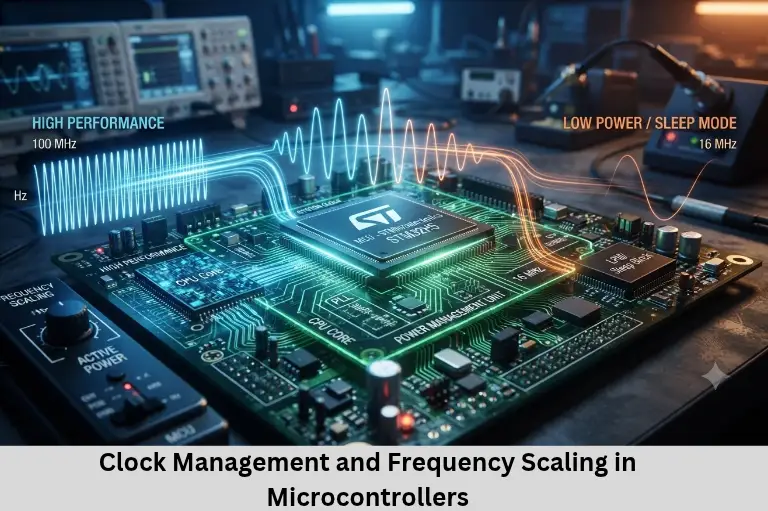
Learn clock management and frequency scaling in microcontrollers, including oscillators, PLL, STM32 clock configuration and power optimization. Embedded Tech Development Academy (ETDA).
- Clock Management and Frequency Scaling in Microcontrollers
-
Clock Management and Frequency Scaling in Microcontrollers
- Introduction
- What Is Clock Management in Microcontrollers?
- Understanding Frequency Scaling
- How Clock Configuration Works in a Microcontroller
- Implementing Clock Management Using Embedded C
- Advantages and Challenges of Frequency Scaling
- Practical Applications in Embedded Systems and IoT
- Learn Practical Microcontroller Programming at ETDA
- Frequently Asked Questions
- Conclusion
Clock Management and Frequency Scaling in Microcontrollers
Introduction
Clock management is an important concept in microcontroller programming because it determines how fast a processor executes instructions and communicates with peripheral devices. Every microcontroller depends on a clock signal to synchronize operations such as data processing, timer execution, serial communication, and interrupt handling. Understanding clock management and frequency scaling helps students develop efficient applications with better performance and power consumption.
In modern embedded systems, selecting the correct clock frequency is essential for applications involving sensors, communication modules, automotive controllers, and Internet of Things (IoT) devices. Students looking for the Top Embedded Training Institute in Bangalore should understand practical microcontroller configuration rather than learning programming concepts alone. Embedded Tech Development Academy (ETDA) focuses on technical training, hardware interfacing, and real-time programming, along with assured placement support to help students prepare for embedded engineering careers.
What Is Clock Management in Microcontrollers?
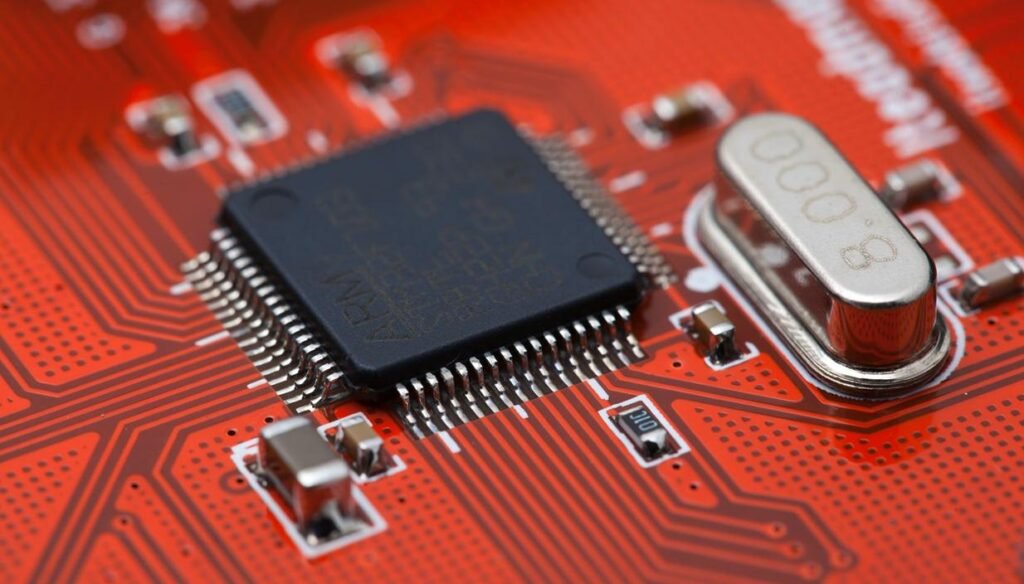
Clock management refers to configuring and controlling the clock signals that drive a microcontroller’s CPU and internal peripherals. The clock provides timing references that determine when instructions execute and when hardware modules perform operations.
A microcontroller may use different clock sources depending on its architecture and application requirements. Proper configuration ensures that the processor, timers, communication interfaces, and other peripherals operate at their intended frequencies.
Common Clock Sources
Microcontrollers support different clock sources for generating system timing.
Internal RC oscillator: An integrated oscillator that provides a convenient clock without external components.
External crystal oscillator: Uses a crystal to generate a stable and accurate clock signal.
External clock input: Accepts a clock signal from another electronic circuit.
PLL (Phase-Locked Loop): Multiplies or adjusts an input clock frequency to generate higher-frequency system clocks.
Understanding Frequency Scaling
Frequency scaling is the process of increasing or decreasing a microcontroller’s operating frequency according to application requirements. Higher frequencies generally allow faster instruction execution, while lower frequencies can reduce dynamic power consumption.
For example, a sensor monitoring application may not require maximum processor speed continuously. The microcontroller can operate at a lower frequency during routine monitoring and increase its frequency when intensive data processing is required.
Types of Frequency Scaling
1. Dynamic Frequency Scaling: The operating frequency changes during execution according to workload and performance requirements.
2. Static Frequency Configuration: The clock frequency is selected during system initialization and remains fixed during normal operation.
3. Dynamic Voltage and Frequency Scaling (DVFS): The processor voltage and clock frequency are adjusted together to manage performance and power consumption. This feature is available only on microcontrollers that support suitable voltage and clock controls.
How Clock Configuration Works in a Microcontroller
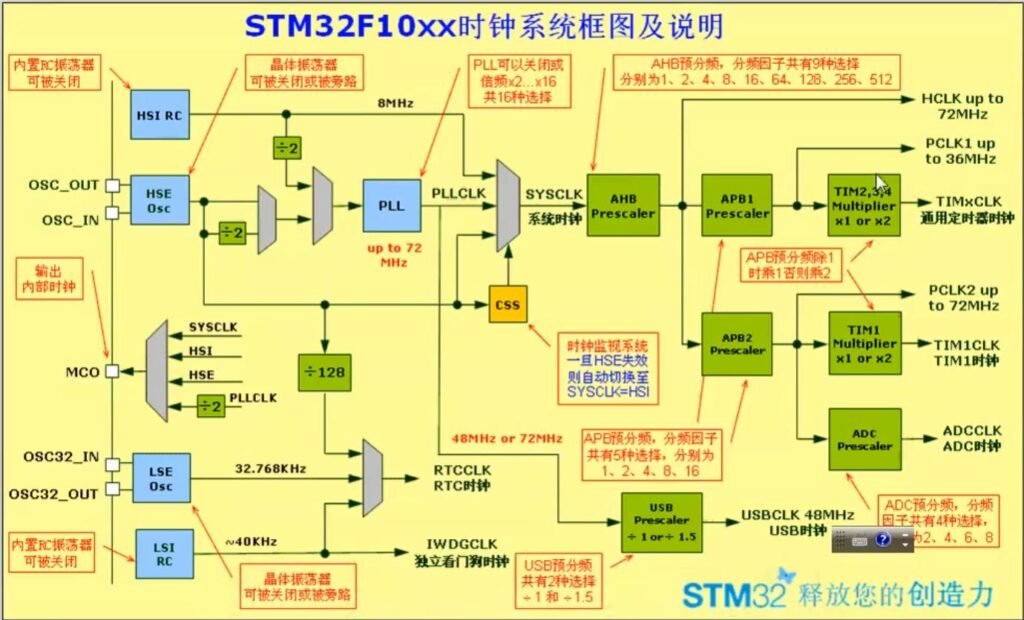
Clock configuration involves selecting a clock source, setting frequency dividers, configuring PLL parameters where supported, and enabling the required peripheral clocks.
For example, an STM32 microcontroller may use an internal oscillator or external crystal as its clock source. A PLL can then generate a higher system clock frequency, while bus prescalers provide suitable frequencies for different peripheral groups.
Important Clock Configuration Parameters
System clock (SYSCLK): Main clock used by the processor and system architecture.
AHB prescaler: Divides the system clock for the AHB bus.
APB prescaler: Controls peripheral bus frequencies.
PLL multiplier and divider: Determine the generated clock frequency.
Peripheral clock enable: Activates clock signals for selected hardware modules.
Implementing Clock Management Using Embedded C
Students can practise clock configuration using microcontroller development boards such as STM32. The following example demonstrates enabling the internal high-speed oscillator on an STM32F4 device using register-level Embedded C programming.
Example – Enabling the Internal Clock in STM32
#include "stm32f4xx.h"

void clock_init(void)
{
    // Enable internal HSI oscillator
    RCC->CR |= RCC_CR_HSION;

    // Wait until HSI becomes ready
    while((RCC->CR & RCC_CR_HSIRDY) == 0)
    {
    }

    // Select HSI as system clock
    RCC->CFGR &= ~RCC_CFGR_SW;

    // Wait until HSI is selected
    while((RCC->CFGR & RCC_CFGR_SWS)
          != RCC_CFGR_SWS_HSI)
    {
    }
}

int main(void)
{
    clock_init();

    while(1)
    {
        // Main application
    }
}
This example selects the internal 16 MHz HSI oscillator as the system clock on a compatible STM32F4 device. It assumes the device starts from its default clock configuration. In a complete application, flash latency, bus prescalers, and peripheral timing must also be configured appropriately when changing to higher frequencies.
Understanding the Clock Initialization Code
The RCC peripheral controls clock configuration in STM32 microcontrollers. The HSION bit enables the internal oscillator, while HSIRDY indicates that the oscillator is stable and ready.
The SW field selects the system clock source, and the SWS field confirms which clock source is currently active. These checks prevent the application from proceeding before the selected clock becomes available.
Why Is Clock Stability Important?
An unstable clock can affect instruction execution, communication baud rates, timer accuracy, and peripheral operation. Waiting for oscillator-ready and clock-switch confirmation flags helps ensure reliable initialization.
Practical Clock Configuration Experiment
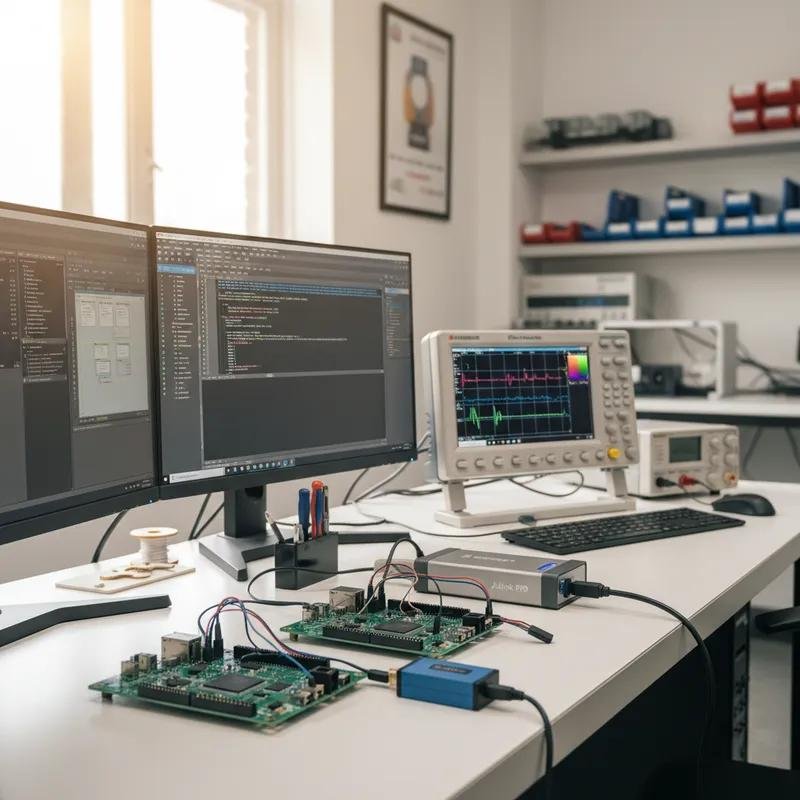
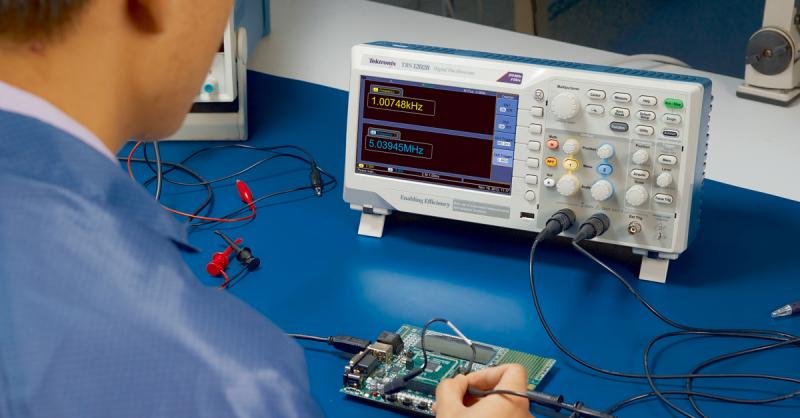
Students can configure an STM32 development board to use different supported clock sources and measure output timing using an oscilloscope or logic analyser. Comparing the results helps them understand the relationship between clock frequency, timer configuration, and peripheral performance.
Advantages and Challenges of Frequency Scaling
Frequency scaling provides several benefits, but engineers must also consider its limitations before implementing it.
Major Advantages
Reduces processor power consumption during low workloads.
Improves performance when higher processing speed is required.
Helps manage thermal conditions.
Supports efficient battery-powered applications.
Allows better resource management in embedded devices.
Common Technical Challenges
Changing clock frequencies can affect UART baud rates, timer periods, PWM generation, and communication interfaces. Developers must recalculate peripheral configurations after a clock change. They must also consider processor voltage limits, flash wait states, and oscillator stability.
Practical Applications in Embedded Systems and IoT
Clock management is important in battery-powered sensors, wearable electronics, automotive controllers, industrial automation, and Internet of Things (IoT) gateways. A low-power sensor can reduce its operating frequency during monitoring and increase processing speed when collecting or transmitting data.
In automotive applications, clock configuration supports reliable timing for communication protocols and control functions. In Internet of Things (IoT) products, efficient frequency scaling helps extend battery life while maintaining the required processing performance.
Learn Practical Microcontroller Programming at ETDA
Understanding clock management requires more than theoretical knowledge. Students should practise oscillator configuration, timer programming, register manipulation, debugging, and peripheral interfacing using actual development boards.
At Embedded Tech Development Academy (ETDA), learners can develop these skills through practical Embedded C programming, microcontroller training, and industry-oriented projects. For students searching for the Top Embedded Training Institute in Bangalore, Embedded Tech Development Academy (ETDA) provides technical learning opportunities that connect programming fundamentals with real hardware applications. Its training approach also includes assured placement support to help students prepare for technical interviews and professional embedded development roles.
Frequently Asked Questions
What is clock management in a microcontroller?
Clock management is the process of configuring and controlling clock sources and frequencies that drive the processor and its peripherals.
What is frequency scaling?
Frequency scaling changes the operating frequency of a processor according to workload and performance requirements.
What is the purpose of a PLL in microcontrollers?
A Phase-Locked Loop generates a desired clock frequency by multiplying or adjusting an input clock signal.
How does frequency scaling reduce power consumption?
Reducing clock frequency can lower dynamic power consumption because switching activity inside digital circuits decreases.
Which microcontrollers support clock configuration?
Many STM32, ARM Cortex-M-based, AVR, and other microcontroller families support configurable clock sources and frequency controls, depending on the specific device.
Why should embedded engineers learn clock management?
Clock management helps engineers configure timers, communication peripherals, processor performance, and power consumption for reliable embedded applications.
Conclusion
Clock management and frequency scaling are essential concepts for developing efficient microcontroller applications. Understanding oscillators, PLL configuration, system clocks, and frequency adjustment helps engineers balance processing performance and power consumption.
Students should practise these concepts using STM32 and other microcontroller platforms to understand real-time clock configuration and peripheral behaviour. Choosing the Top Embedded Training Institute in Bangalore can help aspiring engineers gain practical technical knowledge. Embedded Tech Development Academy (ETDA) supports students through hands-on projects, industry-oriented training, and assured placement support, preparing them for opportunities in embedded systems and Internet of Things (IoT) development.
Author: ETDA Trainers
Experience: 10+ Years of Industry Experience in Embedded Systems, IoT, and Embedded C Programming