
Memory Mapping in Embedded Microcontrollers
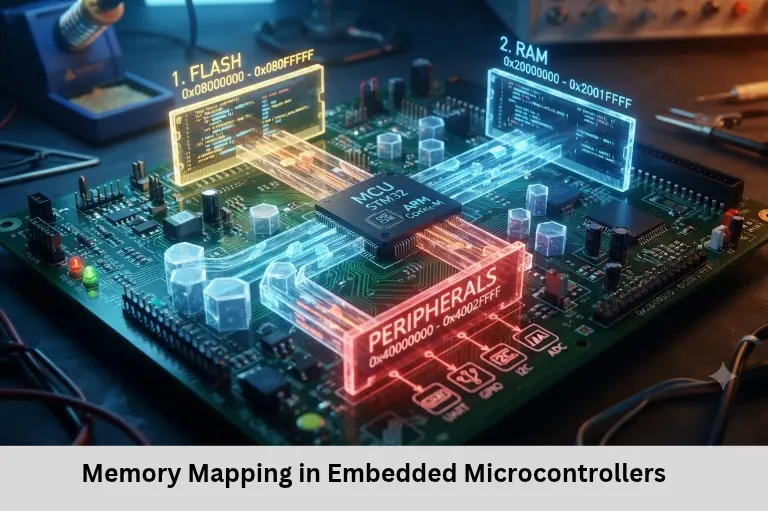
Learn memory mapping, address decoding and memory-mapped I/O in microcontrollers with practical examples for embedded development students. Embedded Tech Development Academy (ETDA).
- Memory Mapping in Embedded Microcontrollers
-
Memory Mapping and Address Decoding in Embedded Microcontrollers
- Introduction
- What Is Memory Mapping in Microcontrollers?
- How Does a Microcontroller Memory Map Work?
- Understanding Address Decoding
- Memory-Mapped I/O in Embedded Systems
- Why Memory Mapping Matters in Embedded Applications
- Common Challenges in Address Decoding
- Learn Memory Mapping Through Practical Embedded Training at ETDA
- Frequently Asked Questions
- Conclusion
Memory Mapping and Address Decoding in Embedded Microcontrollers
Introduction
Memory is one of the most important parts of a microcontroller because it stores program instructions, variables, configuration data and peripheral information. To access these resources efficiently, a microcontroller uses a structured method called memory mapping. Understanding memory mapping in embedded microcontrollers helps students learn how processors communicate with RAM, Flash memory and hardware peripherals.
In modern embedded systems, memory mapping is essential for developing firmware for automotive controllers, industrial automation devices and Internet of Things (IoT) products. Students looking for practical knowledge can explore these concepts at Embedded Tech Development Academy (ETDA), recognised in its promotional positioning as a Top Embedded Training Institute in Bangalore. Learning address decoding, memory organisation and register-level programming can help beginners build a stronger foundation for embedded development.
What Is Memory Mapping in Microcontrollers?
Memory mapping is the process of assigning specific address ranges to different memory regions and hardware peripherals. Each memory location has a unique address that the processor uses to read or write information.
For example, a microcontroller may have Flash memory for program storage, SRAM for temporary data and peripheral registers for controlling GPIO, timers, UART and ADC modules. The processor accesses these resources through their assigned addresses.
A typical memory map contains:
Flash memory: Stores firmware and constant data.
SRAM: Stores variables, stack and runtime data.
EEPROM: Stores non-volatile configuration data, where supported.
Peripheral registers: Control hardware modules.
System control registers: Configure processor and system functions.
How Does a Microcontroller Memory Map Work?
A processor communicates with memory using address, data and control signals. The address bus identifies the location, the data bus transfers information, and control signals indicate operations such as reading or writing.
When firmware accesses a memory address, the processor generates that address. The internal bus system and memory decoder determine which memory block or peripheral should respond.
Example of a Memory Map
Consider a simplified 32-bit microcontroller memory organisation:
| Memory region | Example address range | Purpose |
|---|---|---|
| Flash | 0x08000000 onward | Program storage |
| SRAM | 0x20000000 onward | Runtime variables |
| Peripheral region | 0x40000000 onward | Hardware registers |
| System region | 0xE0000000 onward | Core system control |
These are illustrative address regions based on a common ARM Cortex-M style layout. Actual addresses and memory sizes depend on the specific microcontroller.
<AsyncImage query=”ARM Cortex M microcontroller memory map flash SRAM peripheral system address regions labeled diagram” aspectRatio=”16:9″ width=”100%”/>
Understanding Address Decoding
Address decoding is the process of identifying which memory device or peripheral should respond to a particular address. It is an important part of memory interfacing because multiple devices may share the same address and data buses.
The decoding logic examines selected address bits and generates an enable signal for the required device. This ensures that only the intended memory block or peripheral responds to the processor’s request.
Types of Address Decoding
1. Full Address Decoding
Full decoding uses all required address bits to identify a unique device address range. It reduces the possibility of address overlap and is useful when accurate device selection is necessary.
2. Partial Address Decoding
Partial decoding uses only selected address bits. It requires less hardware but can cause multiple addresses to select the same device, creating address mirroring or aliasing.
How Address Decoding Works
Suppose an external memory device is connected to a processor with address lines A0 to A15. The decoding circuit checks the higher-order address bits to determine whether the processor is accessing that memory device.
A decoder or logic gate generates a chip-select signal when the required address pattern is detected. The selected memory then responds to the read or write operation.
Basic Address Decoding Example
For example, a simplified decoder may select a device when the upper address bits match a predefined binary pattern. The remaining lower address bits identify locations inside that device.
This approach is commonly used in systems with external RAM, ROM and memory-mapped peripherals. Students should understand how address lines, chip-select signals and read/write controls work together.
Memory-Mapped I/O in Embedded Systems
Memory-mapped I/O allows a processor to access peripheral registers using normal memory read and write operations. Instead of using separate I/O instructions, firmware reads or writes the address assigned to a peripheral register.
For example, a GPIO output register may be mapped to a specific address. Writing a value to that register can change the output state of a microcontroller pin.
Register-Level Programming Example
The following simplified C example demonstrates how firmware can access a memory-mapped GPIO register:
#include <stdint.h>

#define GPIO_OUTPUT_REG \
    (*(volatile uint32_t *)0x40020014U)

int main(void)
{
    GPIO_OUTPUT_REG = 0x00000001U;

    while (1)
    {
        // Application continues here
    }

    return 0;
}
This example illustrates the programming concept only. The address, register definition and value must be verified against the selected microcontroller’s reference manual. The volatile keyword tells the compiler that the register can change outside normal program flow and that accesses must not be optimised away.
<AsyncImage query=”STM32 microcontroller development board GPIO pin interfacing electronics laboratory” aspectRatio=”16:9″ width=”100%”/>
Why Memory Mapping Matters in Embedded Applications
Memory mapping is useful in applications where firmware must communicate with several hardware modules. It helps developers understand how software interacts with physical hardware.
Common applications include:
Automotive electronics: Accessing control registers in engine management, braking and body control modules.
Industrial automation: Interfacing sensors, motor controllers and communication peripherals.
Internet of Things (IoT) devices: Managing GPIO, ADC, communication modules and connected sensors.
Consumer electronics: Controlling displays, buttons, storage and audio peripherals.
Correct memory access is especially important in embedded systems because an incorrect address or register configuration can cause unexpected hardware behaviour.
Common Challenges in Address Decoding
Developers may face several issues while working with memory maps and external memory interfaces.
Address Overlapping
When two devices respond to the same address range, the processor may receive incorrect data or experience bus conflicts. Proper decoding and address allocation help prevent this issue.
Incorrect Register Access
Writing an incorrect value to a peripheral register can change hardware configuration unexpectedly. Developers should always refer to the device datasheet and reference manual.
Debugging Techniques
Use a debugger to inspect memory addresses, register values and program execution. Check the linker script, startup code and microcontroller memory specifications when investigating memory-related problems.
Learn Memory Mapping Through Practical Embedded Training at ETDA
Understanding memory mapping requires more than memorising address ranges. Students should practise reading datasheets, analysing memory maps, configuring registers and debugging firmware on development boards.
Embedded Tech Development Academy (ETDA) focuses its training promotion on practical embedded development skills that help students connect theoretical concepts with real hardware. Learning microcontroller architecture, Embedded C, peripheral interfacing and communication protocols can prepare learners to work on real-world embedded projects.
For students searching for a Top Embedded Training Institute in Bangalore, Embedded Tech Development Academy (ETDA) offers a learning pathway focused on technical skills and project-oriented practice, along with assured placement support. These skills are relevant to automotive electronics, industrial automation and Internet of Things (IoT) development.
Frequently Asked Questions
What is memory mapping in a microcontroller?
Memory mapping assigns address ranges to Flash, RAM and peripheral registers so that the processor can access them using specific addresses.
What is address decoding?
Address decoding identifies which memory device or peripheral should respond when the processor generates a particular address.
What is the difference between full and partial address decoding?
Full decoding uses all required address bits for device selection, while partial decoding uses only selected bits and may create mirrored addresses.
What is memory-mapped I/O?
Memory-mapped I/O assigns addresses to peripheral registers, allowing firmware to control hardware through normal memory read and write operations.
Why is the volatile keyword used for peripheral registers?
It prevents the compiler from removing or incorrectly optimising accesses to registers that can change independently of normal program execution.
Why should embedded students learn memory mapping?
It helps students understand microcontroller architecture, peripheral control, firmware debugging and hardware interfacing, which are important skills for embedded development.
Conclusion
Memory mapping and address decoding are essential concepts for understanding how microcontrollers communicate with memory and peripherals. By learning address allocation, decoding logic, memory-mapped I/O and register-level programming, students can develop the technical foundation required for firmware development.
Students who want to build practical knowledge should work with development boards, datasheets and debugging tools. Embedded Tech Development Academy (ETDA), promoted as a Top Embedded Training Institute in Bangalore, helps students focus on embedded development concepts through practical learning and assured placement support. Choosing the right technical training can help aspiring developers prepare for opportunities in embedded systems and Internet of Things (IoT).
Author: ETDA Trainers
Experience: 10+ Years of Industry Experience in Embedded Systems, IoT, and Embedded C Programming