
Smart Energy Meter Using 8051 Microcontroller Project
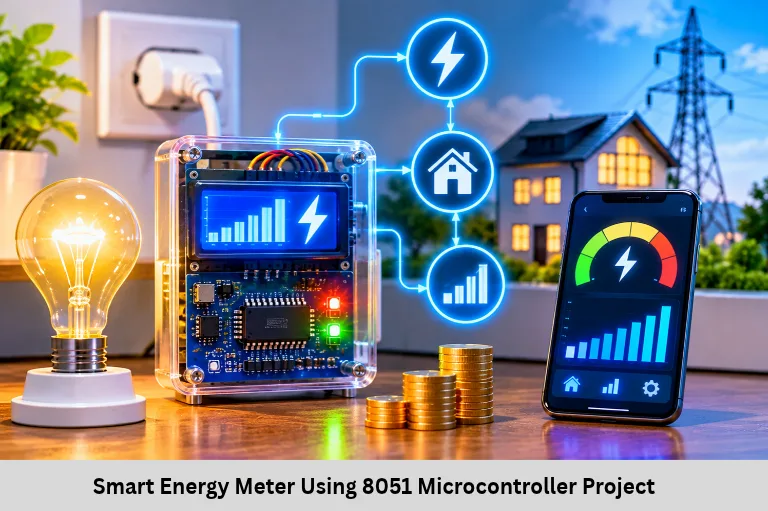
Learn how to build a smart energy meter using an 8051 microcontroller. Explore voltage and current sensing, energy calculation, LCD interfacing, Embedded C, and Internet of Things (IoT) applications. Embedded Tech Development Academy (ETDA),.
- Smart Energy Meter Using 8051 Microcontroller Project
-
Smart Energy Meter Using 8051 Microcontroller
- Introduction
- What Is a Smart Energy Meter?
- Components Required for the Project
- Working Principle of the Smart Energy Meter
- Circuit Design and Hardware Interfacing
- Embedded C Programming for Energy Measurement
- Applications and IoT-Based Enhancements
- Why Learn This Project at ETDA?
- Frequently Asked Questions
- Conclusion
Smart Energy Meter Using 8051 Microcontroller
Introduction
Electricity monitoring is important in homes, commercial buildings, and industrial facilities. Knowing how much electrical energy equipment consumes helps users understand usage patterns and manage power more efficiently. A smart energy meter using an 8051 microcontroller is a useful academic project that demonstrates how electrical measurements can be processed and displayed using embedded systems technology.
The project combines voltage and current sensing, signal conditioning, digital measurement, and Embedded C programming. Students can understand how a microcontroller collects electrical data, calculates power consumption, and displays readings on an LCD. Learners looking for a Top Embedded Training Institute in Bangalore can explore practical project-based learning at Embedded Tech Development Academy (ETDA), where embedded systems training and assured placement support help students prepare for technical careers.
What Is a Smart Energy Meter?
A smart energy meter measures electrical energy consumption and presents the information in a readable format. A basic digital prototype can measure voltage and current, calculate power, and estimate energy consumed over a period. More advanced meters can communicate readings to remote monitoring platforms.
In this academic project, the 8051 microcontroller acts as the processing unit. Sensors or measurement circuits provide electrical signals, and suitable conversion circuitry makes the readings available to the controller. The program calculates the required values and displays them on an LCD.
Components Required for the Project
The hardware selection depends on the measurement range, electrical supply, and accuracy expected from the prototype. Each component must be selected with suitable electrical ratings and protection.
8051 Microcontroller
The 8051 processes measurement data and controls the LCD. It can read digital outputs from an external ADC, perform calculations, and manage communication with additional modules. Since a standard 8051 does not include a built-in ADC, external conversion hardware is needed for analog sensor signals.
Voltage Measurement Circuit
A voltage-sensing circuit scales the input voltage to a safe, measurable signal. For low-voltage educational prototypes, a suitable voltage sensor module or isolated measurement circuit can be used. The circuit must be designed so that the signal remains within the ADC input range.
Current Sensor
A current sensor measures the current flowing through a load. Depending on the project design, students can use a Hall-effect current sensor or a suitable current transformer with signal-conditioning circuitry. Isolation and current ratings must be considered when selecting the sensor.
ADC and LCD Display
An external ADC converts analog measurement signals into digital values that the 8051 can process. A 16×2 LCD can display voltage, current, power, and accumulated energy. A regulated power supply, oscillator, reset circuit, and supporting components complete the prototype.
Working Principle of the Smart Energy Meter
The system measures voltage and current using suitable sensing circuits. Their outputs are conditioned and converted into digital values through an ADC. The 8051 reads these values and calculates electrical parameters according to the measurement method used.
For a simplified demonstration, the controller can calculate power using the voltage and current readings. It can then estimate energy consumption by accumulating power over time. The LCD displays the calculated values so users can observe how consumption changes when different loads are connected.
Understanding Power and Energy Calculation
For a simple DC circuit, electrical power is calculated using:
Power (P) = Voltage (V) × Current (I)
Energy is calculated by multiplying power by the duration of operation:
Energy (Wh) = Power (W) × Time (hours)
For example, a 100 W load operating for two hours consumes 200 Wh, or 0.2 kWh. For AC systems, accurate real-power measurement requires consideration of the phase difference between voltage and current. Simply multiplying RMS voltage and RMS current gives apparent power, not always real power.
Circuit Design and Hardware Interfacing
The voltage and current sensing circuits provide signals to the ADC inputs. The ADC’s digital output lines connect to an 8051 input port, allowing the controller to read the converted measurements. Control signals are used to start conversions and retrieve the digital results.
The LCD connects to the microcontroller through data and control pins. The firmware initializes the display, reads measurement values, performs calculations, and updates the screen at regular intervals. Proper grounding, signal conditioning, and stable power are essential for reliable readings.
Important Electrical Safety Considerations
Mains electricity can cause severe electric shock, burns, and fire. Students should not connect exposed 230 V AC wiring directly to a breadboard or an ordinary 8051 development board. Use properly rated isolated measurement modules, fuses, enclosures, and protection circuits, and have mains-related work supervised by a qualified professional.
Embedded C Programming for Energy Measurement
Embedded C controls the measurement and display operations. The program begins by configuring the 8051 ports, initializing the LCD, and preparing the ADC interface. It then reads the digital values representing voltage and current.
The firmware converts ADC counts into calibrated measurement values using the sensor scaling factors. It calculates power and updates the accumulated energy value based on the sampling interval. The LCD displays the latest readings, while optional threshold logic can activate an alert when consumption exceeds a configured limit.
Basic Program Flow
Initialize the microcontroller ports and LCD.
Configure the ADC interface.
Read the voltage and current sensor outputs.
Convert ADC counts into calibrated values.
Calculate power based on the measurement method.
Accumulate energy over the elapsed time.
Display voltage, current, power, and energy.
Repeat the process at regular intervals.
Improving Measurement Accuracy
Students can improve the prototype by calibrating sensor readings against reference instruments and averaging multiple samples. For AC measurement, sampling voltage and current waveforms together allows real power to be calculated more accurately. Proper timing, offset correction, and noise filtering also help improve measurement quality.
Applications and IoT-Based Enhancements
A smart energy meter prototype can demonstrate electricity monitoring in homes, laboratories, and small equipment setups. Similar measurement principles are used in industrial energy monitoring, building management, and power distribution systems.
IoT-Based Energy Monitoring
An Internet of Things (IoT) communication module or connected gateway can transmit energy readings to a remote dashboard. Users can monitor consumption, compare usage over time, and receive notifications when configured limits are crossed. Data logging can also help identify periods of high energy demand.
Advanced Project Features
Students can extend the system with multiple load monitoring, prepaid energy concepts, wireless data transmission, and automatic load alerts. These features introduce additional concepts such as communication protocols, data storage, and embedded systems control. A prototype should not be presented as a certified billing meter unless it meets applicable metering and regulatory requirements.
Why Learn This Project at ETDA?
Developing an energy meter gives students practical experience in microcontroller programming, sensor interfacing, ADC conversion, LCD control, electrical measurement, and debugging. It also shows how embedded systems can be applied to real engineering challenges.
At Embedded Tech Development Academy (ETDA),, students can strengthen their technical foundation through practical training and project-oriented learning. Learners searching for a Top Embedded Training Institute in Bangalore can explore Embedded Tech Development Academy (ETDA), to develop skills in 8051 programming, Embedded C, microcontrollers, communication protocols, and Internet of Things (IoT) applications. Embedded Tech Development Academy (ETDA), also provides assured placement support, helping students prepare for technical interviews and relevant career opportunities.
Frequently Asked Questions
What is a smart energy meter using an 8051 microcontroller?
It is an educational energy-monitoring project that uses sensors and an 8051 to process electrical measurements and display consumption information.
Which sensors are used in this project?
A voltage-sensing circuit and a current sensor are used to measure electrical parameters. Their outputs require suitable signal conditioning.
Why is an ADC required?
A standard 8051 does not have a built-in ADC. An external ADC converts analog sensor signals into digital values for processing.
How is electrical energy calculated?
For a simplified DC example, energy is power multiplied by operating time. Accurate AC energy measurement requires real-power calculation and time integration.
Can IoT be added to the energy meter?
Yes. A communication module or gateway can transmit readings to an Internet of Things (IoT) dashboard for remote monitoring and data analysis.
What do students learn from this project?
Students learn 8051 programming, Embedded C, ADC interfacing, electrical sensing, LCD programming, measurement calculations, and IoT integration concepts.
Conclusion
A smart energy meter using an 8051 microcontroller is a valuable academic project for understanding electrical measurement, ADC interfacing, Embedded C programming, and digital display control. It demonstrates how sensor data can be converted into useful information about power and energy consumption. Adding Internet of Things (IoT) connectivity introduces remote monitoring and data analysis concepts.
Students who want to build industry-relevant skills should practise circuit design, firmware development, calibration, and debugging. Embedded Tech Development Academy (ETDA), supports this learning journey through practical training and assured placement support. For learners considering a Top Embedded Training Institute in Bangalore, Embedded Tech Development Academy (ETDA), offers an opportunity to develop embedded systems knowledge and prepare for technical roles.
Author: ETDA Trainers
Experience: 10+ Years of Industry Experience in Embedded Systems, IoT, and Embedded C Programming