
Obstacle Detection and Avoidance System Using 8051
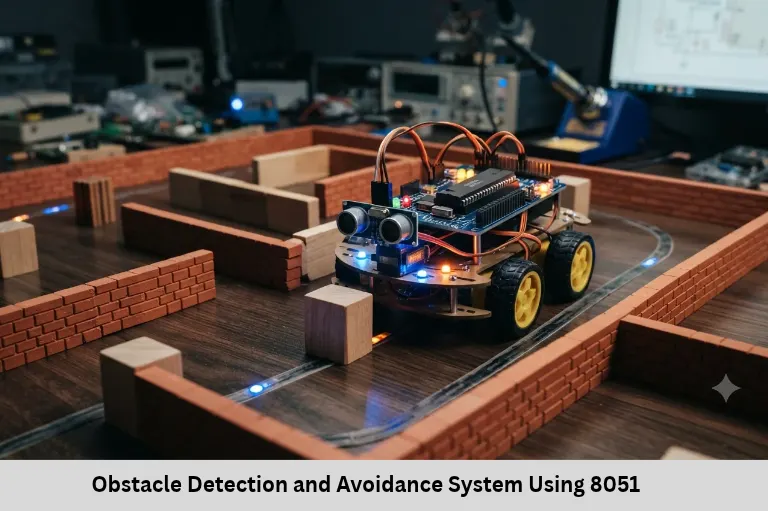
Learn how to build an obstacle detection and avoidance system using 8051. Explore ultrasonic sensors, motor drivers, Embedded C programming, circuit design, and Internet of Things (IoT) applications. Embedded Tech Development Academy (ETDA).
- Obstacle Detection and Avoidance System Using 8051
-
Obstacle Detection and Avoidance System Using 8051
- Introduction
- What Is an Obstacle Detection and Avoidance System?
- Components Required for the Project
- DC Motors and Motor Driver
- Working Principle of the Obstacle Avoidance Robot
- Circuit Design and Hardware Interfacing
- Embedded C Programming for Obstacle Avoidance
- Applications and IoT-Based Enhancements
- Why Learn This Project at ETDA?
- Frequently Asked Questions
- Conclusion
Obstacle Detection and Avoidance System Using 8051
Introduction
Robotics is an important application of embedded systems technology, combining sensors, microcontrollers, motors, and programming to perform automated tasks. An obstacle detection and avoidance system using 8051 is a practical academic project that demonstrates how a robot can identify objects in its path and change direction to avoid collisions. It introduces students to real-time sensing, decision-making, and motor control.
The project uses an ultrasonic sensor to measure the distance between the robot and nearby objects. The 8051 microcontroller processes the sensor information and controls the motors through a driver circuit. Students searching for a Top Embedded Training Institute in Bangalore can explore hands-on project learning at Embedded Tech Development Academy (ETDA), where practical embedded systems training and assured placement support help learners prepare for technical careers.
What Is an Obstacle Detection and Avoidance System?
An obstacle detection and avoidance system is an electronic arrangement that identifies objects in front of a moving robot and changes its movement to prevent collisions. It is commonly used in educational robotics, autonomous mobile platforms, and automated guided vehicle prototypes.
In this project, the 8051 microcontroller acts as the main controller. It receives distance information from an ultrasonic sensor, compares the measured distance with a predefined threshold, and sends control signals to the motor driver. Depending on the result, the robot can move forward, stop, turn left, or turn right.
Components Required for the Project
The project combines sensing, processing, and movement-control components. Selecting compatible hardware is important because the microcontroller, sensor, and motors may require different operating voltages and current levels.
8051 Microcontroller
The 8051 is the central processing unit of the robot. It reads the sensor signals, executes the Embedded C program, and controls the motor driver. Its GPIO pins are useful for interfacing with digital sensors and output devices, while its timers help measure signal durations.
Ultrasonic Sensor
An HC-SR04 ultrasonic sensor is commonly used to measure the distance to an obstacle. It sends an ultrasonic pulse and measures the time taken for the reflected signal to return. The distance is calculated from the measured echo time and the speed of sound.
DC Motors and Motor Driver
Two DC geared motors are commonly used to move the robot. An L293D motor driver allows the 8051 to control motor direction because the microcontroller cannot directly supply the current required by the motors. By changing the driver input signals, the robot can move forward, reverse, or turn.
Chassis and Power Supply
The chassis supports the controller, sensor, motor driver, and wheels. A suitable battery supplies power to the system. Separate regulated supplies may be required for the controller and motors, with a common ground where the circuit design requires it.
Working Principle of the Obstacle Avoidance Robot
The robot continuously measures the distance in front of it. The ultrasonic sensor sends a trigger pulse and waits for the echo signal reflected by an object. The 8051 measures the echo duration and calculates the approximate distance.
If the measured distance is greater than the programmed safety threshold, the robot continues moving forward. When an obstacle is detected within that threshold, the controller stops the motors and executes a programmed avoidance action, such as turning left or right.
Step-by-Step Operation
The controller initializes the sensor, timers, and motor driver.
The ultrasonic sensor sends a trigger pulse.
The sensor receives the reflected echo from an obstacle.
The 8051 measures the echo pulse duration.
The program calculates the approximate obstacle distance.
If the distance is below the threshold, the robot stops.
The controller changes motor direction to turn away.
The robot resumes forward movement after checking the path.
Circuit Design and Hardware Interfacing
The HC-SR04 trigger pin is connected to an 8051 output pin, while its echo pin connects to an input pin. The controller generates a short trigger pulse and measures the duration of the echo signal using a timer. The measured duration is then converted into distance.
The motor driver’s input pins connect to the 8051 GPIO pins. Its output terminals connect to the two DC motors. The enable pins control motor operation, while the input combinations determine direction. A stable power supply and suitable decoupling are important because motor switching can introduce electrical noise.
Distance Measurement Using Timer
The ultrasonic sensor calculates distance using the time taken by sound to travel to the obstacle and return. The basic formula is:
Distance = (Echo Time × Speed of Sound) ÷ 2
The division by two accounts for the outgoing and returning sound waves. The 8051 timer can measure the echo pulse duration, provided the timer configuration and clock frequency are correctly calculated.
Motor Direction Control
The L293D uses input combinations to control motor direction. For example, both motors rotating forward move the robot ahead. Stopping one motor while operating the other can produce a turn. Reversing one motor can help the robot turn more sharply, depending on the chassis design.
Embedded C Programming for Obstacle Avoidance
Embedded C controls the sensor measurement and movement decisions. The program initializes the microcontroller ports, configures the timer, and prepares the motor driver. It then repeatedly triggers the ultrasonic sensor and reads the echo duration.
After calculating the distance, the program compares it with a predefined threshold. If the path is clear, the robot moves forward. If an obstacle is detected, the controller stops the motors and performs the selected turning operation.
Basic Program Logic
The software can follow this simplified sequence:
Initialize GPIO pins and timer settings.
Generate the ultrasonic trigger pulse.
Measure the echo duration.
Calculate the distance.
Compare the distance with the safety threshold.
Move forward if the path is clear.
Stop and turn if an obstacle is detected.
Repeat the sensing and movement cycle.
Improving Robot Performance
Students can improve the robot by adding multiple distance measurements, sensor filtering, and a timeout for missing echo signals. A state machine can manage forward movement, obstacle detection, stopping, turning, and recovery. These improvements make the program easier to debug and reduce unnecessary motor movements.
Applications and IoT-Based Enhancements
Obstacle avoidance concepts are used in educational robots, warehouse automation prototypes, automated guided vehicles, and mobile inspection platforms. Similar sensing and control techniques help machines navigate environments where objects may appear unexpectedly.
IoT Integration
An Internet of Things (IoT)-enabled extension can transmit robot status, obstacle events, and sensor readings to a remote dashboard through a suitable communication module or gateway. Students can explore wireless monitoring, data logging, and remote observation. This provides an introduction to connected robotics and embedded systems communication.
Why Learn This Project at ETDA?
This project gives students practical experience with 8051 architecture, Embedded C, ultrasonic sensor interfacing, timers, motor drivers, and real-time control logic. These concepts are useful for developing skills in robotics, firmware development, industrial automation, and Internet of Things (IoT) applications.
At Embedded Tech Development Academy (ETDA), students can strengthen their technical foundation through hands-on training and project-oriented learning. Learners searching for a Top Embedded Training Institute in Bangalore can explore Embedded Tech Development Academy (ETDA) to develop practical knowledge of microcontrollers, programming, communication protocols, and embedded systems. The academy also provides assured placement support, helping students prepare for technical interviews and relevant career opportunities.
Frequently Asked Questions
What is an obstacle detection and avoidance system using 8051?
It is a robotics project in which an 8051 microcontroller uses sensor information to detect objects and control a robot’s movement to avoid collisions.
Which sensor is commonly used in this project?
The HC-SR04 ultrasonic sensor is commonly used to measure the distance between the robot and nearby obstacles.
Why is a motor driver required?
A motor driver such as the L293D supplies the current needed by DC motors and allows the controller to change their direction.
How does the 8051 calculate obstacle distance?
It measures the ultrasonic echo pulse duration using a timer and calculates distance using the speed of sound.
Can IoT features be added to this robot?
Yes. A suitable communication module or gateway can transmit sensor readings and robot status to a remote monitoring dashboard.
What skills do students gain from this project?
Students learn 8051 programming, Embedded C, ultrasonic sensor interfacing, timer configuration, motor control, robotics, and IoT integration concepts.
Conclusion
An obstacle detection and avoidance system using 8051 is a valuable academic project for understanding ultrasonic sensing, distance measurement, motor control, and Embedded C programming. It demonstrates how a microcontroller can use real-time sensor information to make movement decisions. Adding Internet of Things (IoT) connectivity provides further opportunities to explore connected robotics and remote monitoring.
Students who want to build industry-relevant technical skills should practise hardware interfacing, firmware development, testing, and debugging. Embedded Tech Development Academy (ETDA) supports this learning journey through practical training and assured placement support. For learners considering a Top Embedded Training Institute in Bangalore, Embedded Tech Development Academy (ETDA) offers an opportunity to strengthen embedded systems knowledge and prepare for technical roles.
Author: ETDA Trainers
Experience: 10+ Years of Industry Experience in Embedded Systems, IoT, and Embedded C Programming