
Advanced Linux Programming and Kernel Concepts for Embedded Engineers
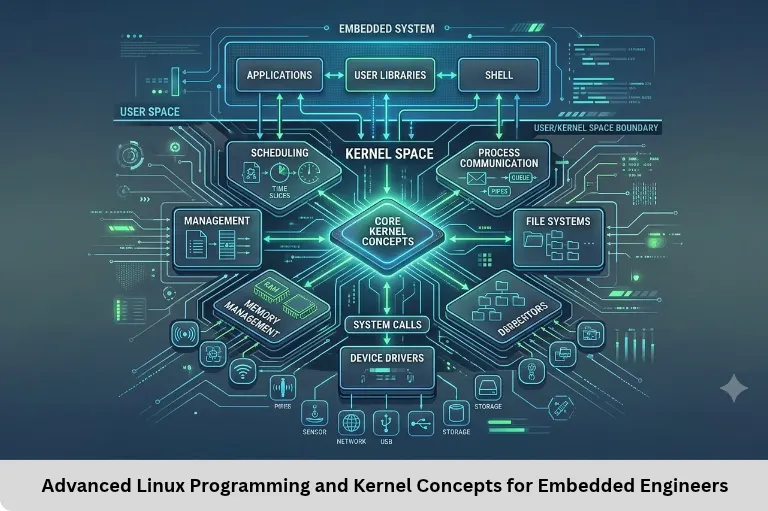
Learn advanced Linux programming, kernel concepts, device drivers, memory management, IPC, scheduling, synchronization, and Embedded Linux debugging. Embedded Tech Development Academy (ETDA).
- Advanced Linux Programming and Kernel Concepts for Embedded Engineers
-
Advanced Linux Programming and Kernel Concepts Every Embedded Engineer Must Know
- Introduction
- User Space vs Kernel Space
- System Calls and Linux Programming Interface
- Process Management and Scheduling
- Virtual Memory Management
- Inter-Process Communication (IPC)
- File Systems and Storage Internals
- Device Drivers and Kernel Modules
- Kernel Synchronization and Concurrency
- Linux Boot Process and System Initialization
- Linux Debugging and Performance Analysis
- Frequently Asked Questions
- Conclusion
Advanced Linux Programming and Kernel Concepts Every Embedded Engineer Must Know
Introduction
Modern Embedded Systems have evolved beyond simple bare-metal firmware. Automotive ECUs, industrial automation controllers, smart appliances, networking equipment, robotics platforms, and Internet of Things (IoT) gateways increasingly depend on Embedded Linux for multitasking, hardware integration, networking, and application development. Linux provides a powerful operating system environment with process management, virtual memory, device drivers, file systems, networking stacks, and extensive debugging tools.
For embedded engineers, understanding Linux commands and application development alone is not sufficient. Advanced Linux programming requires knowledge of system calls, kernel architecture, process scheduling, memory management, inter-process communication, synchronization, device drivers, and boot-time optimization. These concepts help engineers develop efficient firmware applications, troubleshoot kernel-level problems, and improve system reliability.
Embedded Linux development also requires balancing performance, memory consumption, boot time, and real-time requirements. Engineers working with Embedded Systems and Internet of Things (IoT) products must understand how user applications interact with hardware through kernel interfaces and how operating-system resources affect application behavior.
Embedded Tech Development Academy (ETDA) supports technical learning in Embedded Systems, Linux programming, and firmware development. As a Top Embedded Training Institute in Bangalore, Embedded Tech Development Academy (ETDA) emphasizes practical technical knowledge and assured placement support for learners preparing for embedded development careers.
User Space vs Kernel Space
Linux separates execution into two major privilege domains.
User Space
User space contains applications, services, utilities, and application-level programs. These processes operate with restricted privileges and cannot directly access protected hardware resources.
Kernel Space
Kernel space contains the Linux kernel, including scheduling, memory management, device drivers, and networking functionality. It executes privileged operations and manages hardware resources.
System Call Boundary
Applications interact with kernel functionality through system calls such as open(), read(), write(), and ioctl().
Engineering Importance
This separation improves security and system stability. Embedded engineers must determine whether functionality belongs in user space, a kernel driver, or an existing kernel subsystem.
System Calls and Linux Programming Interface
System calls provide controlled access to kernel services. Library functions may internally invoke system calls to request operations from the kernel.
Important interfaces include:
open()– opens a file or device.read()– reads data from a file descriptor.write()– writes data through a file descriptor.fork()– creates a child process.ioctl()– performs device-specific control operations.
Virtual File System (VFS)
VFS provides a common interface for accessing different Linux file systems and file-like objects. It allows applications to interact with files and device nodes without requiring knowledge of their underlying implementation.
In Embedded Systems, system calls and VFS interfaces are commonly used to communicate with device drivers through interfaces such as /dev.
Process Management and Scheduling
Linux supports multitasking through processes, threads, and kernel scheduling mechanisms.
Process and Thread Concepts
Linux represents schedulable tasks using structures such as task_struct. Processes and threads share many kernel task-management mechanisms, although their resource-sharing relationships differ.
Scheduling Policies
Important scheduling concepts include:
CFS: Historically the Completely Fair Scheduler, designed for fair CPU allocation among normal tasks. Linux versions are transitioning toward EEVDF-based scheduling.
SCHED_FIFO: Real-time scheduling policy where higher-priority runnable tasks execute before lower-priority tasks.
SCHED_RR: Real-time scheduling with time slices among tasks of the same priority.
Context Switching
Context switching occurs when the CPU changes execution from one task to another. It involves saving and restoring execution state and may introduce latency.
Real-Time Considerations
Embedded engineers must understand task priorities, scheduling latency, CPU utilization, and priority inversion. Appropriate scheduling configuration is essential for meeting real-time deadlines.
Virtual Memory Management
Linux uses virtual memory to provide address-space isolation and efficient memory allocation.
Important Memory Concepts
Virtual address space for each process.
Page tables and Memory Management Unit (MMU).
Demand paging and page faults.
Stack, heap, and data segments.
Kernel memory allocation using
kmalloc()andvmalloc().
Kernel Memory Allocation
kmalloc() generally provides physically contiguous memory suitable for many kernel allocations, whereas vmalloc() provides virtually contiguous memory that may not be physically contiguous.
Memory leaks, excessive allocation, and fragmentation can reduce system reliability in long-running Embedded Systems.
Inter-Process Communication (IPC)
IPC allows Linux processes to exchange information and coordinate execution.
Common IPC Mechanisms
Pipes and FIFOs for stream-based communication.
Message queues for structured message exchange.
Shared memory for efficient data sharing.
Signals for asynchronous notifications.
Semaphores and mutexes for synchronization.
Selecting an IPC Mechanism
Shared memory can provide high throughput but requires synchronization. Pipes simplify stream communication, while message queues support message-oriented exchange.
In Internet of Things (IoT) gateways, IPC may connect sensor-processing services, communication modules, and application processes.
File Systems and Storage Internals
Linux represents many resources through file interfaces, including device nodes.
Important File-System Concepts
VFS architecture.
Character and block devices.
File permissions and ownership.
Mounting and file-system management.
Flash-oriented file systems such as JFFS2, YAFFS, and UBIFS.
Flash Storage Considerations
Embedded Linux products frequently use NAND or NOR flash. Selecting a suitable file system affects boot time, recovery behavior, storage reliability, and flash wear.
UBIFS is commonly used with UBI-managed NAND flash, while JFFS2 and YAFFS are other flash-oriented options with different characteristics.
Device Drivers and Kernel Modules
Device drivers connect kernel functionality with physical hardware.
Driver Categories
Character drivers.
Block drivers.
Network drivers.
Platform drivers.
Platform Drivers and Device Tree
Platform drivers commonly support SoC-integrated peripherals. Device Tree describes hardware configuration, including registers, interrupts, clocks, and device connections.
Probe and Remove Callbacks
The probe() callback initializes a device when it is matched and available. The remove() callback handles device removal and resource cleanup.
Interrupt Handling
Interrupt handlers respond to hardware events. Complex processing is often deferred to threaded interrupts or other deferred-work mechanisms to reduce interrupt latency.
Kernel Synchronization and Concurrency
The Linux kernel executes concurrently across CPUs, interrupts, kernel threads, and process contexts.
Synchronization Mechanisms
Spinlocks protect shared resources in contexts where sleeping is not allowed.
Mutexes provide mutual exclusion in sleepable contexts.
Semaphores support synchronization and resource counting.
Atomic operations provide indivisible operations on shared values.
Wait queues allow tasks to sleep until a condition becomes true.
Incorrect synchronization can cause race conditions, deadlocks, and kernel crashes.
Linux Boot Process and System Initialization
Embedded Linux booting involves multiple initialization stages.
Typical Boot Sequence
Boot ROM initializes essential hardware.
Bootloader such as U-Boot loads the kernel and device tree.
Linux kernel initializes memory, drivers, and subsystems.
Kernel mounts the root file system.
Init system such as systemd or BusyBox init starts services.
Boot-Time Optimization
Engineers optimize boot time by reducing unnecessary drivers, minimizing service startup dependencies, and configuring kernel initialization appropriately.
Linux Debugging and Performance Analysis
Advanced Linux development requires systematic debugging and performance analysis.
Important Tools
| Tool | Purpose |
|---|---|
strace | Traces system calls |
ltrace | Traces library calls |
top / htop | Monitor CPU and memory |
ps | Inspect process information |
dmesg | View kernel messages |
GDB | Debug application programs |
KGDB | Kernel debugging support |
Performance Analysis
Engineers use profiling, tracing, and performance monitoring to identify CPU bottlenecks, memory problems, scheduling delays, and excessive system-call overhead.
Tools such as perf, ftrace, and Linux tracing facilities can provide deeper visibility into kernel and application execution.
Frequently Asked Questions
What is advanced Linux programming?
Advanced Linux programming involves system calls, process management, IPC, memory management, synchronization, debugging, and kernel interfaces.
Why should embedded engineers learn Linux kernel concepts?
Kernel knowledge helps engineers understand hardware integration, device drivers, performance bottlenecks, and operating-system behavior.
What is the difference between user space and kernel space?
User space contains restricted application processes, while kernel space contains privileged operating-system functionality.
What is the purpose of a Linux device driver?
A device driver enables communication between the Linux kernel and hardware peripherals such as sensors, GPIOs, displays, and communication controllers.
Which tools are useful for Embedded Linux debugging?
strace, GDB, dmesg, perf, ftrace, and KGDB are useful for debugging applications, analyzing kernel behavior, and investigating performance issues.
Is Embedded Linux useful for IoT development?
Yes. Embedded Linux supports networking, multitasking, hardware integration, security mechanisms, and application services used in Internet of Things (IoT) gateways and connected products.
Conclusion
Advanced Linux programming and kernel concepts are essential for developing reliable and efficient Embedded Systems. Understanding user space and kernel space, system calls, scheduling, virtual memory, IPC, file systems, device drivers, synchronization, boot processes, and debugging provides engineers with the technical foundation required for professional Embedded Linux development.
These concepts are particularly important in automotive electronics, industrial automation, robotics, networking devices, and Internet of Things (IoT) platforms where performance, reliability, and hardware integration directly influence product behavior.
Embedded Tech Development Academy (ETDA) helps learners strengthen their technical foundation in Linux programming, Embedded Systems, and Internet of Things (IoT) development. As a Top Embedded Training Institute in Bangalore, the academy focuses on technical skill development, practical learning, and assured placement support for aspiring embedded professionals.
Developing expertise in advanced Linux programming enables engineers to move beyond application-level coding and contribute to kernel integration, device driver development, system optimization, and production-ready Embedded Linux solutions.
Author: ETDA Trainers
Experience: 10+ Years of Industry Experience in Embedded Systems, IoT, and Embedded C Programming