
Advanced Linux Programming for Embedded Engineers
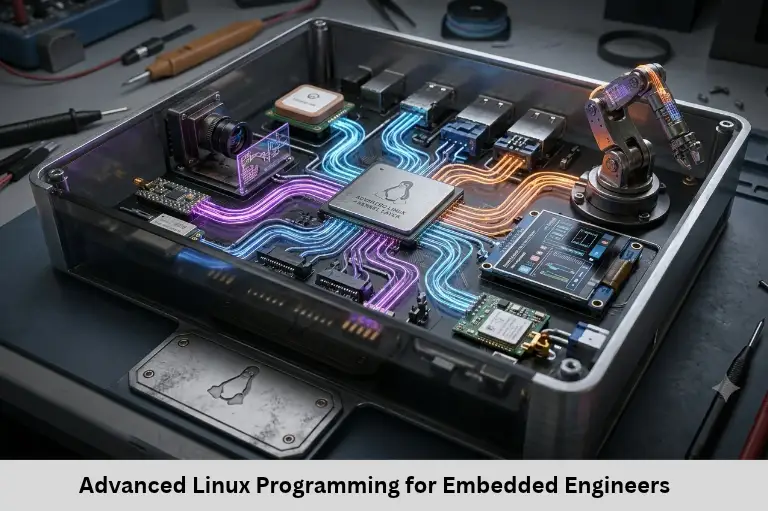
Learn advanced Linux programming, kernel concepts, device drivers, memory management, IPC, scheduling, and debugging for Embedded Systems and Internet of things (IoT). Embedded Tech Development Academy (ETDA).
- Advanced Linux Programming for Embedded Engineers
-
Advanced Linux Programming and Kernel Concepts Every Embedded Engineer Must Know
- Introduction
- 1. User Space, Kernel Space, and System Calls
- 2. Process Management and CPU Scheduling
- 3. Virtual Memory and Kernel Memory Allocation
- 4. Inter-Process Communication and Synchronization
- 5. File Systems and Embedded Storage
- 6. Device Drivers and Kernel Modules
- 7. Kernel Concurrency and Real-Time Behaviour
- 8. Boot Process and System Initialization
- 9. Debugging and Performance Analysis
-
Frequently Asked Questions
- Why is advanced Linux programming important for embedded engineers?
- What is the difference between user space and kernel space?
- Which programming language is useful for Embedded Linux?
- What is the role of a Linux device driver?
- How can engineers improve Embedded Linux performance?
- What should learners look for in an Embedded Linux training program?
- Conclusion
Advanced Linux Programming and Kernel Concepts Every Embedded Engineer Must Know
Introduction
Modern Embedded Systems are no longer limited to simple microcontroller programs. Automotive electronic control units (ECUs), industrial automation equipment, smart appliances, network routers, and Internet of things (IoT) gateways increasingly depend on Embedded Linux to manage complex hardware, communication protocols, and application workloads. Developing these products requires more than basic command-line knowledge or writing simple C programs. Engineers must understand Linux system calls, process scheduling, virtual memory, inter-process communication (IPC), kernel synchronization, device drivers, and boot-time optimization.
Advanced Linux programming helps developers build responsive applications, diagnose resource leaks, improve system reliability, and integrate hardware efficiently. These skills are particularly important when working with ARM-based processors, cross-compilation toolchains, Linux device trees, and real-time applications. For engineers pursuing careers in Embedded Systems and Internet of things (IoT) development, structured practical learning can make complex kernel concepts easier to apply. Embedded Tech Development Academy (ETDA) focuses on technical learning relevant to embedded development, while its position as a Top Embedded Training Institute in Bangalore reflects the training focus highlighted in its promotional content. Learners can also explore practical projects and assured placement support as part of their career preparation.
1. User Space, Kernel Space, and System Calls
Understanding User Space and Kernel Space
Linux separates application execution from privileged kernel operations. User-space applications run with restricted permissions, while kernel space manages hardware, memory, scheduling, and system resources. This separation protects the operating system from many application-level failures.
How System Calls Work
Functions such as open(), read(), write(), fork(), and ioctl() allow applications to request kernel services. The C library may provide wrappers around system calls. When a program requests a protected operation, execution transitions into the kernel, which validates the request and performs the operation.
The Virtual File System (VFS) provides a common interface for accessing different file systems and device files. In Embedded Systems, engineers should check return values, handle errno, and minimize unnecessary system calls when performance matters.
Practical Application
For an Internet of things (IoT) sensor application, a user-space program might read sensor data from a device node exposed by a driver. The application uses a standard file interface instead of directly accessing protected hardware registers.
2. Process Management and CPU Scheduling
Processes, Threads, and Context Switching
Linux represents schedulable tasks using kernel structures such as task_struct. Threads within a process share resources such as memory, while separate processes generally have independent virtual address spaces.
A context switch occurs when the CPU changes from executing one task to another. Although necessary for multitasking, frequent context switching can add overhead, particularly in systems with limited processing power.
Linux Scheduling Policies
Linux supports different scheduling classes and policies. Ordinary tasks are handled by the fair scheduling class, while SCHED_FIFO and SCHED_RR support real-time scheduling.
SCHED_FIFO: A real-time task continues running until it blocks, yields, or is preempted by an eligible higher-priority task.
SCHED_RR: Adds a time slice for tasks with the same real-time priority.
Priorities: Influence which eligible task receives CPU time.
Embedded Systems Considerations
In automotive and industrial Embedded Systems, engineers must measure task execution times, interrupt latency, CPU utilization, and blocking delays. Real-time scheduling does not automatically guarantee deadlines; incorrect priorities can cause starvation or missed timing requirements.
3. Virtual Memory and Kernel Memory Allocation
Understanding Virtual Memory
Linux uses virtual memory to isolate processes and map virtual addresses to physical memory through page tables and the Memory Management Unit (MMU). A process typically contains code, data, heap, stack, and memory-mapped regions.
Heap, Stack, and Kernel Allocation
The stack stores function frames and local variables, while the heap supports dynamic allocation. Kernel code uses specialized memory-management interfaces.
kmalloc()allocates physically contiguous memory for many kernel objects.vmalloc()provides virtually contiguous memory that may not be physically contiguous.Page allocators manage memory in page-sized units.
Memory Optimization in IoT
Internet of things (IoT) devices may operate continuously with limited RAM. Engineers should monitor memory leaks, allocation failures, page faults, and out-of-memory events. Efficient allocation and proper resource cleanup help improve long-term reliability.
4. Inter-Process Communication and Synchronization
Common IPC Mechanisms
Linux supports pipes, FIFOs, message queues, shared memory, signals, and sockets. These mechanisms allow applications to exchange data and coordinate work.
Selecting the Appropriate Mechanism
Shared memory is useful for high-throughput data exchange but requires synchronization. Pipes are suitable for byte streams, while sockets support communication between local processes or networked systems. Mutexes and semaphores help coordinate access to shared resources.
Practical IoT Example
An Internet of things (IoT) gateway may use shared memory to exchange high-volume sensor data between local processes and a Unix domain socket to send commands between services. The best choice depends on latency, throughput, complexity, and failure recovery.
5. File Systems and Embedded Storage
The Role of VFS
The Virtual File System allows applications to use a common interface for different file-system implementations. Linux also represents devices through interfaces such as device nodes, allowing applications to access hardware using standard operations.
Flash File Systems
JFFS2: Designed for raw flash and supports features such as compression and wear levelling.
UBIFS: Designed for raw flash managed through UBI.
YAFFS: Developed for NAND flash environments.
These file systems serve different storage architectures and should not be treated as interchangeable with conventional block-device file systems.
Storage Reliability
Embedded engineers must consider flash endurance, sudden power loss, recovery time, write patterns, and data integrity. Managed storage such as eMMC differs from raw NAND or NOR flash, so the storage architecture should guide file-system selection.
6. Device Drivers and Kernel Modules
Understanding Linux Device Drivers
Device drivers provide the interface between the kernel and hardware such as GPIO controllers, I²C sensors, SPI peripherals, and network interfaces. Drivers manage device initialization, data transfer, interrupts, and resource cleanup.
Platform Drivers and Device Trees
Platform drivers commonly use probe() and remove() callbacks. The probe routine initializes resources when matching hardware is detected, while removal releases resources when appropriate.
Device trees describe hardware configuration, including register addresses, interrupts, clocks, and bus relationships. Driver developers must also understand deferred work, DMA constraints, and kernel APIs.
Hardware Integration
For Embedded Systems and Internet of things (IoT) products, reliable drivers require correct error handling, resource management, and compatibility with the target kernel version. Poorly written drivers can cause instability across the entire system.
7. Kernel Concurrency and Real-Time Behaviour
Why Synchronization Matters
The Linux kernel supports concurrent execution by processes, kernel threads, and interrupt handlers. Multiple execution contexts may access shared resources, creating race conditions unless synchronization is applied correctly.
Important Kernel Synchronization Tools
Spinlocks: Protect short critical sections where sleeping is not permitted.
Mutexes: Protect resources in contexts that may sleep.
Atomic operations: Provide indivisible operations on supported shared values.
Wait queues: Allow tasks to sleep until a condition becomes true.
Semaphores: Coordinate access or signalling according to their intended use.
Preventing Concurrency Errors
Engineers should document lock ordering, keep critical sections short, and choose synchronization primitives according to execution context. Deadlocks, race conditions, and priority inversion are particularly important concerns in real-time Embedded Systems.
8. Boot Process and System Initialization
Embedded Linux Boot Sequence
An Embedded Linux device commonly starts with a bootloader such as U-Boot. The bootloader initializes essential hardware and loads the kernel and device tree. The kernel initializes memory management, drivers, and core services before starting the first user-space process.
Init Systems and Startup Configuration
The init system may be systemd or BusyBox init, depending on the product. Startup scripts, service dependencies, kernel configuration, and boot parameters influence initialization behaviour.
Boot-Time Optimization
Engineers can investigate kernel logs, service startup times, and driver probe delays. Disabling unnecessary services and deferring nonessential initialization can reduce boot time, provided essential hardware checks and security initialization remain intact.
9. Debugging and Performance Analysis
Essential Linux Debugging Tools
stracetraces system calls and signals.ps,top, andhtopshow process and resource usage.dmesgdisplays kernel-ring-buffer messages.GDB supports user-space debugging.
KGDB supports kernel debugging on suitably configured targets.
perfand tracing facilities help investigate CPU hotspots and latency.
A Systematic Debugging Workflow
First reproduce the problem and collect logs. Next measure CPU, memory, and I/O usage. Isolate the affected subsystem, test a targeted fix, and repeat the workload to confirm the result.
Industry-Oriented Learning
Embedded Tech Development Academy (ETDA) is an option for learners who want structured Embedded Systems and Internet of things (IoT) training. When comparing a Top Embedded Training Institute in Bangalore, review the practical syllabus, hardware labs, debugging exercises, instructor experience, and project depth. Also confirm the scope and conditions of the advertised assured placement support.
Frequently Asked Questions
Why is advanced Linux programming important for embedded engineers?
It helps engineers develop efficient applications, understand system calls, manage memory, debug failures, integrate hardware, and optimize Embedded Systems performance.
What is the difference between user space and kernel space?
User space runs applications with restricted privileges, while kernel space runs core operating-system code and provides controlled access to hardware and protected resources.
Which programming language is useful for Embedded Linux?
C is widely used for Linux system programming and kernel development. C++ is common in application software, while Python is useful for testing, automation, and prototyping.
What is the role of a Linux device driver?
A device driver connects the Linux kernel with hardware peripherals and manages operations such as initialization, data transfer, interrupts, and resource cleanup.
How can engineers improve Embedded Linux performance?
They can profile CPU and memory usage, optimize system calls, tune scheduling, reduce unnecessary services, investigate I/O bottlenecks, and use tracing tools to identify latency.
What should learners look for in an Embedded Linux training program?
Look for hands-on Linux programming, kernel fundamentals, device drivers, cross-compilation, debugging, hardware projects, and transparent information about career guidance and assured placement support.
Conclusion
Advanced Linux programming is essential for engineers building reliable Embedded Systems, automotive controllers, industrial products, and Internet of things (IoT) gateways. Mastering system calls, process scheduling, virtual memory, IPC, file systems, device drivers, kernel synchronization, boot optimization, and debugging helps developers diagnose faults systematically and build maintainable software.
Engineers should practise these concepts using Linux development boards, cross-compilation toolchains, device trees, driver interfaces, and performance-tracing tools. Embedded Tech Development Academy (ETDA) can be explored by learners seeking guided technical training and project-based practice. Those considering a Top Embedded Training Institute in Bangalore should evaluate the depth of practical learning and verify what its assured placement support includes. Combining strong Linux fundamentals with hands-on Embedded Systems and Internet of things (IoT) experience can prepare learners for complex embedded software development responsibilities.
Author: ETDA Trainers
Experience: 10+ Years of Industry Experience in Embedded Systems, IoT, and Embedded C Programming