
AI on Microcontrollers: TinyML and Embedded AI Guide
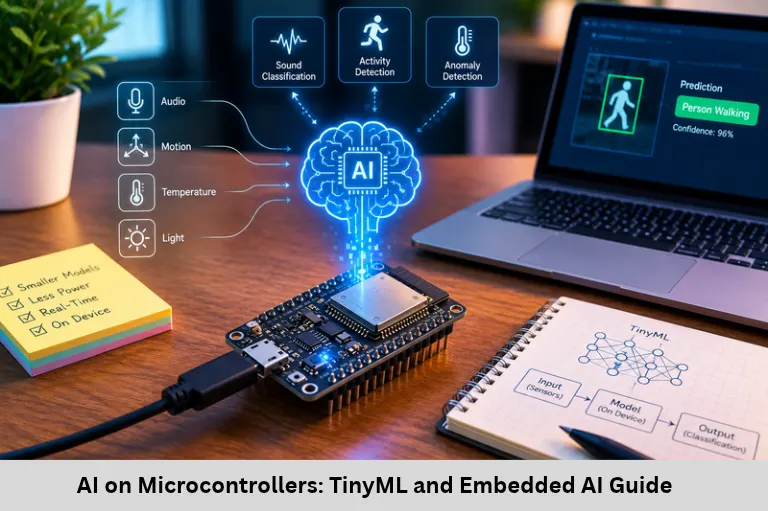
Explore AI on microcontrollers, TinyML, ESP32, STM32, model optimization, Edge AI, Internet of Things (IoT) applications, and embedded machine learning.
- AI on Microcontrollers: TinyML and Embedded AI Guide
-
AI on Microcontrollers: The Future of Intelligent Embedded Systems
- Introduction
- What Is AI on Microcontrollers?
- How a TinyML System Works
- Popular Hardware Platforms for Embedded AI
- Software Tools and Frameworks
- Real-World Applications of AI on Microcontrollers
- Technical Challenges and Optimization
- Career Skills and ETDA Training
- Frequently Asked Questions
- Conclusion
AI on Microcontrollers: The Future of Intelligent Embedded Systems
Introduction
Artificial Intelligence (AI) is moving beyond powerful computers, cloud servers, and dedicated GPUs into compact, low-power electronic devices. This transformation, commonly known as AI on Microcontrollers or TinyML, enables intelligent processing directly on embedded hardware. By combining machine learning, sensor interfacing, firmware development, and real-time data processing, developers can build intelligent Embedded Systems that respond to their surroundings without continuously depending on cloud connectivity.
AI-enabled microcontrollers are increasingly relevant in smart home automation, industrial predictive maintenance, wearable technology, automotive electronics, and Internet of Things (IoT) applications. These systems can analyze vibration, sound, temperature, motion, and other sensor measurements to identify patterns and trigger actions locally. The result can be lower communication overhead, faster responses, and improved privacy when data remains on the device.
For engineers interested in developing these technologies, understanding microcontroller architecture, memory management, digital interfaces, model quantization, and embedded inference is essential. Embedded Tech Development Academy (ETDA) promotes practical technical learning in this area. Learners researching a Top Embedded Training Institute in Bangalore can explore Embedded Tech Development Academy (ETDA)‘s embedded training approach and assured placement support. With a strong foundation in Embedded Systems, machine learning, and Internet of Things (IoT), aspiring developers can prepare to build practical Edge AI solutions.
What Is AI on Microcontrollers?
AI on microcontrollers means executing a trained machine learning model on a microcontroller or similarly resource-constrained embedded processor. Unlike conventional AI applications that may require a GPU or remote server, TinyML applications are designed to operate within restricted RAM, Flash storage, processing speed, and power budgets.
A typical system collects sensor data, preprocesses the input, executes a trained model, and generates a prediction. For example, a vibration-monitoring device can classify machine vibration as normal or abnormal based on patterns learned during training.
How TinyML Differs from Cloud-Based AI
Cloud-based AI sends data to a remote server for processing, which can introduce network latency and connectivity requirements. TinyML performs inference locally, allowing supported applications to operate offline.
However, local inference does not automatically make a system more accurate or secure. Developers must evaluate model performance, firmware security, and resource consumption on the actual target hardware.
How a TinyML System Works
A microcontroller-based AI project generally follows five stages.
1. Data Collection
Sensors collect measurements such as temperature, acceleration, sound, pressure, or electrical current. Data quality is important because incomplete or inconsistent samples can reduce model reliability.
2. Model Training
Developers use a computer and machine learning frameworks such as TensorFlow or PyTorch to train a model. The training dataset should represent expected operating conditions and include relevant examples of different classes.
3. Model Optimization
Microcontrollers have limited memory and processing capacity. Optimization techniques such as quantization, pruning, and compact model architectures can reduce computational requirements. Quantization converts model values to lower-precision representations, such as 8-bit integers, when the model and inference runtime support them.
4. Model Deployment
The trained and optimized model is converted into a format supported by the embedded inference framework. Model parameters may be stored in Flash, while input tensors, intermediate buffers, and other runtime data use RAM.
5. On-Device Inference
The firmware acquires fresh sensor readings, applies the same preprocessing used during training, and executes the model. The predicted class or value can trigger an alert, update a display, or control another device.
Popular Hardware Platforms for Embedded AI
ESP32
The ESP32 family is popular for Internet of Things (IoT) and Embedded Systems projects because many variants provide Wi-Fi, Bluetooth, GPIO, and useful processing capabilities. Developers can explore sound classification, motion recognition, and connected automation, depending on the specific chip’s resources.
STM32 Microcontrollers
STM32 devices from STMicroelectronics are used in industrial, consumer, and automotive applications. Compatible devices can use STM32Cube.AI to convert supported trained models into optimized code for embedded deployment. Available RAM, Flash, processor instructions, and tool support vary by model.
Arduino Nano 33 BLE Sense
This board is suitable for educational TinyML experiments because versions of the board include integrated sensors and Bluetooth Low Energy. The available sensors depend on the board revision, so developers should verify the hardware specifications before selecting a project.
Raspberry Pi Pico
The Raspberry Pi Pico family offers low-cost microcontroller platforms for embedded experimentation. Lightweight inference is possible when the selected model, memory footprint, and runtime are compatible with the specific Pico variant.
Software Tools and Frameworks
TensorFlow Lite for Microcontrollers
TensorFlow Lite for Microcontrollers, also known as TensorFlow Lite Micro, is designed for machine learning inference on microcontrollers. It provides a compact runtime and allows developers to integrate supported models into firmware without requiring a full operating system.
Edge Impulse
Edge Impulse supports workflows for collecting sensor data, creating signal-processing pipelines, training models, and deploying supported embedded solutions. It can help accelerate TinyML prototyping and evaluation.
STM32Cube.AI
STM32Cube.AI supports model conversion and optimization for compatible STM32 devices. Developers should check model compatibility and generated-code requirements before deployment.
Real-World Applications of AI on Microcontrollers
Industrial Predictive Maintenance
Vibration and temperature sensors can monitor machinery. A trained model may identify abnormal patterns and notify maintenance teams before a fault becomes severe. Reliable implementation requires representative training data and validation under actual operating conditions.
Smart Home Automation
Microcontrollers can recognize selected sounds, gestures, or occupancy patterns to control lighting and appliances. Local processing can reduce network dependency, while Internet of Things (IoT) connectivity can provide optional remote monitoring.
Healthcare and Wearables
Wearable devices can analyze movement or physiological sensor signals to identify patterns and generate notifications. Medical applications require appropriate validation, privacy protections, and regulatory consideration; a prototype should not be treated as a clinically validated diagnostic system.
Automotive and Agriculture
Automotive embedded devices can use local inference for selected monitoring and assistance functions. Agricultural systems can analyze sensor readings to support irrigation decisions, equipment monitoring, or crop-condition assessment. Safety-critical functions require additional safeguards beyond model predictions.
Technical Challenges and Optimization
Memory and Processing Constraints
Large models may exceed available Flash or RAM. Developers should measure the compiled model size, runtime memory, inference latency, and processor utilization. Reducing model complexity can help, but it must not compromise essential detection performance.
Accuracy and Power Consumption
Aggressive quantization or reduced input resolution can lower resource usage but may affect accuracy. Test the optimized model against an independent dataset and measure energy consumption under realistic workloads.
Firmware Integration and Debugging
The inference pipeline must handle sensor errors, invalid inputs, buffer boundaries, and unexpected model outputs. Use profiling tools, serial logs, hardware debugging, and automated tests to identify failures. For connected Internet of Things (IoT) devices, implement authentication, secure communication, and controlled firmware updates.
A Practical Development Checklist
Select a microcontroller based on memory, processing, peripherals, and power requirements.
Collect representative sensor data and label it accurately.
Train and validate the model on a computer.
Optimize the model and confirm inference-runtime compatibility.
Integrate inference into the firmware.
Test latency, memory usage, energy consumption, and prediction quality on the actual board.
Career Skills and ETDA Training
Developing AI-enabled Embedded Systems requires knowledge of C or C++, microcontroller architecture, sensor interfaces, debugging, and firmware optimization. Familiarity with machine learning, data preprocessing, and Internet of Things (IoT) communication adds further value.
Embedded Tech Development Academy (ETDA) promotes practical embedded technology learning for aspiring developers. Those comparing a Top Embedded Training Institute in Bangalore can examine Embedded Tech Development Academy (ETDA)‘s curriculum, hands-on exercises, and project opportunities. Its promotional offering includes assured placement support, while employment outcomes depend on individual skills, preparation, and hiring requirements.
Frequently Asked Questions
What is AI on microcontrollers?
It is the execution of trained machine learning models on resource-constrained embedded processors, allowing devices to analyze data and make predictions locally.
What does TinyML mean?
TinyML stands for Tiny Machine Learning. It focuses on deploying machine learning inference on devices with limited memory, processing capacity, and energy availability.
Which microcontrollers can support TinyML?
Compatible ESP32 and STM32 devices, Arduino boards, and Raspberry Pi Pico variants can support selected lightweight models. Actual support depends on memory, processing resources, and available inference software.
Why is model quantization important?
Quantization reduces the numerical precision used by a model and can reduce memory requirements and computational cost. Accuracy must be tested after quantization.
Can TinyML work without an internet connection?
Yes. If the model and required processing run locally, inference can continue offline. Network access may still be needed for optional data uploads, remote monitoring, or updates.
What skills are useful for an embedded AI developer?
Useful skills include C/C++, microcontroller programming, sensor interfacing, data preprocessing, machine learning fundamentals, model optimization, debugging, and Internet of Things (IoT) communication.
Conclusion
AI on microcontrollers is expanding the capabilities of Embedded Systems by enabling local machine learning inference on compact, low-power hardware. Through TinyML, devices can classify sensor data, recognize patterns, detect abnormal operating conditions, and support responsive automation. Platforms such as ESP32 and STM32, together with tools including TensorFlow Lite for Microcontrollers, Edge Impulse, and STM32Cube.AI, provide development options for suitable applications.
Successful deployment requires more than a trained model. Engineers must consider memory allocation, processor performance, sensor quality, quantization, power consumption, firmware reliability, and data security. These skills are valuable across Internet of Things (IoT), industrial automation, wearables, automotive electronics, and intelligent consumer devices.
Embedded Tech Development Academy (ETDA) promotes hands-on learning for people interested in these technical fields. Learners exploring the Top Embedded Training Institute in Bangalore can review Embedded Tech Development Academy (ETDA)‘s practical training options and assured placement support. Building and testing real projects is a useful way to strengthen embedded programming, machine learning integration, and hardware debugging skills for the evolving Edge AI ecosystem.
Author: ETDA Trainers
Experience: 10+ Years of Industry Experience in Embedded Systems, IoT, and Embedded C Programming