
AI Smart Attendance System Using ESP32-CAM and AI
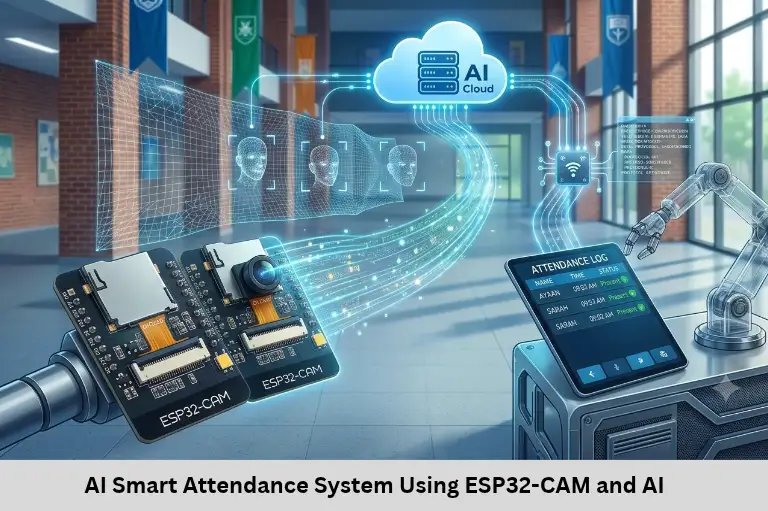
Learn to build an AI-based smart attendance system using ESP32-CAM, MicroPython, OpenCV, Wi-Fi, facial recognition, and automated attendance logging. Embedded Tech Development Academy (ETDA).
- AI Smart Attendance System Using ESP32-CAM and AI
-
AI-Based Smart Attendance System Using ESP32-CAM and MicroPython Face Recognition
- Introduction
- Understanding the ESP32-CAM Smart Attendance System
- Hardware and Software Requirements
- System Architecture and Working Principle
- MicroPython Image-Capture Foundation
- Server-Side Face Detection and Record Management
- Applications and Future Enhancements
- Learn Embedded AI and IoT with ETDA
- Frequently Asked Questions
- Conclusion
AI-Based Smart Attendance System Using ESP32-CAM and MicroPython Face Recognition
Introduction
Attendance management is an important requirement in educational institutions, corporate offices, laboratories, and training centers. Traditional methods such as paper registers, RFID cards, and manual attendance sheets require human intervention and can lead to recording errors or proxy attendance. Embedded Systems, Artificial Intelligence (AI), Computer Vision, and the Internet of Things (IoT) provide opportunities to automate this process using connected hardware and intelligent software.
An AI-based smart attendance system using ESP32-CAM and MicroPython combines image acquisition, wireless communication, face detection, facial recognition, and digital record management. The ESP32-CAM captures facial images, while a connected computer or server can process those images using Python and OpenCV. When an authorized identity is matched, the application records the person’s name, date, time, and attendance status.
This project demonstrates how Embedded Systems and Internet of Things (IoT) technologies can support practical automation. For learners interested in developing real-world projects, Embedded Tech Development Academy (ETDA) offers a technical learning pathway focused on embedded programming, microcontrollers, and connected applications. As a Top Embedded Training Institute in Bangalore, Embedded Tech Development Academy (ETDA) can help learners develop relevant project-building skills, with assured placement support as part of its promotional training offering.
Understanding the ESP32-CAM Smart Attendance System
The ESP32-CAM is a compact development board featuring an ESP32-based controller and a camera interface, commonly used with an OV2640 camera module. Depending on the board and firmware, it can capture images and transmit data through Wi-Fi.
In this architecture, the ESP32-CAM primarily handles image acquisition and communication. A computer or server performs the more computationally intensive facial recognition operations. This division helps manage the ESP32-CAM’s limited memory and processing resources.
Why Use Face Recognition?
Facial recognition can reduce the need for physical attendance cards or fingerprint scanners. Its effectiveness, however, depends on image quality, lighting, enrollment quality, recognition algorithms, and appropriate security controls.
Key benefits include:
Contactless attendance recording.
Reduced manual data entry.
Timestamped digital records.
Integration with reporting dashboards.
Potential support for multiple classrooms or office locations.
Face recognition does not automatically eliminate attendance fraud. Presentation attacks, such as displaying a photograph to the camera, require additional liveness detection and verification measures.
Role of MicroPython
MicroPython is a lightweight Python implementation designed for microcontrollers. It supports rapid prototyping, GPIO control, and networking on compatible boards.
The exact camera API depends on the ESP32-CAM variant and MicroPython firmware. Camera initialization and image capture are not universally available in every standard MicroPython build, so hardware and firmware compatibility must be checked before implementation.
Hardware and Software Requirements
Hardware Components
The basic prototype requires:
ESP32-CAM development board and compatible camera.
FTDI USB-to-serial programmer for flashing and debugging.
Stable, regulated power supply.
Wi-Fi router or access point.
Computer or server for image processing.
Jumper wires and a breadboard, if required.
The ESP32-CAM can draw significant current when Wi-Fi and the camera operate together. Use a suitable power supply and verify the board’s voltage requirements rather than assuming a USB-to-serial adapter can provide sufficient current.
Software Tools
The software environment may include MicroPython firmware, Thonny or another compatible IDE, Python 3, OpenCV, NumPy, and a CSV file or database for attendance records.
A server-side implementation can use OpenCV for face detection and a suitable recognition model for identification. Haar Cascade is one option for detecting facial regions, but it does not itself identify a person’s identity.
System Architecture and Working Principle
The system follows this sequence:
Image Capture → Image Transmission → Face Detection → Face Recognition → Attendance Validation → Record Storage
Step 1 — Face Enrollment
Enroll authorized users with their informed consent. Capture multiple representative facial images under different lighting conditions and viewing angles. Store the resulting data securely, restrict access, and establish a process for correcting or deleting records.
Step 2 — Image Acquisition
The camera captures an image when triggered by a schedule, user action, or configured capture loop. The ESP32-CAM can then transfer the image to the server over Wi-Fi.
Step 3 — Face Detection
OpenCV can identify candidate facial regions using a detector such as Haar Cascade. Detection answers the question, “Where is a face in this image?” It does not establish who the person is.
Step 4 — Facial Recognition
A recognition model generates a representation of the detected face and compares it with enrolled representations. The application should accept a match only when the similarity score meets a validated threshold. Poor-quality images should be rejected or flagged for manual review.
Step 5 — Attendance Logging
After recognition and attendance rules are checked, the application records the person’s identifier, date, time, and status. Duplicate entries should be controlled through rules such as one valid attendance event per person per session.
MicroPython Image-Capture Foundation
The following is an illustrative outline. The camera module and its API must be supported by the selected ESP32-CAM firmware.
import network
import time

SSID = "Your_WiFi_Name"
PASSWORD = "Your_WiFi_Password"

wifi = network.WLAN(network.STA_IF)
wifi.active(True)
wifi.connect(SSID, PASSWORD)

timeout = 15
start = time.time()

while not wifi.isconnected():
    if time.time() - start > timeout:
        raise RuntimeError("Wi-Fi connection timed out")
    time.sleep(0.2)

print("Wi-Fi connected")

# Initialize and capture using the camera API
# supported by your specific firmware.
# Transfer the captured image to an authenticated server.
This example establishes a bounded Wi-Fi connection attempt. Camera initialization, image capture, HTTP requests, and secure transmission must be implemented using APIs supported by the actual board. Do not store Wi-Fi credentials in publicly shared source code.
Server-Side Face Detection and Record Management
A server can load an image, convert it to grayscale, and use a detector to locate faces. For example, OpenCV’s Haar Cascade can provide an initial detection stage. A separate recognition model is then required to compare detected faces against authorized users.
Database and Attendance Validation
A production-ready system should store attendance in a structured database rather than relying exclusively on a CSV file. Database records can include a user ID, session ID, timestamp, confidence score, and processing status.
Security and Privacy
Facial data is sensitive biometric information. Use encrypted communication, access control, secure storage, retention limits, and a documented consent process. Provide a manual attendance alternative when recognition fails. Where appropriate, add liveness detection and audit logs.
Applications and Future Enhancements
Practical Applications
This Embedded Systems and Internet of Things (IoT) project can be adapted for educational attendance, office check-ins, training sessions, and controlled laboratory access. Deployment should follow the institution’s privacy, security, and accessibility requirements.
Possible Improvements
Future development may include a web dashboard, cloud synchronization, email notifications, multi-camera support, analytics, offline buffering, and mobile application integration. Each addition requires testing for network failures, duplicate records, data security, and system recovery.
Testing and Performance Evaluation
Measure face-detection success, recognition precision and recall, false acceptance and rejection rates, end-to-end latency, and recovery after Wi-Fi disconnection. Test across different lighting conditions and user groups. These measurements are more meaningful than claiming high accuracy without documented test results.
Learn Embedded AI and IoT with ETDA
Building this project develops practical skills in MicroPython, camera interfaces, networking, Python programming, Computer Vision, and database integration. These skills connect Embedded Systems development with real-world Internet of Things (IoT) applications.
Embedded Tech Development Academy (ETDA) promotes practical embedded training for learners who want to develop portfolio projects. Learners exploring the Top Embedded Training Institute in Bangalore can investigate Embedded Tech Development Academy (ETDA)‘s curriculum and hands-on project approach. Its training promotion includes assured placement support, while actual employment outcomes depend on individual skills, interviews, and available opportunities.
Frequently Asked Questions
What is an ESP32-CAM smart attendance system?
It is a system that captures facial images using an ESP32-CAM and uses recognition software to identify enrolled users and record attendance.
Can ESP32-CAM perform complete face recognition independently?
The board has limited processing and memory resources. This project uses a server for recognition, although some compatible configurations can support limited on-device vision tasks.
Why is MicroPython used?
MicroPython simplifies prototyping, networking, and peripheral control on compatible microcontrollers. Camera support depends on the firmware and board.
What is the role of OpenCV?
OpenCV provides image-processing functions and face-detection tools. A separate recognition algorithm is needed to identify a person.
How can attendance records be stored?
Records can be stored in CSV files or, preferably for multi-user deployments, a database with timestamps, user identifiers, and duplicate-entry controls.
Is facial recognition completely secure?
No. Accuracy and security depend on the recognition model, image quality, liveness checks, access controls, and protection of biometric data.
Conclusion
An AI-based smart attendance system using ESP32-CAM demonstrates how camera hardware, embedded programming, wireless communication, and server-side Computer Vision can work together. The ESP32-CAM captures images, MicroPython can manage compatible networking functions, and OpenCV and a dedicated recognition model process facial data. Reliable attendance recording also requires duplicate prevention, privacy safeguards, secure communication, and thorough performance testing.
This project is a valuable learning exercise for students interested in Embedded Systems, Internet of Things (IoT), AI-based automation, and connected devices. Embedded Tech Development Academy (ETDA) encourages practical technical learning through project-oriented training. Learners evaluating the Top Embedded Training Institute in Bangalore can explore Embedded Tech Development Academy (ETDA)‘s technical programs and assured placement support. Strong implementation skills, careful testing, and an understanding of privacy and security are essential for developing responsible embedded AI applications.
Author: ETDA Trainers
Experience: 10+ Years of Industry Experience in Embedded Systems, IoT, and Embedded C Programming