
ARM Cortex-M3 LPC1768 Microcontroller: Features & Architecture | ETDA
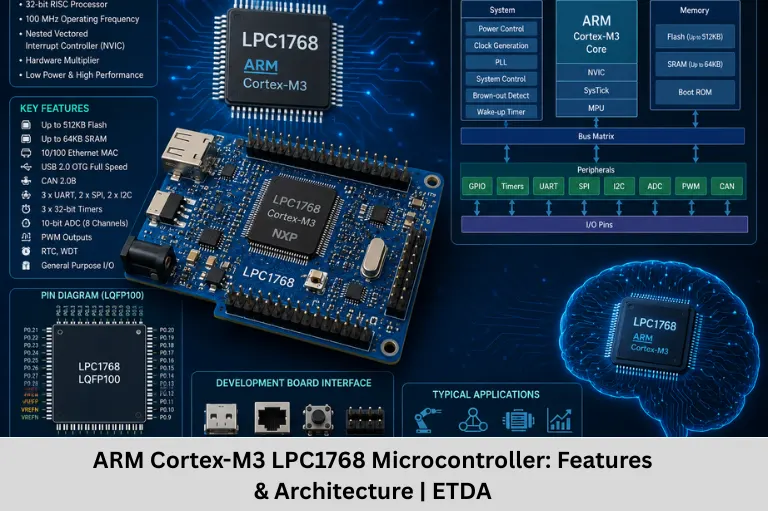
Learn about the LPC1768 ARM Cortex-M3 microcontroller, including architecture, memory, GPIO, timers, ADC, PWM, Ethernet, CAN, applications, and programming. Embedded Tech Development Academy (ETDA).
- ARM Cortex-M3 LPC1768 Microcontroller: Features & Architecture | ETDA
-
What Is ARM Cortex-M3 LPC1768 Microcontroller? Features, Architecture & Applications
- What Is LPC1768?
- ARM Cortex-M3 Architecture
- LPC1768 Memory Architecture
- GPIO in LPC1768
- Timers and Counters
- PWM in LPC1768
- ADC and DAC
- UART Communication
- SPI and I2C Communication
- CAN Communication
- Ethernet Interface in LPC1768
- Automotive Embedded Software Development Process
- Interrupts in LPC1768
- Watchdog Timer
- Programming LPC1768 Using Embedded C
- LPC1768 Applications
- Advantages of LPC1768
- Learn LPC1768 and Embedded Systems at ETDA
-
Assured Placement Support at ETDA
- Placement Preparation
- FAQs
- What is the LPC1768 microcontroller?
- What processor is used in LPC1768?
- How much Flash memory does LPC1768 have?
- How much SRAM is available in LPC1768?
- Which communication protocols are supported by LPC1768?
- Is LPC1768 suitable for Embedded C programming?
- What are the applications of LPC1768?
- Why is Ethernet important in LPC1768?
- Does ETDA provide placement support?
- Why choose ETDA for LPC1768 and Embedded Systems training?
- Conclusion
What Is ARM Cortex-M3 LPC1768 Microcontroller? Features, Architecture & Applications
The LPC1768 is a 32-bit microcontroller from NXP based on the ARM Cortex-M3 processor core. It is designed for embedded applications that require a combination of processing performance, memory, communication peripherals, timers, analog interfaces, and networking capabilities.
The LPC1768 is particularly useful for learning and developing embedded applications because it provides a wide range of peripherals on a single microcontroller. Engineers can work with GPIO, UART, SPI, I2C, CAN, ADC, DAC, PWM, timers, watchdog functionality, and Ethernet.
For engineering students looking for a Top Embedded Training Institute in Bangalore, understanding controllers such as the LPC1768 provides valuable practical exposure to ARM architecture, Embedded C, peripheral programming, and hardware interfacing. Embedded Tech Development Academy (ETDA) focuses on practical embedded systems training, microcontroller programming, real-time projects, and assured placement support.
What Is LPC1768?
The LPC1768 is a high-performance microcontroller based on the ARM Cortex-M3 core and is part of NXP’s LPC1700 family.
It is suitable for applications requiring:
- 32-bit processing
- Real-time control
- Multiple communication interfaces
- Analog signal processing
- Motor control
- Ethernet connectivity
- Industrial automation
- Embedded networking
The microcontroller combines a processor core, memory, and numerous peripherals into one device.
LPC1768 at a Glance
Key Specifications
The LPC1768 includes:
- ARM Cortex-M3 core
- Up to 100 MHz CPU operation
- 512 KB Flash memory
- 64 KB SRAM
- Multiple GPIO pins
- ADC
- DAC
- PWM
- Timers
- UART
- SPI
- I2C
- CAN
- USB
- Ethernet MAC
- Watchdog timer
Why LPC1768 Is Useful for Learning
The large peripheral set makes the LPC1768 a useful platform for learning how a processor communicates with real hardware.
Students can progress from simple LED control to advanced networking and industrial communication projects.
ARM Cortex-M3 Architecture
The LPC1768 uses the ARM Cortex-M3 processor core.
Cortex-M3 is designed specifically for microcontroller and embedded applications.
32-Bit ARM Architecture
The Cortex-M3 uses a 32-bit architecture, allowing the processor to efficiently handle 32-bit data and address operations.
The architecture is based on the ARMv7-M architecture.
Important Cortex-M3 Features
The processor provides:
- 32-bit processing
- Thumb-2 instruction set
- Nested Vectored Interrupt Controller (NVIC)
- SysTick timer
- Hardware exception handling
- Memory protection support
- Efficient interrupt response
Thumb-2 Technology
Thumb-2 combines 16-bit and 32-bit instructions to provide a balance between code density and processing capability.
This is useful in microcontrollers where Flash memory and performance both matter.
LPC1768 Memory Architecture
Memory is a critical part of any microcontroller.
The LPC1768 provides Flash memory for program storage and SRAM for runtime data.
Flash Memory
The LPC1768 provides 512 KB of on-chip Flash memory.
Flash is typically used to store:
- Application firmware
- Constant data
- Startup code
- Interrupt vector tables
- Embedded software
Because Flash is non-volatile, its contents are retained when power is removed.
SRAM
The LPC1768 provides 64 KB of SRAM.
SRAM is used during program execution for:
- Global variables
- Local variables
- Stack
- Buffers
- Temporary data
Why Memory Knowledge Matters
Embedded programmers must understand how memory is used because microcontrollers have significantly fewer resources than desktop computers.
Poor memory management can lead to:
- Stack overflow
- Buffer overflow
- Memory corruption
- Unexpected resets
- System instability
GPIO in LPC1768
GPIO (General Purpose Input/Output) allows the microcontroller to interact directly with external digital hardware.
GPIO as Output
A GPIO pin configured as an output can control devices such as:
- LEDs
- Relays
- Buzzers
- Digital control signals
Example
An Embedded C program can configure a GPIO pin and write a logic HIGH or LOW value to control an LED.
GPIO as Input
GPIO pins can also receive digital signals from:
- Push buttons
- Switches
- Digital sensors
- External controllers
The firmware reads the input state and takes appropriate action.
GPIO Programming
GPIO programming teaches important embedded concepts such as:
- Register configuration
- Bit manipulation
- Pin direction
- Digital input/output
- Hardware interfacing
Timers and Counters
Timers are essential peripherals in embedded systems.
The LPC1768 provides timer/counter peripherals that can be used for precise timing operations.
Applications of Timers
- Creating delays
- Measuring time intervals
- Generating periodic events
- Counting external events
- Scheduling tasks
- Generating timing signals
Timers can also work with interrupts so that the CPU can respond when a predefined timing condition occurs.
PWM in LPC1768
Pulse Width Modulation (PWM) is used to generate digital signals with controlled duty cycles.
PWM Applications
PWM can control:
- Motor speed
- LED brightness
- Servo motors
- Power converters
- Actuators
Duty Cycle
The duty cycle represents the percentage of one PWM period during which the signal remains HIGH.
For example, a 50% duty cycle means the signal remains HIGH for half of the period and LOW for the other half.
Why PWM Matters
PWM is one of the most important techniques used in embedded control applications, particularly motor-control and power-management systems.
ADC and DAC
The LPC1768 provides analog interfaces for working with real-world signals.
ADC
An Analog-to-Digital Converter (ADC) converts an analog voltage into a digital value that the processor can understand.
ADC Applications
It can be used with:
- Temperature sensors
- Light sensors
- Potentiometers
- Pressure sensors
- Battery monitoring circuits
DAC
A Digital-to-Analog Converter (DAC) performs the opposite operation by generating an analog output from a digital value.
Applications
DAC can be used in:
- Signal generation
- Audio applications
- Analog control systems
- Instrumentation
UART Communication
UART is a common serial communication interface available in the LPC1768.
UART Applications
UART can connect the microcontroller to:
- Computers
- GPS modules
- Bluetooth modules
- GSM modules
- Serial terminals
- Debugging tools
Important UART Parameters
UART communication involves parameters such as:
- Baud rate
- Data bits
- Stop bits
- Parity
- Transmission mode
UART is often one of the first communication interfaces engineers learn when working with microcontrollers.
SPI and I2C Communication
The LPC1768 supports common serial communication protocols such as SPI and I2C.
SPI
Serial Peripheral Interface (SPI) is commonly used for high-speed communication with external devices.
Applications include:
- Displays
- Flash memory
- Sensors
- ADC/DAC devices
SPI generally uses separate lines for clock and data transmission and can support multiple slave devices.
I2C
Inter-Integrated Circuit (I2C) is a two-wire communication protocol.
It uses:
- SDA — Serial Data
- SCL — Serial Clock
I2C Applications
I2C is commonly used with:
- EEPROM
- RTC modules
- Sensors
- Display controllers
- Digital temperature sensors
Why Learn Both?
SPI is generally useful when higher speed is required, while I2C is convenient when multiple peripherals need to share a simple two-wire bus.
CAN Communication
The LPC1768 provides CAN (Controller Area Network) functionality.
CAN is widely used in:
- Automotive electronics
- Industrial automation
- Motor controllers
- Distributed embedded systems
Advantages of CAN
- Multi-node communication
- Message-based communication
- Error detection
- Robust communication
- Priority-based arbitration
CAN is particularly useful when multiple controllers need to communicate reliably over a shared network.
Ethernet Interface in LPC1768
One of the notable capabilities of the LPC1768 is its integrated Ethernet MAC.
Automotive Embedded Software Development Process
Automotive software development follows structured engineering processes.
Ethernet Applications
LPC1768 can be used in embedded networking applications such as:
- Industrial Ethernet devices
- Embedded web servers
- Networked controllers
- Internet of things (IoT) gateways
- Remote monitoring
- Data acquisition systems
Ethernet Architecture
The microcontroller’s Ethernet MAC works with an external PHY to provide physical Ethernet connectivity.
Embedded Networking
Interrupts in LPC1768
Interrupts allow the processor to respond to events without continuously polling hardware.
The Cortex-M3’s NVIC manages interrupts and exceptions.
Examples of Interrupt Sources
- GPIO interrupts
- Timer interrupts
- UART interrupts
- ADC interrupts
- CAN interrupts
- External hardware events
Why Interrupts Matter
Interrupt-driven programming allows the processor to perform other tasks until an important event occurs.
This can improve responsiveness and reduce unnecessary CPU activity.
Watchdog Timer
A watchdog timer is a hardware mechanism used to detect software failures.
If software fails to periodically refresh the watchdog, the watchdog can trigger a reset.
Applications
Watchdog functionality is useful for systems that must recover from:
- Software hangs
- Infinite loops
- Unexpected execution failures
- Certain system faults
This is particularly important in industrial and unattended embedded applications.
Programming LPC1768 Using Embedded C
Embedded C is commonly used to develop LPC1768 firmware.
A typical development process includes:
- Configure the microcontroller.
- Initialize clock settings.
- Configure GPIO or peripheral registers.
- Write application logic.
- Compile the source code.
- Link the program.
- Generate the firmware image.
- Flash the program into the microcontroller.
- Debug the application on hardware.
Important Embedded C Concepts
- Pointers
- Structures
- Bitwise operators
- Registers
- Interrupts
- Volatile variables
- Arrays
- Functions
- Memory management
Understanding these concepts makes it easier to develop reliable LPC1768 firmware.
LPC1768 Applications
The LPC1768 can be used for a wide variety of embedded applications.
Industrial Automation
It can control:
- Motors
- Sensors
- Actuators
- Industrial communication systems
Embedded Networking
Its Ethernet capability makes it suitable for:
- Network controllers
- Remote monitoring
- Data acquisition
- Embedded servers
Automotive Applications
CAN support makes the controller useful for learning and prototyping:
- Vehicle communication
- Instrumentation
- Control systems
IoT Applications
The LPC1768 can collect sensor data and communicate with networked systems.
Advantages of LPC1768
The LPC1768 offers several advantages for embedded development.
Key Advantages
- 32-bit ARM Cortex-M3 architecture
- High processing capability for its class
- Large Flash memory
- Multiple communication interfaces
- Ethernet support
- CAN support
- ADC and DAC
- Timers and PWM
- Extensive GPIO
- Suitable for real-time applications
Learn LPC1768 and Embedded Systems at ETDA
Embedded Tech Development Academy (ETDA) focuses on practical embedded systems education for engineering students and aspiring embedded engineers.
Technical Training
Students can build skills in:
- C Programming
- Embedded C
- Data Structures
- ARM Architecture
- LPC1768
- STM32
- GPIO
- Timers
- PWM
- ADC
- UART
- SPI
- I2C
- CAN
- Ethernet
- RTOS
- Embedded Linux
Hands-On Learning
Working with real hardware helps students understand how software interacts with registers, peripherals, sensors, communication interfaces, and external devices.
Assured Placement Support at ETDA
Technical skills are only one part of becoming an industry-ready engineer. Embedded Tech Development Academy (ETDA) also provides assured placement support to help students prepare for embedded technology opportunities.
Placement Preparation
- Resume preparation
- Technical interview training
- Coding practice
- Aptitude preparation
- Mock interviews
- HR interview preparation
- Communication skills
- Career guidance
This combination of technical training and placement preparation helps students approach embedded engineering opportunities with greater confidence.
FAQs
What is the LPC1768 microcontroller?
LPC1768 is a 32-bit NXP microcontroller based on the ARM Cortex-M3 processor core. It provides Flash, SRAM, GPIO, timers, communication interfaces, analog peripherals, USB, and Ethernet capabilities.
What processor is used in LPC1768?
The LPC1768 uses an ARM Cortex-M3 processor core based on the ARMv7-M architecture.
How much Flash memory does LPC1768 have?
The LPC1768 provides 512 KB of on-chip Flash memory.
How much SRAM is available in LPC1768?
The LPC1768 provides 64 KB of SRAM for runtime data, stack, buffers, and other program variables.
Which communication protocols are supported by LPC1768?
LPC1768 supports communication interfaces including UART, SPI, I2C, CAN, USB, and Ethernet.
Is LPC1768 suitable for Embedded C programming?
Yes. LPC1768 is well suited for learning Embedded C, register-level programming, peripheral configuration, interrupts, communication protocols, and real-time embedded development.
What are the applications of LPC1768?
LPC1768 can be used in industrial automation, embedded networking, data acquisition, automotive communication, IoT prototypes, motor-control applications, and other embedded systems.
Why is Ethernet important in LPC1768?
The LPC1768 includes an Ethernet MAC, making it suitable for embedded networking applications such as networked controllers, monitoring systems, data acquisition, and embedded communication projects.
Does ETDA provide placement support?
Yes. Embedded Tech Development Academy (ETDA) provides assured placement support, including technical interview preparation, coding practice, resume guidance, mock interviews, aptitude training, and career mentoring.
Why choose ETDA for LPC1768 and Embedded Systems training?
Embedded Tech Development Academy (ETDA) provides practical training covering Embedded C, ARM architecture, LPC1768, STM32, GPIO, timers, communication protocols, RTOS, embedded projects, and hardware interfacing, along with assured placement support for aspiring embedded engineers.
Conclusion
The ARM Cortex-M3 LPC1768 microcontroller is a powerful platform for understanding practical embedded systems development. Its combination of a 32-bit Cortex-M3 core, Flash and SRAM, GPIO, timers, PWM, ADC, DAC, UART, SPI, I2C, CAN, USB, and Ethernet makes it suitable for a wide range of embedded applications.
For beginners and engineering students, LPC1768 provides an excellent opportunity to learn how Embedded C interacts with microcontroller hardware. By working with registers, interrupts, communication protocols, timers, sensors, and networking, learners can develop a strong foundation in embedded firmware development.
Students searching for a Top Embedded Training Institute in Bangalore can consider Embedded Tech Development Academy (ETDA) for practical embedded systems training. Embedded Tech Development Academy (ETDA) combines programming, microcontroller development, communication protocols, real-time projects, and hardware-based learning with assured placement support, helping aspiring engineers develop industry-relevant embedded skills.
Author: ETDA Trainers
Experience: 10+ Years of Industry Experience in Embedded Systems, IoT, and Embedded C Programming