
Arrays and Pointers in C: Understanding the Relationship | ETDA
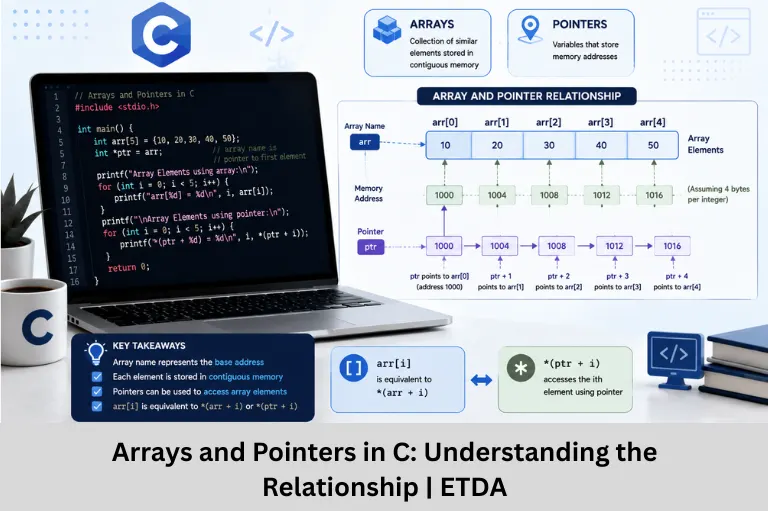
Learn the relationship between arrays and pointers in C Programming with practical examples. Build strong embedded programming skills with Embedded Tech Development Academy (ETDA).
- Arrays and Pointers in C: Understanding the Relationship | ETDA
-
Arrays and Pointers in C: Understanding the Relationship
- What Are Arrays in C?
- What Are Pointers in C?
- Relationship Between Arrays and Pointers
- Differences Between Arrays and Pointers
- Accessing Array Elements
- Accessing Arrays Using Pointers
- Pointer Arithmetic
- Array Traversal Using Pointers
- Arrays and Pointers in Embedded Systems
- Learn Arrays and Pointers at ETDA
- Arrays of Pointers and Pointers to Arrays
- Dynamic Memory Allocation and Pointers
- Passing Arrays to Functions
- Common Mistakes Beginners Should Avoid
- Real-World Applications of Arrays and Pointers
- Why Learn Arrays and Pointers at ETDA?
- Assured Placement Support at ETDA
-
Frequently Asked Questions (FAQs)
- What is the relationship between arrays and pointers in C?
- Why are pointers important in Embedded Systems?
- What is pointer arithmetic?
- What is the difference between an array of pointers and a pointer to an array?
- Where are arrays and pointers used in real-world applications?
- Does ETDA provide practical training on arrays and pointers?
- What projects can I build after learning arrays and pointers?
- Does ETDA provide placement support after C Programming training?
- Conclusion
Arrays and Pointers in C: Understanding the Relationship
Arrays and pointers are among the most important concepts in C Programming. Individually, they are powerful programming tools, but together they form the backbone of efficient memory management and high-performance applications. Whether you are developing desktop software, embedded firmware, operating systems, or Internet of Things (IoT) applications, understanding how arrays and pointers work together is essential.
Many beginners find pointers challenging because they deal directly with memory addresses. However, once you understand the relationship between arrays and pointers, writing efficient and optimized programs becomes much easier. This knowledge is especially valuable in Embedded Systems, where memory and processing power are limited.
Engineering students who master arrays and pointers gain a significant advantage in technical interviews and Embedded Systems development. At Embedded Tech Development Academy (ETDA), students learn these concepts through practical coding sessions, real-time embedded projects, and hardware-based applications. As a Top Embedded Training Institute in Bangalore, Embedded Tech Development Academy (ETDA) provides industry-oriented training with assured placement support, preparing students for successful careers in embedded technology.
What Are Arrays in C?
An array is a collection of elements of the same data type stored in contiguous memory locations. Arrays allow programmers to store multiple values using a single variable name, making data management more organized and efficient.
Instead of creating separate variables for each value, an array groups related data together.
Common examples include:
- Student marks
- Temperature readings
- Sensor values
- Employee salaries
- Product prices
Arrays simplify repetitive data processing and improve program readability.
Why Use Arrays?
Arrays provide several benefits in programming.
Advantages of Arrays
- Store multiple values efficiently
- Simplify data processing
- Improve program readability
- Reduce code repetition
- Enable fast access using indexes
Arrays are widely used in software applications and embedded firmware.
What Are Pointers in C?
A pointer is a special variable that stores the memory address of another variable rather than the actual value.
Pointers provide direct access to memory, making them one of the most powerful features of C Programming.
Instead of working only with data values, pointers allow programmers to manipulate memory locations directly.
Why Are Pointers Important?
Pointers are extensively used because they:
- Improve memory efficiency
- Support dynamic memory allocation
- Enable efficient function parameter passing
- Facilitate hardware register access
- Improve program performance
In embedded systems, pointers are essential for interacting with hardware registers and memory-mapped peripherals.
Relationship Between Arrays and Pointers
The close relationship between arrays and pointers is one of the defining features of C Programming.
The name of an array represents the address of its first element. Because of this, arrays and pointers are closely connected, although they are not the same thing.
Understanding this relationship allows programmers to process arrays efficiently using pointer operations.
How Arrays and Pointers Work Together
When an array is declared, its elements occupy consecutive memory locations.
A pointer can reference the first element of the array and access subsequent elements through pointer arithmetic.
Benefits
- Faster data access
- Efficient memory usage
- Simplified array traversal
- Reduced indexing overhead
This feature makes C Programming highly efficient for embedded applications.
Differences Between Arrays and Pointers
Although related, arrays and pointers have distinct characteristics.
Arrays
Arrays:
- Allocate memory during declaration
- Store multiple values
- Have a fixed size
- Cannot be reassigned to another memory location
Pointers
Pointers:
- Store memory addresses
- Can point to different variables
- Support dynamic memory operations
- Allow flexible memory manipulation
Understanding these differences helps programmers choose the appropriate data structure for different tasks.
Accessing Array Elements
Array elements can be accessed using their index positions.
Indexing
Arrays begin with index 0.
For example:
- First element → Index 0
- Second element → Index 1
- Third element → Index 2
Index-based access is simple and commonly used in beginner-level programs.
Accessing Arrays Using Pointers
Pointers provide another efficient method for accessing array elements.
Instead of using indexes, a pointer moves through memory locations to access each element.
Why Use Pointer Access?
- Faster iteration
- Better performance
- Efficient memory handling
- Common practice in embedded programming
Many embedded applications prefer pointer-based access because it reduces overhead.
Pointer Arithmetic
Pointer arithmetic allows pointers to move between memory locations automatically.
Common Pointer Operations
Pointers can be:
- Incremented
- Decremented
- Compared
- Used to traverse arrays
The compiler automatically adjusts memory addresses according to the data type size.
Why Pointer Arithmetic Matters
Pointer arithmetic is widely used in:
- Embedded firmware
- Communication buffers
- Device drivers
- Data processing algorithms
- Memory management
Array Traversal Using Pointers
Traversing an array means visiting every element one by one.
Using pointers for traversal often improves efficiency, especially when processing large datasets.
Applications
Pointer traversal is commonly used in:
- Searching
- Sorting
- Sensor data collection
- Signal processing
- Image processing
Efficient traversal techniques improve overall application performance.
Arrays and Pointers in Embedded Systems
Arrays and pointers are fundamental to embedded firmware development.
Sensor Data Storage
Arrays store continuous sensor readings from:
- Temperature Sensors
- Pressure Sensors
- Motion Sensors
- Humidity Sensors
- Light Sensors
Pointers help process this data quickly and efficiently.
Communication Buffers
Communication protocols require temporary storage areas.
Arrays are used for:
- UART Buffers
- SPI Buffers
- I2C Buffers
- CAN Messages
Pointers simplify reading and writing data within these buffers.
Memory-Mapped Registers
Embedded systems interact directly with hardware registers.
Pointers allow firmware to:
- Configure GPIO
- Read ADC values
- Control Timers
- Access Peripheral Registers
Direct memory access is one of the primary reasons C remains the preferred language for embedded development.
Learn Arrays and Pointers at ETDA
At Embedded Tech Development Academy (ETDA), students learn arrays and pointers through hands-on programming exercises and real-time embedded projects. The focus is on practical implementation, helping learners understand how memory management works in real Embedded Systems.
As a Top Embedded Training Institute in Bangalore, Embedded Tech Development Academy (ETDA) provides comprehensive training in:
Core Programming Concepts
- Variables and Data Types
- Operators
- Control Statements
- Functions
- Arrays
- Pointers
- Structures
- File Handling
Embedded Technologies
- Embedded C
- STM32 Programming
- ARM Cortex-M
- UART
- SPI
- I2C
- CAN
- RTOS
- Embedded Linux
- IoT Development
Students work on practical hardware-based projects that strengthen programming and debugging skills.
Arrays of Pointers and Pointers to Arrays
As programmers progress in C Programming, they encounter more advanced concepts such as arrays of pointers and pointers to arrays. Although these concepts may sound similar, they serve different purposes and are widely used in embedded systems, operating systems, and firmware development.
Arrays of Pointers
An array of pointers is a collection where each element stores the memory address of another variable or object.
Common Applications
- String storage
- Command tables
- Device driver tables
- File management
- Sensor configuration lists
Arrays of pointers improve flexibility when handling multiple memory locations.
Pointer to an Array
A pointer to an array stores the address of an entire array instead of individual elements.
Benefits
- Efficient array handling
- Passing large arrays to functions
- Reduced memory overhead
- Faster processing of multidimensional data
This concept is commonly used in embedded firmware and scientific applications.
Dynamic Memory Allocation and Pointers
Pointers play a key role in dynamic memory allocation, allowing memory to be allocated during program execution instead of at compile time.
Why Dynamic Memory Allocation Matters
Dynamic memory allocation helps when:
- Data size is unknown beforehand
- Applications require flexible memory usage
- Large datasets need efficient handling
- Memory must be allocated only when required
Although embedded systems often use static memory allocation, dynamic memory is useful in advanced applications where flexibility is needed.
Passing Arrays to Functions
Functions frequently process arrays to perform calculations, sorting, searching, or data analysis.
Advantages
Passing arrays to functions helps:
- Reduce code duplication
- Improve modular programming
- Simplify maintenance
- Encourage code reusability
This approach is widely used in both software applications and embedded firmware.
Common Mistakes Beginners Should Avoid
Arrays and pointers are powerful concepts, but beginners often make mistakes that lead to bugs and unexpected behavior.
Confusing Arrays with Pointers
Although closely related, arrays and pointers are not identical. Arrays reserve memory for multiple elements, whereas pointers simply store memory addresses.
Accessing Memory Outside Array Bounds
Reading or writing beyond the valid range of an array can cause unpredictable program behavior and system crashes.
Always ensure array indexes remain within valid limits.
Using Uninitialized Pointers
Pointers should always point to a valid memory location before being used. Uninitialized pointers may contain random addresses, resulting in undefined behavior.
Incorrect Pointer Arithmetic
Pointer arithmetic automatically considers the size of the data type. Manually calculating addresses incorrectly can introduce bugs and make debugging difficult.
Ignoring Memory Safety
Always validate pointers before accessing memory. Safe pointer handling improves program reliability, especially in embedded and safety-critical applications.
Real-World Applications of Arrays and Pointers
Arrays and pointers are used extensively across various industries.
Embedded Systems
Applications include:
- Sensor data logging
- GPIO control
- Communication buffers
- Firmware development
- Interrupt handling
Internet of Things (IoT)
IoT devices use arrays and pointers for:
- Sensor value storage
- Packet processing
- Wi-Fi communication
- Cloud data transmission
- Device configuration
Robotics
Robotics applications use arrays and pointers for:
- Motion control
- Path planning
- Object detection
- Camera image processing
- Navigation systems
Automotive Electronics
Modern vehicles use arrays and pointers in:
- Electronic Control Units (ECUs)
- Battery Management Systems
- Engine control software
- Vehicle diagnostics
- Advanced Driver Assistance Systems (ADAS)
Consumer Electronics
Examples include:
- Smart TVs
- Washing machines
- Smart speakers
- Wearable devices
- Home automation systems
Why Learn Arrays and Pointers at ETDA?
Mastering arrays and pointers requires consistent practice and exposure to real-world programming challenges. Embedded Tech Development Academy (ETDA) provides practical training that helps students understand these concepts through coding exercises and embedded hardware projects.
As a Top Embedded Training Institute in Bangalore, Embedded Tech Development Academy (ETDA) focuses on industry-relevant skills that prepare students for careers in Embedded Systems, Internet of Things (IoT), Robotics, and Firmware Development.
Industry-Oriented Curriculum
Students receive practical training in:
Core Programming Skills
- Variables and Data Types
- Operators
- Control Statements
- Functions
- Arrays
- Pointers
- Structures
- File Handling
Embedded Technologies
Students also learn:
- Embedded C
- STM32 Programming
- ARM Cortex-M
- UART
- SPI
- I2C
- CAN Protocol
- RTOS
- Embedded Linux
- Internet of Things (IoT) Development
The curriculum is designed to bridge the gap between academic learning and industry requirements.
Hands-On Project Experience
Students gain practical exposure through projects such as:
- Smart Home Automation
- IoT-Based Environmental Monitoring
- Industrial Automation Systems
- Robotics Applications
- Sensor Interfacing Projects
- Vehicle Tracking Systems
Working on real hardware improves debugging skills and enhances technical confidence.
Assured Placement Support at ETDA
Embedded Tech Development Academy (ETDA) believes that practical knowledge combined with career preparation leads to better employment opportunities. Along with technical training, students receive assured placement support.
Placement Preparation
Students receive guidance in:
- Resume Building
- Aptitude Training
- Technical Interview Preparation
- Mock Interviews
- Communication Skills
- HR Interview Preparation
These activities help students perform confidently in campus and off-campus recruitment drives.
Industry-Focused Learning Environment
ETDA provides:
- Experienced Industry Trainers
- Modern Embedded Systems Laboratories
- Practical Coding Sessions
- Hardware-Based Learning
- Real-Time Embedded Projects
- Continuous Mentorship
- Career Guidance
This comprehensive training model prepares students for the evolving Embedded Systems industry.
Frequently Asked Questions (FAQs)
What is the relationship between arrays and pointers in C?
The name of an array represents the address of its first element, allowing pointers to access and traverse array elements efficiently. Although related, arrays and pointers are different concepts.
Why are pointers important in Embedded Systems?
Pointers provide direct access to memory and hardware registers, making them essential for firmware development, device drivers, communication protocols, and efficient memory management.
What is pointer arithmetic?
Pointer arithmetic allows pointers to move between memory locations automatically based on the size of the data type. It is commonly used for array traversal and buffer management.
What is the difference between an array of pointers and a pointer to an array?
An array of pointers stores multiple memory addresses, while a pointer to an array stores the address of an entire array. Both are useful for different programming scenarios.
Where are arrays and pointers used in real-world applications?
They are widely used in embedded systems, IoT devices, robotics, automotive electronics, industrial automation, operating systems, communication protocols, and consumer electronics.
Does ETDA provide practical training on arrays and pointers?
Yes. ETDA offers hands-on training through coding exercises, hardware interfacing, embedded firmware development, and real-time projects to help students master arrays and pointers.
What projects can I build after learning arrays and pointers?
You can develop sensor monitoring systems, IoT devices, robotics applications, industrial automation projects, communication protocol implementations, and embedded firmware solutions.
Does ETDA provide placement support after C Programming training?
Yes. Embedded Tech Development Academy (ETDA) provides assured placement support, including resume preparation, aptitude training, mock interviews, technical interview guidance, and career mentoring to help students secure opportunities with leading embedded systems and technology companies.
Conclusion
Arrays and pointers are fundamental concepts that every C programmer must master. Arrays provide an efficient way to store multiple values, while pointers enable direct memory access and optimized data manipulation. Understanding how these two concepts work together is essential for writing efficient, high-performance applications.
In embedded systems, arrays and pointers are indispensable for tasks such as sensor data processing, communication protocols, memory management, and hardware interfacing. Mastering these concepts not only improves programming skills but also prepares students for advanced topics like Embedded C, device drivers, RTOS, and Internet of Things (IoT) development.
If you aspire to build a successful career in embedded technology, Embedded Tech Development Academy (ETDA) offers the perfect learning platform. With expert trainers, practical lab sessions, real-time projects, and assured placement support, Embedded Tech Development Academy (ETDA) equips students with the technical expertise and industry exposure needed to excel. As a Top Embedded Training Institute in Bangalore, Embedded Tech Development Academy (ETDA) is committed to helping engineering students transform their programming knowledge into rewarding careers.
Author: ETDA Trainers
Experience: 10+ Years of Industry Experience in Embedded Systems, IoT, and Embedded C Programming