
Automatic Water Level Controller Using 8051 Microcontroller
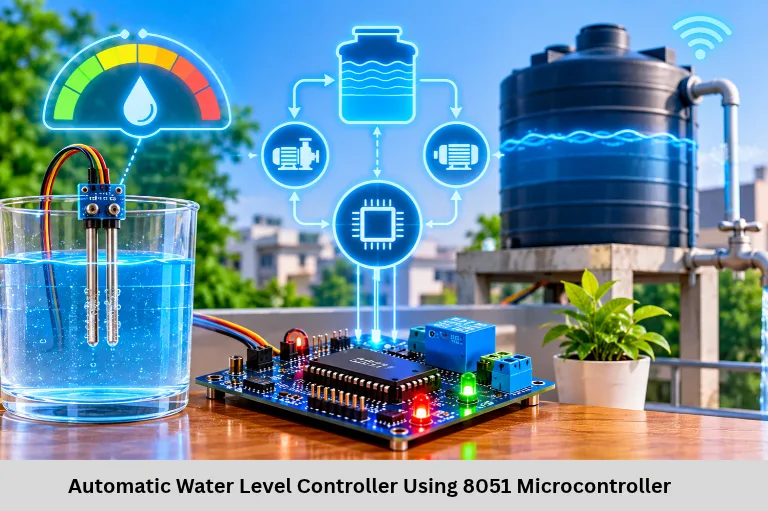
Learn how to design an automatic water level controller using the 8051 microcontroller, including sensors, circuit components, working, and applications. Explore practical embedded systems training at Embedded Tech Development Academy (ETDA).
- Automatic Water Level Controller Using 8051 Microcontroller
-
Automatic Water Level Controller Using 8051 Microcontroller
- Introduction
- What Is an Automatic Water Level Controller?
- Components Required for the Project
- Block Diagram and Working Principle
- Embedded C Programming for 8051
- Applications of an 8051 Water Level Controller
- Skills Students Gain from This Embedded Project
- Why Choose ETDA for Embedded Systems Training?
- Frequently Asked Questions
- Conclusion
Automatic Water Level Controller Using 8051 Microcontroller
Introduction
Water management is important in homes, industries, agriculture, and commercial buildings. Manually switching water pumps ON and OFF can lead to tank overflow, water wastage, and unnecessary electricity consumption. An Automatic Water Level Controller Using 8051 Microcontroller provides a practical solution by monitoring the water level and controlling the pump automatically.
This project is also an excellent starting point for engineering students who want to understand real-time embedded applications. Students looking for practical learning at a Top Embedded Training Institute in Bangalore can explore how Embedded C, sensors, microcontrollers, and interfacing techniques work together. At Embedded Tech Development Academy (ETDA), learners gain project-oriented technical exposure and assured placement support.
What Is an Automatic Water Level Controller?
An automatic water level controller is an electronic system that detects the amount of water inside a tank and controls a motor or pump based on predefined water-level conditions. It reduces the need for manual monitoring and helps prevent both overflow and water shortage.
In an 8051-based design, the microcontroller receives signals from water-level sensors, processes the inputs, and controls the pump through a relay driver circuit. An LCD can also display the current water-level status, making the system easier to monitor.
Components Required for the Project
The project combines basic electronic components with microcontroller programming. Each component has a specific role in detecting water levels and controlling the pump.
8051 Microcontroller
The 8051 microcontroller, such as the AT89C51, acts as the main processing unit. It reads sensor inputs through its digital input pins and executes the programmed control logic. Its GPIO ports can also be used to operate an LCD and relay-driver circuit.
Water Level Sensors
Water-level sensors detect whether water has reached particular points inside the tank. Conductive probes or float switches can be used to identify low, medium, and high levels. Sensor selection depends on tank material, water properties, and the required reliability.
Relay Module and Motor
The relay switches the pump supply based on the microcontroller’s output. Since an 8051 pin cannot directly drive a motor or relay coil, a suitable transistor or relay-driver IC is required. A flyback diode should protect the driver when using a DC relay coil.
LCD Display and Power Supply
A 16×2 LCD can display messages such as “LOW LEVEL”, “PUMP ON”, and “TANK FULL”. A regulated 5V supply powers the microcontroller and low-voltage electronics. The motor should use an appropriately rated power circuit.
Block Diagram and Working Principle
The basic system contains four functional sections: sensor inputs, microcontroller processing, pump control, and status display.
Block diagram flow:
Water-level sensors → 8051 microcontroller → Relay driver → Water pump
The LCD connects to the microcontroller to display the operating status. The controller continuously checks the sensor inputs and decides whether the pump should run.
Step-by-Step Working
When the water level falls below the lower threshold, the sensor sends a signal to the 8051.
The microcontroller processes the input and switches ON the pump through the relay driver.
As water enters the tank, the sensors detect the rising level.
When the water reaches the upper threshold, the controller switches OFF the pump.
The LCD updates the status so the user can understand the system’s operation.
Using separate ON and OFF thresholds creates hysteresis. This prevents rapid switching when the water level fluctuates around a single sensor point.
Embedded C Programming for 8051
Embedded C is used to write the control logic. The program continuously reads the sensor inputs and changes the pump output according to the required conditions.
Sample Control Logic
The following simplified example assumes active-low sensor inputs and an active-high pump control signal. Actual pin connections and relay-driver polarity must be verified with the hardware.
#include <reg51.h>

sbit LOW_SENSOR  = P1^0;
sbit HIGH_SENSOR = P1^1;
sbit PUMP        = P2^0;

void main(void)
{
    PUMP = 0;  // Pump initially OFF

    while(1)
    {
        if(HIGH_SENSOR == 0)
        {
            PUMP = 0;  // Tank full: stop pump
        }
        else if(LOW_SENSOR == 0)
        {
            PUMP = 1;  // Low level: start pump
        }
    }
}
This example demonstrates the basic control concept. A complete implementation should include sensor validation, suitable startup behaviour, fault handling, and protection against dry running. The input polarity must also match the selected sensor circuit.
Why Is Hysteresis Important?
If the same sensor threshold is used to start and stop the pump, small changes in water level may cause frequent switching. Using a lower start threshold and a higher stop threshold helps maintain stable operation.
For example, the pump can start when the tank reaches a low level and stop only when the water reaches the high-level sensor. This reduces unnecessary relay operation and improves control reliability.
Applications of an 8051 Water Level Controller
An automatic water-level system can be adapted for different environments. Common applications include:
Residential buildings: Automatically controls overhead tank filling.
Agriculture: Helps manage water storage for irrigation systems.
Industries: Monitors water tanks used in manufacturing processes.
Commercial buildings: Reduces manual pump operation in offices and apartments.
Educational laboratories: Demonstrates sensor interfacing and embedded control.
For industrial use, additional protections such as motor overload detection, dry-run protection, sensor-failure detection, and electrical isolation are important.
Skills Students Gain from This Embedded Project
Building this project gives students practical experience beyond writing a basic program. They learn how to connect digital sensors, configure microcontroller ports, develop Embedded C logic, interface an LCD, and control external devices through driver circuits.
At Embedded Tech Development Academy (ETDA), students can strengthen these skills through practical embedded training, guided projects, and technical mentoring. The learning process helps connect classroom concepts with real engineering tasks.
Career Opportunities
Knowledge of 8051 programming and embedded project development builds a foundation for roles such as:
Embedded Software Engineer
Firmware Developer
Junior Embedded Systems Engineer
Internet of Things (IoT) Developer
Hardware and Firmware Testing Engineer
Students aiming for these careers should also learn ARM controllers, STM32, communication protocols, RTOS concepts, and debugging tools.
Take Your Project Skills Further
A single 8051 project can introduce important concepts used in larger automation systems. Students can extend it with an ultrasonic sensor, GSM alerts, data logging, or Internet of Things (IoT) monitoring to explore more advanced embedded applications.
Why Choose ETDA for Embedded Systems Training?
Choosing the right training environment helps students develop confidence in hardware and software development. Embedded Tech Development Academy (ETDA) focuses on practical learning that helps students understand microcontrollers, Embedded C, peripheral interfacing, and real-time project development.
For learners comparing options for a Top Embedded Training Institute in Bangalore, practical lab exposure and project guidance are important factors. Embedded Tech Development Academy (ETDA) offers hands-on training and assured placement support, helping students prepare for technical interviews and entry-level embedded opportunities. Students should confirm current course details and placement-support terms directly with the academy.
Frequently Asked Questions
What is an automatic water level controller using 8051?
It is an embedded system that monitors tank water levels using sensors and automatically switches a pump ON or OFF through a relay circuit controlled by an 8051 microcontroller.
Which sensors are used in this project?
Conductive water-level probes and float switches are common options. Ultrasonic sensors can also be used when non-contact level measurement is required.
Why is a relay required?
A microcontroller output pin cannot directly operate a water pump. A properly rated relay and driver circuit provide the switching interface between low-voltage control electronics and the pump supply.
Which programming language is used?
Embedded C is commonly used to program the 8051 microcontroller because it supports structured control logic and direct access to microcontroller registers and ports.
Can this project be upgraded using IoT?
Yes. Wi-Fi or GSM-based modules can be added to send water-level alerts and support remote monitoring. The controller and communication hardware must be designed with suitable voltage and interface protection.
Can beginners learn this project at ETDA?
Yes. Students with basic electronics and C programming knowledge can learn the concepts step by step through microcontroller programming, sensor interfacing, and practical project development at Embedded Tech Development Academy (ETDA).
Conclusion
An Automatic Water Level Controller Using 8051 Microcontroller demonstrates how sensors, Embedded C programming, and electronic control circuits can solve a real-world problem. By developing this project, students understand digital input handling, output control, relay interfacing, and automation logic.
For aspiring embedded engineers, practical projects are an important step towards industry readiness. Embedded Tech Development Academy (ETDA) supports students through practical learning and assured placement support. If you are searching for a Top Embedded Training Institute in Bangalore, choose a learning path that builds strong fundamentals and real project experience.
Author: ETDA Trainers
Experience: 10+ Years of Industry Experience in Embedded Systems, IoT, and Embedded C Programming