
Automotive Embedded Systems: Applications and Future Trends
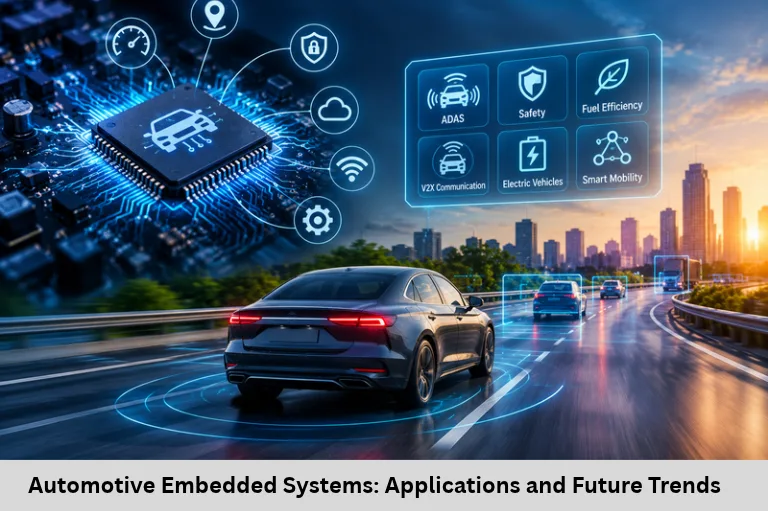
Explore automotive embedded systems, ECUs, CAN, AUTOSAR, ADAS, electric vehicles, RTOS, automotive cybersecurity, and Internet of Things (IoT) technologies.
- Automotive Embedded Systems: Applications and Future Trends
-
Automotive Innovation Powered by Embedded Systems
- Introduction to Automotive Embedded Systems
- What Are Embedded Systems?
- Core Components of Automotive Embedded Systems
- Major Applications in the Automotive Industry
- AUTOSAR, Functional Safety, and Cybersecurity
- Challenges and Future Trends
-
Frequently Asked Questions
- What is an automotive embedded system?
- What is the role of an ECU in a vehicle?
- Which programming languages are used in automotive embedded development?
- What is AUTOSAR in automotive software?
- How are Embedded Systems and IoT used in modern vehicles?
- What skills are useful for an automotive embedded engineer?
- Conclusion
Automotive Innovation Powered by Embedded Systems
Introduction to Automotive Embedded Systems
The automotive industry is evolving through electrification, intelligent safety features, software-defined vehicles, and connected mobility. Modern vehicles combine mechanical engineering with sophisticated electronics and software to improve safety, efficiency, performance, and driving comfort. At the centre of this transformation are embedded systems, which monitor sensors, process real-time data, control actuators, and coordinate communication between electronic control units (ECUs).
Automotive embedded technology supports engine management, anti-lock braking systems (ABS), advanced driver assistance systems (ADAS), battery management systems (BMS), infotainment, and autonomous driving research. These applications depend on microcontrollers, automotive communication protocols, embedded C/C++, real-time operating systems (RTOS), and functional safety engineering. The integration of Embedded Systems and Internet of Things (IoT) also enables connected vehicle diagnostics, fleet monitoring, over-the-air updates, and data-driven maintenance.
Embedded Tech Development Academy (ETDA) is relevant to learners developing practical embedded programming and automotive electronics skills. Students exploring a Top Embedded Training Institute in Bangalore can investigate technical learning opportunities and assured placement support while preparing for careers in automotive firmware, ECU development, and connected-device engineering. Understanding automotive Embedded Systems and Internet of Things (IoT) provides a foundation for working with modern vehicle architectures and intelligent transportation technologies.
What Are Embedded Systems?
Definition and Key Characteristics
An embedded system is a computing system designed to perform a specific function within a larger product. Unlike general-purpose computers, automotive embedded systems are developed around defined performance, memory, power, reliability, and timing requirements.
Key characteristics include:
Real-time operation: Responding to inputs within required deadlines.
Reliability: Operating consistently under specified environmental conditions.
Hardware-software integration: Combining MCUs, sensors, actuators, and firmware.
Resource efficiency: Working within limits on memory, processing power, and energy.
Fault handling: Detecting abnormal conditions and entering appropriate safe states.
Microcontrollers and Processors
Automotive microcontrollers from NXP, Infineon, Renesas, STMicroelectronics, and Texas Instruments are used in different vehicle applications. High-performance processors may support digital cockpits, computer vision, and central vehicle computing. Component selection depends on processing requirements, peripheral interfaces, safety needs, and the intended application.
The Role of Embedded C and RTOS
Embedded C and C++ are widely used for firmware development. An RTOS can schedule concurrent activities such as sensor acquisition, communication, and control. Some applications use bare-metal firmware, while others use RTOS platforms or automotive operating environments, depending on timing and system complexity.
Core Components of Automotive Embedded Systems
Sensors and Actuators
Sensors measure physical conditions and provide data to ECUs. Examples include temperature sensors, oxygen sensors, wheel-speed sensors, accelerometers, gyroscopes, radar, and cameras. Sensor data may require filtering, calibration, and plausibility checks before the controller uses it.
Actuators convert electrical control signals into physical action. Examples include fuel injectors, electric motor drives, braking mechanisms, and steering actuators. Accurate control depends on sensor quality, actuator response, and reliable firmware.
Automotive Communication Protocols
Vehicle ECUs exchange information using communication networks designed for different data rates and application requirements.
CAN: Commonly used for robust communication between control modules.
LIN: A lower-cost network for suitable body electronics and simpler subsystems.
FlexRay: Designed for particular applications requiring deterministic communication.
Automotive Ethernet: Supports higher-bandwidth applications, including advanced diagnostics and data-intensive systems.
MOST: Historically used in automotive multimedia networks.
The selection of a protocol depends on latency, bandwidth, cost, topology, and reliability requirements. Embedded Systems and Internet of Things (IoT) gateways can connect selected vehicle data to external services, but require appropriate security controls.
Major Applications in the Automotive Industry
Engine Management and Vehicle Safety
The engine management system controls fuel injection, ignition timing, idle speed, and emission-related functions using sensor feedback and calibrated control algorithms. The ECU adjusts outputs according to operating conditions while monitoring faults.
Safety-related systems include ABS, traction control, airbags, and electronic stability control. These systems require careful hardware design, fault detection, verification, and validation. Their safety requirements depend on the vehicle function and applicable standards.
ADAS and Autonomous Driving
Advanced Driver Assistance Systems use sensors and embedded processing to support features such as adaptive cruise control, lane-departure warnings, blind-spot detection, parking assistance, and automatic emergency braking.
Camera, radar, and sometimes LiDAR data may be combined through sensor fusion. High-performance processors and embedded AI can support object detection and road-scene interpretation. However, driver assistance features differ in capability, and automated-driving levels depend on the system’s defined operational scope.
Electric Vehicles and Battery Management
Electric vehicles rely on Embedded Systems for battery monitoring, motor control, charging, and thermal management. A battery management system monitors cell voltage, pack current, temperature, and other parameters to estimate battery state and detect unsafe conditions.
Embedded controllers also regulate motor inverters and coordinate charging operations. Embedded Systems and Internet of Things (IoT) connectivity can support fleet-level battery analysis and maintenance, subject to suitable data security and reliability requirements.
Infotainment and Telematics
Infotainment systems provide navigation, touchscreens, Bluetooth, voice interaction, and smartphone integration. Telematics systems collect vehicle status and location-related information for diagnostics, fleet management, or connected services. Linux and high-performance processors are common in some infotainment platforms, while smaller controllers handle dedicated real-time functions.
AUTOSAR, Functional Safety, and Cybersecurity
Understanding AUTOSAR
AUTOSAR stands for AUTomotive Open System ARchitecture. It defines standardised software architectures and interfaces to improve software reuse and integration across automotive suppliers.
Classic Platform: Intended primarily for deeply embedded, resource-constrained ECUs with statically configured software and real-time requirements.
Adaptive Platform: Designed for high-performance computing applications that may need dynamic deployment and service-oriented communication.
AUTOSAR is not an operating system by itself; it defines architecture and platform specifications used in automotive software development.
Safety and Cybersecurity Requirements
ISO 26262 addresses functional safety for road vehicles, including hazard analysis, risk assessment, and safety lifecycle activities. ISO/SAE 21434 addresses cybersecurity engineering for road vehicles. These standards address different risks and do not replace rigorous implementation and testing.
Connected Embedded Systems and Internet of Things (IoT) features introduce risks such as unauthorised access, insecure updates, and data exposure. Security measures may include secure boot, authenticated communication, access control, and vulnerability management.
Challenges and Future Trends
Engineering Challenges
Automotive developers must manage strict timing requirements, hardware constraints, integration complexity, cybersecurity risks, and extensive testing. Engineers use simulation, static analysis, hardware-in-the-loop testing, debugging, and verification to improve system quality.
Software-Defined and Connected Vehicles
Software-defined vehicles increasingly separate vehicle functions from individual hardware modules, allowing features to be updated through controlled software releases. Domain and zonal architectures can consolidate computing and simplify some wiring arrangements.
Vehicle-to-everything (V2X) communication connects vehicles with infrastructure, other vehicles, and network services. Together with electrification, AI-assisted perception, and Embedded Systems and Internet of Things (IoT) platforms, these developments are changing how vehicles are designed and maintained.
Embedded Tech Development Academy (ETDA) can be explored by learners building skills in embedded C, microcontrollers, automotive protocols, RTOS, and Internet of Things (IoT). Students considering a Top Embedded Training Institute in Bangalore can investigate its technical learning options and assured placement support as part of career preparation.
Frequently Asked Questions
What is an automotive embedded system?
It is a specialised computing system inside a vehicle that performs a dedicated function, such as engine control, braking assistance, battery monitoring, or infotainment.
What is the role of an ECU in a vehicle?
An electronic control unit reads relevant inputs, executes control logic, communicates with other modules, and operates outputs for a particular vehicle function.
Which programming languages are used in automotive embedded development?
Embedded C and C++ are widely used. Python is also used for testing, automation, and data analysis, while other languages may be selected for specific platforms.
What is AUTOSAR in automotive software?
AUTOSAR is a standardised automotive software architecture initiative with Classic and Adaptive platforms that support different ECU and high-performance computing needs.
How are Embedded Systems and IoT used in modern vehicles?
They enable connected diagnostics, fleet monitoring, remote data analysis, software-update workflows, and maintenance insights through appropriately secured communication gateways.
What skills are useful for an automotive embedded engineer?
Important skills include Embedded C/C++, microcontrollers, CAN and LIN protocols, RTOS concepts, debugging, testing, functional safety fundamentals, and automotive cybersecurity awareness.
Conclusion
Automotive innovation depends on the integration of embedded hardware, real-time firmware, sensors, actuators, communication networks, and safety engineering. From engine management and braking systems to ADAS, electric vehicles, and connected infotainment, Embedded Systems enable vehicles to respond to changing conditions and deliver advanced functionality. Technologies such as AUTOSAR, CAN, automotive Ethernet, RTOS, and secure Internet of Things (IoT) gateways help developers build and integrate increasingly complex vehicle systems.
As software-defined vehicles, electrification, and connected mobility expand, expertise in Embedded Systems and Internet of Things (IoT), Embedded C/C++, automotive communication protocols, functional safety, and cybersecurity will remain valuable for engineers. Embedded Tech Development Academy (ETDA) is an option for learners seeking practical embedded development education. Those researching a Top Embedded Training Institute in Bangalore can explore technical training opportunities and assured placement support while preparing for roles in automotive firmware, ECU integration, and connected vehicle development.
Author: ETDA Trainers
Experience: 10+ Years of Industry Experience in Embedded Systems, IoT, and Embedded C Programming