
Bit Manipulation in Embedded C: Set, Clear & Toggle
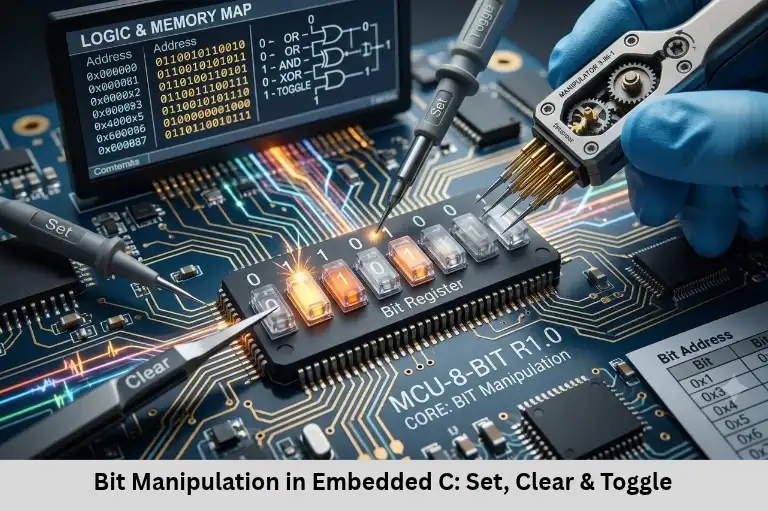
Learn bit manipulation in Embedded C with set, clear, toggle, and check operations, bitwise operators, register programming, and practical examples. Embedded Tech Development Academy (ETDA).
- Bit Manipulation in Embedded C: Set, Clear & Toggle
-
Bit Manipulation in Embedded C: Set, Clear, Toggle and Check Bits
- Introduction
- What Is Bit Manipulation in Embedded C?
- Understanding Binary Representation
- Setting Bits in Embedded C
- Clearing Bits in Embedded C
- Toggling Bits in Embedded C
- Checking Bits in Embedded C
- Bit Masking and Shift Operations
- Applications of Bit Manipulation in Embedded Systems
- Common Bit Manipulation Mistakes
- Learn Embedded C Programming at ETDA
- Frequently Asked Questions
- Conclusion
Bit Manipulation in Embedded C: Set, Clear, Toggle and Check Bits
Introduction
Bit manipulation in Embedded C is one of the most important programming skills for students learning microcontrollers, firmware development, and embedded systems. Unlike application-level programming, embedded software frequently interacts with hardware through individual bits inside control registers. Understanding how to set, clear, toggle, and check bits helps developers configure GPIO pins, control peripherals, manage interrupts, and optimize memory usage.
These techniques are widely used in automotive embedded systems, industrial automation, robotics, and Internet of Things (IoT) devices. Embedded Tech Development Academy (ETDA), a Top Embedded Training Institute in Bangalore, helps students develop practical programming skills through Embedded C training, microcontroller exercises, and hardware-based projects. Its technical learning approach and assured placement support help learners prepare for embedded engineering opportunities.
What Is Bit Manipulation in Embedded C?
Bit manipulation means performing operations on individual bits of a binary value using bitwise operators. Every microcontroller register contains binary information, where each bit may represent a particular configuration, status, or control function.
For example, a GPIO direction register may use one bit to configure a pin as an input and another bit to configure a different pin as an output. Instead of modifying the complete register, developers can change only the required bits.
Understanding Binary Representation
Computers represent information using binary digits, commonly called bits. Each bit can contain either zero or one, and multiple bits combine to represent integers and hardware configuration values.
Consider the binary value 00001000. Only bit 3 is set, while all remaining bits are cleared. Understanding bit positions is essential when configuring microcontroller registers and writing efficient Embedded C programs.
Bitwise Operators in C
C provides several operators for manipulating binary values.
| Operator | Symbol | Purpose | |
|---|---|---|---|
| AND | & | Clear or check bits | |
| OR | ` | ` | Set selected bits |
| XOR | ^ | Toggle selected bits | |
| NOT | ~ | Invert every bit | |
| Left Shift | << | Shift bits left | |
| Right Shift | >> | Shift bits right |
These operators allow developers to manipulate individual bits without using complicated conditional statements or unnecessary arithmetic operations.
Setting Bits in Embedded C
Setting a bit means changing its value from zero to one while preserving the remaining bits.
Using the Bitwise OR Operator
The OR operator is commonly used to set selected bits in a register.
#include <stdint.h>

uint32_t reg = 0x00;

reg |= (1U << 3);
Here, 1U << 3 generates the binary mask 00001000. Performing OR with the original register sets bit 3 without changing the other bits.
Practical GPIO Application
Suppose a microcontroller GPIO output register controls eight pins. To switch ON the LED connected to bit 2, the firmware can use:
GPIO_OUT |= (1U << 2);This operation sets the required output bit while preserving the states of other GPIO pins. It is useful in LED control, motor-driver configuration, and peripheral activation.
Clearing Bits in Embedded C
Clearing a bit means changing its value from one to zero while keeping other bits unchanged.
Using AND and NOT Operators
The AND operator combined with the NOT operator clears selected bits.
uint32_t reg = 0xFF;

reg &= ~(1U << 3);
The expression ~(1U << 3) creates a mask with every bit set except bit 3. Applying AND clears bit 3 and preserves the remaining register values.
Practical Peripheral Control
A developer may need to disable a GPIO output or clear a configuration flag without affecting other hardware settings.
GPIO_OUT &= ~(1U << 2);This clears bit 2 of the output register. Students should verify the register’s access rules before applying this technique because some hardware registers use special write behavior.
Toggling Bits in Embedded C
Toggling means changing a bit from zero to one or from one to zero. The XOR operator is particularly useful for this operation.
Using the XOR Operator
uint32_t reg = 0x00;

reg ^= (1U << 3);
The first execution sets bit 3. Executing the same statement again clears it because XOR with one reverses the selected bit.
LED Blinking Application
GPIO_OUT ^= (1U << 5);This operation toggles the LED output bit. When combined with a timer delay, it can generate a blinking LED pattern.
In actual microcontrollers, dedicated GPIO toggle registers may be preferable because they can avoid read-modify-write problems and improve atomicity.
Checking Bits in Embedded C
Checking a bit means determining whether a particular bit is set or cleared without modifying the original value.
Using the Bitwise AND Operator
if (reg & (1U << 4))
{
    // Bit 4 is set
}
else
{
    // Bit 4 is cleared
}
The expression produces a nonzero result when bit 4 is set. Otherwise, the result is zero.
This method is useful for checking peripheral status flags, button inputs, communication conditions, and interrupt-related information.
Checking Multiple Bits
Developers can check whether several bits are set using a combined mask.
if ((reg & 0x03U) == 0x03U)
{
    // Bits 0 and 1 are both set
}
This approach is useful when multiple conditions must be satisfied before executing a particular operation.
Bit Masking and Shift Operations
Bit masks are binary patterns used to select specific bits in a register or variable. They make register programming more readable and reduce the risk of modifying unrelated configuration values.
Creating Masks Using Shift Operators
#define BIT(n) (1U << (n))Using this macro, developers can write:
REG |= BIT(5);
REG &= ~BIT(5);
REG ^= BIT(5);
The macro simplifies repeated bit manipulation operations. However, the shift value must remain within the valid width of the unsigned integer type.
Extracting a Register Field
Some peripheral registers contain multi-bit fields rather than individual control bits.
uint32_t field;

field = (REG >> 4) & 0x07U;
This extracts three bits beginning at bit 4 and stores their value in field. Register-field extraction is useful for reading timer modes, ADC configurations, and peripheral status information.
Applications of Bit Manipulation in Embedded Systems
Bit manipulation is essential for low-level hardware programming because microcontrollers depend heavily on binary control information.
GPIO and Peripheral Configuration
GPIO direction registers, output registers, and alternate-function registers use individual bits to configure hardware pins. Bitwise operations allow developers to change selected pins without disturbing others.
Interrupt and Status Flag Handling
Interrupt controllers and peripheral status registers frequently contain flags representing events such as timer overflow, UART reception, or ADC conversion completion.
Developers use bit masking to identify specific events and configure interrupt-related hardware. Register-specific clearing rules must always be followed.
IoT and Automotive Applications
Internet of Things (IoT) devices use bit manipulation for sensor configuration, communication status, and compact data representation. Automotive controllers use it for ECU configuration, diagnostic information, and peripheral control.
These applications make bit manipulation a fundamental skill for students learning embedded systems and firmware development.
Common Bit Manipulation Mistakes
Beginners sometimes use incorrect masks, shift values, or integer types while manipulating registers. Such errors can modify unexpected bits or produce incorrect hardware behavior.
Students should use unsigned integer types, verify bit positions against the datasheet, and avoid unnecessary read-modify-write operations on registers with special access rules.
Debugging register values using debugger watch windows and hexadecimal representations helps learners understand the actual binary changes occurring during program execution.
Learn Embedded C Programming at ETDA
Students preparing for embedded engineering careers should develop strong knowledge of pointers, bitwise operators, memory management, register-level programming, and microcontroller architecture.
Embedded Tech Development Academy (ETDA) provides technical learning opportunities in Embedded C, microcontroller programming, communication protocols, and hardware-based projects.
Choosing a Top Embedded Training Institute in Bangalore helps learners strengthen their practical programming knowledge through structured training and project exercises. Embedded Tech Development Academy (ETDA) emphasizes industry-oriented learning and provides assured placement support to help students prepare for technical interviews and firmware development opportunities.
Frequently Asked Questions
What is bit manipulation in Embedded C?
Bit manipulation is the process of changing, checking, or extracting individual bits using bitwise operators such as AND, OR, XOR, and NOT.
How do you set a bit in Embedded C?
Use the OR operator with a bit mask, such as REG |= (1U << 3);, to set bit 3 without changing other bits.
How do you clear a bit in C?
Use AND with an inverted mask, such as REG &= ~(1U << 3);, to clear a specific bit.
How do you toggle a bit in Embedded C?
Use XOR with a bit mask, such as REG ^= (1U << 3);, to reverse the selected bit’s current value.
How do you check whether a bit is set?
Use an AND operation with a mask and test whether the result is nonzero.
Why is bit manipulation important for embedded engineers?
It enables efficient register configuration, GPIO control, interrupt handling, peripheral programming, and compact data processing in embedded systems.
Conclusion
Bit manipulation in Embedded C is a fundamental skill for controlling microcontroller hardware efficiently. Understanding how to set, clear, toggle, and check bits helps students configure registers, manage peripheral operations, and develop reliable firmware.
From GPIO programming and interrupt handling to automotive controllers and Internet of Things (IoT) applications, bitwise operations remain essential in embedded development. Students searching for a Top Embedded Training Institute in Bangalore can explore Embedded Tech Development Academy (ETDA) to strengthen their technical knowledge through practical learning and hardware-based projects. Embedded Tech Development Academy (ETDA) combines industry-oriented training with assured placement support, helping students prepare for embedded engineering career opportunities.
Author: ETDA Trainers
Experience: 10+ Years of Industry Experience in Embedded Systems, IoT, and Embedded C Programming