
Conditional Statements and Loops in C Programming
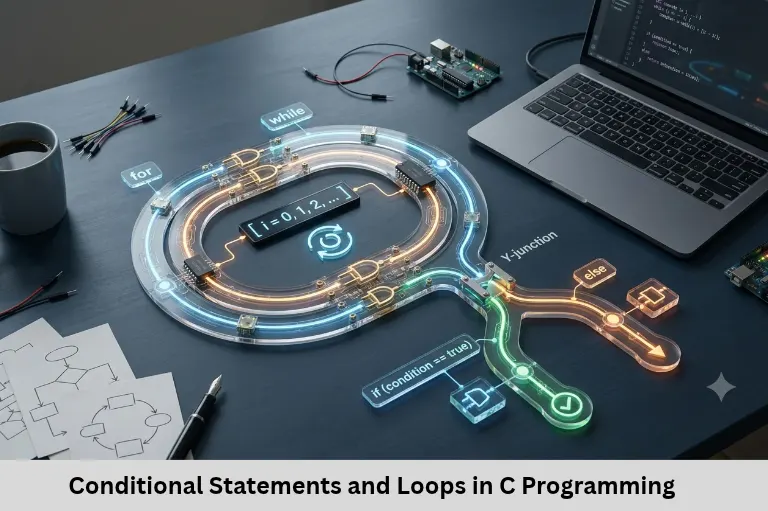
Learn conditional statements and looping techniques in C with practical examples. Understand if-else, switch, for, while and do-while loops for embedded programming. Embedded Tech Development Academy (ETDA).
- Conditional Statements and Loops in C Programming
- Conditional Statements and Looping Techniques in C Programming
Conditional Statements and Looping Techniques in C Programming
Introduction
C programming is one of the most important foundations for software development, microcontroller programming and embedded systems application design. Two essential concepts every beginner must understand are conditional statements and looping techniques. Conditional statements help a program make decisions, while loops allow instructions to execute repeatedly without writing the same code multiple times.
These concepts are especially important in embedded systems, where a microcontroller continuously reads sensors, checks conditions and controls hardware. For example, a temperature-monitoring program may switch on a fan when the temperature crosses a predefined limit. Students looking for the Top Embedded Training Institute in Bangalore can explore Embedded Tech Development Academy (ETDA), which focuses on practical programming, hardware-oriented learning and assured placement support.
What Are Conditional Statements in C?
Conditional statements are decision-making instructions that control the execution of a program based on whether a condition is true or false. They help developers create programs that respond differently to different inputs.
C supports several decision-making structures, including if, if-else, nested if and switch-case. These statements are useful for checking sensor values, validating user input and selecting appropriate operations in embedded systems applications.
1. The if Statement
The if statement executes a block of code only when the specified condition is true. If the condition is false, the program skips that block and continues with the next instruction.
Example:
#include <stdio.h>

int main()
{
    int temperature = 35;

    if (temperature > 30)
    {
        printf("High temperature detected");
    }

    return 0;
}
In this example, the message is displayed because the temperature value is greater than 30. In an embedded systems application, similar logic can be used to activate a cooling fan when a sensor reading crosses a selected threshold.
2. The if-else Statement
The if-else statement provides two possible execution paths. If the condition is true, the if block runs; otherwise, the else block executes.
Example:
int temperature = 25;

if (temperature > 30)
{
    printf("Fan ON");
}
else
{
    printf("Fan OFF");
}
This structure is useful when a system must choose between two actions. It is commonly applied in motor control, alarm systems and temperature-based automation.
3. Nested if Statements
A nested if statement places one if condition inside another. It is useful when a decision depends on multiple conditions that must be checked in sequence.
For example, a security system may first check whether a password is correct and then verify whether the user has access permission. Nested conditions help organise this decision-making process.
4. The else-if Ladder
An else-if ladder checks multiple conditions one after another. The first condition that evaluates to true determines which block executes.
Example:
int marks = 75;

if (marks >= 90)
    printf("Grade A");
else if (marks >= 70)
    printf("Grade B");
else if (marks >= 50)
    printf("Grade C");
else
    printf("Needs Improvement");
This technique is useful for selecting different operating levels, such as low, medium and high motor speeds based on sensor readings.
5. The switch-case Statement
The switch statement selects one execution block from several alternatives based on the value of an expression. It is often clearer than a long else-if ladder when checking one variable against several constant values.
Example:
int choice = 2;

switch (choice)
{
    case 1:
        printf("Light ON");
        break;

    case 2:
        printf("Fan ON");
        break;

    default:
        printf("Invalid choice");
}
The break statement prevents execution from continuing into the next case. The default block handles values that do not match any listed case.
What Are Looping Techniques in C?
Loops are programming structures that execute a block of instructions repeatedly while a specified condition is satisfied. They reduce code repetition and make programs easier to maintain.
In embedded systems, loops are important because controllers often monitor sensors, process incoming data and update outputs continuously. C provides three main looping techniques: for, while and do-while.
1. The for Loop
The for loop is useful when the number of repetitions is known or controlled by a counter. It contains initialization, condition checking and an update expression.
Example:
#include <stdio.h>

int main()
{
    int i;

    for (i = 1; i <= 5; i++)
    {
        printf("%d\n", i);
    }

    return 0;
}
This program prints numbers from 1 to 5. The for loop is commonly used for array processing, repeated calculations and fixed-count operations.
2. The while Loop
The while loop checks its condition before executing the loop body. If the condition is false initially, the statements inside the loop are not executed.
Example:
int count = 1;

while (count <= 5)
{
    printf("%d\n", count);
    count++;
}
This loop continues until the count becomes greater than five. In microcontroller applications, while loops are often used for continuous monitoring and waiting for input conditions.
3. The do-while Loop
The do-while loop executes its statements at least once because the condition is checked after the loop body.
Example:
int option = 1;

do
{
    printf("System is running\n");
    option++;
}
while (option <= 3);
This structure is useful when an operation must happen once before checking whether it should repeat, such as displaying an initial menu or performing a first measurement.
Understanding break and continue
The break statement immediately terminates the nearest loop or switch statement. The continue statement skips the remaining statements in the current loop iteration and moves to the next iteration.
These control statements help manage program flow. However, embedded developers should use them carefully so that important hardware checks and safety-related operations are not accidentally skipped.
Difference Between for, while and do-while Loops
| Loop | Condition check | Typical use |
|---|---|---|
| for | Before execution | Known or counter-controlled repetitions |
| while | Before execution | Repetition based on a condition |
| do-while | After execution | At least one execution required |
Choosing the right loop depends on the application. A for loop suits fixed repetitions, while a while loop is useful for continuous monitoring. A do-while loop is appropriate when the first execution must happen regardless of the initial condition.
Importance in Embedded Systems and IoT
Conditional statements and loops are used in almost every microcontroller program. A controller may repeatedly read an ADC value, compare it with a threshold and operate a motor, buzzer or LED.
For example, an Internet of Things (IoT)-based temperature-monitoring device can use a loop to collect sensor readings and conditional statements to identify abnormal temperatures. It can then send information through a communication module to a monitoring platform.
For learners preparing for embedded development, understanding these concepts is essential before moving to Embedded C, device drivers, communication protocols and RTOS programming.
Learn Practical C Programming at ETDA
Understanding syntax is only the first step toward becoming a capable programmer. Students must practise writing programs, identifying logical errors, debugging code and applying programming concepts to real hardware.
Embedded Tech Development Academy (ETDA) focuses on practical, industry-oriented learning in C, Embedded C, microcontrollers and Internet of Things (IoT). Students can strengthen their programming foundation through hands-on exercises and application-based projects.
For students searching for the Top Embedded Training Institute in Bangalore, Embedded Tech Development Academy (ETDA) offers practical learning that connects programming fundamentals with embedded hardware applications. Its training approach helps learners understand how conditional logic and loops are used in real-time projects.
Embedded Tech Development Academy (ETDA) also provides assured placement support, including resume guidance, technical interview preparation and career-readiness assistance. These learning opportunities can help students prepare for roles such as Embedded Software Engineer, Firmware Developer and Internet of Things (IoT) Developer.
Frequently Asked Questions
What are conditional statements in C?
Conditional statements allow a program to make decisions based on whether a given expression is true or false. Common examples include if, if-else and switch-case.
What are the three main loops in C?
The three main loops are for, while and do-while. Each provides a different way to repeat instructions based on a condition.
What is the difference between while and do-while?
A while loop checks its condition before executing the body. A do-while loop checks the condition afterward, so its body executes at least once.
What is the purpose of break in C?
The break statement immediately terminates the nearest loop or switch block and transfers program execution to the statement following it.
Why are loops important in embedded programming?
Loops allow microcontrollers to repeatedly monitor sensors, process data and control hardware without duplicating the same instructions.
Should beginners learn C before Embedded C?
Yes. Learning C fundamentals such as conditions, loops, functions, pointers and arrays provides a strong foundation for understanding Embedded C and microcontroller programming.
Conclusion
Conditional statements and looping techniques in C are essential programming concepts for developing logical, efficient and reliable applications. Decision-making structures help programs respond to different conditions, while loops support repeated operations. Together, they form the foundation for microcontroller programming and advanced embedded systems development.
Students looking for the Top Embedded Training Institute in Bangalore can explore Embedded Tech Development Academy (ETDA) for practical programming, project-based learning and assured placement support. Building strong C programming skills is an important step toward developing a career in embedded systems and Internet of Things (IoT).
Author: ETDA Trainers
Experience: 10+ Years of Industry Experience in Embedded Systems, IoT, and Embedded C Programming