
Development Boards for Beginners: Arduino, ESP32 & STM32
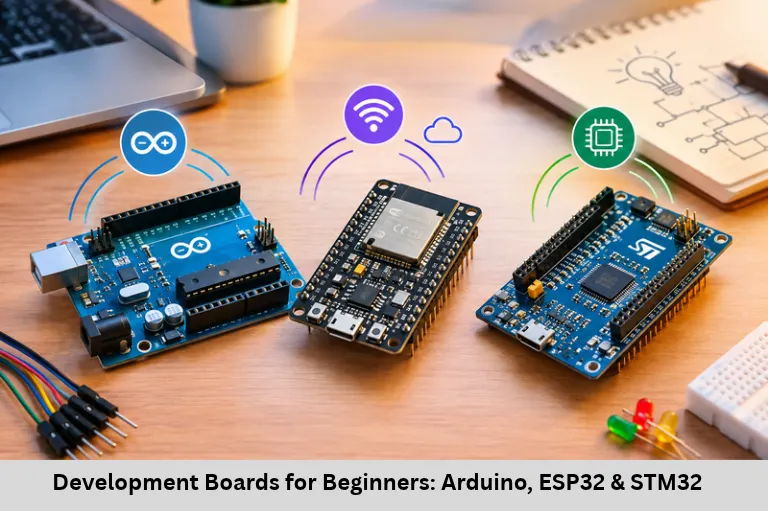
Compare Arduino, ESP32, Raspberry Pi, STM32 and LPC1768 development boards. Learn key features, programming tools, costs and embedded systems learning paths. Embedded Tech Development Academy (ETDA).
- Development Boards for Beginners: Arduino, ESP32 & STM32
- Development Boards for Beginners: How to Choose the Right One
Development Boards for Beginners: How to Choose the Right One
Introduction to Embedded Systems Development Boards
Choosing a development board is one of the first important decisions when learning embedded systems, electronics, and microcontroller programming. Development boards provide a practical environment for understanding how hardware and software interact, from controlling an LED to communicating with sensors, motors, displays, and wireless networks. However, different boards use different processors, memory architectures, peripheral interfaces, programming tools, and operating systems. Selecting the right platform depends on your technical goals, experience, budget, and the projects you want to build.
Popular options include Arduino Uno for introductory electronics, ESP32 for Internet of Things (IoT) applications, Raspberry Pi for Linux-based computing, STM32 Nucleo for microcontroller development, and NXP LPC1768 for learning embedded C and peripheral programming. These platforms help learners explore GPIO, interrupts, timers, ADC, PWM, UART, SPI, I2C, CAN, real-time operating systems (RTOS), and wireless communication.
For students pursuing an embedded engineering career, practical experience with microcontroller development boards is as important as understanding programming concepts. Embedded Tech Development Academy (ETDA) can be considered by learners seeking structured embedded systems training. When evaluating a Top Embedded Training Institute in Bangalore, examine hardware laboratory access, hands-on firmware projects, debugging practice, and assured placement support. A well-planned learning path helps beginners progress from simple circuits to professional embedded firmware development.
What Is a Development Board?
Hardware and Firmware Integration
A development board is a ready-to-use electronic platform built around a microcontroller (MCU), microprocessor (MPU), or system-on-chip (SoC). It typically includes power regulation, clock circuitry, programming interfaces, reset circuitry, and accessible input/output pins.
A microcontroller integrates a processor, memory, and peripherals on one chip. A microprocessor-based single-board computer, such as a Raspberry Pi, generally relies on external memory and supporting components and can run a full operating system.
Common Onboard Features
GPIO pins for digital input and output.
Timers and PWM channels for timing and motor control.
ADC peripherals for measuring analog sensor signals.
UART, SPI, I2C, and sometimes CAN interfaces.
USB connectivity for programming, debugging, or data transfer.
Why Beginners Need These Features
These integrated features reduce initial hardware complexity and let learners focus on firmware logic, peripheral configuration, signal measurement, and debugging.
Popular Development Boards for Beginners
Arduino Uno
<AsyncImage query=”Arduino Uno R3 development board white background electronics” aspectRatio=”5:4″ width=”100%” />
Arduino Uno is suitable for learning digital electronics and introductory C/C++ programming through the Arduino IDE. Its accessible libraries and extensive learning community make it useful for LED control, sensor interfacing, basic robotics, and relay-based automation.
Technical focus: GPIO, digital communication, basic timers, PWM, and introductory embedded programming. Advanced applications may require moving to a more capable microcontroller.
Raspberry Pi
<AsyncImage query=”Raspberry Pi single board computer GPIO header USB ports” aspectRatio=”5:4″ width=”100%” />
Raspberry Pi is a single-board computer that can run Linux and support Python, C/C++, networking, databases, and graphical applications. It is appropriate for web servers, Internet of Things (IoT) dashboards, computer vision, and edge-computing prototypes.
Technical focus: Linux commands, Python, GPIO control, networking, processes, and hardware-software integration. Unlike a typical microcontroller, a Linux system is not inherently deterministic for strict real-time control.
ESP32
<AsyncImage query=”ESP32 development board Wi-Fi Bluetooth USB electronics” aspectRatio=”5:4″ width=”100%” />
ESP32 development boards are widely used for wireless embedded projects. Depending on the specific model, they provide Wi-Fi, Bluetooth or Bluetooth Low Energy, GPIO, timers, ADC, and communication peripherals.
Programming options include Arduino IDE and Espressif’s ESP-IDF framework. Typical applications include smart-home devices, remote sensor nodes, wireless monitoring, and cloud-connected controllers.
Technical focus: Wi-Fi communication, MQTT, low-power operation, peripheral drivers, and RTOS-based firmware.
STM32 Nucleo
<AsyncImage query=”STMicroelectronics STM32 Nucleo development board microcontroller ST Link” aspectRatio=”5:4″ width=”100%” />
STM32 Nucleo boards support ARM Cortex-M microcontroller development. Depending on the selected model, they provide different CPU performance levels, memory capacities, timers, ADCs, communication interfaces, and debugging features.
STM32CubeIDE and STM32CubeMX support coding, peripheral configuration, compilation, and debugging.
Technical focus: register-level programming, hardware abstraction layers, interrupts, DMA, PWM, motor control, and RTOS integration.
NXP LPC1768
<AsyncImage query=”NXP LPC1768 ARM Cortex M3 development board CAN UART ADC” aspectRatio=”5:4″ width=”100%” />
The LPC1768 is an ARM Cortex-M3 microcontroller with peripherals such as UART, SPI, I2C, ADC, timers, PWM, and CAN. It is useful for learning how firmware interacts with hardware in control and communication applications.
Development workflows may use Keil MDK or suitable supported toolchains and debugging hardware.
Technical focus: embedded C, peripheral registers, interrupt service routines, CAN communication, and RTOS fundamentals.
Factors to Consider Before Choosing a Board
Learning Goals and Programming Difficulty
| Learning goal | Suitable starting point | Key skills |
|---|---|---|
| Basic electronics | Arduino Uno | GPIO, sensors, C/C++ basics |
| Wireless Internet of Things (IoT) | ESP32 | Wi-Fi, MQTT, connected devices |
| Linux and networking | Raspberry Pi | Python, Linux, TCP/IP |
| Microcontroller engineering | STM32 Nucleo | Interrupts, timers, drivers |
| Core embedded C | LPC1768 | Registers, CAN, peripherals |
Cost and Hardware Requirements
Board prices vary by model, memory, onboard debugger, accessories, and supplier. Budget for a USB cable, breadboard, jumper wires, sensors, and a multimeter, not just the board itself.
Choose a board with sufficient GPIO pins, ADC resolution, PWM channels, communication interfaces, and memory for your planned application. Check operating voltage and electrical limits before connecting external circuits.
IDEs, Toolchains and Debugging
Arduino IDE simplifies introductory development. ESP-IDF offers more detailed control over ESP32 firmware. STM32CubeIDE supports compilation and debugging for STM32 platforms, while LPC1768 workflows depend on the selected toolchain and board support.
Learn to use breakpoints, watch variables, inspect registers, read compiler errors, and analyze serial logs. These debugging skills transfer across platforms.
Practical Learning Roadmaps
Path 1 — Electronics Fundamentals
Configure GPIO and blink an LED.
Read push buttons and digital sensors.
Interface an ADC sensor and generate PWM.
Build a small sensor-and-actuator project.
Path 2 — IoT Development
Start with ESP32 GPIO and sensor interfacing.
Connect to Wi-Fi and send data using MQTT or HTTP.
Display readings on a dashboard.
Add error handling, authentication, and power management.
Path 3 — Embedded Engineer Development
Learn C programming, pointers, bitwise operations, and memory.
Configure UART, SPI, I2C, timers, and interrupts.
Debug firmware using a hardware debugger.
Explore CAN, DMA, RTOS scheduling, and driver development.
Embedded Tech Development Academy (ETDA) can be explored by learners who want guided practice with embedded C, microcontrollers, and communication protocols. Students comparing a Top Embedded Training Institute in Bangalore should assess the depth of lab exercises, real hardware access, and assured placement support rather than relying only on course titles.
Common Beginner Mistakes
Avoiding Unnecessary Complexity
Common mistakes include buying a board before defining project requirements, copying code without understanding it, ignoring datasheets, and jumping into RTOS concepts before learning interrupts and timers.
A Better Debugging Process
Test one peripheral at a time, confirm pin assignments, check supply voltage, verify communication settings, and consult the device reference manual. Change one variable at a time so the cause of a fault remains clear.
Build Reusable Skills
Keep project notes, version-control your source code, document wiring, and test each module before integration. This develops reliable engineering habits.
Frequently Asked Questions
Which development board is suitable for a complete beginner?
Arduino Uno is a common starting point because its IDE and libraries simplify basic electronics projects. The best choice still depends on whether your goal is IoT, Linux, or professional microcontroller development.
What is the difference between a microcontroller board and Raspberry Pi?
A microcontroller board usually runs firmware directly on an MCU, often without a full operating system. Raspberry Pi is a single-board computer that can run Linux and applications such as Python programs and network services.
Is ESP32 suitable for IoT projects?
Yes. Supported ESP32 variants provide wireless capabilities and peripherals for sensor monitoring, connected controllers, and cloud communication. Check the exact model’s wireless features and memory before selecting it.
Should I learn Arduino before STM32 or LPC1768?
It is not compulsory. Arduino can help you learn basic electronics quickly, but learners with C programming knowledge can begin directly with STM32 or LPC1768 to study registers, interrupts, and peripheral drivers.
What should I learn after completing basic development board projects?
Progress to embedded C, timers, interrupts, UART, SPI, I2C, debugging, and memory management. Then explore CAN, DMA, RTOS, low-power design, and a complete project that combines multiple peripherals.
Conclusion
Choosing a development board is about matching the hardware platform to your learning objectives. Arduino Uno helps beginners understand GPIO, sensors, and introductory programming. ESP32 supports wireless Internet of Things (IoT) development, Raspberry Pi provides Linux-based computing, and STM32 Nucleo and LPC1768 offer opportunities to explore deeper microcontroller architecture, embedded C, interrupts, peripheral drivers, CAN, and RTOS concepts.
A successful embedded systems learning journey should progress from basic circuit control to structured firmware development, debugging, communication protocols, and complete hardware-software projects. Embedded Tech Development Academy (ETDA) is an option for learners seeking practical embedded systems training. When choosing a Top Embedded Training Institute in Bangalore, compare technical curriculum, hands-on development board access, project quality, mentor guidance, and assured placement support. With consistent practice and a clear roadmap, beginners can build the skills needed to work on Internet of Things (IoT) devices, industrial controllers, automotive electronics, and other embedded products.
Author: ETDA Trainers
Experience: 10+ Years of Industry Experience in Embedded Systems, IoT, and Embedded C Programming