
ECU Development: Architecture, Programming and Testing
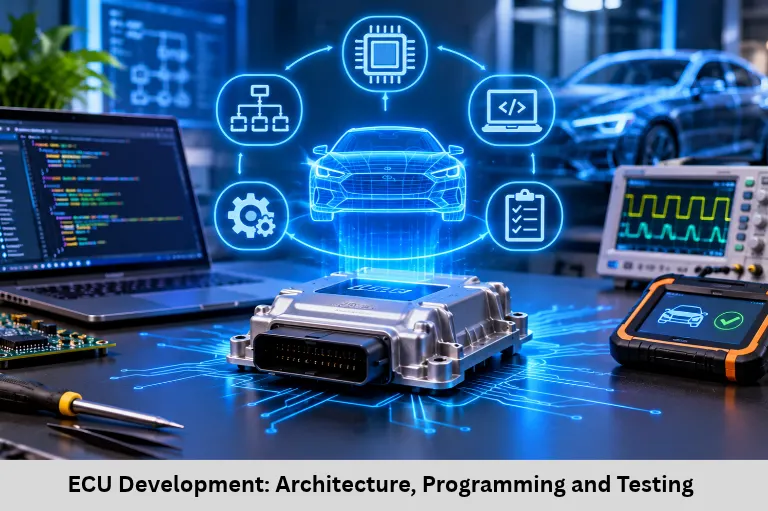
Learn ECU development, automotive ECU architecture, Embedded C programming, AUTOSAR, CAN communication, hardware integration, and ECU testing with practical insights from Embedded Tech Development Academy (ETDA).
- ECU Development: Architecture, Programming and Testing
-
ECU Development: Architecture, Programming and Testing – A Complete Technical Guide
- ECU Development: Architecture, Programming and Testing
- What Is an Electronic Control Unit (ECU)?
- ECU Hardware Architecture
- ECU Software Architecture and Development
- Embedded C Programming for ECU Development
- Automotive Communication Protocols in ECU Development
- ECU Testing and Validation Techniques
- ECU Development Lifecycle
- Career Opportunities in Automotive ECU Development
- Learn Automotive Embedded Development at ETDA
-
Frequently Asked Questions
- What is ECU development in automotive engineering?
- Which programming language is used for ECU development?
- What is the role of CAN communication in ECU development?
- What is AUTOSAR in automotive software development?
- What is HIL testing in ECU development?
- Can beginners learn ECU development at ETDA?
- Conclusion
ECU Development: Architecture, Programming and Testing – A Complete Technical Guide
ECU Development: Architecture, Programming and Testing
Modern vehicles depend on electronic control units (ECUs) to manage essential operations such as engine control, braking, steering, transmission, airbags, and vehicle diagnostics. An ECU combines hardware and software to monitor sensor inputs, process information, and control vehicle components in real time. As automotive technology advances, understanding ECU development, including architecture, programming, and testing, has become an important skill for aspiring embedded engineers.
ECU development involves selecting suitable microcontrollers, designing hardware interfaces, writing embedded firmware, implementing communication protocols, and performing systematic testing. Students interested in automotive embedded systems should understand these concepts to prepare for real-world engineering projects. Embedded Tech Development Academy (ETDA) helps students develop practical programming and microcontroller skills through technical training and project-based learning. Students searching for a Top Embedded Training Institute in Bangalore can build their industry-oriented knowledge with hands-on training and assured placement support.
What Is an Electronic Control Unit (ECU)?
An Electronic Control Unit is an embedded controller responsible for performing a specific function inside a vehicle. It receives information from sensors, executes programmed control algorithms, and sends commands to actuators.
For example, an Engine Control Unit (ECU) monitors engine temperature, throttle position, oxygen sensor readings, and engine speed. Based on this information, it calculates appropriate fuel injection and ignition timing.
Modern vehicles may contain dozens of ECUs communicating through automotive networks. These interconnected embedded systems help improve vehicle performance, efficiency, safety, and reliability.
Major Types of Automotive ECUs
Engine Control Unit: Manages fuel injection, ignition timing, and engine performance.
Transmission Control Unit: Controls automatic transmission operations and gear shifting.
Electronic Brake Control Unit: Supports braking functions and stability-related operations.
Airbag Control Unit: Monitors crash-related sensor signals and controls airbag deployment.
Body Control Module: Manages lighting, power windows, central locking, and other body electronics.
Battery Management System: Monitors battery voltage, temperature, current, and charging conditions in electric vehicles.
ECU Hardware Architecture
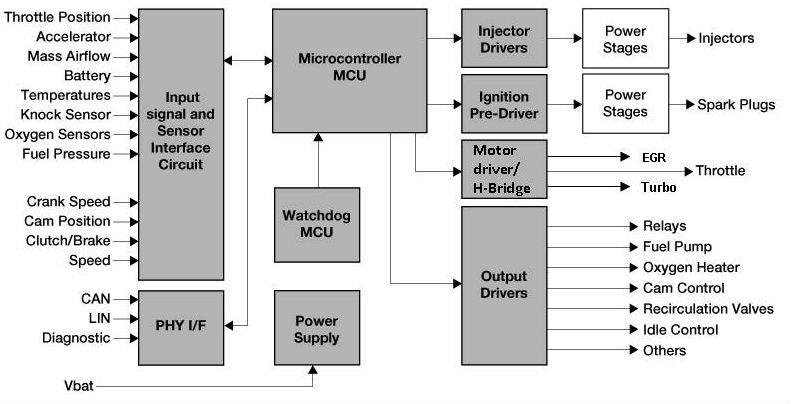
ECU hardware architecture defines how different electronic components interact to perform vehicle control functions. A typical ECU contains a microcontroller, memory, power supply circuits, sensor interfaces, actuator drivers, and communication transceivers.
Microcontroller Unit (MCU)
The microcontroller acts as the processing core of an ECU. It executes firmware, processes sensor information, controls peripherals, and manages communication.
Automotive microcontrollers commonly include:
ARM Cortex-M processor cores.
Flash memory for program storage.
SRAM for runtime data.
Timers and interrupt controllers.
ADC and PWM peripherals.
CAN, LIN, and SPI communication interfaces.
Sensor Interface Circuits
Sensors provide information about vehicle operating conditions. Since sensor outputs may be analog or digital, the ECU requires suitable interface circuits to process their signals.
For example, an analog temperature sensor produces a voltage corresponding to temperature. The microcontroller uses an Analog-to-Digital Converter (ADC) to convert this voltage into digital information.
Actuator Driver Circuits
Actuators perform physical operations based on ECU commands. Examples include fuel injectors, motors, relays, solenoids, and cooling fans.
Driver circuits provide the required electrical current and voltage to operate these components. Engineers must consider switching characteristics, protection circuits, and thermal limitations during hardware design.
Power Management and Protection
Automotive ECUs operate under challenging electrical conditions, including voltage fluctuations and transient disturbances. Power management circuits regulate supply voltages and protect sensitive electronics against electrical faults.
ECU Software Architecture and Development
ECU software architecture organizes firmware into logical modules so that developers can manage hardware access, application logic, communication, and diagnostics.
Embedded Software Layers
A typical ECU software architecture includes:
Application Layer: Contains control algorithms and vehicle-specific functionality.
Middleware Layer: Provides communication and software abstraction services.
Hardware Abstraction Layer: Separates application software from hardware-specific implementation.
Microcontroller Driver Layer: Controls peripherals such as ADC, timers, GPIO, and communication interfaces.
AUTOSAR is widely used to standardize automotive software architecture. Its Classic Platform separates application software, Runtime Environment (RTE), and Basic Software (BSW), supporting software reuse and hardware independence.
Embedded C Programming for ECU Development
Embedded C is an important programming language for developing automotive firmware. It provides direct access to microcontroller registers and allows developers to implement efficient control algorithms.
Engineers use Embedded C to configure peripherals, process sensor readings, manage interrupts, and control actuators.
Important Programming Techniques
Register-level programming for peripheral configuration.
Bitwise operations for controlling hardware registers.
Interrupt handling for time-critical events.
Timer programming for periodic operations.
Memory management for limited hardware resources.
State machines for managing ECU operating conditions.
Example: Reading an ADC Value
Consider an ECU monitoring an analog temperature sensor. The microcontroller reads the sensor voltage through its ADC peripheral and converts the digital result into a meaningful temperature value.
A simplified conversion formula is:
Here, \(N\) represents the ADC resolution and \(V_{ref}\) is the reference voltage.
The firmware can compare the calculated value against predefined thresholds and activate a cooling fan when necessary. This illustrates how Embedded C connects sensor information with real-time control decisions.
Automotive Communication Protocols in ECU Development
Automotive ECUs exchange information through communication networks. These protocols enable different controllers to coordinate vehicle operations.
CAN Protocol
Controller Area Network (CAN) is one of the most widely used automotive communication protocols. It supports message arbitration, error detection, and reliable data exchange between multiple ECUs.
For example, an engine ECU can transmit engine speed information over CAN, allowing the instrument cluster to display the current RPM.
LIN Protocol
Local Interconnect Network (LIN) is a cost-effective communication protocol used for simpler automotive applications, including power windows, mirrors, and seat controls.
Automotive Ethernet
Automotive Ethernet provides high-speed communication for advanced applications such as ADAS, cameras, diagnostics, and connected vehicle technologies.
These communication technologies also support connected embedded systems and Internet of Things (IoT) applications involving remote monitoring, vehicle data collection, and cloud-based services.
ECU Testing and Validation Techniques
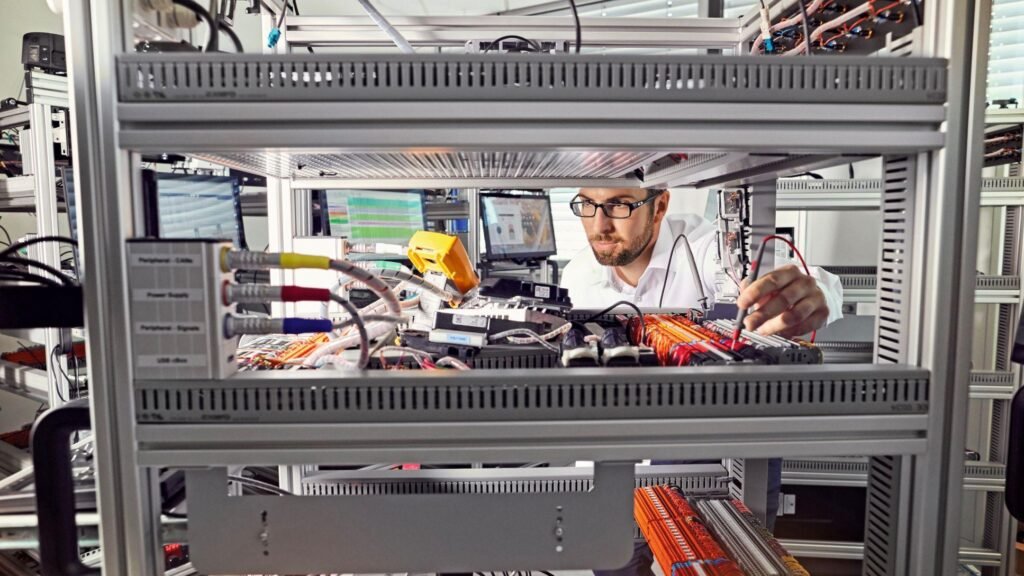
Testing is essential because an ECU must perform reliably under different operating conditions. Developers verify hardware functionality, firmware behaviour, communication, and system-level performance.
Unit Testing
Unit testing verifies individual software modules independently. For example, developers test ADC conversion functions, timer routines, communication drivers, and diagnostic functions separately.
Integration Testing
Integration testing checks whether hardware and software components work correctly together. It identifies interface problems, communication errors, and incorrect data exchange between modules.
Hardware-in-the-Loop (HIL) Testing
HIL testing connects a physical ECU to a real-time simulation environment. The simulator generates sensor signals and operating conditions while monitoring ECU responses.
This allows engineers to test complex scenarios without requiring a complete vehicle for every experiment.
Functional Safety Testing
Automotive safety-critical ECUs require systematic fault analysis and verification. ISO 26262 provides functional safety requirements for electrical and electronic vehicle systems.
Testing may include watchdog monitoring, memory diagnostics, fault injection, and verification of safe-state behaviour.
Common ECU Testing Tools
Engineers use tools such as oscilloscopes, digital multimeters, CAN analyzers, debuggers, and automated test platforms to evaluate ECU performance.
ECU Development Lifecycle
ECU development follows a structured engineering process to ensure that the final product satisfies functional and safety requirements.
The major stages include:
Requirement analysis and system specification.
Hardware architecture and component selection.
Software architecture and firmware development.
Hardware and software integration.
Unit, integration, and system testing.
Validation, documentation, and production release.
Following this lifecycle helps development teams identify defects early and reduce integration problems.
Career Opportunities in Automotive ECU Development
ECU development offers opportunities for students interested in automotive software, firmware, and hardware engineering.
Common career roles include:
Automotive Embedded Software Engineer.
ECU Firmware Developer.
Embedded C Programmer.
AUTOSAR Developer.
Automotive Testing and Validation Engineer.
Hardware Integration Engineer.
Students should develop strong fundamentals in C programming, microcontroller architecture, RTOS, CAN communication, and debugging before moving into specialized automotive development.
Learn Automotive Embedded Development at ETDA
Embedded Tech Development Academy (ETDA) helps engineering students develop practical skills required for embedded software and hardware development.
Students can strengthen their understanding of Embedded C, 8051, ARM Cortex-M, STM32, LPC1768, UART, SPI, I2C, CAN, RTOS, and microcontroller interfacing.
These subjects provide a technical foundation for understanding ECU architecture, firmware development, and automotive communication. Practical assignments and hardware-based projects help learners connect programming concepts with real engineering applications.
For students searching for a Top Embedded Training Institute in Bangalore, Embedded Tech Development Academy (ETDA) offers industry-oriented training with practical project exposure and assured placement support. Developing these skills can help aspiring engineers prepare for opportunities in automotive embedded systems, industrial automation, robotics, and Internet of Things (IoT).
Frequently Asked Questions
What is ECU development in automotive engineering?
ECU development is the process of designing, programming, integrating, and testing electronic control units used in vehicles. It combines microcontroller hardware, embedded software, sensors, actuators, and communication protocols.
Which programming language is used for ECU development?
Embedded C is widely used for automotive ECU firmware development. C++ is also used in various automotive applications, particularly in advanced software platforms.
What is the role of CAN communication in ECU development?
CAN enables different automotive ECUs to exchange information reliably. It supports communication between engine controllers, transmission systems, instrument clusters, and other vehicle electronics.
What is AUTOSAR in automotive software development?
AUTOSAR is a standardized automotive software architecture that improves software portability, reuse, and integration. It provides structured interfaces and software layers for automotive ECUs.
What is HIL testing in ECU development?
Hardware-in-the-Loop testing connects a real ECU to a real-time simulator. It allows engineers to evaluate ECU responses under different simulated vehicle operating conditions.
Can beginners learn ECU development at ETDA?
Yes. Beginners can start with C programming, microcontroller fundamentals, Embedded C, and communication protocols before progressing toward automotive applications. Embedded Tech Development Academy (ETDA) provides practical embedded training and assured placement support to help students prepare for embedded engineering careers.
Conclusion
ECU development combines hardware architecture, Embedded C programming, communication protocols, and systematic testing to create reliable automotive control systems. Understanding microcontrollers, sensor interfaces, actuator drivers, AUTOSAR, CAN communication, and HIL testing provides a strong foundation for automotive embedded engineering.
For students planning to enter this industry, practical knowledge of embedded programming and hardware debugging is essential. Embedded Tech Development Academy (ETDA) supports aspiring engineers through technical training, hands-on projects, and assured placement support. Students looking for a Top Embedded Training Institute in Bangalore can strengthen their engineering fundamentals at Embedded Tech Development Academy (ETDA) and prepare for opportunities in automotive embedded systems and Internet of Things (IoT) development.
Author: ETDA Trainers
Experience: 10+ Years of Industry Experience in Embedded Systems, IoT, and Embedded C Programming