
Embedded Firmware Design and Development Guide
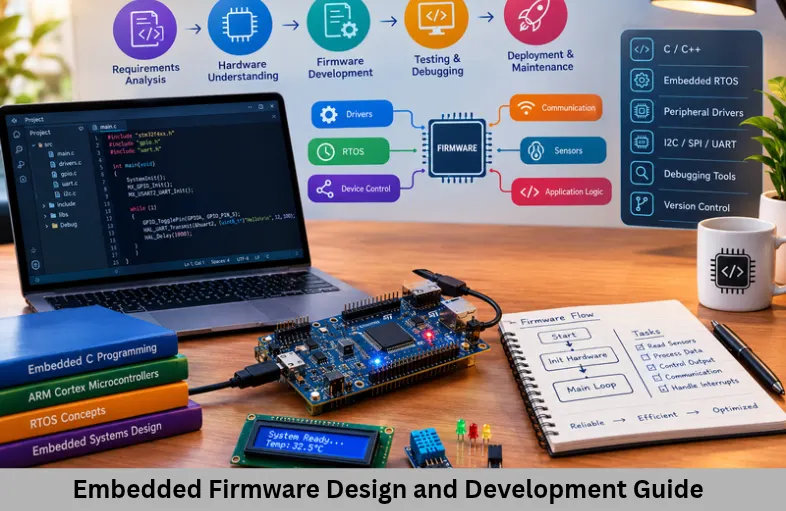
Learn embedded firmware design, Embedded C programming, super loop architecture, RTOS-based development, hardware initialization, debugging, and watchdog timers. Embedded Tech Development Academy (ETDA).
- Embedded Firmware Design and Development Guide
- Embedded Firmware Design and Development: A Complete Technical Guide
Embedded Firmware Design and Development: A Complete Technical Guide
Introduction to Embedded Firmware Design and Development
Embedded firmware design and development is a fundamental part of building reliable embedded systems. Firmware is the low-level software that controls a microcontroller or processor, manages hardware peripherals, processes input signals, and generates outputs according to the product’s functional requirements. It connects hardware components with application logic and enables devices such as automotive controllers, medical instruments, industrial automation equipment, smart appliances, and Internet of Things (IoT) products to perform their intended functions.
Embedded firmware can be developed using Embedded C, C++, assembly language, or a combination of these technologies. The development process involves requirement analysis, hardware configuration, memory mapping, peripheral initialization, algorithm implementation, compilation, linking, debugging, testing, and firmware programming. Engineers must also understand interrupt handling, timers, communication protocols, power management, and real-time constraints.
Two common firmware architectures are the super-loop architecture and the RTOS-based architecture. A super loop executes application tasks sequentially within an infinite loop, whereas a real-time operating system (RTOS) schedules independent tasks according to priorities and timing requirements.
For learners interested in microcontroller programming, firmware architecture, Embedded C, debugging tools, and real-time systems, Embedded Tech Development Academy (ETDA) provides an industry-oriented learning pathway. As a Top Embedded Training Institute in Bangalore, Embedded Tech Development Academy (ETDA) promotes practical embedded systems learning and offers assured placement support to help learners prepare for relevant technical careers.
What Is Embedded Firmware?
Embedded firmware is software programmed into a device’s non-volatile memory to control its operation. It may reside in internal flash memory, external flash, EEPROM, or other suitable storage, depending on the hardware architecture.
Main Responsibilities of Firmware
Firmware performs several essential operations:
Initializes the processor, clocks, GPIO pins, and peripherals.
Reads sensor inputs and processes data.
Controls actuators, displays, motors, and communication interfaces.
Handles interrupts, timers, and error conditions.
Implements application-specific control algorithms.
Monitors system status and supports fault recovery.
Firmware Development Languages and Tools
Embedded C is widely used because it provides low-level memory and register access while supporting structured programming. C++ is useful for modular designs, reusable components, and abstraction. Assembly language is used where processor-specific instructions or specialized optimization are required.
An integrated development environment (IDE) may include a code editor, compiler, assembler, linker, debugger, and simulator. Examples include STM32CubeIDE, Keil MDK, and MPLAB X, depending on the target microcontroller.
The Embedded Firmware Development Lifecycle
Step 1 — Requirement Analysis and System Design
Engineers identify the device’s inputs, outputs, processing requirements, timing constraints, power budget, and fault-handling behavior. These requirements guide the choice of microcontroller, memory, peripherals, and firmware architecture.
Step 2 — Hardware Initialization
The startup code configures clock sources, memory, GPIO directions, timers, communication interfaces, and interrupt controllers. Correct initialization ensures that the hardware is ready before application tasks begin.
Register-Level Configuration
Microcontroller peripherals are controlled through memory-mapped registers. Developers must consult the device reference manual to configure register fields correctly, including clock enables, pin multiplexing, interrupt flags, and peripheral operating modes.
Step 3 — Coding, Compilation, and Linking
Developers implement the control algorithm and peripheral drivers, then compile the source files into object files. The linker combines these files and libraries, places sections according to the linker script, and produces an executable image such as an ELF file or a flashable binary.
Step 4 — Debugging and Testing
A debugger can inspect registers, memory, breakpoints, and program execution. Testing should include normal operation, boundary conditions, invalid inputs, communication failures, and recovery from faults. Hardware-in-the-loop testing may be used for complex products.
Firmware Updates and Reliability
Firmware may require updates to correct defects or introduce new functionality. Secure boot, firmware integrity checks, and fail-safe update mechanisms help prevent corrupted or unauthorized images from disabling a device.
Super-Loop-Based Firmware Architecture
A super loop is a simple firmware architecture in which initialization happens first, followed by an infinite loop that executes application functions sequentially. It is useful for smaller systems with limited concurrency and manageable timing requirements.
Super-Loop Execution Flow
Configure clocks and system parameters.
Initialize peripherals and variables.
Execute the first application task.
Execute the remaining tasks sequentially.
Repeat the loop continuously.
Embedded C Example
#include <stdint.h>

static void System_Init(void);
static void Read_Sensor(void);
static void Process_Data(void);
static void Update_Output(void);

int main(void)
{
    System_Init();

    while (1)
    {
        Read_Sensor();
        Process_Data();
        Update_Output();
    }

    return 0;
}
In a typical embedded application, main() does not return because the loop continues indefinitely. The task functions should execute quickly and avoid uncontrolled blocking delays.
Advantages and Limitations
The super-loop architecture requires no RTOS scheduler, has a small memory footprint, and is relatively easy to debug. However, a long-running task can delay all subsequent tasks. As the application grows, predictable response times become harder to maintain unless execution times and scheduling behavior are carefully controlled.
RTOS-Based Firmware Architecture
An RTOS is appropriate when an embedded systems contains multiple activities with different timing requirements. It allows developers to divide software into tasks and schedule them using priorities and synchronization mechanisms.
Key RTOS Components
Tasks: Independent execution units for sensor acquisition, processing, and communication.
Scheduler: Selects which ready task executes.
Interrupt service routines: Respond to hardware events.
Queues and semaphores: Transfer data and coordinate task execution.
Mutexes: Protect shared resources from concurrent access.
When Should You Choose an RTOS?
Use an RTOS when the system requires predictable task scheduling, concurrent communication, complex event handling, or separation of time-sensitive functions. A super loop may remain suitable for simpler products with modest timing requirements.
Best Practices for Reliable Firmware
Watchdog Timers and Error Handling
A watchdog timer can reset a system when software fails to provide a required heartbeat. However, feeding the watchdog blindly from a single loop may conceal failures in individual tasks. A robust design verifies that critical functions are making progress before refreshing the watchdog.
Memory and Timing Optimization
Avoid unnecessary dynamic memory allocation in systems with strict resource limits. Measure execution time, stack usage, interrupt latency, and memory consumption. Use hardware timers and non-blocking communication where appropriate.
Embedded Tech Development Academy (ETDA) helps learners build familiarity with embedded programming, microcontroller peripherals, firmware debugging, and RTOS fundamentals. If you are looking for a Top Embedded Training Institute in Bangalore, practical experience with these technologies can strengthen your preparation for embedded software roles, supported by assured placement support.
Frequently Asked Questions
What is embedded firmware?
Embedded firmware is low-level software stored in non-volatile memory that controls a device’s hardware, processes inputs, and performs predefined functions.
Which programming language is commonly used for firmware development?
Embedded C is widely used because it supports efficient, hardware-oriented programming. C++, assembly language, and other languages may also be used depending on the application.
What is a super-loop architecture?
A super loop is a firmware design in which initialization occurs once and application functions execute repeatedly in an infinite loop without an RTOS scheduler.
What is the difference between super-loop and RTOS-based firmware?
A super loop executes functions sequentially, while an RTOS schedules multiple tasks according to its scheduling policy and priorities. An RTOS is often useful for more complex applications with demanding timing requirements.
Why is a watchdog timer important in embedded firmware?
A watchdog timer can reset a microcontroller if software stops making expected progress. Correctly designed watchdog supervision improves fault recovery and helps prevent a device from remaining indefinitely in a failed state.
Conclusion
Embedded firmware design and development transforms hardware into a functional, intelligent product. From register-level configuration and peripheral drivers to application algorithms, debugging, testing, and secure updates, each stage contributes to system reliability. Choosing between super-loop and RTOS-based architecture depends on the application’s complexity, execution deadlines, resource limitations, and concurrency requirements. Strong knowledge of Embedded C, interrupt handling, timers, memory management, watchdog timers, and real-time scheduling helps developers build dependable firmware for industrial automation, automotive electronics, robotics, and Internet of Things (IoT) applications.
Embedded Tech Development Academy (ETDA) supports learners who want to strengthen their embedded systems and firmware development skills through industry-oriented learning. For those searching for a Top Embedded Training Institute in Bangalore, building practical experience with microcontrollers, debugging tools, Embedded C, and RTOS concepts is a valuable step toward an embedded engineering career. Embedded Tech Development Academy (ETDA) also offers assured placement support to help learners prepare for relevant job opportunities.
Author: ETDA Trainers
Experience: 10+ Years of Industry Experience in Embedded Systems, IoT, and Embedded C Programming