
Embedded Systems Course at ETDA Bangalore
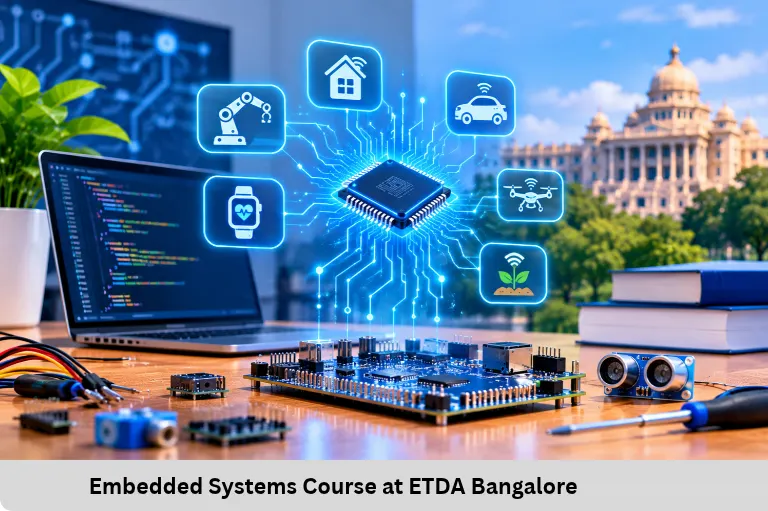
Explore the Embedded Systems course at Embedded Tech Development Academy (ETDA) Bangalore, covering Embedded C, ARM, RTOS, Embedded Linux, Internet of Things (IoT), projects, and career opportunities.
- Embedded Systems Course at ETDA Bangalore
-
Comprehensive Guide to the Embedded Systems Course at Embedded Tech Development Academy
- Introduction – Embedded Systems Course
- Embedded Systems Course Curriculum
- Microcontroller Architecture and Programming
- Real-Time Operating Systems and Embedded Linux
- Embedded System Design and Development
- Faculty and Practical Training Approach
- Admissions and Eligibility Requirements
- Certification and Career Opportunities
- Why Choose Embedded Tech Development Academy?
-
Frequently Asked Questions
- What is an Embedded Systems course?
- Who can join an Embedded Systems course at ETDA?
- What programming languages are required for Embedded Systems?
- What topics are covered in Embedded Systems training?
- What career opportunities are available after Embedded Systems training?
- Does ETDA provide placement support for Embedded Systems training?
- Conclusion
Comprehensive Guide to the Embedded Systems Course at Embedded Tech Development Academy
Introduction – Embedded Systems Course
Embedded Systems are the foundation of modern intelligent electronics, powering automotive ECUs, industrial automation equipment, medical devices, robotics, consumer electronics, and Internet of Things (IoT) applications. Unlike general-purpose computers, Embedded Systems are designed to perform dedicated functions using microcontrollers, processors, firmware, sensors, and communication interfaces. Developing these systems requires a combination of programming knowledge, electronic hardware understanding, real-time processing, and debugging skills.
The Embedded Systems course at Embedded Tech Development Academy (ETDA) is designed for engineering graduates, students, and aspiring firmware developers who want to develop practical technical skills. The training focuses on Embedded C programming, microcontroller architecture, peripheral interfacing, RTOS concepts, Embedded Linux, communication protocols, and hardware-oriented software development. These technologies help learners understand how firmware interacts directly with electronic components.
With growing demand for automotive embedded software, industrial Internet of Things (IoT), robotics, and connected devices, structured technical training can help students build a strong foundation. Learners searching for the Top Embedded Training Institute in Bangalore can explore Embedded Tech Development Academy (ETDA)‘s practical approach to Embedded Systems education, project development, and assured placement support. The program emphasizes technical understanding, implementation, debugging, and industry-oriented preparation.
Embedded Systems Course Curriculum
The curriculum combines programming fundamentals, hardware architecture, peripheral communication, operating systems, and practical implementation. Students progressively learn how to develop firmware for microcontrollers and integrate software with external electronic devices.
Introduction to Embedded Systems
Students understand embedded architecture, hardware-software interaction, firmware development, and real-time applications.
Core Concepts
Embedded processors and microcontrollers
Firmware and boot processes
Memory architecture: RAM, ROM, Flash, EEPROM
Interrupts and polling
Real-time constraints and resource management
Practical Understanding
Learners identify embedded components and understand how firmware controls sensors, actuators, and peripheral devices.
Microcontroller Architecture and Programming
Microcontroller programming introduces processor architecture, registers, memory maps, GPIO, timers, and peripheral controllers.
Students explore ARM Cortex-M architecture, clock configuration, interrupt handling, and register-level programming. These concepts are essential for developing reliable Embedded Systems applications.
Embedded C Programming
Embedded C is a fundamental skill for firmware developers. The course covers pointers, arrays, structures, unions, bitwise operators, storage classes, and memory management.
Advanced Embedded C Concepts
Register manipulation using bitwise operations
Volatile and const keywords
Interrupt service routines
Function pointers and callbacks
Bit fields and memory-efficient coding
Hardware-Oriented Programming
Students learn to configure registers, access memory-mapped peripherals, and develop firmware for GPIO, ADC, PWM, UART, SPI, and I2C interfaces.
Real-Time Operating Systems and Embedded Linux
Real-Time Operating Systems
RTOS provides task scheduling, synchronization, communication, and predictable execution for time-critical Embedded Systems.
The curriculum introduces task creation, scheduling algorithms, priorities, semaphores, mutexes, queues, and software timers.
RTOS Implementation
Students understand preemptive scheduling, cooperative scheduling, context switching, and interrupt-driven task execution.
Practical RTOS Applications
A practical project may involve reading sensor data, processing inputs, and controlling actuators using multiple tasks in FreeRTOS.
Device Drivers and Interrupts
Device drivers enable software to communicate with hardware peripherals. Students understand interrupt controllers, interrupt priorities, register configuration, and peripheral initialization.
Driver development includes GPIO, UART, SPI, I2C, ADC, and timer interfaces. Debugging techniques help identify communication failures and timing issues.
Embedded Linux
Embedded Linux is used in gateways, industrial controllers, automotive platforms, and intelligent Internet of Things (IoT) devices.
Students explore Linux architecture, shell commands, system programming, process management, device drivers, and kernel fundamentals.
Linux Development Concepts
Processes and threads
Inter-process communication
File operations
System calls
Kernel modules and driver architecture
Linux-Based Embedded Applications
Learners understand how Linux applications communicate with hardware through device interfaces and system-level software.
Embedded System Design and Development
Interfacing with External Devices
Hardware interfacing connects microcontrollers with sensors, displays, motors, and communication modules.
Students develop applications using UART, SPI, I2C, CAN, ADC, and PWM. These interfaces are important in automotive Embedded Systems, industrial automation, and Internet of Things (IoT) devices.
System-on-Chip (SoC) Design
SoC platforms integrate processors, memory controllers, communication interfaces, and peripheral hardware into a single chip.
Students understand SoC architecture, peripheral integration, hardware abstraction, and processor-based embedded design.
Embedded Projects and Practical Development
Project work allows learners to combine programming, hardware interfacing, and debugging techniques.
Example projects include:
Sensor monitoring using ARM microcontrollers
UART-based communication applications
FreeRTOS-based multitasking systems
IoT sensor data acquisition
Embedded Linux hardware applications
CAN communication-based automotive projects
At Embedded Tech Development Academy (ETDA), practical Embedded Systems training helps learners connect theoretical concepts with real hardware implementation.
Faculty and Practical Training Approach
Embedded Systems training requires instructors who understand programming, microcontroller architecture, hardware debugging, and firmware development.
Embedded Tech Development Academy (ETDA) emphasizes practical learning through laboratory exercises, technical assignments, programming practice, and project implementation. Learners can strengthen their understanding of memory management, communication protocols, real-time execution, and debugging workflows.
Students seeking the Top Embedded Training Institute in Bangalore should evaluate technical depth, practical exposure, project opportunities, and trainer experience before selecting a course.
Admissions and Eligibility Requirements
Engineering graduates and students from relevant technical backgrounds can pursue Embedded Systems training.
A basic understanding of C programming and digital electronics is beneficial. Beginners can strengthen their programming foundation before progressing into microcontroller development.
Typical preparation includes:
C programming fundamentals
Basic electronics and digital logic
Computer architecture fundamentals
Problem-solving and programming practice
Admission requirements, course duration, and batch availability should be confirmed directly with Embedded Tech Development Academy (ETDA).
Certification and Career Opportunities
Embedded Systems certification demonstrates technical learning and project exposure. Career opportunities depend on programming ability, practical implementation, interview preparation, and engineering fundamentals.
Career Roles
Embedded Software Developer
Firmware Engineer
Embedded Linux Developer
Automotive Embedded Engineer
Internet of Things (IoT) Developer
RTOS Developer
Device Driver Engineer
Automotive, robotics, industrial automation, consumer electronics, and Internet of Things (IoT) industries require engineers who can develop and debug hardware-oriented software.
Embedded Tech Development Academy (ETDA) provides technical training with assured placement support to help learners prepare for embedded development opportunities. Students exploring the Top Embedded Training Institute in Bangalore can evaluate the curriculum, practical projects, and career preparation offered by Embedded Tech Development Academy (ETDA).
Why Choose Embedded Tech Development Academy?
Embedded Tech Development Academy (ETDA) focuses on practical Embedded Systems education, programming fundamentals, microcontroller development, and industry-oriented technical skills.
The training approach helps learners understand how firmware operates at hardware level while developing applications using Embedded C, RTOS, communication protocols, and Internet of Things (IoT) technologies.
For aspiring engineers, choosing the Top Embedded Training Institute in Bangalore involves evaluating hands-on learning, technical assessments, project development, and assured placement support. Embedded Tech Development Academy (ETDA) combines technical training with career-oriented preparation to help students build confidence in embedded engineering.
Frequently Asked Questions
What is an Embedded Systems course?
An Embedded Systems course teaches microcontroller programming, Embedded C, hardware interfacing, RTOS, communication protocols, and firmware development.
Who can join an Embedded Systems course at ETDA?
Engineering graduates and students with an interest in programming, electronics, and firmware development can explore the course. Basic C programming knowledge is beneficial.
What programming languages are required for Embedded Systems?
Embedded C is fundamental. C++, Python, and scripting languages are also useful for advanced embedded applications, testing, and automation.
What topics are covered in Embedded Systems training?
Topics include ARM microcontrollers, Embedded C, RTOS, UART, SPI, I2C, CAN, Embedded Linux, device drivers, debugging, and practical projects.
What career opportunities are available after Embedded Systems training?
Learners can prepare for roles such as Embedded Software Developer, Firmware Engineer, Automotive Embedded Engineer, Embedded Linux Developer, and IoT Developer.
Does ETDA provide placement support for Embedded Systems training?
Embedded Tech Development Academy (ETDA) provides assured placement support as part of its career-oriented training approach. Students should confirm the applicable placement terms and eligibility conditions with the academy.
Conclusion
Embedded Systems are transforming automotive electronics, industrial automation, robotics, consumer devices, and Internet of Things (IoT) applications. Developing expertise in Embedded C, ARM microcontrollers, RTOS, Embedded Linux, device drivers, communication protocols, and hardware interfacing creates a strong foundation for firmware development.
A comprehensive Embedded Systems course should combine programming fundamentals, practical laboratory exercises, real-time implementation, debugging, and project development. These skills help learners understand the complete hardware-software development process and prepare for technical responsibilities in embedded engineering.
Embedded Tech Development Academy (ETDA) offers practical Embedded Systems training with assured placement support for aspiring engineers. Students searching for the Top Embedded Training Institute in Bangalore can explore Embedded Tech Development Academy (ETDA) to strengthen their technical capabilities, develop industry-oriented projects, and prepare for careers in automotive embedded software, firmware development, industrial Internet of Things (IoT), and embedded Linux. With consistent practice and hands-on experience, learners can build the technical foundation required for long-term growth in the embedded technology industry.
Author: ETDA Trainers
Experience: 10+ Years of Industry Experience in Embedded Systems, IoT, and Embedded C Programming