
Embedded Systems Course Fees in Bangalore | ETDA
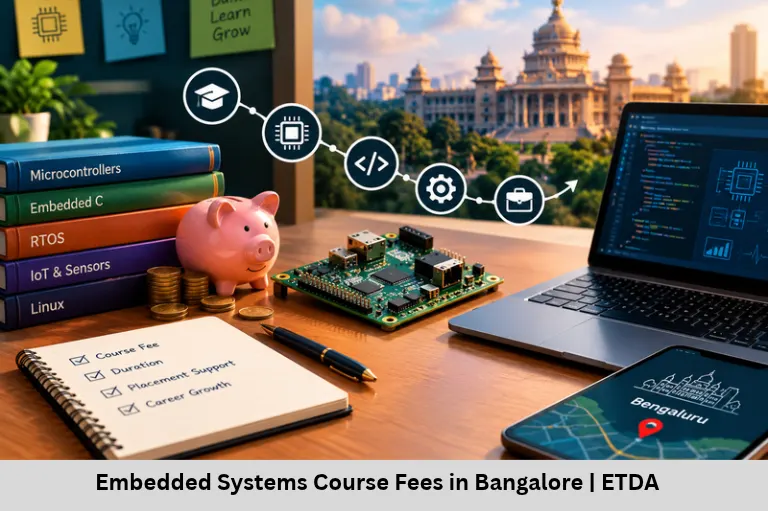
Explore embedded systems course fees in Bangalore, course syllabus, practical projects, ARM, STM32, RTOS, and placement support at Embedded Tech Development Academy (ETDA).
- Embedded Systems Course Fees in Bangalore | ETDA
-
Embedded Systems Course Fees in Bangalore: A Complete Guide for Students
- What Are Embedded Systems Course Fees in Bangalore?
- Technical Syllabus to Look for in an Embedded Systems Course
- Microcontrollers, ARM, and STM32 Training
- Communication Protocols, RTOS, and Embedded Linux
- How Projects Affect Course Value
- Why Consider ETDA for Embedded Systems Training?
- How to Choose the Right Course for Your Budget
-
Frequently Asked Questions (FAQs)
- What are embedded systems course fees in Bangalore?
- What topics should an embedded systems course cover?
- Can beginners join an embedded systems course?
- Does ETDA provide placement support?
- Is practical training important in embedded systems?
- How should I compare embedded training institutes?
- Contact ETDA
- Conclusion
Embedded Systems Course Fees in Bangalore: A Complete Guide for Students
Choosing the right embedded systems training program is an important decision for engineering students who want to build a career in firmware development, automotive electronics, Internet of Things (IoT), or robotics. Before enrolling, many students search for embedded systems course fees in Bangalore to understand the cost, technical syllabus, practical training, and placement assistance offered by different institutes.
Course fees can vary depending on the duration, trainer expertise, hardware access, programming modules, project work, and career support. Students should compare the learning outcomes instead of selecting a course based only on its price.
For students exploring a Top Embedded Training Institute in Bangalore, Embedded Tech Development Academy (ETDA) focuses on practical, industry-oriented embedded systems training. Its learning areas include C programming, Embedded C, microcontrollers, communication protocols, RTOS, debugging, and project development, alongside assured placement support.
What Are Embedded Systems Course Fees in Bangalore?
The cost of an embedded systems course depends on what the program teaches and how students gain practical experience. A course focused on introductory C programming may have a different fee structure from an advanced program covering ARM microcontrollers, RTOS, Embedded Linux, and hardware debugging
Factors That Influence Course Fees
Before comparing training institutes, consider these factors:
Course duration: Longer programs may cover more advanced topics and projects.
Technical syllabus: C, Embedded C, ARM, STM32, CAN, RTOS, and Embedded Linux require different levels of instruction.
Practical lab access: Working with development boards, sensors, and debugging equipment adds hands-on value.
Project training: Individual projects and guided troubleshooting require additional instructor time.
Trainer experience: Experienced trainers can help students understand practical engineering challenges.
Placement preparation: Coding assessments, mock interviews, resume reviews, and career guidance may be included.
Why the Lowest Fee Is Not Always the Best Value
A low-cost course may be suitable for learning basic concepts, but students who want an embedded engineering role also need coding practice, hardware interaction, and debugging experience. Compare what is included before deciding.
Questions to Ask About the Fee
Ask whether the quoted fee includes course materials, hardware lab sessions, project components, assessments, and placement support. Confirm any registration charges, taxes, instalment options, and additional expenses before enrolling.
Technical Syllabus to Look for in an Embedded Systems Course
A comprehensive course should progress from programming fundamentals to microcontroller-based applications.
C Programming and Embedded C
C is widely used for embedded firmware because it provides efficient execution and low-level control. Students should learn variables, functions, arrays, pointers, structures, bitwise operators, and memory concepts.
Embedded C training should also cover volatile, const, register access, interrupt handling, and memory-mapped peripherals.
Example of Register-Level Programming
Consider setting a particular bit in a hardware control register:
register_value |= (1U << 2);This operation sets bit 2 while preserving the other bits. Students should understand how bit manipulation is used to configure microcontroller peripherals.
Why This Foundation Matters
A strong understanding of C and Embedded C helps learners write efficient firmware, inspect hardware registers, and troubleshoot unexpected behavior.
Microcontrollers, ARM, and STM32 Training
Microcontrollers combine a processor core, memory, and peripherals in one chip. They are used in consumer electronics, automotive systems, industrial equipment, and Internet of Things (IoT) devices.
Essential Microcontroller Topics
A practical course should include:
CPU architecture and memory maps
Flash memory and SRAM
GPIO configuration
Timers and counters
ADC and PWM
Interrupts and exception handling
Clock configuration
Peripheral drivers
ARM Cortex-M and STM32
ARM Cortex-M microcontrollers are widely used in embedded applications. STM32 development boards allow students to practise GPIO control, timer configuration, ADC conversion, PWM generation, and communication with external devices.
Hands-On Development
Students should practise compiling firmware, flashing it onto a development board, setting breakpoints, inspecting registers, and verifying hardware signals. This process builds skills that theory alone cannot provide.
Communication Protocols, RTOS, and Embedded Linux
Advanced embedded systems often communicate with multiple devices and execute several operations under timing constraints.
UART, SPI, I2C, and CAN
UART is used for asynchronous serial communication. SPI supports synchronous communication with peripherals such as displays and sensors. I2C connects multiple addressed devices through shared SDA and SCL lines. CAN is widely used in automotive and industrial networks.
Students should learn signal timing, data frames, device addressing, configuration parameters, and troubleshooting techniques.
RTOS Fundamentals
A Real-Time Operating System helps organise concurrent tasks. Important topics include task scheduling, priorities, queues, semaphores, mutexes, and software timers.
Embedded Linux and IoT
Advanced modules may introduce Linux commands, processes, device drivers, cross-compilation, networking, and Internet of Things (IoT) connectivity. These subjects are useful for students interested in processor-based embedded products and connected devices.
How Projects Affect Course Value
Projects help students apply multiple technical concepts in a complete application. When comparing embedded systems course fees in Bangalore, check whether the program includes guided project development rather than only classroom explanations.
Beginner Projects
LED and push-button control
UART serial communication
Temperature monitoring
ADC-based sensor measurement
Intermediate and Advanced Projects
PWM-based motor control
SPI display interfacing
CAN communication between controllers
RTOS-based sensor monitoring
Internet of Things (IoT) data collection and transmission
Project Documentation and Testing
Students should document circuit connections, firmware logic, test cases, debugging steps, and results. This helps them explain technical decisions during interviews.
Evaluate Individual Participation
Ask whether students write and debug their own code, use development boards directly, and explain the project architecture. Genuine individual participation is more valuable than simply receiving a completed project.
Why Consider ETDA for Embedded Systems Training?
Embedded Tech Development Academy (ETDA) provides practical embedded systems training for students who want to strengthen their technical foundation and prepare for industry-oriented roles.
Structured Technical Learning
Embedded Tech Development Academy (ETDA)‘s training areas include C programming, Embedded C, C++, data structures, 8051, ARM Cortex-M, STM32, LPC1768, communication protocols, RTOS, Embedded Linux, Internet of Things (IoT), and debugging.
The value of a program depends on how effectively these subjects are taught and applied through exercises, assessments, and practical projects.
Assured Placement Support
Embedded Tech Development Academy (ETDA) offers assured placement support to help students prepare for employment opportunities. Career preparation may include technical interview practice, coding exercises, resume guidance, mock interviews, aptitude preparation, and HR interview preparation.
Students should confirm the exact placement-support terms, eligibility conditions, and services included in the program before registration.
Compare the Complete Learning Experience
When evaluating Embedded Tech Development Academy (ETDA) or any other institute, ask for the detailed syllabus, course duration, practical lab arrangements, project requirements, assessment process, total fee, and placement-support details. This allows you to make an informed decision based on your career goals and budget.
How to Choose the Right Course for Your Budget
A suitable course should match your current skill level and the role you want to pursue.
For Beginners
Start with C programming, digital electronics fundamentals, and microcontroller basics. Choose a program that introduces hardware gradually and includes regular coding exercises.
For Students With Programming Knowledge
Look for deeper coverage of Embedded C, ARM, STM32, interrupts, communication protocols, and debugging.
For Advanced Learners
If you already understand microcontrollers, consider RTOS, Embedded Linux, device drivers, automotive communication, and more complex projects.
Make an Informed Investment
Do not evaluate a course by fees alone. Compare syllabus depth, practical exposure, instructor support, project quality, and career preparation. A course that builds demonstrable skills can provide better long-term value than one chosen solely because it is inexpensive.
Frequently Asked Questions (FAQs)
What are embedded systems course fees in Bangalore?
Fees vary by course duration, syllabus, hardware access, projects, and placement services. Contact individual institutes for current prices and a complete breakdown of charges.
What topics should an embedded systems course cover?
Look for C, Embedded C, microcontrollers, ARM, STM32, GPIO, timers, interrupts, UART, SPI, I2C, CAN, RTOS, debugging, and practical projects.
Can beginners join an embedded systems course?
Yes. Beginners can start with C programming and electronics fundamentals before progressing to microcontrollers, peripheral interfacing, and firmware development.
Does ETDA provide placement support?
Yes. Embedded Tech Development Academy (ETDA) provides assured placement support. Students should confirm the specific services, eligibility requirements, and terms applicable to their chosen program.
Is practical training important in embedded systems?
Yes. Practical training helps students learn firmware compilation, hardware interfacing, peripheral configuration, testing, and debugging.
How should I compare embedded training institutes?
Compare syllabus coverage, trainer experience, lab access, project work, course duration, total fees, assessment methods, and placement-support details before enrolling.
Contact ETDA
Conclusion
Understanding embedded systems course fees in Bangalore helps students plan their training budget and compare programs based on technical depth, practical learning, and career preparation. A valuable course should teach programming, microcontrollers, communication protocols, debugging, and project development in a structured way.
For students searching for a Top Embedded Training Institute in Bangalore, Embedded Tech Development Academy (ETDA) offers practical embedded systems learning and assured placement support to help students prepare for engineering opportunities.
When comparing a Top Embedded Training Institute in Bangalore, review the complete syllabus, hardware access, project requirements, total fee, and placement-support terms. Embedded Tech Development Academy (ETDA)‘s technical learning areas can help students work toward skills relevant to firmware, automotive electronics, Internet of Things (IoT), and industrial embedded applications.
Choosing a Top Embedded Training Institute in Bangalore should be based on practical training quality and transparent course details, not promotional claims alone. Contact Embedded Tech Development Academy (ETDA) directly for the current fee structure, course schedule, syllabus, and placement-support conditions before making your decision.
Author: ETDA Trainers
Experience: 10+ Years of Industry Experience in Embedded Systems, IoT, and Embedded C Programming