
Embedded Systems Course Near Bengaluru Karnataka: Complete Guide | ETDA
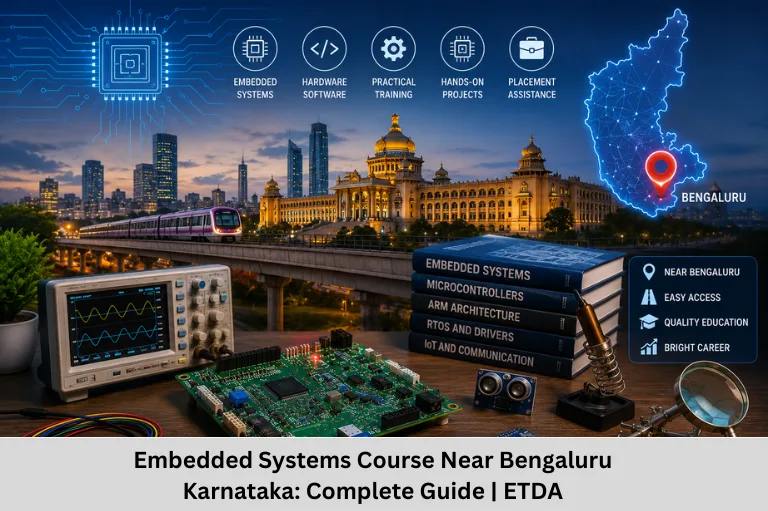
Looking for an embedded systems course near Bengaluru, Karnataka? Learn C, Embedded C, ARM, microcontrollers, UART, SPI, I2C, CAN, RTOS, projects and placement skills. Embedded Tech Development Academy (ETDA).
- Embedded Systems Course Near Bengaluru Karnataka: Complete Guide | ETDA
-
Embedded Systems Course Near Bengaluru Karnataka: Complete Technical Guide
- What Are Embedded Systems?
- Why Learn Embedded Systems in Bengaluru?
- What Does an Embedded Systems Course Cover?
- Embedded C Programming
- Microcontrollers and ARM Architecture
- GPIO, Timers, ADC and PWM
- Communication Protocols in Embedded Systems
- Interrupts and Real-Time Programming
- RTOS Training for Embedded Developers
- Embedded Linux
- Why Hands-On Projects Are Important
- How to Choose an Embedded Systems Course Near Bengaluru Karnataka
- Why Choose Embedded Tech Development Academy (ETDA)?
-
Career Opportunities After Embedded Training
- Embedded Software Engineer
- Firmware Engineer
- FAQs
- What should beginners learn in an embedded systems course?
- Is C programming important for embedded systems?
- Which microcontroller should beginners learn?
- What communication protocols should an embedded engineer know?
- Is Bengaluru a good location for learning embedded systems?
- Why are projects important in embedded training?
- Does ETDA provide placement support?
- Why choose ETDA for embedded systems training?
- Conclusion
Embedded Systems Course Near Bengaluru Karnataka: Complete Technical Guide
Embedded systems are an important part of modern technology, powering automobiles, industrial machines, medical equipment, smart appliances, robotics, consumer electronics, and Internet of Things (IoT) devices. As products become more connected and software-driven, the demand for engineers who understand both embedded programming and hardware interaction continues to grow.
For engineering students and graduates searching for an embedded systems course near Bengaluru Karnataka, choosing a technically strong training program can make a significant difference. Embedded development requires knowledge of C programming, Embedded C, microcontrollers, ARM architecture, digital electronics, communication protocols, interrupts, RTOS, debugging, and project development.
Embedded Tech Development Academy (ETDA) is a practical learning option for students looking for a Top Embedded Training Institute in Bangalore. The institute focuses on embedded technologies, hands-on technical learning, real-world projects, and assured placement support to help learners prepare for embedded software and firmware careers.
What Are Embedded Systems?
An embedded systems is a specialized computing system designed to perform a particular function within a larger electronic or mechanical product.
A typical embedded system combines:
- Hardware
- Firmware
- Microcontroller or processor
- Memory
- Sensors
- Actuators
- Communication interfaces
- Application software
Examples of Embedded Systems
Embedded systems are found in:
- Cars and electric vehicles
- Washing machines
- Medical equipment
- Smart meters
- Industrial controllers
- Security systems
- Robotics
- Drones
- Internet of Things (IoT) devices
- Smart home products
Embedded System Architecture
A simplified embedded architecture can be represented as:
Input → Processing → Output
A sensor provides input, the microcontroller processes the information using firmware, and an actuator or display produces the required output.
Hardware-Software Interaction
The key difference between embedded development and conventional application development is the close interaction between software and physical hardware.
Firmware may directly control GPIO pins, timers, ADCs, motors, displays, sensors, and communication peripherals.
Why Learn Embedded Systems in Bengaluru?
Bengaluru has a strong technology and electronics ecosystem, making embedded systems an attractive field for engineering graduates.
Opportunities Across Multiple Industries
Embedded technologies are used in:
- Automotive
- Aerospace
- Consumer electronics
- Industrial automation
- Healthcare
- Telecommunications
- Internet of Things (IoT)
- Semiconductor products
- Robotics
Growing Technical Requirements
Modern embedded products increasingly combine:
Microcontrollers + Sensors + Connectivity + Software + Cloud
Engineers therefore need practical knowledge rather than only theoretical understanding.
Importance of Industry-Oriented Training
A good embedded training program should help learners understand how a product is designed from the hardware and firmware perspective.
What Does an Embedded Systems Course Cover?
A comprehensive embedded systems course near Bengaluru Karnataka should provide a structured path from programming fundamentals to advanced embedded technologies.
C Programming
C is one of the most important programming languages for embedded development.
Students should learn:
- Variables
- Data types
- Operators
- Conditional statements
- Loops
- Functions
- Arrays
- Strings
- Pointers
- Structures
- Unions
- Enumerations
- Preprocessor directives
Pointers and Memory
Pointers are especially important in embedded programming because firmware frequently interacts with specific memory locations and hardware registers.
Understanding pointers helps students work with arrays, buffers, structures, memory addresses, and peripheral registers.
Bitwise Programming
Embedded developers frequently manipulate individual bits.
These operations can be used for configuring individual bits within registers.
Embedded C Programming
After learning C fundamentals, students need to understand how C is applied to resource-constrained hardware.
Important Embedded C Concepts
A technical course should cover:
volatile- Bit manipulation
- Memory-mapped I/O
- Registers
- Interrupt service routines
- Fixed-width data types
- Peripheral programming
- Static memory concepts
Understanding Volatile
The volatile keyword is important when a value can change independently of normal program flow, such as hardware registers or variables modified by interrupt routines.
Register-Level Programming
Understanding registers gives students insight into how microcontroller peripherals actually operate.
Instead of treating a peripheral as a black box, developers can understand:
Clock → Register Configuration → Peripheral Operation → Status → Data
Microcontrollers and ARM Architecture
Microcontrollers are the core of many embedded products.
What Is a Microcontroller?
A microcontroller integrates several components into a single chip, including:
- CPU
- Flash memory
- SRAM
- GPIO
- Timers
- ADC
- PWM
- Communication peripherals
- Interrupt controller
ARM Cortex-M
ARM Cortex-M processors are widely used in microcontroller-based embedded systems.
Learners may encounter:
- Cortex-M0
- Cortex-M0+
- Cortex-M3
- Cortex-M4
- Cortex-M7
Practical Microcontroller Programming
Students should learn how to configure:
- GPIO
- Timers
- PWM
- ADC
- Interrupts
- UART
- SPI
- I2C
- CAN
This creates the foundation for real embedded application development.
GPIO, Timers, ADC and PWM
Microcontroller peripherals form the foundation of embedded firmware.
GPIO
GPIO allows the microcontroller to read digital inputs and control digital outputs.
Applications include:
- LEDs
- Push buttons
- Relays
- Digital sensors
Timers
Timers can generate precise timing events.
They are used for:
- Delays
- Periodic interrupts
- Event counting
- Input capture
- Output compare
PWM
Pulse Width Modulation is commonly used for:
- Motor speed control
- LED brightness
- Servo control
- Power control
ADC
ADC converts analog signals into digital values.
It is useful for interfacing with:
- Temperature sensors
- Light sensors
- Potentiometers
- Pressure sensors
- Battery monitoring circuits
Communication Protocols in Embedded Systems
Communication protocols are an essential part of embedded training.
UART
UART is an asynchronous serial communication protocol.
It is commonly used for:
- Debugging
- GPS
- Bluetooth modules
- Serial communication
Students should understand:
- Baud rate
- Start bit
- Stop bit
- Parity
- Transmit
- Receive
- UART interrupts
SPI
SPI is a synchronous serial protocol commonly used for high-speed peripheral communication.
Typical signals include:
- SCLK
- MOSI
- MISO
- CS
SPI Applications
SPI can be used with:
- Displays
- Flash memory
- Sensors
- ADCs
- DACs
SPI Modes
Students should understand CPOL and CPHA and the four standard SPI modes because peripheral devices may require specific timing configurations.
I2C
I2C uses two primary lines:
- SDA
- SCL
It supports multiple addressed devices on a shared bus.
Important concepts include:
- START condition
- STOP condition
- ACK
- NACK
- Addressing
- Repeated START
- Clock stretching
CAN
CAN is especially important in automotive embedded systems.
Students should understand:
- CAN frames
- Identifiers
- Arbitration
- Error handling
- CAN controllers
- Multi-node communication
Interrupts and Real-Time Programming
Embedded systems frequently need to respond to events immediately.
What Is an Interrupt?
An interrupt allows a hardware or software event to temporarily interrupt the normal execution flow.
A simplified sequence is:
Event → Interrupt Request → CPU → ISR → Return
Interrupt Service Routine
An ISR should generally be short and efficient.
Students should understand:
- Interrupt vectors
- Interrupt priorities
- ISR execution
- Interrupt latency
- Nested interrupts
Real-Time Requirements
Many embedded systems have deadlines. Missing an important timing requirement can result in incorrect system behavior.
This is why real-time programming is an important part of embedded engineering.
RTOS Training for Embedded Developers
A Real-Time Operating System (RTOS) helps manage multiple tasks in embedded applications.
Important RTOS Concepts
Students should learn:
- Tasks
- Scheduling
- Priorities
- Semaphores
- Mutexes
- Queues
- Event groups
- Software timers
Example RTOS Application
A monitoring system could contain:
Sensor Task → Processing Task → Communication Task → Display Task
The RTOS scheduler manages task execution according to priorities and timing requirements
Why RTOS Matters
RTOS knowledge is particularly useful for complex applications involving multiple concurrent activities.
Embedded Linux
Embedded Linux provides another pathway for engineers who want to work with processor-based embedded platforms.
Embedded Linux Fundamentals
Important areas include:
- Linux commands
- Processes
- Threads
- Shell scripting
- File systems
- Cross-compilation
- Boot process
- Device drivers
Embedded Linux Applications
Embedded Linux is used in:
- Internet of Things (IoT) gateways
- Smart cameras
- Industrial systems
- Networking devices
- Automotive platforms
Bare Metal vs Embedded Linux
Bare-metal firmware typically runs directly on a microcontroller without a general-purpose operating system.
Embedded Linux provides features such as multitasking, networking, file systems, and a larger software ecosystem.
Why Hands-On Projects Are Important
Theory alone cannot make someone an effective embedded developer.
Beginner Projects
Students can start with:
- LED controller
- Digital clock
- Traffic light controller
- UART terminal
- Temperature monitoring system
Intermediate Projects
Examples include:
- I2C sensor interface
- SPI display controller
- EEPROM data logger
- CAN communication system
- Motor controller
Advanced Projects
Advanced learners can work on:
- RTOS-based applications
- Internet of Things (IoT) devices
- Automotive communication systems
- Embedded Linux applications
- Industrial automation controllers
Project Benefits
Projects help students develop:
- Debugging skills
- Driver development skills
- Hardware understanding
- Communication protocol knowledge
- Problem-solving ability
- System design skills
How to Choose an Embedded Systems Course Near Bengaluru Karnataka
Before joining a course, students should evaluate its technical depth and practical approach.
Check the Curriculum
Look for coverage of:
- C Programming
- Embedded C
- Microcontrollers
- ARM
- Communication protocols
- RTOS
- Embedded Linux
- Debugging
- Projects
Check Practical Exposure
A good program should provide opportunities to work with actual microcontrollers and peripherals.
Check Placement Support
Students should also consider:
- Technical interview training
- Coding assessments
- Resume support
- Mock interviews
- Aptitude preparation
- Career guidance
For students looking for a Top Embedded Training Institute in Bangalore, Embedded Tech Development Academy (ETDA) combines technical training with assured placement support.
Why Choose Embedded Tech Development Academy (ETDA)?
Embedded Tech Development Academy (ETDA) focuses on practical embedded systems education for engineering students, graduates, and aspiring embedded professionals.
Technical Curriculum
The training can cover:
- C Programming
- Embedded C
- C++
- Data Structures
- ARM Cortex-M
- STM32
- LPC1768
- GPIO
- Timers
- ADC
- PWM
- UART
- SPI
- I2C
- CAN
- Ethernet
- RTOS
- Embedded Linux
- Internet of Things (IoT)
Practical Learning
Students can develop firmware and work with microcontroller peripherals to understand how hardware and software interact.
Assured Placement Support
Embedded Tech Development Academy (ETDA) provides assured placement support, including:
- Technical interview preparation
- Resume preparation
- Embedded C coding practice
- Mock interviews
- Aptitude preparation
- HR interview preparation
- Career guidance
Career Opportunities After Embedded Training
An embedded systems course can prepare learners for multiple technical roles.
Embedded Software Engineer
Develops software and firmware for embedded products.
Firmware Engineer
Works at the low-level interface between software and hardware.
Automotive Embedded Engineer
Works with ECUs, CAN communication, diagnostics, and automotive electronic systems.
IoT Embedded Developer
Develops connected devices using microcontrollers, sensors, communication technologies, and networking.
Device Driver Developer
Develops software that allows operating systems to communicate with hardware peripherals.
FAQs
What should beginners learn in an embedded systems course?
Beginners should start with C programming, digital electronics, Embedded C, microcontrollers, GPIO, timers, interrupts, and basic communication protocols such as UART, SPI, and I2C.
Is C programming important for embedded systems?
Yes. C is one of the most widely used languages for embedded firmware because it provides efficient memory and hardware control.
Which microcontroller should beginners learn?
ARM Cortex-M-based microcontrollers are a strong starting point. Learners may work with platforms such as STM32 and LPC1768 depending on the training curriculum.
What communication protocols should an embedded engineer know?
UART, SPI, I2C, and CAN are important protocols. Ethernet can be added for networked embedded applications.
Is Bengaluru a good location for learning embedded systems?
Bengaluru has a strong technology and electronics ecosystem, making it a suitable location for students seeking embedded systems education and related career opportunities.
Why are projects important in embedded training?
Projects demonstrate the practical application of programming, microcontrollers, peripherals, communication protocols, and debugging techniques.
Does ETDA provide placement support?
Yes. Embedded Tech Development Academy (ETDA) provides assured placement support, including technical interview preparation, resume guidance, coding practice, mock interviews, aptitude preparation, and career guidance.
Why choose ETDA for embedded systems training?
Embedded Tech Development Academy (ETDA) focuses on practical embedded technologies such as C, Embedded C, ARM, STM32, LPC1768, UART, SPI, I2C, CAN, RTOS, Embedded Linux, and Internet of Things (IoT), making it an option for learners looking for a Top Embedded Training Institute in Bangalore with placement-focused technical training.
Conclusion
Finding the right embedded systems course near Bengaluru Karnataka is an important decision for engineering students who want to build careers in embedded software, firmware, automotive electronics, Internet of Things (IoT), industrial automation, and related fields.
A technically strong learning path should begin with C programming and digital electronics, followed by Embedded C, microcontrollers, ARM architecture, GPIO, timers, ADC, PWM, interrupts, UART, SPI, I2C, CAN, debugging, RTOS, and Embedded Linux. Practical projects should be included throughout the learning process so students can apply these concepts to real hardware.
For learners searching for a Top Embedded Training Institute in Bangalore, Embedded Tech Development Academy (ETDA) provides practical technical training covering embedded programming, ARM microcontrollers, communication protocols, RTOS, Embedded Linux, Internet of Things (IoT), and project development. Embedded Tech Development Academy (ETDA) also provides assured placement support to help students prepare for technical interviews and career opportunities.
Choosing a Top Embedded Training Institute in Bangalore should therefore be based on technical curriculum, hands-on exposure, project experience, trainer support, and career preparation—not simply the duration or price of the course.
Author: ETDA Trainers
Experience: 10+ Years of Industry Experience in Embedded Systems, IoT, and Embedded C Programming