
Functional Safety in Automotive Embedded Systems
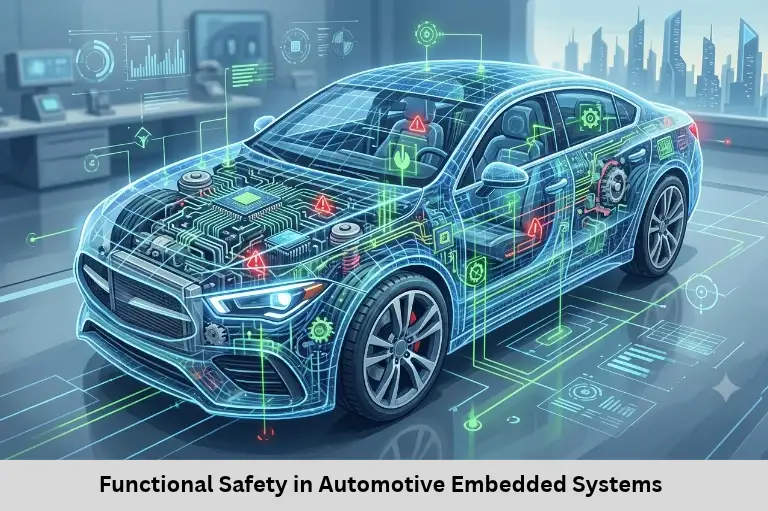
Learn functional safety in automotive embedded systems, ISO 26262, ASIL levels, safety mechanisms, automotive ECUs, and career opportunities with Embedded Tech Development Academy (ETDA).
- Functional Safety in Automotive Embedded Systems
-
Functional Safety in Automotive Embedded Systems: A Complete Guide
- Functional Safety in Automotive Embedded Systems
- What Is Functional Safety in Automotive Embedded Systems?
- Understanding ISO 26262 Automotive Functional Safety Standard
- Automotive Safety Integrity Levels (ASIL)
- Safety Mechanisms Used in Automotive Embedded Systems
- Role of Embedded C and RTOS in Automotive Functional Safety
- Automotive Communication Protocols and Functional Safety
- Career Opportunities in Automotive Functional Safety
- Learn Automotive Embedded Systems at Embedded Tech Development Academy
- Frequently Asked Questions
- Conclusion
Functional Safety in Automotive Embedded Systems: A Complete Guide
Functional Safety in Automotive Embedded Systems
Functional safety in automotive embedded systems is one of the most important engineering concepts behind modern vehicle technology. Today’s cars use electronic control units (ECUs), sensors, microcontrollers, and software to manage critical operations such as braking, steering, engine control, and airbag deployment. These systems must operate reliably even when hardware failures or software errors occur.
For engineering students interested in automotive embedded systems, understanding functional safety creates opportunities to explore advanced automotive technologies. Embedded Tech Development Academy (ETDA) helps students develop practical knowledge of embedded programming, microcontrollers, communication protocols, and real-time applications. Students aspiring to become automotive embedded engineers can strengthen their technical foundation through hands-on learning and assured placement support. For students looking for a Top Embedded Training Institute in Bangalore, learning functional safety alongside embedded programming can provide valuable industry-oriented exposure.
What Is Functional Safety in Automotive Embedded Systems?
Functional safety refers to the ability of an electrical or electronic system to perform its intended functions safely, even when faults occur. In automotive applications, it focuses on identifying dangerous failures and implementing mechanisms that prevent them from causing unacceptable risks.
For example, consider an electronic braking system. If the brake controller receives incorrect sensor information or experiences a software malfunction, the vehicle must not lose braking capability without warning. Functional safety engineering introduces diagnostic mechanisms, redundant components, fault detection, and safe-state transitions to reduce these risks.
Automotive embedded systems combine hardware and software to achieve these safety objectives. Engineers must understand how microcontrollers execute control algorithms, how sensors provide feedback, and how communication networks transfer safety-related information.
Why Functional Safety Is Important
Functional safety is essential because vehicle electronics directly influence passenger safety, vehicle stability, and road safety. A software defect or hardware malfunction in a safety-critical ECU can potentially result in serious consequences.
Modern vehicles contain interconnected electronic systems, making safety engineering increasingly complex. Electric vehicles, advanced driver assistance systems (ADAS), and autonomous driving technologies require additional safety considerations.
Functional safety helps engineers:
Identify potential hardware and software failures.
Reduce risks associated with electronic control systems.
Detect faults before they cause dangerous situations.
Implement reliable fault-handling mechanisms.
Maintain predictable system behaviour during abnormal conditions.
Understanding ISO 26262 Automotive Functional Safety Standard
ISO 26262 is the international functional safety standard for road vehicles’ electrical and electronic systems. It provides guidelines for managing safety throughout the automotive product lifecycle, from concept development to hardware design, software implementation, testing, production, and maintenance.
The standard encourages systematic safety engineering instead of depending only on final product testing.
ISO 26262 Development Lifecycle
The ISO 26262 lifecycle includes several important activities:
Hazard analysis and risk assessment.
Functional safety concept development.
Technical safety requirements.
Hardware and software safety design.
Verification and validation.
Safety assessment and documentation.
Automotive engineers must understand how safety requirements influence ECU architecture, software design, and hardware selection.
Hazard Analysis and Risk Assessment (HARA)
HARA identifies potential hazards caused by malfunctioning electrical or electronic systems. Engineers evaluate the severity of consequences, exposure to operational situations, and controllability by the driver.
These assessments help determine the Automotive Safety Integrity Level required for a particular safety function.
Automotive Safety Integrity Levels (ASIL)
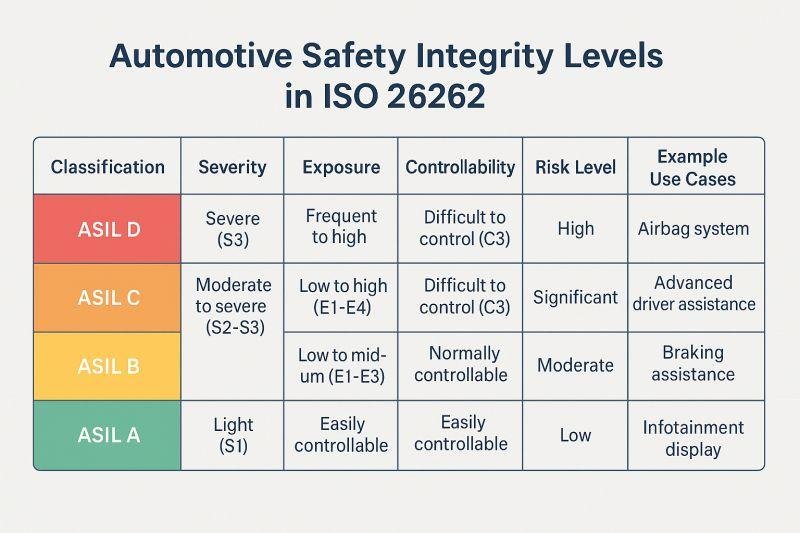
ASIL is a risk classification system defined by ISO 26262. It determines the level of safety rigor required during development and verification.
ASIL Level | Safety Requirement |
|---|---|
ASIL A | Lowest safety integrity requirements |
ASIL B | Moderate safety integrity requirements |
ASIL C | High safety integrity requirements |
ASIL D | Highest safety integrity requirements |
ASIL determination depends on severity, exposure, and controllability rather than simply the complexity of the ECU.
For example, an airbag deployment controller may require a higher safety integrity level than a non-critical infotainment feature. Engineers must ensure that safety mechanisms and verification activities match the assigned ASIL.
Safety Goals and Safety Requirements
Safety goals describe the high-level objectives established after hazard analysis. These goals are subsequently translated into functional and technical safety requirements.
For example, a safety goal for an electronic braking system may require maintaining adequate braking functionality during a detected controller fault. Engineers convert this goal into measurable requirements involving hardware diagnostics, software monitoring, and fault response.
Safety Mechanisms Used in Automotive Embedded Systems
Safety mechanisms help automotive ECUs detect, prevent, or control failures. They are implemented through hardware architecture, embedded software, diagnostic algorithms, and system-level monitoring.
Watchdog Timer
A watchdog timer monitors whether the microcontroller executes software correctly within an expected time interval. If the software becomes stuck or fails to refresh the watchdog, the timer triggers a reset or another configured recovery mechanism.
Engineers commonly use watchdogs in automotive microcontrollers to detect execution failures and recover from abnormal software behaviour.
Memory Protection and ECC
Automotive controllers must protect critical software and data against memory-related failures.
Error Correcting Code (ECC) detects and, in supported configurations, corrects certain memory errors. Memory protection mechanisms help prevent unintended access between software components or memory regions.
These techniques improve the reliability of embedded systems operating in safety-critical environments.
Redundancy and Fault Detection
Redundancy involves using additional hardware or independent processing paths to improve fault tolerance. Depending on the safety architecture, engineers may implement redundant sensors, processing channels, or communication paths.
For example, a safety-critical controller may compare measurements from multiple sensors to identify inconsistent readings.
Safe State and Fail-Safe Operation
A safe state is a condition in which the system reduces risk after detecting a dangerous fault. Depending on the application, this may involve disabling a particular function, switching to degraded operation, or activating an alternative control strategy.
The safe response must be carefully designed because simply switching off an ECU may itself create a dangerous situation.
Role of Embedded C and RTOS in Automotive Functional Safety
Embedded C is widely used in automotive software development because it supports efficient, predictable programming for microcontrollers.
Engineers use Embedded C to develop peripheral drivers, sensor interfaces, diagnostic routines, control algorithms, and communication modules. Understanding pointers, memory management, interrupts, bitwise operations, and register-level programming is essential for developing reliable ECU software.
Real-Time Operating Systems (RTOS) support task scheduling, synchronization, timing management, and resource allocation. Automotive software may require multiple tasks to execute within defined deadlines.
Students learning automotive embedded systems should understand:
Interrupt handling and priority management.
Task scheduling and execution timing.
Mutexes, semaphores, and synchronization.
Stack usage and memory limitations.
Hardware peripheral configuration.
Real-time debugging and fault analysis.
At Embedded Tech Development Academy (ETDA), practical exposure to Embedded C, microcontrollers, RTOS concepts, and communication protocols helps students build the technical foundation required to understand automotive ECU development.
Automotive Communication Protocols and Functional Safety
Automotive ECUs communicate through several protocols depending on system requirements.
CAN Communication
Controller Area Network (CAN) is extensively used for communication between automotive electronic control units. It supports reliable message transmission, error detection, arbitration, and fault handling.
CAN-based systems may incorporate safety-related communication mechanisms such as message counters, timeouts, and data integrity checks.
LIN and Automotive Ethernet
LIN is commonly used for lower-cost communication between automotive components, including window controls and seat electronics.
Automotive Ethernet supports higher bandwidth requirements in advanced automotive applications, including ADAS, diagnostics, and data-intensive electronic architectures.
Internet of Things (IoT) technologies and connected vehicle systems also introduce additional communication and cybersecurity considerations. Although functional safety and cybersecurity are distinct engineering disciplines, they can interact when communication failures or security attacks affect vehicle safety.
Career Opportunities in Automotive Functional Safety
Functional safety knowledge can support students pursuing careers in automotive embedded engineering.
Common career opportunities include:
Automotive Embedded Software Engineer.
ECU Software Developer.
Functional Safety Engineer.
Automotive Verification and Validation Engineer.
Embedded Test Engineer.
Automotive System Engineer.
Students should build programming skills before moving into advanced safety engineering. A strong understanding of C programming, microcontrollers, communication protocols, and debugging makes it easier to understand safety-related software development.
For students searching for a Top Embedded Training Institute in Bangalore, Embedded Tech Development Academy (ETDA) provides an opportunity to develop practical embedded systems knowledge through technical training and project-oriented learning.
Learn Automotive Embedded Systems at Embedded Tech Development Academy
Embedded Tech Development Academy (ETDA) supports aspiring engineers who want to develop industry-oriented embedded programming skills.
Students can strengthen their understanding of:
Embedded C programming and microcontroller architecture.
Peripheral interfacing and register-level programming.
UART, SPI, I2C, and CAN communication.
RTOS fundamentals and task scheduling.
Embedded Linux and device driver concepts.
Practical embedded projects and debugging.
These skills are valuable starting points for students interested in automotive ECUs, industrial automation, robotics, and Internet of Things (IoT) applications.
Embedded Tech Development Academy (ETDA) combines technical learning with practical exposure and assured placement support to help students prepare for embedded engineering opportunities. Students searching for a Top Embedded Training Institute in Bangalore can explore training that builds a foundation for automotive embedded development.
Frequently Asked Questions
What is functional safety in automotive embedded systems?
Functional safety ensures that automotive electronic systems operate safely even when hardware failures, software faults, or unexpected conditions occur. It involves risk assessment, safety requirements, diagnostics, and fault-handling mechanisms.
What is ISO 26262?
ISO 26262 is an international standard that defines functional safety requirements for electrical and electronic systems in road vehicles. It covers the complete safety lifecycle, including design, development, verification, and validation.
What are ASIL A, B, C, and D?
ASIL represents Automotive Safety Integrity Level. ASIL A has the lowest safety integrity requirements, while ASIL D represents the highest. The assigned level depends on the risk associated with a particular automotive safety function.
Which programming language is used in automotive embedded systems?
Embedded C is widely used for automotive ECU programming. C++, assembly language, and other technologies are also used depending on the software architecture and application requirements.
Is functional safety a good career option for embedded engineers?
Yes. Functional safety is an important specialization in automotive software development, particularly in braking, steering, airbags, powertrain, and ADAS applications. Knowledge of Embedded C, microcontrollers, testing, and ISO 26262 can support career development.
Can beginners learn automotive embedded systems at ETDA?
Yes. Students can begin with programming fundamentals, Embedded C, microcontrollers, and communication protocols before progressing toward automotive applications. Embedded Tech Development Academy (ETDA) offers practical embedded training and assured placement support for students pursuing embedded engineering careers.
Conclusion
Functional safety in automotive embedded systems is essential for developing reliable and safety-critical vehicle electronics. Understanding ISO 26262, ASIL classifications, watchdog timers, memory protection, redundancy, and fault handling helps engineers understand how modern automotive ECUs achieve safe operation.
For students, developing strong Embedded C, microcontroller, RTOS, and communication protocol skills is an important first step toward automotive embedded engineering. Embedded Tech Development Academy (ETDA) helps aspiring engineers strengthen these fundamentals through practical training, project exposure, and assured placement support. Students looking for a Top Embedded Training Institute in Bangalore can build their embedded engineering foundation at Embedded Tech Development Academy (ETDA) and prepare for opportunities in automotive embedded systems, Internet of Things (IoT), and other technology-driven industries.
Author: ETDA Trainers
Experience: 10+ Years of Industry Experience in Embedded Systems, IoT, and Embedded C Programming