
Functions in C Programming: Types, Declaration and Definition | ETDA
Learn functions in C Programming with examples. Understand function types, declaration, definition, and applications with practical training at Embedded Tech Development Academy (ETDA).
- Functions in C Programming: Types, Declaration and Definition | ETDA
-
Functions in C Programming: Types, Declaration and Definition | ETDA
- What Are Functions in C Programming?
- Components of a Function
- Types of Functions in C
- Types of User-Defined Functions
- Advantages of Using Functions
- Real-World Applications of Functions
- Learn C Programming at ETDA
- Function Parameters and Return Types
- Recursion in C Programming
- Functions in Embedded Systems
- Common Mistakes Beginners Should Avoid
- Career Benefits of Learning Functions in C
- Why Learn C Programming at ETDA?
- Assured Placement Support at ETDA
-
Frequently Asked Questions (FAQs)
- What is a function in C Programming?
- What is the difference between function declaration and function definition?
- What are the different types of functions in C?
- Why are functions important in Embedded Systems?
- What is recursion in C Programming?
- Does ETDA provide practical C Programming training?
- What projects can I build after learning functions in C?
- Does ETDA provide placement support after C Programming training?
- Conclusion
Functions in C Programming: Types, Declaration and Definition | ETDA
Functions are one of the most important concepts in C Programming. They help programmers write organized, reusable, and efficient code by breaking a large program into smaller, manageable sections. Whether you’re developing simple console applications or complex embedded firmware, functions play a vital role in improving code readability, maintenance, and debugging.
Every engineering student learning C Programming should understand how functions work because they are widely used in software development, embedded systems, Internet of Things (IoT) applications, robotics, and industrial automation. Most technical interviews also include questions on function declaration, function definition, parameter passing, and return values.
If you’re planning to build a career in Embedded Systems, mastering functions is essential. At Embedded Tech Development Academy (ETDA), students gain practical knowledge of C Programming through coding exercises, real-time projects, and hardware-based applications. As a Top Embedded Training Institute in Bangalore, Embedded Tech Development Academy (ETDA) provides industry-oriented training with assured placement support, helping students become job-ready embedded engineers.
What Are Functions in C Programming?
A function is a self-contained block of code that performs a specific task. Instead of writing the same code repeatedly, programmers can write it once inside a function and call it whenever needed.
Functions improve the modularity of programs and make large applications easier to understand and maintain.
For example, instead of writing code for calculating the average of marks multiple times, you can create a function that performs the calculation whenever it is called.
Why Are Functions Important?
Functions provide several advantages that make programming more efficient.
Code Reusability
A function can be called multiple times without rewriting the same logic.
Better Readability
Breaking a large program into smaller functions makes the code easier to understand.
Easier Debugging
If an error occurs, developers can focus on the specific function instead of searching through the entire program.
Simplified Maintenance
Updating a function automatically updates every place where that function is called.
Components of a Function
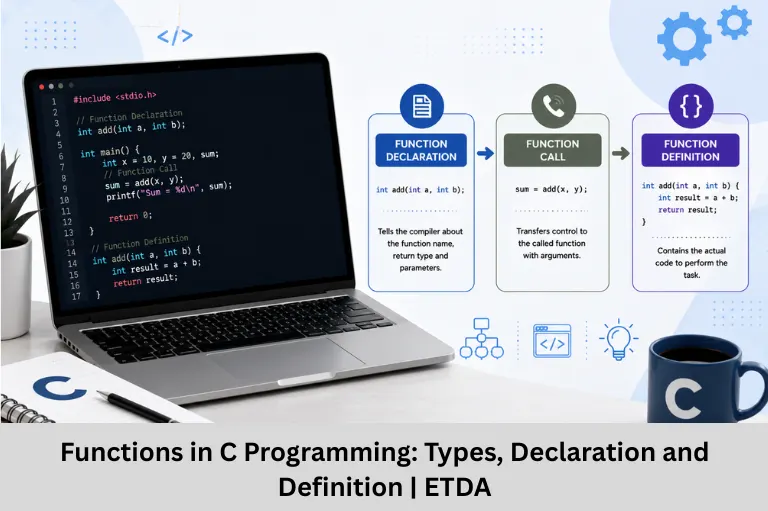
Every function in C consists of three important parts.
Function Declaration
A function declaration informs the compiler about the function’s name, return type, and parameters before it is used.
It is also known as a function prototype.
Purpose of Function Declaration
- Helps the compiler verify function calls.
- Improves program organization.
- Allows functions to be defined later in the program.
Function Definition
A function definition contains the actual code that performs a task.
It specifies:
- Function name
- Return type
- Parameters
- Statements to execute
The function definition is where the logic of the program is implemented.
Function Call
A function call executes the function whenever it is needed.
Instead of rewriting code, programmers simply call the function by its name.
Benefits
- Saves development time
- Reduces code duplication
- Improves program structure
Types of Functions in C
Functions in C are broadly classified into two categories.
Library Functions
Library functions are predefined functions provided by the C Standard Library.
Examples include functions for:
- Input and output
- String manipulation
- Mathematical calculations
- Memory management
- File handling
These functions reduce development time by providing ready-to-use functionality.
User-Defined Functions
User-defined functions are created by programmers to perform specific tasks.
Examples
- Calculating student grades
- Finding the largest number
- Controlling LEDs in embedded systems
- Reading sensor values
- Motor control
- Password validation
User-defined functions improve code modularity and make programs easier to maintain.
Types of User-Defined Functions
User-defined functions are categorized based on whether they accept parameters and return values.
Function Without Arguments and Without Return Value
This type performs a task without receiving input or returning output.
Suitable For
- Displaying menus
- Printing messages
- LED blinking
- System initialization
Function With Arguments but Without Return Value
These functions receive input values but do not return a result.
Applications
- Displaying reports
- Configuring peripherals
- Sending communication data
- Controlling hardware devices
Function Without Arguments but With Return Value
These functions do not take input but return a calculated value.
Common Uses
- Reading sensor values
- System status checking
- Device identification
Function With Arguments and Return Value
This is the most commonly used type of function.
Applications
- Mathematical calculations
- Data processing
- Searching algorithms
- Sorting algorithms
- Embedded firmware operations
These functions provide maximum flexibility and reusability.
Advantages of Using Functions
Functions make software development more organized and efficient.
Reduces Code Duplication
Instead of writing identical code multiple times, programmers write it once and reuse it throughout the program.
Improves Program Structure
Functions divide a large application into smaller logical modules.
This makes the program easier to understand and maintain.
Encourages Team Development
Large software projects involve multiple developers.
Functions allow different team members to work on different modules simultaneously.
Simplifies Testing
Each function can be tested independently before integrating it into the complete application.
This improves software quality and reliability.
Real-World Applications of Functions
Functions are used in almost every software and embedded application.
Embedded Systems
Examples include:
- GPIO Control
- Timer Configuration
- ADC Reading
- PWM Generation
- UART Communication
- SPI Communication
- I2C Communication
- CAN Communication
Internet of Things (IoT)
Functions are used for:
- Sensor Data Collection
- Cloud Communication
- Wi-Fi Configuration
- Bluetooth Communication
- Device Monitoring
Robotics
Functions help manage:
- Motor Control
- Distance Measurement
- Object Detection
- Navigation
- Servo Control
Industrial Automation
Applications include:
- PLC Programming
- Process Monitoring
- Machine Control
- Alarm Systems
Learn C Programming at ETDA
At Embedded Tech Development Academy (ETDA), students learn C Programming through practical coding exercises rather than theory alone. The curriculum is designed to build a strong programming foundation before progressing to Embedded C, ARM Programming, RTOS, and Internet of Things (IoT).
As a Top Embedded Training Institute in Bangalore, Embedded Tech Development Academy (ETDA) offers hands-on training in:
Core Programming Concepts
- Variables and Data Types
- Operators
- Decision Making
- Loops
- Functions
- Arrays
- Strings
- Pointers
- Structures
- File Handling
Embedded Technologies
- Embedded C
- STM32 Programming
- ARM Cortex-M
- UART
- SPI
- I2C
- CAN
- RTOS
- Embedded Linux
Students also work on real-time embedded projects that strengthen their practical programming skills.
Function Parameters and Return Types
Function parameters and return types determine how information is exchanged between functions. Understanding these concepts helps you write modular, reusable, and efficient programs.
Function Parameters
Parameters are values passed to a function when it is called. They allow a function to process different inputs without changing its internal code.
Benefits of Using Parameters
- Makes functions reusable
- Reduces code duplication
- Improves program flexibility
- Simplifies testing and debugging
For example, a single function can calculate the area of different shapes by accepting different input values.
Return Types
A return type specifies the kind of value a function sends back after execution.
Common Return Types
- Integer values
- Floating-point values
- Characters
- Pointers
- No value (
void)
Using appropriate return types improves code clarity and helps prevent programming errors.
Recursion in C Programming
Recursion is a technique where a function calls itself to solve a problem.
It is useful for problems that can be divided into smaller versions of the same problem.
Applications of Recursion
Examples include:
- Factorial calculation
- Fibonacci series
- Tree traversal
- Searching algorithms
- Mathematical computations
When Should Recursion Be Used?
Recursion should be used when it simplifies problem-solving. However, excessive recursion may consume more memory, so developers should use it carefully in embedded systems with limited resources.
Functions in Embedded Systems
Functions are a core part of embedded firmware development. They help organize hardware-related tasks into manageable modules.
GPIO Control Functions
Separate functions can be created to:
- Initialize GPIO pins
- Turn LEDs ON/OFF
- Read switch inputs
- Configure pin modes
This improves code readability and simplifies debugging.
Communication Functions
Embedded devices frequently communicate using standard protocols.
Common Communication Functions
- UART transmission and reception
- SPI data transfer
- I2C device communication
- CAN message handling
Using dedicated functions for each protocol keeps firmware modular and easy to maintain.
Sensor Functions
Embedded applications often require separate functions for sensor operations.
Examples include:
- Reading temperature sensors
- Measuring humidity
- Monitoring pressure
- Detecting motion
- Reading battery voltage
This modular design improves firmware reliability.
Interrupt Service Functions
Interrupts enable embedded systems to respond quickly to external events.
Typical interrupt functions handle:
- Button presses
- Timer overflows
- UART reception
- ADC completion
- External hardware events
Organizing interrupt logic into dedicated functions enhances system stability.
Common Mistakes Beginners Should Avoid
Many beginners encounter issues while working with functions. Avoiding these mistakes leads to cleaner and more reliable programs.
Forgetting Function Declarations
Calling a function before declaring it can result in compiler warnings or errors. Always declare functions before they are used.
Using Incorrect Return Types
Returning the wrong type of value may cause unexpected behavior. Ensure the return type matches the data being returned.
Passing Incorrect Parameters
Always pass the correct number and type of arguments to a function. Mismatched parameters can lead to compilation errors or incorrect output.
Writing Very Large Functions
Functions should perform one specific task. Large functions are difficult to understand, debug, and maintain.
Ignoring Code Reusability
Instead of copying and pasting the same code, create reusable functions. This reduces development time and improves software quality.
Career Benefits of Learning Functions in C
Understanding functions is essential for careers in software development and embedded systems.
Technical Interview Preparation
Most programming interviews include questions on:
- Function declaration
- Function definition
- Function calls
- Parameter passing
- Recursion
- Return values
Strong knowledge of functions improves interview performance.
Foundation for Advanced Programming
Functions form the basis of advanced topics such as:
- Embedded C
- C++
- Object-Oriented Programming
- Data Structures
- Embedded Linux
- Real-Time Operating Systems (RTOS)
Mastering functions makes learning these technologies much easier.
Why Learn C Programming at ETDA?
Learning functions through practical implementation is the best way to become proficient in C Programming. Embedded Tech Development Academy (ETDA) provides industry-oriented training designed to bridge the gap between academic learning and industry requirements.
As a Top Embedded Training Institute in Bangalore, Embedded Tech Development Academy (ETDA) focuses on hands-on learning and real-world applications.
Industry-Oriented Curriculum
Students receive practical training in:
Core Programming
- Variables and Data Types
- Operators
- Decision Making
- Loops
- Functions
- Arrays
- Strings
- Pointers
- Structures
- File Handling
Embedded Technologies
Students also gain experience with:
- Embedded C
- STM32 Programming
- ARM Cortex-M
- UART
- SPI
- I2C
- CAN
- RTOS
- Embedded Linux
- Internet of Things (IoT) Development
This structured curriculum prepares students for careers in embedded systems and firmware development.
Hands-On Project Experience
Embedded Tech Development Academy (ETDA) emphasizes project-based learning through applications such as:
- Smart Home Automation
- Internet of Things (IoT)-Based Monitoring Systems
- Industrial Automation
- Robotics Projects
- Sensor Interfacing
- Motor Control Systems
Working on real hardware helps students develop practical programming and debugging skills.
Assured Placement Support at ETDA
Embedded Tech Development Academy (ETDA) complements technical training with assured placement support, helping students confidently enter the embedded systems industry.
Placement Preparation
Students receive guidance in:
- Resume Building
- Aptitude Training
- Technical Interview Preparation
- Mock Interviews
- Communication Skills
- HR Interview Preparation
These sessions improve confidence and increase employability.
Industry-Focused Learning Environment
Embedded Tech Development Academy (ETDA) provides:
- Experienced Industry Trainers
- Well-Equipped Embedded Labs
- Practical Coding Sessions
- Real-Time Embedded Projects
- Continuous Mentorship
- Career Guidance
This comprehensive approach ensures students graduate with industry-ready skills.
Frequently Asked Questions (FAQs)
What is a function in C Programming?
A function is a reusable block of code designed to perform a specific task. Functions help organize programs into smaller, manageable modules and reduce code duplication.
What is the difference between function declaration and function definition?
A function declaration tells the compiler about the function’s name, return type, and parameters, while the function definition contains the actual implementation of the function.
What are the different types of functions in C?
C supports library functions provided by the standard library and user-defined functions created by programmers. User-defined functions can be categorized based on arguments and return values.
Why are functions important in Embedded Systems?
Functions improve code modularity, simplify hardware interfacing, enhance debugging, and make firmware easier to maintain. They are widely used for GPIO control, communication protocols, sensor interfacing, and interrupt handling.
What is recursion in C Programming?
Recursion is a technique where a function calls itself to solve a problem. It is commonly used for tasks such as factorial calculations, tree traversal, and recursive algorithms.
Does ETDA provide practical C Programming training?
Yes. ETDA offers hands-on C Programming training through coding exercises, hardware interfacing, mini-projects, and real-time embedded systems development.
What projects can I build after learning functions in C?
You can develop applications such as LED control systems, sensor monitoring devices, IoT solutions, motor controllers, robotics projects, industrial automation systems, and embedded firmware.
Does ETDA provide placement support after C Programming training?
Yes. Embedded Tech Development Academy (ETDA) provides assured placement support, including resume building, aptitude training, mock interviews, technical interview preparation, and career guidance to help students secure opportunities in leading embedded systems and technology companies.
Conclusion
Functions are one of the most powerful features of C Programming. They make programs modular, reusable, readable, and easier to maintain. By understanding function declaration, definition, function calls, parameters, return types, and recursion, engineering students build a strong programming foundation that is essential for software development, embedded systems, Internet of Things (IoT), robotics, and industrial automation.
For aspiring embedded engineers, practical implementation is just as important as theoretical knowledge. Writing modular programs, developing hardware drivers, and building firmware all rely heavily on well-designed functions.
If you’re looking to build a successful career in embedded technology, Embedded Tech Development Academy (ETDA) offers the ideal learning environment. With experienced trainers, practical laboratory sessions, real-time projects, and assured placement support, ETDA helps students gain the technical expertise required by the industry. As a Top Embedded Training Institute in Bangalore, Embedded Tech Development Academy (ETDA) prepares engineering students for rewarding careers in embedded systems, firmware development, and Internet of Things (IoT).
Author: ETDA Trainers
Experience: 10+ Years of Industry Experience in Embedded Systems, IoT, and Embedded C Programming