
GSM-Based Home Security System Using 8051 Microcontroller
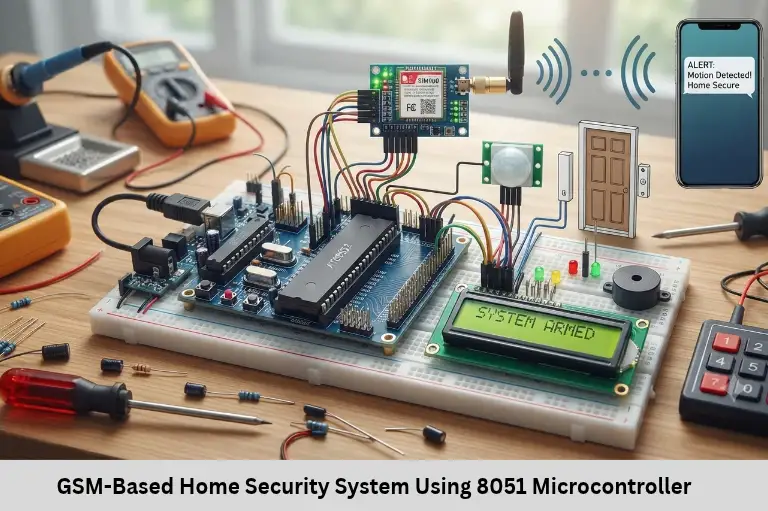
Learn how to build a GSM-based home security system using an 8051 microcontroller, PIR sensors, and SMS alerts. Explore its working, components, and applications. Embedded Tech Development Academy (ETDA).
- GSM-Based Home Security System Using 8051 Microcontroller
-
GSM-Based Home Security System Using 8051 Microcontroller
- Introduction
- What Is a GSM-Based Home Security System?
- Components Required for the Project
- Working Principle of the GSM Security System
- Circuit Design and Hardware Connections
- Embedded C Programming Logic
- Applications and Future Improvements
- Skills Students Gain from This Project
- Why Learn Embedded Systems at ETDA?
-
Frequently Asked Questions
- What is a GSM-based home security system using 8051?
- Which sensor is commonly used in this project?
- How does the 8051 communicate with the GSM module?
- Can this project send alerts without an internet connection?
- Can IoT features be added to this project?
- What skills do students learn from this project?
- Conclusion
GSM-Based Home Security System Using 8051 Microcontroller
Introduction
Home security systems help protect houses, offices, and other properties from unauthorized entry. A GSM-based home security system using an 8051 microcontroller is a practical embedded systems project that detects suspicious movement and sends an SMS alert to the owner’s mobile phone. It combines sensors, a microcontroller, and wireless communication to provide basic remote monitoring.
For students interested in developing real-time applications, this project offers valuable experience in Embedded C programming, sensor interfacing, UART communication, and GSM technology. Learning these concepts through practical projects is an important part of training at Embedded Tech Development Academy (ETDA), recognised by students looking for a Top Embedded Training Institute in Bangalore. With practical learning and assured placement support, Embedded Tech Development Academy (ETDA) helps students connect classroom concepts with industry-oriented embedded development.
What Is a GSM-Based Home Security System?
A GSM-based home security system is an electronic monitoring setup that uses a GSM module to communicate security alerts through the mobile network. When a sensor detects movement or an unauthorized entry, the 8051 microcontroller processes the input and instructs the GSM module to send an SMS notification to a predefined mobile number.
Unlike a basic alarm system that only produces a sound, this project can notify the owner even when they are away from home. It is useful for understanding how embedded systems combine hardware and software to solve practical problems. Depending on the design, a buzzer can also provide an immediate local warning.
Components Required for the Project
The project uses commonly available electronic components. Each component performs a specific function in detecting movement, processing signals, or communicating with the user.
8051 Microcontroller
The 8051 microcontroller acts as the main control unit. It receives signals from sensors, executes the Embedded C program, and controls output devices such as the buzzer and GSM module. Its GPIO pins support sensor interfacing, while its UART peripheral enables serial communication.
GSM Module
A GSM module provides mobile-network connectivity and sends SMS alerts. Modules such as SIM800-series devices can communicate with the microcontroller through serial AT commands. Students must check network availability and module compatibility before selecting hardware because some regions have phased out older 2G services.
PIR Motion Sensor
A Passive Infrared (PIR) sensor detects changes in infrared radiation caused by movement of people or animals. When motion is detected within its sensing range, it produces a digital output that can be connected to an input pin of the 8051.
Additional Components
Other required components include a regulated power supply, crystal oscillator, reset circuit, buzzer, connecting wires, resistors, and a SIM card with an active SMS service. A suitable voltage regulator and level-shifting circuit may be necessary because the GSM module and 8051 development board may operate at different voltage levels.
Working Principle of the GSM Security System
The system continuously monitors the output of the PIR sensor. When the sensor detects movement, it sends a logic signal to the 8051 microcontroller. The microcontroller checks the input and executes the programmed response.
First, the controller activates the buzzer to provide a local warning. It then communicates with the GSM module through UART and sends the required AT commands. After the module registers on the mobile network, it sends an SMS alert to the stored phone number.
A typical message could be: “Warning: Movement detected at home.” The owner receives this notification on their mobile phone and can take appropriate action. The reliability of the system depends on sensor placement, power stability, network coverage, and correct program execution.
Circuit Design and Hardware Connections
The PIR sensor output is connected to one of the 8051’s GPIO input pins. The buzzer can be connected through a suitable transistor driver circuit because a microcontroller pin may not provide enough current to drive it directly.
The GSM module communicates with the 8051 using serial transmission and reception lines. The microcontroller’s TX and RX connections must be correctly matched with the module’s RX and TX pins. A common ground is essential, and the GSM module should have a stable power supply capable of handling its current peaks during transmission.
UART Communication
UART is used to exchange data between the 8051 and GSM module. The baud rate, data format, and oscillator configuration must match on both sides. A common project configuration uses 9600 baud, but the actual setting depends on the selected module and firmware.
GSM AT Commands
The microcontroller sends AT commands to control the GSM module. For example, AT checks communication, while AT+CMGF=1 selects SMS text mode. The command AT+CMGS starts the SMS sending process, followed by the destination number and message content. The program should check module responses rather than assuming every command succeeds.
Embedded C Programming Logic
The software is responsible for monitoring the sensor and controlling the communication sequence. The program begins by configuring the microcontroller’s input and output pins and initializing UART communication. It then sends basic AT commands to check whether the GSM module is responding.
When the PIR sensor output becomes active, the controller activates the buzzer and starts the SMS procedure. After sending the alert, the program should avoid repeatedly sending messages for the same detection event. This can be managed through a flag, delay, or re-arming condition.
Important Programming Concepts
Students can practise GPIO configuration, conditional statements, functions, UART initialization, serial data transmission, and timing control. They can also learn how to handle communication failures and prevent repeated alerts. These concepts are useful in many embedded systems applications beyond home security.
Applications and Future Improvements
A basic GSM security system can be adapted for small homes, shops, storage rooms, laboratories, and offices. Additional sensors, such as magnetic door sensors, smoke detectors, and vibration sensors, can improve monitoring capabilities.
Integrating IoT Features
The project can be extended with Internet of Things (IoT) technology to provide remote monitoring through a web dashboard or mobile application. With a suitable internet-enabled controller or communication module, users can view sensor status and receive notifications online.
Adding More Security Features
Students can introduce password-based activation, keypad control, multiple-zone monitoring, battery backup, and a door-opening detection circuit. These improvements make the project more useful while introducing additional hardware and software design challenges.
Skills Students Gain from This Project
Building this project helps students understand how hardware and software work together in a real-time application. They gain practical experience with the 8051 architecture, Embedded C, PIR sensor interfacing, UART communication, GSM modules, and circuit debugging.
At Embedded Tech Development Academy (ETDA), students can strengthen these skills through practical embedded systems training and project-oriented learning. As a Top Embedded Training Institute in Bangalore, Embedded Tech Development Academy (ETDA) focuses on helping learners understand microcontrollers, communication protocols, firmware development, and Internet of Things (IoT) concepts. Its assured placement support also helps students prepare for technical interviews and explore relevant career opportunities.
Why Learn Embedded Systems at ETDA?
Understanding a project theoretically is only the first step. Students need practical experience in writing code, connecting hardware, testing circuits, identifying errors, and debugging firmware. These abilities are important for entry-level roles in embedded software and hardware development.
Embedded Tech Development Academy (ETDA) provides industry-oriented learning opportunities for students who want to build a career in embedded technology. Its training approach introduces important topics such as Embedded C, microcontrollers, communication protocols, and real-time project development. Students searching for a Top Embedded Training Institute in Bangalore can explore Embedded Tech Development Academy (ETDA) to develop practical knowledge and receive assured placement support.
Frequently Asked Questions
What is a GSM-based home security system using 8051?
It is a microcontroller-based security project that detects movement through sensors and sends SMS alerts using a GSM module.
Which sensor is commonly used in this project?
A PIR sensor is commonly used to detect movement by identifying changes in infrared radiation.
How does the 8051 communicate with the GSM module?
The 8051 uses UART serial communication to send AT commands and receive responses from the GSM module.
Can this project send alerts without an internet connection?
Yes. A compatible GSM module can send SMS alerts through a supported mobile network without requiring Wi-Fi or an internet connection.
Can IoT features be added to this project?
Yes. An internet-enabled controller or communication module can be added to support online monitoring, dashboards, and mobile notifications.
What skills do students learn from this project?
Students learn Embedded C, 8051 programming, sensor interfacing, UART communication, GSM integration, circuit design, and hardware debugging.
Conclusion
A GSM-based home security system using an 8051 microcontroller is an effective academic project for learning sensor interfacing, UART communication, Embedded C programming, and wireless alert systems. It demonstrates how a simple microcontroller can be used to develop a practical security application and can be extended with Internet of Things (IoT) features for smarter monitoring.
Students who want to develop similar real-time projects should focus on practical circuit design, programming, and debugging. Embedded Tech Development Academy (ETDA) supports this learning journey through hands-on training and assured placement support. For learners looking for a Top Embedded Training Institute in Bangalore, Embedded Tech Development Academy (ETDA) offers an opportunity to strengthen embedded systems knowledge and prepare for industry requirements.
Author: ETDA Trainers
Experience: 10+ Years of Industry Experience in Embedded Systems, IoT, and Embedded C Programming