
How C Programming Powers Embedded Systems and IoT Devices | ETDA
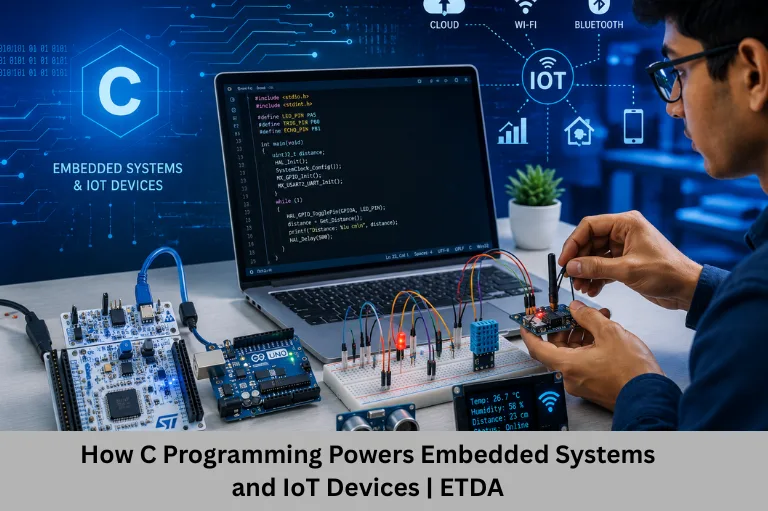
Discover how C Programming powers Embedded Systems and Internet of Things (IoT) devices. Learn its applications, benefits, and career opportunities with Embedded Tech Development Academy (ETDA).
- How C Programming Powers Embedded Systems and IoT Devices | ETDA
-
How C Programming Powers Embedded Systems and IoT Devices
- What is C Programming?
- Why C Programming is the Foundation of Embedded Systems
- How C Programming Powers Embedded Systems
- How C Programming Powers IoT Devices
- Popular Applications of C Programming in Embedded Systems and IoT
- Why Engineering Students Should Learn C Programming
- Benefits of Learning C Programming for Embedded Systems and IoT
- Career Opportunities After Learning C Programming
- Advanced C Programming Concepts Every Engineering Student Should Know
- Learn C Programming at ETDA
- Assured Placement Support at ETDA
- Why Choose ETDA?
-
Frequently Asked Questions (FAQs)
- Why is C Programming widely used in Embedded Systems?
- How does C Programming support IoT device development?
- Is C Programming necessary before learning Embedded C?
- Which industries use C Programming for embedded applications?
- What projects can I build after learning C Programming?
- Does ETDA provide practical C Programming training?
- Will learning C Programming improve my placement opportunities?
- Does ETDA provide placement support after C Programming training?
- Conclusion
How C Programming Powers Embedded Systems and IoT Devices
From smart home appliances and wearable fitness trackers to autonomous vehicles and industrial automation systems, embedded technology has become an essential part of modern life. At the heart of these intelligent devices lies one programming language that has stood the test of time—C Programming.
Despite the emergence of many modern programming languages, C remains the preferred choice for developing embedded firmware because of its speed, efficiency, portability, and direct hardware access. Whether you’re controlling a microcontroller, communicating with sensors, or developing an Internet of Things (IoT) application, C Programming plays a vital role in ensuring reliable and high-performance operation.
For engineering students aspiring to build a career in Embedded Systems or Internet of Things (IoT), learning C Programming is the first and most important step. At Embedded Tech Development Academy (ETDA), students gain practical experience in C Programming through hands-on projects, hardware interfacing, and industry-focused training. As a Top Embedded Training Institute in Bangalore, ETDA equips learners with job-ready skills and assured placement support to help them succeed in the embedded industry.
What is C Programming?
C Programming is a powerful, general-purpose programming language known for its simplicity, efficiency, and close interaction with computer hardware. Developed to create system software, C has become the foundation for many modern programming languages and remains one of the most widely used languages in engineering.
Its ability to produce fast and memory-efficient programs makes it ideal for developing firmware for embedded systems and resource-constrained IoT devices.
Some of the key characteristics of C Programming include:
- High execution speed
- Efficient memory management
- Portability across platforms
- Structured programming
- Direct hardware access
- Rich standard library
These features make C the preferred language for embedded application development.
Why C Programming is the Foundation of Embedded Systems
Embedded systems are designed to perform dedicated tasks with limited processing power and memory. Unlike desktop applications, embedded software must be lightweight, reliable, and capable of interacting directly with hardware components.
C Programming meets these requirements exceptionally well.
Efficient Memory Utilization
Embedded devices often have limited RAM and Flash memory. C allows developers to write optimized code that consumes minimal system resources.
Why Memory Optimization Matters
Efficient memory usage helps:
- Improve device performance
- Reduce execution time
- Extend battery life
- Minimize hardware costs
- Increase overall system reliability
Direct Hardware Control
One of the biggest strengths of C Programming is its ability to access hardware registers directly.
Developers can control:
- GPIO Pins
- Timers
- Interrupts
- ADC
- PWM
- UART
- SPI
- I2C
- CAN
This direct interaction enables precise control over embedded hardware.
High Performance
Embedded applications often require real-time execution. C generates efficient machine code, allowing devices to respond quickly to external events.
Examples include:
- Motor control
- Medical equipment
- Automotive braking systems
- Industrial robots
- Smart security systems
Fast execution is critical in these applications.
How C Programming Powers Embedded Systems
C Programming forms the core of firmware development across various embedded platforms.
Microcontroller Programming
Microcontrollers are the brains behind most embedded systems.
C Programming is widely used with:
Popular Microcontrollers
- STM32
- ARM Cortex-M Series
- LPC1768
- AVR
- PIC
- MSP430
- ESP32
Developers use C to configure peripherals, read sensor data, and control connected devices.
Peripheral Interfacing
Embedded devices communicate with multiple peripherals.
C Programming enables communication with:
Hardware Components
- LCD Displays
- OLED Displays
- Keypads
- Sensors
- Motors
- EEPROM
- Flash Memory
- GPS Modules
Firmware written in C ensures smooth and reliable interaction between these components.
Communication Protocol Implementation
Embedded systems depend on communication protocols to exchange information.
Using C Programming, engineers implement protocols such as:
UART
For serial communication with Bluetooth, GPS, and debugging interfaces.
SPI
For high-speed communication with displays, memory devices, and sensors.
I2C
For connecting multiple peripherals using only two communication lines.
CAN
For robust communication in automotive and industrial automation systems.
Understanding these protocols is essential for embedded engineers.
How C Programming Powers IoT Devices
The Internet of Things (IoT) connects physical devices to the internet, allowing them to collect, process, and exchange data.
C Programming plays a significant role in developing firmware for these connected devices.
Sensor Data Collection
IoT devices continuously collect information from sensors.
Examples include:
- Temperature Sensors
- Humidity Sensors
- Motion Sensors
- Pressure Sensors
- Gas Sensors
- Light Sensors
C Programming reads, processes, and prepares this data for transmission.
Device Communication
Internet of Things (IoT) devices communicate using various wireless technologies.
C Programming enables integration with:
Wireless Technologies
- Wi-Fi
- Bluetooth
- Zigbee
- LoRa
- GSM
- NB-IoT
Reliable communication ensures seamless data transfer between devices and cloud platforms.
Real-Time Decision Making
Many IoT applications require instant responses based on sensor inputs.
Examples include:
- Smart Door Locks
- Fire Alarm Systems
- Home Automation
- Smart Irrigation
- Industrial Monitoring
- Healthcare Devices
C Programming allows microcontrollers to process data quickly and trigger immediate actions.
Popular Applications of C Programming in Embedded Systems and IoT
C Programming is used in a wide range of industries due to its efficiency and reliability.
Consumer Electronics
Applications include:
- Smart TVs
- Washing Machines
- Microwave Ovens
- Smart Speakers
- Wearable Devices
Automotive Electronics
C Programming is widely used for:
- Engine Control Units (ECUs)
- Anti-lock Braking Systems (ABS)
- Airbag Controllers
- Battery Management Systems
- Electric Vehicles
Industrial Automation
Embedded firmware developed in C powers:
- PLC Systems
- Factory Automation
- Robotics
- Process Control Systems
- Smart Manufacturing
Healthcare Devices
Medical applications include:
- Patient Monitoring Systems
- Infusion Pumps
- ECG Machines
- Portable Diagnostic Equipment
Why Engineering Students Should Learn C Programming
For students interested in Embedded Systems, Internet of Things (IoT), Robotics, or Automotive Electronics, C Programming is not optional—it is a core skill. It provides the programming foundation required to understand hardware interaction, firmware development, and real-time systems.
At Embedded Tech Development Academy (ETDA), students learn C Programming through practical coding exercises, hardware interfacing, and real-time projects. As a Top Embedded Training Institute in Bangalore, ETDA ensures students gain industry-relevant skills that prepare them for successful careers in embedded technology.
Benefits of Learning C Programming for Embedded Systems and IoT
C Programming is much more than a beginner-friendly language. It is the foundation upon which many embedded technologies are built. Learning C enables engineering students to develop the technical expertise required for designing efficient, reliable, and high-performance embedded applications.
Builds Strong Programming Logic
C Programming teaches students how software works internally, helping them develop a structured approach to solving engineering problems.
Skills You Develop
By learning C Programming, students improve their understanding of:
- Algorithms
- Data Structures
- Memory Management
- Functions
- Pointers
- Bitwise Operations
- Debugging Techniques
These skills are valuable not only in embedded systems but also in software development and technical interviews.
Makes Learning Embedded C Easier
Embedded C is an extension of the C language. Students with a strong foundation in C can quickly understand advanced embedded concepts such as:
- Register Programming
- Interrupt Handling
- Peripheral Configuration
- Device Drivers
- Real-Time Operating Systems (RTOS)
This progression helps students become industry-ready faster.
Improves Problem-Solving Skills
Writing programs in C requires logical thinking and systematic debugging. As students practice coding, they become more confident in identifying errors, optimizing performance, and designing efficient solutions.
These analytical skills are highly valued by employers across engineering domains.
Career Opportunities After Learning C Programming
The demand for professionals with expertise in C Programming continues to grow as industries increasingly adopt embedded technologies, IoT solutions, automation, and connected devices.
Advanced C Programming Concepts Every Engineering Student Should Know
The demand for professionals with expertise in C Programming continues to grow as industries increasingly adopt embedded technologies, IoT solutions, automation, and connected devices.
Popular Job Roles
Students with strong C Programming skills can pursue careers such as:
- Embedded Software Engineer
- Firmware Engineer
- Embedded Systems Developer
- IoT Developer
- Robotics Engineer
- Automotive Embedded Engineer
- Electronics Design Engineer
- Embedded Test Engineer
- Linux Embedded Engineer
These roles offer excellent career growth and opportunities to work on cutting-edge technologies.
Industries Hiring C Programmers
Automotive
Develop firmware for Electric Vehicles (EVs), Battery Management Systems, Advanced Driver Assistance Systems (ADAS), and Electronic Control Units (ECUs).
Internet of Things (IoT)
Work on smart homes, wearable devices, industrial IoT, healthcare monitoring systems, and connected consumer products.
Industrial Automation
Develop software for PLCs, robotics, process control systems, and factory automation.
Consumer Electronics
Build applications for smart TVs, home appliances, gaming devices, wearable technology, and smart entertainment systems.
Healthcare
Contribute to medical devices such as patient monitoring systems, ECG machines, infusion pumps, and diagnostic equipment.
Learn C Programming at ETDA
Learning C Programming through practical implementation is the fastest way to become industry-ready. Embedded Tech Development Academy (ETDA) provides comprehensive training that combines theoretical concepts with hands-on experience.
As a Top Embedded Training Institute in Bangalore, ETDA offers a curriculum designed to meet current industry requirements.
Industry-Oriented Curriculum
Students receive practical training in:
Core Programming Concepts
- Variables and Data Types
- Operators
- Decision Making
- Loops
- Functions
- Arrays
- Strings
- Structures
- Pointers
- File Handling
Embedded Programming
Students also learn:
- Embedded C
- STM32 Programming
- ARM Cortex-M
- GPIO Programming
- UART
- SPI
- I2C
- CAN Communication
- Embedded Linux Basics
This structured learning path helps students progress from programming fundamentals to advanced embedded development.
Hands-On Project Experience
ETDA emphasizes project-based learning to reinforce technical concepts. Students work on real-time applications such as:
- Smart Home Automation
- IoT-Based Monitoring Systems
- Industrial Automation Projects
- Smart Agriculture Solutions
- Vehicle Tracking Systems
- Robotics Applications
Working on live projects strengthens technical confidence and improves employability.
Assured Placement Support at ETDA
Technical knowledge alone is not enough to secure a job. Embedded Tech Development Academy (ETDA) complements its training programs with assured placement support, helping students prepare for successful careers.
Placement-Focused Training
Students receive guidance in:
- Resume Building
- Aptitude Preparation
- Technical Interview Preparation
- Mock Interviews
- Communication Skills
- HR Interview Preparation
These sessions improve interview confidence and job readiness.
Industry-Ready Learning Environment
ETDA provides:
- Experienced Industry Trainers
- Modern Embedded Systems Laboratories
- Practical Coding Sessions
- Hardware-Based Learning
- Continuous Mentorship
- Career Guidance
This practical approach ensures students develop the skills expected by leading embedded systems companies.
Why Choose ETDA?
Choosing the right institute is an important step toward building a successful engineering career. ETDA stands out by offering a blend of practical training, experienced faculty, and career-oriented programs.
Key Advantages of ETDA
- Industry-aligned curriculum
- Hands-on C Programming and Embedded C training
- Practical experience with STM32, ARM, RTOS, IoT, and Embedded Linux
- Real-time embedded systems projects
- Well-equipped laboratory facilities
- Expert mentorship from industry professionals
- Soft skills and interview preparation
- Assured placement support
As a Top Embedded Training Institute in Bangalore, Embedded Tech Development Academy (ETDA) focuses on helping students acquire the practical knowledge and confidence needed to succeed in the competitive embedded systems industry.
Frequently Asked Questions (FAQs)
Why is C Programming widely used in Embedded Systems?
C Programming provides high performance, efficient memory management, and direct hardware access, making it ideal for programming microcontrollers and developing embedded firmware.
How does C Programming support IoT device development?
C Programming enables IoT devices to read sensor data, control hardware, process information in real time, and communicate with cloud platforms using protocols such as Wi-Fi, Bluetooth, Zigbee, and LoRa.
Is C Programming necessary before learning Embedded C?
Yes. Embedded C is based on the C language, so understanding C Programming fundamentals is essential before moving on to embedded firmware development.
Which industries use C Programming for embedded applications?
C Programming is widely used in automotive, consumer electronics, industrial automation, healthcare, aerospace, telecommunications, and IoT industries.
What projects can I build after learning C Programming?
Students can develop projects such as smart home automation systems, IoT monitoring devices, robotics applications, industrial automation solutions, and sensor-based embedded systems.
Does ETDA provide practical C Programming training?
Yes. ETDA offers hands-on C Programming training through coding exercises, hardware interfacing, mini-projects, and real-time embedded applications.
Will learning C Programming improve my placement opportunities?
Absolutely. C Programming is one of the most sought-after skills in embedded systems and software development. Practical knowledge significantly enhances technical interview performance and employability.
Does ETDA provide placement support after C Programming training?
Yes. ETDA provides assured placement support, including resume building, mock interviews, technical interview preparation, aptitude training, and career guidance to help students secure opportunities in leading embedded systems and technology companies.
Conclusion
C Programming continues to be the backbone of embedded systems and Internet of Things (IoT) development. Its efficiency, speed, and ability to interact directly with hardware make it the preferred language for firmware development across industries such as automotive, consumer electronics, healthcare, industrial automation, and smart devices.
For engineering students, mastering C Programming is the first step toward building a rewarding career in embedded systems A solid understanding of programming fundamentals, combined with practical project experience, prepares students for advanced technologies like Embedded C, ARM Programming, RTOS, and Internet of Things (IoT).
If you’re looking to build a strong career in embedded technology, Embedded Tech Development Academy (ETDA) offers the ideal platform. With industry-oriented training, expert faculty, modern laboratories, real-time projects, and assured placement support, ETDA helps students transform theoretical knowledge into practical expertise. As a Top Embedded Training Institute in Bangalore, ETDA is committed to preparing future engineers for success in today’s technology-driven world.
Author: ETDA Trainers
Experience: 10+ Years of Industry Experience in Embedded Systems, IoT, and Embedded C Programming