
Industry-Oriented Undergraduate Workshops at Colleges | ETDA
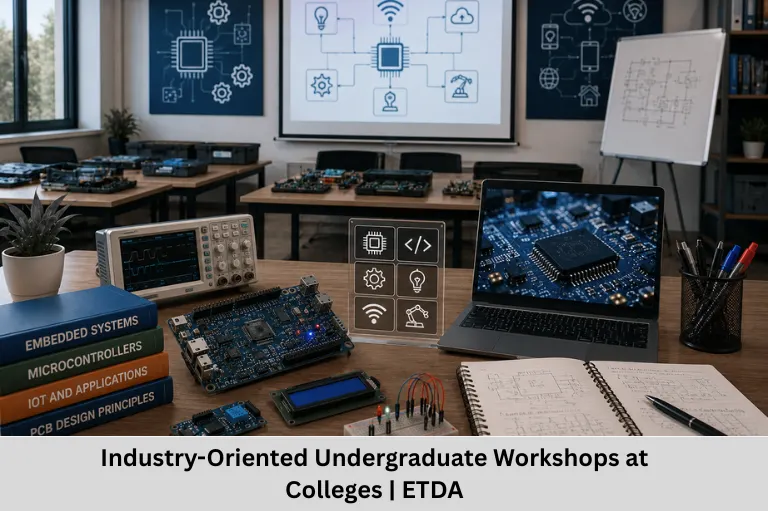
Explore industry-oriented undergraduate workshops at colleges with Embedded Tech Development Academy (ETDA). Build practical skills in Embedded C, microcontrollers (STM32, ARM 1768), Internet of Things (IoT), communication protocols, debugging, and projects.
- Industry-Oriented Undergraduate Workshops at Colleges | ETDA
-
Industry-Oriented Undergraduate Workshops at Colleges: Bridging Classroom Learning and Real-World Engineering
- Introduction
- Why Industry-Oriented Workshops Matter for Undergraduate Students
- Technical Areas Covered in Industry-Oriented Embedded Workshops
- Communication Protocols: Learning How Embedded Devices Exchange Data
- Sensors, Actuators, and Real-Time Applications
- Debugging: A Critical Industry Skill
- Mini Projects for Undergraduate Students
- How ETDA Designs Industry-Oriented College Workshops
- Benefits for Engineering Colleges
- Benefits for Undergraduate Students
- What Colleges Should Look for in a Technical Workshop Partner
- Why Choose ETDA for College Technical Workshops?
-
Building Industry-Ready Engineers Through Practical Exposure
- Why Practical Skills Matter
- Developing a Problem-Solving Mindset
- FAQs
- What are industry-oriented workshops for undergraduate students?
- Which students can attend embedded systems workshops?
- What technologies can students learn in an embedded workshop?
- Are college workshops completely practical?
- Can workshops help students with final-year projects?
- Does ETDA provide placement support?
- Why should colleges conduct industry-oriented technical workshops?
- Conclusion
Industry-Oriented Undergraduate Workshops at Colleges: Bridging Classroom Learning and Real-World Engineering
Introduction
Engineering education becomes more valuable when students can connect classroom concepts with practical hardware, development tools, debugging techniques, and real-world engineering workflows. Industry-oriented undergraduate workshops at colleges provide this connection by allowing students to work with technologies and engineering problems before entering the professional world.
For students interested in embedded systems, electronics, Internet of Things (IoT), robotics, automotive technology, and firmware development, practical exposure can significantly improve technical confidence and career readiness.
Embedded Tech Development Academy (ETDA) conducts industry-oriented technical workshops designed around hands-on learning, engineering practices, and real-world applications.
For colleges looking to provide meaningful technical exposure to students, partnering with a Top Embedded Training Institute in Bangalore can help transform theoretical concepts into practical engineering skills.
Why Industry-Oriented Workshops Matter for Undergraduate Students
Traditional engineering education focuses heavily on theoretical concepts, examinations, and laboratory experiments. Although these are important, students also need to understand how these concepts are applied when developing an actual engineering product.
Industry-oriented workshops can introduce students to:
- Embedded C programming
- Microcontroller architecture
- GPIO and peripheral interfacing
- UART, SPI, and I2C communication
- Sensors and actuators
- Interrupts and timers
- Debugging techniques
- Firmware development
- Basic RTOS concepts
- Internet of Things (IoT)-based systems
- Embedded project development
From Theory to Engineering Practice
For example, students may learn UART communication theoretically in their academic curriculum. During a practical workshop, they can configure a UART peripheral, connect a development board to a serial terminal, transmit data, receive characters, and troubleshoot communication errors.
This transition from knowing a concept to implementing it is one of the major advantages of industry-oriented technical workshops.
Technical Areas Covered in Industry-Oriented Embedded Workshops
A technically strong undergraduate workshop should go beyond PowerPoint presentations. Students should receive exposure to technologies and development practices commonly used in embedded engineering.
Embedded C Programming
Embedded C is one of the fundamental programming skills required for microcontroller-based development.
Students can learn:
- Data types and variables
- Operators and expressions
- Conditional statements
- Loops
- Functions
- Arrays
- Structures
- Pointers
- Bitwise operations
- Memory concepts
- Register-level programming
- Interrupt-based programming
Importance of Bitwise Operations
Bitwise operations are particularly important in embedded systems because individual bits are frequently used to configure hardware registers.
For example, setting, clearing, toggling, or checking a specific bit can control GPIO states or configure peripheral registers.
Microcontroller Architecture
Students can explore the internal architecture of a modern microcontroller.
Important topics can include:
- CPU core
- Flash memory
- SRAM
- GPIO
- Timers
- ADC
- UART
- SPI
- I2C
- Interrupt controller
- Clock system
Rather than memorizing architecture diagrams, students can configure peripherals and observe their behavior using actual hardware.
GPIO and Peripheral Interfacing
GPIO is usually one of the first practical concepts students encounter in embedded development.
A workshop can demonstrate how a microcontroller interacts with:
- LEDs
- Push buttons
- Relays
- Buzzers
- Displays
- Sensors
- Motors
Students can implement small applications such as LED control, button-based switching, sensor monitoring, and actuator control.
Communication Protocols: Learning How Embedded Devices Exchange Data
Modern embedded products rarely operate as isolated systems. Multiple sensors, controllers, displays, and communication modules need to exchange information.
UART Communication
UART is widely used for serial communication, configuration, diagnostics, and debugging.
Students can learn:
- TX and RX operation
- Baud rate
- Start and stop bits
- Serial terminals
- Data transmission
- Data reception
- Basic troubleshooting
SPI Communication
SPI is commonly used for communication with displays, memory devices, sensors, and other peripherals.
Students can understand:
- Master and slave architecture
- Clock signal
- MOSI
- MISO
- Chip Select
- Clock polarity
- Clock phase
I2C Communication
I2C allows multiple peripherals to communicate using a shared bus.
Students can learn:
- SDA and SCL
- Device addressing
- Master and slave communication
- Pull-up resistors
- Read and write transactions
- Multiple devices on a single bus
Practical implementation makes these communication concepts easier to understand and remember.
Sensors, Actuators, and Real-Time Applications
An industry-oriented embedded workshop should demonstrate how software interacts with the physical environment.
Sensor Interfacing
Students can work with components such as:
- Temperature sensors
- Light sensors
- Ultrasonic sensors
- Motion sensors
- Gas sensors
- Potentiometers
The sensor generates information, which is read and processed by the microcontroller.
Actuator Control
Based on sensor information or programmed conditions, the microcontroller can control an actuator.
A basic embedded control flow can be represented as:
Sensor → Microcontroller → Decision Logic → Actuator
For example, a temperature-monitoring application can read temperature data, compare it against a threshold, and activate a cooling mechanism when the temperature exceeds the configured value.
Debugging: A Critical Industry Skill
One major difference between basic academic programming and professional embedded development is the importance of debugging.
A program may compile successfully but still fail because of:
- Incorrect register configuration
- Wrong GPIO configuration
- Clock problems
- Communication mismatch
- Hardware wiring errors
- Timing issues
- Interrupt configuration errors
- Pointer-related problems
- Incorrect peripheral initialization
Hands-On Debugging Exercises
Students can be given intentionally faulty programs and asked to identify and correct the problem.
Depending on the workshop setup, students can use:
- Serial logs
- Debuggers
- Breakpoints
- Watch windows
- Register inspection
- Logic analyzers
- Multimeters
Debugging exercises teach students how to approach engineering problems systematically instead of simply rewriting code until it works.
A Typical Debugging Process
A simple debugging workflow can be:
Observe → Reproduce → Identify → Test → Fix → Verify
This process helps students develop logical troubleshooting skills.
Mini Projects for Undergraduate Students
Project-based learning is an important component of a technical workshop.
Suitable Embedded Mini Projects
Students can develop projects such as:
- Smart temperature monitoring system
- Digital sensor dashboard
- Automatic street-light controller
- Obstacle detection system
- Smart irrigation prototype
- Password-based access system
- Internet of Things (IoT) sensor monitoring system
- UART-based command controller
- Energy monitoring prototype
Project Development Workflow
Students can follow a simplified engineering workflow:
Requirement → Block Diagram → Hardware Selection → Firmware Development → Testing → Debugging → Demonstration
This introduces students to the basic development cycle used in real-world embedded projects.
How ETDA Designs Industry-Oriented College Workshops
Embedded Tech Development Academy (ETDA) focuses on practical and technically structured learning for engineering students.
Step 1 – Concept Introduction
The workshop begins with the engineering fundamentals required to understand the technology.
Step 2 – Hardware Demonstration
Trainers demonstrate development boards, electronic components, peripherals, sensors, and communication interfaces.
Step 3 – Guided Implementation
Students implement programs with trainer guidance instead of simply watching demonstrations.
Step 4 – Debugging and Testing
Students test their programs and troubleshoot hardware and firmware problems.
Step 5 – Mini Project Development
Participants combine multiple concepts to develop a practical application.
Step 6 – Technical Discussion
Trainers explain how the concepts relate to actual embedded development, testing, and engineering careers.
Benefits for Engineering Colleges
Industry-oriented workshops can benefit educational institutions as well as students.
Improve Practical Learning
Students gain hands-on experience that complements classroom theory and laboratory experiments.
Introduce Industry Technologies
Colleges can expose students to technologies such as microcontrollers, Embedded C, communication protocols, Internet of Things (IoT), and firmware development.
Support Project Development
Students can apply workshop concepts to academic mini projects and final-year projects.
Improve Career Readiness
Technical workshops can help students understand the skills and workflows expected in embedded engineering roles.
Benefits for Undergraduate Students
Technical Skill Development
Students gain practical experience with programming, hardware interfacing, communication protocols, and debugging.
Better Project Understanding
Students can approach academic projects with a stronger understanding of system architecture and implementation.
Improved Interview Preparation
Hands-on experience gives students practical examples to discuss during technical interviews.
Career Awareness
Students can learn about career opportunities such as:
- Embedded Software Engineer
- Firmware Engineer
- Embedded Developer
- Internet of Things (IoT) Engineer
- Automotive Embedded Engineer
- Embedded Testing Engineer
- Hardware-Firmware Integration Engineer
Students who want to continue beyond introductory workshops can also pursue structured embedded training programs with assured placement support through Embedded Tech Development Academy (ETDA).
What Colleges Should Look for in a Technical Workshop Partner
Industry-Relevant Curriculum
The workshop should cover technologies that students can continue learning after the program.
Hands-On Hardware
Students should have opportunities to work directly with development boards and electronic components.
Experienced Technical Trainers
Trainers should be capable of explaining both fundamental concepts and practical implementation.
Project-Based Learning
Students should build and test working applications instead of only attending theoretical sessions.
Career Orientation
The workshop should help students understand the technical skills expected in embedded engineering careers.
Why Choose ETDA for College Technical Workshops?
Embedded Tech Development Academy (ETDA) focuses on bridging the gap between academic learning and practical engineering.
Key Areas of ETDA Workshop Training
The technical workshops can focus on:
- Embedded C
- Microcontrollers
- Hardware interfacing
- UART
- SPI
- I2C
- Sensors
- Actuators
- Debugging
- Internet of Things (IoT) concepts
- Real-time applications
- Embedded projects
Embedded Tech Development Academy (ETDA)‘s objective is not simply to complete a workshop or provide a certificate. The focus is on helping students understand how embedded technologies are designed, programmed, tested, and debugged.
For colleges searching for a technically focused training partner, a Top Embedded Training Institute in Bangalore can provide structured exposure to practical embedded development.
Building Industry-Ready Engineers Through Practical Exposure
Why Practical Skills Matter
The engineering industry values graduates who can apply their technical knowledge.
A student who understands C programming has a foundation. A student who can write Embedded C, configure a microcontroller, interface a sensor, communicate through UART or I2C, debug firmware, and explain system architecture is better prepared for embedded engineering opportunities.
Developing a Problem-Solving Mindset
Technical workshops should encourage students to ask:
- Why is the peripheral not responding?
- Why is the sensor producing incorrect data?
- Why is UART communication failing?
- Is the issue related to hardware or software?
- Which register or configuration needs to be checked?
- How can the problem be reproduced and verified?
This type of thinking is essential for real-world engineering.
FAQs
What are industry-oriented workshops for undergraduate students?
Industry-oriented workshops are practical technical programs designed to expose college students to real-world technologies, tools, development practices, and engineering problems.
Which students can attend embedded systems workshops?
Students from ECE, EEE, CSE, ISE, Instrumentation, Mechatronics, and related engineering branches can benefit from embedded systems workshops.
What technologies can students learn in an embedded workshop?
Students can learn Embedded C, microcontrollers, GPIO, UART, SPI, I2C, sensors, actuators, debugging, IoT concepts, and project development.
Are college workshops completely practical?
A strong workshop combines technical explanations with hands-on implementation. Students should get opportunities to write code, configure hardware, test systems, and troubleshoot problems.
Can workshops help students with final-year projects?
Yes. Practical exposure to microcontrollers, communication protocols, sensors, debugging, and system design can help students understand and develop embedded-based academic projects.
Does ETDA provide placement support?
ETDA offers embedded-focused training programs with assured placement support, helping eligible learners prepare for employment opportunities through technical training and career-oriented preparation.
Why should colleges conduct industry-oriented technical workshops?
Workshops help bridge the gap between academic theory and practical engineering by giving students exposure to technologies, development tools, debugging methods, and project implementation.
Conclusion
Industry-oriented undergraduate workshops at colleges can play an important role in preparing engineering students for technology-driven careers. By combining Embedded C programming, microcontroller architecture, peripheral interfacing, communication protocols, debugging, sensors, and project development, students can gain a practical understanding of how embedded products are developed.
Embedded Tech Development Academy (ETDA) focuses on delivering technical, hands-on, industry-oriented learning that helps students move beyond theoretical knowledge.
For institutions looking to strengthen practical engineering education and give students exposure to real-world embedded development, partnering with a Top Embedded Training Institute in Bangalore such as Embedded Tech Development Academy (ETDA) can be a valuable step.
With practical workshops, project-based learning, technical guidance, industry-focused training, and assured placement support through its career-oriented programs, Embedded Tech Development Academy (ETDA) helps students build a foundation for progressing from engineering graduates toward industry-ready embedded professionals.
Author: ETDA Trainers
Experience: 10+ Years of Industry Experience in Embedded Systems, IoT, and Embedded C Programming