
Introduction to Data Structures and Their Importance
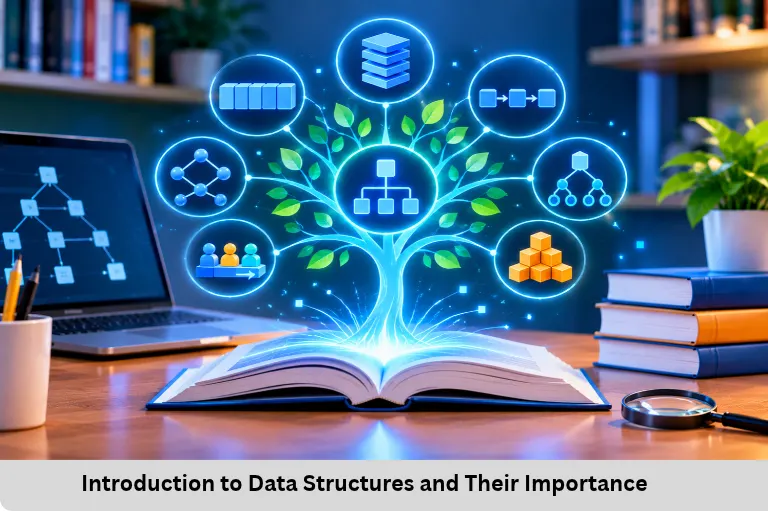
Learn data structures, their types, applications, and importance in programming. Explore arrays, linked lists, stacks, queues, trees, and graphs with Embedded Tech Development Academy (ETDA).
- Introduction to Data Structures and Their Importance
-
Introduction to Data Structures and Their Importance
- What Are Data Structures?
- Importance of Data Structures in Programming
- Types of Data Structures
- Applications of Data Structures in Embedded Systems
- Why Engineering Students Should Learn Data Structures
-
Frequently Asked Questions
- What are data structures in programming?
- What are the main types of data structures?
- Why are data structures important for Embedded C?
- Which data structure is commonly used in embedded systems?
- Are data structures important for embedded developer interviews?
- Where can students learn Embedded C and data structures in Bangalore?
- Conclusion
Introduction to Data Structures and Their Importance
Data structures are fundamental concepts in computer science and software development. They provide systematic methods for organizing, storing, accessing, and processing data efficiently. Whether developing embedded firmware, operating systems, application software, or Internet of Things (IoT) solutions, programmers depend on suitable data structures to improve performance and memory utilization.
For engineering students interested in programming careers, understanding data structures is essential for developing efficient algorithms and solving complex technical problems. At Embedded Tech Development Academy (ETDA), students can strengthen their programming knowledge through practical learning and industry-oriented technical training. Choosing the Top Embedded Training Institute in Bangalore helps aspiring embedded developers build strong foundations in programming and software development.
What Are Data Structures?
A data structure is a particular way of organizing and storing information in computer memory so that it can be accessed and modified efficiently. Different data structures support different operations, including insertion, deletion, searching, sorting, and traversal.
For example, an array stores elements in consecutive memory locations, whereas a linked list connects elements through pointers. Selecting an appropriate data structure depends on application requirements, memory availability, processing speed, and the complexity of operations.
Data structures are closely connected to algorithms. An algorithm defines the procedure for solving a problem, while a data structure determines how the required information is organized and accessed during execution.
Importance of Data Structures in Programming
Data structures play an important role in designing efficient software applications. They help programmers manage information systematically and reduce unnecessary computational overhead.
Efficient Memory Management
Data structures help programmers utilize available memory effectively. Arrays provide predictable memory allocation, while dynamically allocated linked lists allow memory to be allocated when required.
In embedded systems, memory availability is often limited. Selecting suitable data structures helps reduce RAM consumption and improves firmware reliability.
Improved Processing Performance
Efficient data structures reduce the time required to perform operations such as searching, inserting, deleting, and sorting information.
For instance, binary search trees can support efficient searching when appropriately balanced. Hash tables provide average constant-time lookup under suitable conditions, making them useful for fast data retrieval.
Better Software Design
Data structures improve code organization and maintainability. They allow programmers to separate data management from application logic.
Well-designed data structures also simplify debugging, testing, and software optimization, especially in large programming projects.
Types of Data Structures
Data structures are generally classified into primitive and non-primitive categories. Non-primitive data structures are further classified into linear and non-linear structures.
Primitive Data Structures
Primitive data structures are basic data types supported by programming languages. They represent individual values and provide building blocks for complex data structures.
Common examples include:
Integer: Stores whole numbers.
Character: Stores individual characters.
Float: Stores floating-point values.
Boolean: Represents true or false conditions.
Linear Data Structures
Linear data structures organize elements sequentially, where each element follows a logical order.
Arrays
An array stores multiple elements of the same data type in contiguous memory locations. Elements can be accessed using an index, making random access efficient.
Arrays are widely used in sensor data processing, signal processing, lookup tables, and embedded firmware.
Array Implementation in C
#include <stdio.h>

int main()
{
    int sensor[4] = {10, 20, 30, 40};

    for(int i = 0; i < 4; i++)
    {
        printf("%d\n", sensor[i]);
    }

    return 0;
}
This program demonstrates how an array stores sensor-related values and how a loop accesses individual elements. Array indexing begins at zero in C, and accessing elements outside their valid boundaries can cause undefined behavior.
Linked Lists
A linked list consists of nodes containing data and pointers connecting them to other nodes. Unlike arrays, linked-list elements do not require contiguous memory allocation.
Linked lists support flexible insertion and deletion operations. However, accessing a particular element requires sequential traversal, making random access inefficient.
Stacks
A stack follows the Last In, First Out (LIFO) principle. The most recently inserted element is removed first.
Stack operations include push, pop, and peek. Function calls, recursion, expression evaluation, and interrupt-related execution contexts are associated with stack usage.
Queues
A queue follows the First In, First Out (FIFO) principle. The element inserted first is removed first.
Queues are useful in task scheduling, communication buffers, printer management, and embedded applications involving sensor data transmission.
Non-Linear Data Structures
Non-linear data structures organize information hierarchically or through interconnected relationships.
Trees
A tree contains nodes connected through parent-child relationships. The topmost node is called the root, while nodes without children are called leaf nodes.
Binary trees, binary search trees, and heaps are commonly used in searching, sorting, hierarchical storage, and priority-based processing.
Graphs
A graph consists of vertices and edges representing relationships between different elements. Graphs may be directed or undirected and can represent weighted connections.
Graphs are useful in computer networks, navigation systems, communication networks, and dependency analysis.
Hash Tables
Hash tables store key-value pairs using a hash function that converts keys into array indices. They provide efficient lookup when hash distribution and collision handling are managed properly.
Collision resolution techniques include chaining and open addressing. Hash tables are useful for symbol tables, configuration management, and fast data retrieval.
Applications of Data Structures in Embedded Systems
Embedded systems use data structures extensively because firmware operates with specific memory, timing, and processing constraints.
Arrays store ADC readings, temperature measurements, and sensor samples. Circular buffers manage UART, SPI, and CAN communication data efficiently. Queues help organize tasks and messages in RTOS-based applications.
Trees and hash tables support configuration management, lookup operations, and structured information processing. Choosing the right data structure helps embedded developers improve execution efficiency and maintain predictable resource utilization.
Why Engineering Students Should Learn Data Structures
Engineering students entering software development, Embedded systems automotive electronics, robotics, and Internet of Things (IoT) require strong programming fundamentals.
Data structures improve problem-solving abilities and help students understand algorithm design, memory allocation, pointer manipulation, and computational complexity.
At Embedded Tech Development Academy (ETDA), students can develop practical programming skills through technical training involving Embedded C, microcontrollers, communication protocols, and real-time programming concepts.
Embedded Tech Development Academy (ETDA) focuses on helping learners connect programming fundamentals with practical embedded applications. Its industry-oriented learning approach and assured placement support can help students prepare for technical interviews and entry-level engineering opportunities.
Students searching for the Top Embedded Training Institute in Bangalore should evaluate practical lab exposure, trainer experience, project opportunities, and career preparation before selecting a training program.
Frequently Asked Questions
What are data structures in programming?
Data structures are methods of organizing and storing data in computer memory to support efficient access, modification, searching, and processing.
What are the main types of data structures?
The main categories include primitive data structures, linear data structures, and non-linear data structures. Arrays, linked lists, stacks, queues, trees, graphs, and hash tables are common examples.
Why are data structures important for Embedded C?
Data structures help embedded programmers manage limited memory, process sensor readings, organize communication buffers, and develop efficient firmware for microcontrollers.
Which data structure is commonly used in embedded systems?
Arrays and circular buffers are widely used in embedded systems. Queues are also important in RTOS applications, communication handling, and task management.
Are data structures important for embedded developer interviews?
Yes. Data structures, pointers, arrays, linked lists, stacks, queues, and algorithm complexity are frequently relevant to technical interviews for programming and embedded development roles.
Where can students learn Embedded C and data structures in Bangalore?
Students can explore Embedded Tech Development Academy (ETDA) for practical Embedded C and Embedded Systems training. The academy emphasizes hands-on learning, technical project development, and assured placement support for aspiring embedded professionals.
Conclusion
Data structures are essential for efficient programming, memory management, algorithm development, and software optimization. Arrays, linked lists, stacks, queues, trees, graphs, and hash tables solve different computational problems and are widely used across modern software and embedded applications.
Learning these concepts through practical programming improves technical confidence and prepares engineering students for industry-oriented development work. Embedded Tech Development Academy (ETDA) supports learners through technical training, practical projects, and assured placement support.
For students seeking the Top Embedded Training Institute in Bangalore, Embedded Tech Development Academy (ETDA) offers an opportunity to strengthen Embedded C, programming fundamentals, and embedded systems development skills. Building a strong foundation in data structures is an important step toward becoming a capable embedded developer.
Author: ETDA Trainers
Experience: 10+ Years of Industry Experience in Embedded Systems, IoT, and Embedded C Programming