
Introduction to Embedded Systems: Types & Applications
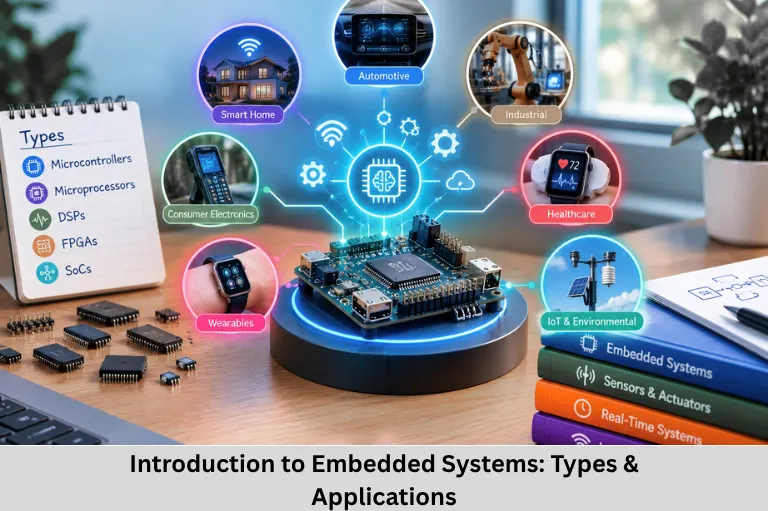
Learn embedded systems basics, architecture, types, real-time operation, applications, data processing, and career opportunities with Embedded Tech Development Academy (ETDA) Bangalore.
- Introduction to Embedded Systems: Types & Applications
-
Introduction to Embedded Systems: Fundamentals, Types, and Applications
- Introduction to Embedded Systems
- What Is an Embedded System?
- Embedded Systems vs. General-Purpose Computing Systems
- History of Embedded Systems
- Classification of Embedded Systems
- Major Application Areas of Embedded Systems
- Major Purposes of Embedded Systems
- Learning Embedded Systems for Engineering Careers
- Frequently Asked Questions
- Conclusion
Introduction to Embedded Systems: Fundamentals, Types, and Applications
Introduction to Embedded Systems
Embedded systems are an essential part of modern electronics, combining hardware and software to perform specific functions efficiently. From washing machines and smartphones to automotive control units, medical equipment, industrial automation systems, and Internet of Things (IoT) devices, embedded technology enables electronic products to monitor inputs, process data, and control outputs. Unlike general-purpose computers, embedded systems are designed around a particular application, with carefully selected microcontrollers, processors, memory, firmware, and peripheral interfaces.
Understanding embedded systems fundamentals is important for students and engineers interested in microcontroller programming, Embedded C, real-time operating systems (RTOS), digital electronics, sensor interfacing, and hardware-software integration. As connected devices and intelligent automation continue to develop, embedded systems are increasingly used in real-time control, low-power electronics, and edge computing.
For learners planning to enter this field, Embedded Tech Development Academy (ETDA) provides a learning pathway focused on practical embedded technology. Aspiring engineers exploring the Top Embedded Training Institute in Bangalore can develop their technical knowledge through microcontroller-based projects and firmware development. With industry-oriented learning and assured placement support, Embedded Tech Development Academy (ETDA) aims to help learners understand the practical skills expected in embedded engineering roles.
What Is an Embedded System?
An embedded system is an electronic or electromechanical system that combines hardware and firmware to perform a specific, predefined task. Its hardware may include a microcontroller or microprocessor, memory, sensors, actuators, communication interfaces, and power-management circuits. Firmware controls how these components operate.
For example, a washing machine uses sensors to detect water levels, a controller to execute the selected washing program, and actuators to operate valves and motors. The firmware coordinates these operations according to predefined conditions.
Key Characteristics of Embedded Systems
- Application-specific design: Hardware and software are selected for a defined purpose.
- Hardware-software integration: Firmware directly controls electronic components and peripherals.
- Resource constraints: Memory, processing power, storage, and energy may be limited.
- Real-time response: Some systems must respond within strict timing deadlines.
- Reliability: Devices may need to operate continuously in demanding environments.
- Specialized behavior: Operation is determined by the intended application and system requirements.
Common Examples
Embedded systems include electronic toys, mobile handsets, air conditioners, smart televisions, automotive engine control units, printers, digital cameras, and industrial controllers.
Embedded Systems vs. General-Purpose Computing Systems
General-purpose computers are designed to support a wide variety of applications, while embedded systems are optimized for particular functions.
| Feature | General-Purpose System | Embedded System |
|---|---|---|
| Primary purpose | Executes diverse applications | Performs a specific task or defined set of tasks |
| Hardware | General-purpose processor and peripherals | Application-specific hardware and peripherals |
| Operating system | Usually uses a general-purpose OS | May use an RTOS, embedded OS, or no OS |
| Software updates | Users can generally install applications | Firmware updates depend on the device design |
| Power consumption | Varies by system; often prioritizes performance | Frequently optimized for low power |
| Timing requirements | Usually flexible for everyday applications | May require strict real-time responses |
| Resource allocation | Often has substantial memory and processing resources | Commonly designed around resource constraints |
| Determinism | Depends on the OS and application | Can be engineered for deterministic execution |
A critical distinction is that not every embedded system requires an operating system. Small controllers may execute firmware directly using a super-loop architecture, while complex devices may use Linux or an RTOS. Similarly, embedded firmware is not always permanently fixed; many products support secure firmware updates.
History of Embedded Systems
Early Development
The Apollo Guidance Computer (AGC), developed for NASA’s Apollo missions, is a landmark example of an early modern embedded computer. It performed guidance and navigation calculations under strict constraints on processing power, memory, size, and reliability.
Mass Production and Modern Development
The Autonetics D-17 guidance computer, used in the Minuteman missile system, is an important early example of a mass-produced embedded computer. Over time, advances in integrated circuits, microprocessors, and microcontrollers made embedded systems smaller, more affordable, and more powerful.
Today, embedded technology supports connected vehicles, smart factories, wearable devices, robotics, Internet of Things (IoT) gateways, and AI-enabled edge devices.
Classification of Embedded Systems
Embedded systems can be classified according to several technical criteria.
Based on Generation
- First generation: Systems built around early processors and simple control logic.
- Second generation: Systems using more capable microprocessors and microcontrollers.
- Third generation: Systems incorporating advanced processors, networking, and sophisticated software.
- Fourth generation: Modern systems using multicore processors, wireless connectivity, Internet of Things (IoT), and edge intelligence.
Based on Complexity and Performance
- Small-scale systems: Use simple microcontrollers, limited memory, and basic firmware.
- Medium-scale systems: May use 16-bit or 32-bit controllers, peripheral drivers, and an RTOS.
- Sophisticated systems: Use powerful processors, complex operating systems, networking, and advanced control algorithms.
Based on Deterministic Behavior
- Hard real-time systems: Missing a critical deadline can cause system failure or unacceptable consequences.
- Soft real-time systems: Delays reduce performance or quality but may not cause complete failure.
- Firm real-time systems: Results delivered after a deadline may have little or no value.
Based on Triggering
- Time-triggered systems: Tasks execute according to a predefined schedule.
- Event-triggered systems: Tasks execute in response to events, such as sensor signals or communication interrupts.
Major Application Areas of Embedded Systems
Consumer Electronics and Home Automation
Cameras, televisions, microwave ovens, refrigerators, washing machines, smart lighting, security alarms, and air conditioners use embedded controllers to manage user inputs, sensors, and output devices.
Automotive and Transportation
Automotive embedded systems manage engine control, anti-lock braking systems (ABS), airbags, electronic stability control, navigation, battery management, and advanced driver-assistance systems. These applications require reliable hardware, validated software, and carefully defined timing behavior.
Telecommunications and Networking
Routers, switches, modems, cellular devices, and network gateways use embedded processors to manage packet forwarding, wireless connectivity, and communication protocols such as Ethernet, Wi-Fi, and Bluetooth.
Healthcare and Instrumentation
Electrocardiogram (ECG) machines, electroencephalogram (EEG) equipment, patient monitors, digital multimeters, oscilloscopes, and programmable logic controllers (PLCs) use embedded technology for measurement, monitoring, and control.
Banking and Identification
Automated teller machines (ATMs), point-of-sale (POS) terminals, barcode scanners, and smart-card readers combine embedded hardware, firmware, and communication interfaces to process transactions or identify items.
Major Purposes of Embedded Systems
Data Collection, Storage, and Representation
Embedded systems acquire data from sensors and external devices. Analog signals may be converted into digital values using an analog-to-digital converter (ADC), while digital inputs can be read directly through suitable interfaces. The collected data may be stored in memory, displayed to users, transmitted to another device, or processed immediately.
Example of Sensor Data Acquisition
A temperature-monitoring system reads a sensor, converts the measurement into a usable value, compares it with configured limits, and displays or transmits the result.
Technical Considerations
Engineers must consider sampling frequency, ADC resolution, calibration, noise filtering, memory capacity, and data format to obtain reliable measurements.
Data Communication
Embedded communication systems transfer information through wired interfaces such as UART, RS-232, USB, and Ethernet, or wireless technologies such as Wi-Fi, Bluetooth, Zigbee, and cellular networks.
Communication Protocols
Protocols define data framing, addressing, timing, error detection, and transmission behavior. The appropriate protocol depends on bandwidth, distance, power consumption, cost, and reliability requirements.
Practical Implementation
Developers configure communication peripherals, implement protocol handling, manage transmission buffers, and diagnose errors using debugging tools or logic analyzers.
Data and Signal Processing
Embedded systems process digital data for audio, video, sensor analysis, filtering, speech processing, and control algorithms. Digital signal processors (DSPs) and capable microcontrollers are commonly used where efficient mathematical computation is essential.
Monitoring and Control
Monitoring systems measure parameters such as temperature, pressure, speed, and voltage. Control systems use these measurements to adjust outputs through motors, relays, valves, or power electronics. Feedback control enables devices to maintain desired operating conditions.
Application-Specific User Interfaces
Displays, indicator LEDs, touchscreens, buttons, and alarms allow users to configure devices and understand system status. The interface must be designed for clear feedback, dependable operation, and the needs of the application.
Learning Embedded Systems for Engineering Careers
Developing embedded engineering skills requires a combination of programming and electronics knowledge. Important areas include Embedded C, microcontroller architecture, GPIO, interrupts, timers, ADC, PWM, UART, SPI, I2C, debugging, and basic RTOS concepts.
Embedded Tech Development Academy (ETDA) emphasizes the importance of connecting theoretical knowledge with practical development. Students researching the Top Embedded Training Institute in Bangalore should evaluate hands-on microcontroller projects, lab access, technical mentoring, and firmware debugging opportunities. Embedded Tech Development Academy (ETDA)‘s training approach and assured placement support are intended to help learners prepare for entry-level technical opportunities.
Frequently Asked Questions
What is an embedded system?
An embedded system is a hardware-software combination designed to perform a specific function. Examples include washing machine controllers, automotive ECUs, medical monitors, and smart sensors.
How is an embedded system different from a PC?
A PC supports a broad range of applications, whereas an embedded system is optimized for a particular task, often with strict limits on power, memory, cost, and response time.
Do all embedded systems use an operating system?
No. Simple systems can run firmware directly on a microcontroller. More complex systems may use an RTOS or an embedded operating system such as embedded Linux.
Where are embedded systems used?
They are used in automotive electronics, consumer appliances, industrial automation, telecommunications, healthcare equipment, banking terminals, robotics, and IoT devices.
Why are embedded systems important?
They enable reliable, efficient, and application-specific control of electronic products. Their ability to collect data, process signals, communicate, and respond to events makes them essential to modern automation and connected technology.
Conclusion
Embedded systems are specialized computing platforms that integrate microcontrollers, processors, firmware, sensors, communication interfaces, and control logic to perform dedicated tasks. Their applications span automotive electronics, healthcare instrumentation, industrial automation, consumer devices, networking, and Internet of Things (IoT). Understanding real-time systems, Embedded C programming, sensor interfacing, signal processing, and communication protocols provides a strong foundation for embedded engineering.
As connected devices, edge computing, and intelligent control become more widespread, practical embedded development skills will remain valuable. Embedded Tech Development Academy (ETDA) offers a route for learners to build these skills through technical training and project-based learning. Those comparing options for the Top Embedded Training Institute in Bangalore should prioritize practical implementation, debugging experience, and industry-relevant projects. With structured learning and assured placement support, aspiring engineers can work toward careers in firmware development, microcontroller programming, automotive embedded systems, and Internet of Things (IoT) development.
Author: ETDA Trainers
Experience: 10+ Years of Industry Experience in Embedded Systems, IoT, and Embedded C Programming