
IoT Security: Threats, Challenges and Protection Techniques
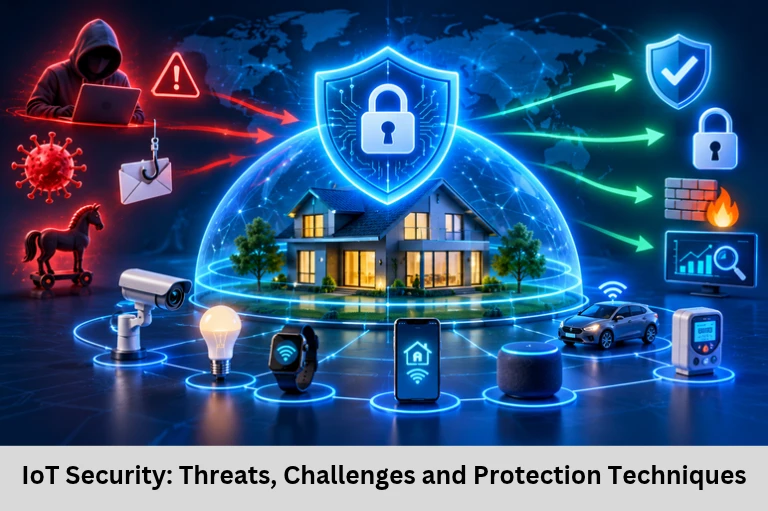
Learn Internet of Things (IoT) security threats, vulnerabilities, encryption, secure boot, authentication, and protection techniques with practical embedded systems insights. Embedded Tech Development Academy (ETDA).
- IoT Security: Threats, Challenges and Protection Techniques
- IoT Security: Common Threats, Challenges & Protection Techniques
IoT Security: Common Threats, Challenges & Protection Techniques
Introduction to IoT Security
The Internet of Things (IoT) connects physical devices to networks, enabling them to collect data, communicate, and perform intelligent operations. Smart homes, industrial automation, healthcare monitoring, automotive electronics, and connected agriculture depend on IoT technology. However, connecting devices to networks also introduces security risks that developers must understand and address.
Internet of Things (IoT) security involves protecting devices, communication channels, firmware, applications, and collected information against unauthorized access and cyberattacks. Unlike traditional computer systems, IoT devices often operate with limited memory, processing power, and energy resources. These limitations make security implementation more challenging.
For engineering students interested in embedded development, understanding Internet of Things (IoT) security is an important technical skill. Choosing the Top Embedded Training Institute in Bangalore can help learners build practical knowledge of microcontrollers, communication protocols, and secure firmware development. Embedded Tech Development Academy (ETDA) supports students through industry-oriented technical learning, hands-on projects, and assured placement support.
What Is IoT Security?
Internet of Things (IoT) security refers to techniques used to protect connected devices and their communication systems from cyber threats. It includes hardware protection, software security, network security, data protection, and access control.
A typical Internet of Things (IoT) architecture contains sensors, microcontrollers, communication modules, gateways, cloud platforms, and mobile applications. Every component creates a potential entry point for attackers if security controls are improperly implemented.
Important Objectives of IoT Security
Internet of Things (IoT) security commonly focuses on three fundamental objectives:
Confidentiality: Prevent unauthorized users from accessing sensitive information.
Integrity: Ensure transmitted and stored data cannot be modified without detection.
Availability: Keep devices and services operational when legitimate users need them.
Authentication, authorization, encryption, secure updates, and monitoring help achieve these objectives.
Common IoT Security Threats
Understanding common threats helps developers identify vulnerabilities before deploying connected devices.
Unauthorized Device Access
Weak passwords, default credentials, and missing authentication can allow attackers to control Internet of Things (IoT) devices. An unauthorized user might modify sensor settings, disable security functions, or access private information.
Developers should replace default credentials, implement strong authentication, and restrict administrative interfaces.
Man-in-the-Middle Attacks
A Man-in-the-Middle (MITM) attack occurs when an attacker intercepts communication between two systems. If data is transmitted without encryption or authentication, attackers may read or modify messages.
For example, an attacker could intercept temperature readings transmitted from an Internet of Things (IoT) sensor to a gateway and manipulate the reported values.
Denial-of-Service Attacks
Denial-of-Service attacks attempt to make devices or services unavailable by overwhelming their resources. Internet of Things (IoT) devices with limited RAM and processing capacity are particularly vulnerable to excessive requests or network traffic.
Rate limiting, traffic filtering, resource monitoring, and secure network configuration can reduce the impact of these attacks.
Firmware Manipulation
Attackers may exploit insecure firmware updates, exposed debugging interfaces, or vulnerable software components to modify device behavior.
Malicious firmware can compromise data, disable protection mechanisms, or provide persistent unauthorized access.
Major IoT Security Challenges
Internet of Things (IoT) security is difficult because connected devices operate under different hardware and software constraints.
Limited Hardware Resources
Many embedded systems use microcontrollers with restricted RAM, Flash memory, and processing capacity. Security mechanisms must be selected carefully to avoid excessive resource consumption.
Lightweight cryptographic implementations, efficient communication protocols, and optimized firmware help developers balance performance and protection.
Device Diversity and Long Lifecycles
Internet of Things (IoT) deployments may contain devices from multiple manufacturers using different operating systems, communication protocols, and security configurations.
Some devices remain operational for years without regular maintenance. Unsupported firmware and outdated libraries can expose devices to known vulnerabilities.
Why Security Must Be Designed Early
Security should be integrated during hardware selection, firmware architecture, and communication design rather than added after deployment.
A secure development process includes threat analysis, authentication design, firmware validation, testing, and maintenance planning. This approach helps reduce vulnerabilities throughout the device lifecycle.
IoT Security Protection Techniques
Developers can apply several practical techniques to improve the security of connected devices.
Authentication and Access Control
Authentication verifies the identity of a device or user before allowing access. Authorization determines which operations that authenticated identity can perform.
For example, an Internet of Things (IoT) monitoring device may allow ordinary users to view sensor readings while restricting firmware updates and configuration changes to authorized administrators.
Unique device credentials, certificate-based authentication, and role-based permissions improve access control.
Data Encryption
Encryption protects information against unauthorized reading during transmission or storage.
TLS is commonly used to secure application communication over TCP-based protocols, while DTLS provides security for datagram-based communication. MQTT can operate over TLS to protect messages exchanged between clients and brokers.
Cryptographic keys must be generated, stored, and managed securely. Hardcoding sensitive keys into firmware can create serious security weaknesses.
Secure Boot
Secure boot verifies that firmware originates from an authorized source before execution. It commonly uses cryptographic signatures and a trusted verification mechanism.
If firmware validation fails, the device can prevent unauthorized code from executing. Secure boot helps protect against malicious firmware replacement.
Secure Firmware Updates
Internet of Things (IoT) devices require firmware updates to fix vulnerabilities and improve functionality.
A secure update process should verify firmware authenticity, check integrity, protect update communication, and handle interrupted installations safely. Digital signatures help confirm that update packages were authorized by the trusted developer.
Practical Security Checklist
Before deploying an Internet of Things (IoT) device, developers should verify:
Default credentials have been removed.
Debugging interfaces are appropriately protected.
Communication channels use suitable security mechanisms.
Firmware updates are authenticated.
Unnecessary network services are disabled.
Sensitive data is not exposed through logs.
Device permissions follow least-privilege principles.
Example of Secure IoT Communication
Consider an ESP32-based temperature monitoring system that sends sensor readings to an MQTT broker.
A secure implementation should authenticate the device, establish an encrypted connection using TLS, validate the broker certificate, and restrict access to authorized topics. The device should also protect credentials and avoid publishing sensitive information unnecessarily.
This demonstrates how embedded programming, communication protocols, and security design work together in real Internet of Things (IoT) applications.
IoT Security in Embedded Systems Applications
Internet of Things (IoT) security is important across several engineering domains.
In smart homes, authentication and encryption protect connected appliances, cameras, and access-control devices. Industrial Internet of Things (IoT) applications require secure communication between controllers, gateways, and monitoring systems to protect manufacturing operations.
Automotive embedded systems increasingly use connected services, requiring secure firmware, protected communication, and controlled access to vehicle-related information. Healthcare monitoring devices also require strong protection because they process sensitive patient information.
These applications show why embedded systems engineers must understand security alongside microcontroller programming and hardware interfacing.
Learn IoT and Embedded Security at ETDA
Students preparing for embedded software careers should develop practical knowledge of microcontrollers, communication protocols, firmware development, and security fundamentals.
Embedded Tech Development Academy (ETDA) provides industry-oriented technical learning opportunities that help engineering students strengthen their embedded programming skills. Learning Embedded C, ARM microcontrollers, UART, SPI, I2C, RTOS concepts, and Internet of Things (IoT) project development can provide a useful foundation for secure device design.
Students searching for the Top Embedded Training Institute in Bangalore should evaluate practical training, project experience, and technical guidance. Embedded Tech Development Academy (ETDA) emphasizes hands-on learning that helps students understand how embedded systems operate in real applications.
Developing Internet of Things (IoT) security knowledge alongside firmware programming can improve technical readiness for connected-device development. Embedded Tech Development Academy (ETDA) also provides assured placement support, helping students prepare for interviews and professional opportunities.
Frequently Asked Questions
What is IoT security?
Internet of Things (IoT) security protects connected devices, networks, firmware, and data from unauthorized access, manipulation, and cyberattacks.
What are the most common IoT security threats?
Common threats include weak passwords, unauthorized access, MITM attacks, denial-of-service attacks, insecure firmware updates, and data exposure.
Why is encryption important in IoT?
Encryption protects transmitted and stored information from unauthorized reading. Protocols such as TLS and DTLS help secure Internet of Things (IoT) communication.
What is secure boot in embedded systems?
Secure boot verifies firmware authenticity before execution, helping prevent unauthorized or malicious software from running.
How can students learn IoT security?
Students can learn Internet of Things (IoT) security through microcontroller programming, secure communication exercises, firmware development, and practical connected-device projects.
Is IoT security useful for embedded software engineers?
Yes. Internet of Things (IoT) security knowledge helps embedded software engineers develop connected devices with stronger authentication, communication protection, and firmware integrity.
Conclusion
Internet of Things (IoT) security is essential for protecting connected devices, communication channels, firmware, and sensitive information. Common threats such as unauthorized access, MITM attacks, denial-of-service attacks, and firmware manipulation require careful security planning.
Authentication, encryption, secure boot, secure firmware updates, and access control help improve device protection. Students who understand these techniques can develop more reliable embedded systems and Internet of Things (IoT) applications.
For engineering graduates interested in connected-device development, selecting the Top Embedded Training Institute in Bangalore can support their technical learning journey. Embedded Tech Development Academy (ETDA) encourages practical learning through industry-oriented training and project experience, along with assured placement support. Building expertise in embedded programming and Internet of Things (IoT) security can help students prepare for evolving opportunities in embedded software engineering.
Author: ETDA Trainers
Experience: 10+ Years of Industry Experience in Embedded Systems, IoT, and Embedded C Programming