
LPC1768 Ethernet Communication Using Socket Programming
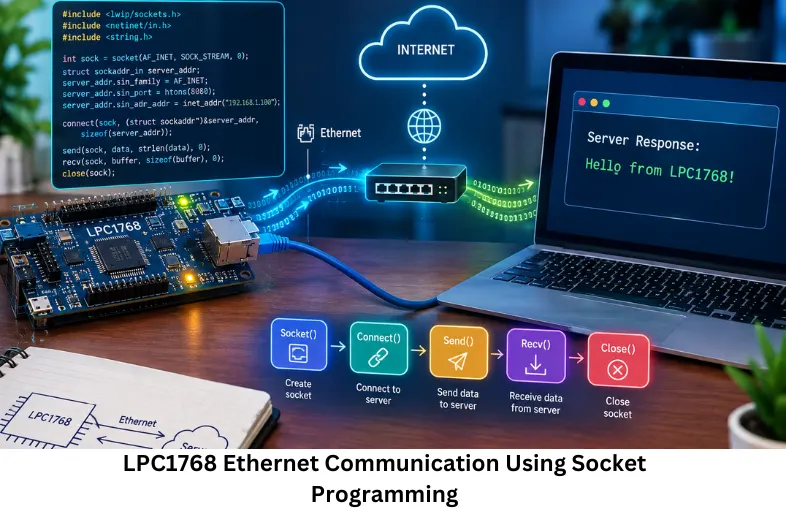
Learn LPC1768 Ethernet communication, TCP/IP, UDP, socket concepts, lwIP, Ethernet PHY, client-server architecture and Internet of Things (IoT) applications. Embedded Tech Development Academy (ETDA).
- LPC1768 Ethernet Communication Using Socket Programming
-
LPC1768 Ethernet Communication Using Socket Programming Concepts
- Introduction to LPC1768 Ethernet Communication
- Understanding Socket Programming
- Why Traditional PC Socket Programming Does Not Directly Apply
- LPC1768 Ethernet Hardware Architecture
- Using an Embedded TCP/IP Stack
- Implementing Socket-Like Communication on LPC1768
- LPC1768 as a TCP Server
- UDP Communication on LPC1768
- Network Configuration and Data Flow
- Applications of LPC1768 Ethernet Communication
- Advantages and Limitations
- PC Socket Programming vs LPC1768 Networking
- Learning Path for Embedded Networking
- Frequently Asked Questions
- Conclusion
LPC1768 Ethernet Communication Using Socket Programming Concepts
Introduction to LPC1768 Ethernet Communication
Networking is no longer restricted to desktop computers and servers. Modern embedded systems increasingly communicate with other controllers, industrial computers, gateways, sensors, and cloud platforms through Ethernet and TCP/IP networks. This connectivity is particularly important in Internet of Things (IoT) applications, industrial automation, remote monitoring, building automation, and networked control systems.
One of the most widely used networking techniques in computer programming is socket programming. On Linux or Windows, applications use socket APIs to establish TCP or UDP communication between clients and servers. A microcontroller such as the NXP LPC1768 does not provide a desktop operating system or conventional POSIX socket environment by default, but the same networking concepts can be implemented using an embedded TCP/IP stack.
The LPC1768 contains an integrated 10/100 Ethernet MAC, while an external Ethernet PHY is required to interface the MAC with the physical Ethernet network. Embedded TCP/IP stacks such as lwIP can provide protocols including IP, TCP, UDP, ARP, ICMP, DHCP, and other networking functionality. Application firmware can then use stack APIs that conceptually resemble socket-based communication.
Understanding Ethernet MAC, PHY, TCP/IP, UDP, TCP sockets, client-server architecture, IP addressing, ports, packet transmission, network buffers, lwIP, embedded networking, and Internet of Things (IoT) communication is therefore important for engineers developing network-enabled embedded products.
Embedded Tech Development Academy (ETDA) provides practical learning in microcontrollers, embedded C, communication protocols, Ethernet, and firmware development. Learners searching for a Top Embedded Training Institute in Bangalore can develop practical embedded systems and networking skills with assured placement support. These concepts are also valuable for engineers building Internet of Things (IoT) products that require reliable Ethernet communication.
Understanding Socket Programming
Client and Server Architecture
Socket programming provides an abstraction for network communication between applications.
TCP Communication
A TCP server normally creates a socket, binds it to an IP address and port, listens for incoming connections, accepts a connection, and exchanges data.
Basic TCP Flow
Server:
Socket → Bind → Listen → Accept → Receive/Send

Client:
Socket → Connect → Send/Receive
TCP provides connection-oriented, reliable and ordered data delivery.
UDP Communication
UDP does not establish a connection in the same manner as TCP.
Datagram Communication
An application can send a UDP datagram to a destination IP address and port.
Embedded Applications
UDP can be useful where low protocol overhead and fast datagram transmission are more important than TCP-style reliability.
Why Traditional PC Socket Programming Does Not Directly Apply
Microcontroller Environment
The LPC1768 is a microcontroller designed for firmware execution rather than desktop application processing.
Missing Operating-System Services
A typical desktop socket environment depends on:
- Operating-system networking services
- Process and thread management
- File descriptors
- TCP/IP networking APIs
- Network device drivers
- Memory-management facilities
Embedded Alternative
The LPC1768 can provide equivalent networking functionality using an embedded TCP/IP stack, Ethernet driver, and application-level networking APIs.
LPC1768 Ethernet Hardware Architecture
Integrated Ethernet MAC
The LPC1768 includes a 10/100 Mbps Ethernet MAC.
Ethernet PHY Requirement
The MAC handles Ethernet frame processing at the controller level, but an external PHY (Physical Layer Transceiver) is required to convert digital Ethernet signals into the physical electrical signaling used by the Ethernet interface.
Typical Hardware Path
LPC1768 Ethernet MAC
        ↓
External Ethernet PHY
        ↓
Magnetics / RJ45
        ↓
Ethernet Network
This distinction is important when designing LPC1768 Ethernet hardware.
Using an Embedded TCP/IP Stack
lwIP Architecture
lwIP (Lightweight IP) is a commonly used TCP/IP stack designed for resource-constrained embedded devices.
Protocol Layers
A simplified architecture is:
Application
     ↓
TCP / UDP
     ↓
IP
     ↓
ARP / ICMP
     ↓
Ethernet Driver
     ↓
Ethernet MAC
     ↓
PHY
Network Buffer Management
Embedded networking requires careful management of packet buffers and memory. lwIP uses structures such as pbuf to manage packet data efficiently.
This is important because the LPC1768 has significantly fewer resources than a desktop computer.
Implementing Socket-Like Communication on LPC1768
TCP Client
A TCP client can initiate communication with a remote server.
Connection Sequence
The firmware generally performs the following operations:
- Initialize Ethernet hardware.
- Initialize the TCP/IP stack.
- Configure the IP address.
- Create or configure a TCP connection.
- Connect to the remote server.
- Transmit application data.
- Receive responses.
- Close or maintain the connection.
Example Application
An LPC1768-based monitoring controller could connect to a PC server and periodically transmit:
Temperature: 31.8 C
Pressure: 101.4 kPa
Status: NORMAL
LPC1768 as a TCP Server
Listening for Client Connections
The LPC1768 can also operate as a TCP server when the embedded TCP/IP stack provides the required server-side APIs.
Server Processing
The application waits for a client connection and processes incoming commands.
Remote Control Example
PC Client
   ↓
TCP Command
   ↓
LPC1768 Server
   ↓
GPIO / Motor / Relay
For example, a PC application could send a command to switch a GPIO-controlled device ON or OFF.
UDP Communication on LPC1768
Datagram-Based Networking
UDP is useful when applications exchange independent packets without requiring a persistent TCP connection.
Sensor Data Transmission
An LPC1768 sensor node could periodically transmit:
Device_ID=01
Temperature=29.4
Humidity=61
UDP Design Considerations
UDP does not provide TCP-style delivery guarantees. If an application requires reliable delivery, sequencing, acknowledgements, retransmission, or duplicate detection, these mechanisms may need to be implemented at the application level.
Network Configuration and Data Flow
IP Address Configuration
The Ethernet interface requires network parameters such as:
- IP address
- Subnet mask
- Gateway
- DNS server where required
Static and Dynamic Addressing
A device can use a static IP configuration or obtain network parameters through DHCP when the TCP/IP stack supports it.
Complete Communication Flow
Application
     ↓
TCP / UDP
     ↓
IP Addressing
     ↓
Ethernet Driver
     ↓
LPC1768 MAC
     ↓
PHY
     ↓
Ethernet Cable
     ↓
PC / Gateway / Server
Applications of LPC1768 Ethernet Communication
Industrial Automation
Ethernet connectivity allows controllers to exchange machine status, sensor measurements, alarms, and control commands.
Remote Monitoring
A central PC can periodically request diagnostic information from multiple LPC1768-based controllers.
Fault Reporting
The controller can transmit fault codes immediately when abnormal conditions are detected.
Internet of Things (IoT)
An LPC1768 Ethernet node can collect sensor data and forward it to a gateway or server.
IoT Data Pipeline
Sensor
  ↓
LPC1768
  ↓
Ethernet
  ↓
Gateway / Server
  ↓
Database / Dashboard
Edge Processing
Local filtering can reduce unnecessary network traffic before measurements are transmitted.
Advantages and Limitations
Advantages
LPC1768 Ethernet communication provides:
- Wired network connectivity
- TCP and UDP communication through suitable stacks
- Real-time embedded control
- Direct Ethernet MAC integration
- Industrial networking possibilities
- Internet of Things (IoT) connectivity
Limitations
Resource Constraints
The LPC1768 has substantially less memory and processing capability than a PC.
Engineering Considerations
Developers must carefully manage:
- TCP/IP buffers
- Stack memory
- Packet sizes
- Connection counts
- CPU utilization
- Timeout handling
- Network error recovery
A robust implementation should also handle link loss, connection timeout, malformed packets, retransmission behavior, and PHY status changes.
PC Socket Programming vs LPC1768 Networking
Architecture Comparison
| Feature | PC | LPC1768 |
|---|---|---|
| Operating system | Usually available | Bare-metal or RTOS |
| TCP/IP | OS networking stack | Embedded TCP/IP stack |
| Socket API | Standard OS APIs | Stack-dependent APIs |
| Ethernet | Network controller | Ethernet MAC + external PHY |
| Memory | Large | Limited |
| Application model | Processes/threads | Firmware tasks/functions |
Common Networking Principle
Client-Server Model
Despite implementation differences, both platforms use the same fundamental concepts: IP addresses, ports, packets, TCP/UDP transport, clients, servers, and application protocols.
Learning Path for Embedded Networking
Recommended Technical Sequence
Step-by-Step Learning
- Learn Ethernet fundamentals.
- Understand MAC and PHY operation.
- Study IPv4 addressing and subnetting.
- Learn TCP and UDP.
- Practice socket programming on Linux or Windows.
- Study embedded TCP/IP stacks such as lwIP.
- Interface LPC1768 with an Ethernet PHY.
- Build TCP client and server projects.
- Implement UDP sensor communication.
- Add error handling and timeout recovery.
Project-Based Practice
A useful project is an LPC1768 Ethernet-based environmental monitoring system where the controller reads sensors, processes the data, and sends measurements to a PC dashboard using TCP or UDP.
Embedded Tech Development Academy (ETDA) can help learners develop practical knowledge of embedded C, microcontrollers, Ethernet, TCP/IP, and Internet of Things (IoT) communication. As a Top Embedded Training Institute in Bangalore, Embedded Tech Development Academy (ETDA) focuses on practical technical skills with assured placement support.
Frequently Asked Questions
Can LPC1768 run normal Linux socket programming?
No. The LPC1768 does not natively provide the desktop operating-system environment required for conventional Linux socket programming. However, embedded TCP/IP stacks can provide similar networking functionality.
Does LPC1768 have built-in Ethernet?
The LPC1768 includes a 10/100 Ethernet MAC, but an external Ethernet PHY is required to provide the physical Ethernet interface.
Can LPC1768 work as a TCP server?
Yes. With an appropriate TCP/IP stack and Ethernet driver, LPC1768 firmware can implement TCP server functionality and accept connections from network clients.
What is the role of lwIP?
lwIP is a lightweight TCP/IP stack designed for embedded systems. It provides networking protocols and APIs that allow resource-constrained microcontrollers to communicate over IP networks.
Is LPC1768 Ethernet useful for IoT projects?
Yes. Ethernet-connected LPC1768 systems can collect sensor information, perform local processing, communicate with gateways or servers, and support industrial and Internet of Things (IoT) applications.
Conclusion
LPC1768 Ethernet communication demonstrates how networking concepts normally associated with computers can be adapted to resource-constrained embedded systems. Although a microcontroller does not normally execute traditional desktop socket programming, it can implement the same fundamental networking concepts through an embedded TCP/IP stack such as lwIP.
The LPC1768’s integrated Ethernet MAC, combined with an external PHY, Ethernet driver, TCP/IP stack, and application firmware, provides a complete path for network communication. Depending on the application, the controller can function as a TCP client, TCP server, UDP sender, or UDP receiver. This makes it suitable for industrial monitoring, remote control, data acquisition, automation, and Internet of Things (IoT) applications.
Engineers working with networked embedded systems should understand Ethernet frames, MAC and PHY layers, IP addressing, TCP, UDP, ports, packet buffers, connection management, timeouts, error recovery, and application protocols. Embedded Tech Development Academy (ETDA) provides practical technical learning in these areas. Learners looking for a Top Embedded Training Institute in Bangalore can develop hands-on networking and firmware skills with assured placement support.
Practical projects are particularly valuable because embedded networking requires both hardware and software understanding. Working with an LPC1768 Ethernet MAC, external PHY, TCP/IP stack, network debugging tools, and PC-based client applications helps learners understand the complete communication path. Embedded Tech Development Academy (ETDA) supports practical embedded technology learning, while a Top Embedded Training Institute in Bangalore environment can provide structured exposure to microcontrollers, networking, and embedded systems, along with assured placement support.
As connected devices continue to expand, Ethernet remains important in industrial and Internet of Things (IoT) environments where reliable wired communication is required. Learning how LPC1768 implements TCP/IP networking and socket programming concepts provides a strong foundation for embedded networking development. Embedded Tech Development Academy (ETDA), as a Top Embedded Training Institute in Bangalore, helps learners develop practical skills in embedded C, Ethernet, TCP/IP, microcontrollers, and Internet of Things (IoT) communication with assured placement support.
Author: ETDA Trainers
Experience: 10+ Years of Industry Experience in Embedded Systems, IoT, and Embedded C Programming