
Modern Embedded C++ for Safe, High-Performance Firmware
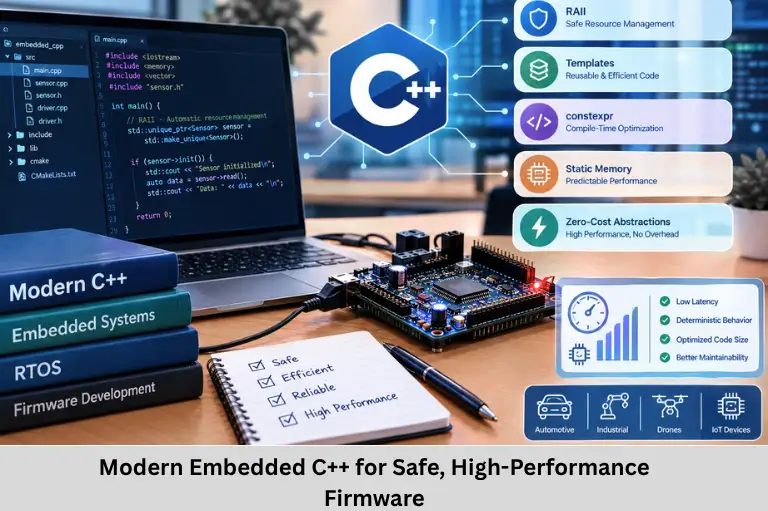
Learn Modern Embedded C++ techniques for safe, deterministic and high-performance firmware using RAII, templates, constexpr, static memory and zero-cost abstractions. Embedded Tech Development Academy (ETDA).
- Modern Embedded C++ for Safe, High-Performance Firmware
-
Modern Embedded C++: Writing Safe, High-Performance Firmware
- Introduction to Modern Embedded C++
- Why Modern C++ Is Used in Embedded Systems
- Safety Techniques in Embedded C++
- RAII and Deterministic Resource Management
- Static Memory and Avoiding Dynamic Allocation
- High-Performance Modern Embedded C++ Techniques
- Controlling Virtual Functions, Exceptions and RTTI
- Selective Use of the C++ Standard Library
- Coding Standards and Embedded C++ Compliance
- When Embedded C May Still Be Preferred
- Frequently Asked Questions
- Conclusion
Modern Embedded C++: Writing Safe, High-Performance Firmware
Introduction to Modern Embedded C++
Embedded systems have evolved significantly from simple 8-bit microcontroller applications and basic bare-metal control programs. Modern firmware is now responsible for complex functionality in automotive ECUs, industrial controllers, robotics, medical devices, Internet of Things (IoT) gateways, consumer electronics, aerospace systems, and AI-enabled edge devices. These systems require firmware that is not only fast but also predictable, maintainable, testable, and resistant to programming errors.
This increasing software complexity has encouraged many engineering teams to adopt Modern Embedded C++. Features introduced from C++11 onward provide stronger type safety, deterministic resource management, compile-time computation, generic programming, and zero-cost abstractions while still allowing direct access to hardware registers and memory-mapped peripherals.
Modern Embedded C++ does not mean using every feature of desktop C++. Instead, it means selecting language features that provide measurable engineering benefits while controlling runtime overhead, memory consumption, binary size, and execution-time behavior. Techniques such as RAII, constexpr, templates, enum class, static allocation, compile-time polymorphism, fixed-size containers, and type-safe interfaces can improve firmware architecture without sacrificing performance.
For engineers developing these skills, Embedded Tech Development Academy (ETDA) focuses on practical embedded programming, microcontrollers, firmware development, and related technologies. Learners searching for a Top Embedded Training Institute in Bangalore can develop hands-on embedded C++ skills with assured placement support.
Why Modern C++ Is Used in Embedded Systems
Limitations of Traditional Embedded C
Embedded C provides excellent hardware-level control, but large firmware projects can become difficult to maintain because of:
- Weak type separation
- Extensive pointer usage
- Manual resource management
- Global-state dependencies
- Repeated boilerplate code
- Limited compile-time validation
Modern C++ Improvements
Modern C++ introduces stronger abstractions without requiring automatic runtime overhead. Features such as strong typing, templates, constexpr, RAII, namespaces, inline functions, and scoped enumerations allow firmware developers to express hardware and software relationships more precisely.
Zero-Cost Abstraction Principle
A zero-cost abstraction aims to provide a higher-level programming interface without imposing runtime costs compared with an equivalent low-level implementation. When abstractions are resolved during compilation, the generated machine code can remain highly efficient.
Safety Techniques in Embedded C++
Safety is particularly important in firmware controlling braking systems, industrial machinery, medical equipment, motor controllers, and safety-related automation.
Strong Type Safety with enum class
Traditional enumerations can participate in implicit conversions. enum class provides stronger type separation.
enum class MotorState {
    Stopped,
    Running,
    Fault
};

MotorState state = MotorState::Stopped;
Preventing Invalid Assignments
The scoped enumeration requires explicit qualification, reducing accidental mixing of unrelated enumeration values.
Compile-Time Error Detection
Stronger typing allows the compiler to identify many programming mistakes before firmware reaches the target hardware, reducing debugging effort and improving software reliability.
RAII and Deterministic Resource Management
Understanding RAII
Resource Acquisition Is Initialization (RAII) connects the lifetime of a resource with the lifetime of an object. Although commonly associated with memory management, RAII can also be applied to mutexes, peripheral states, interrupt locks, communication interfaces, and hardware resources.
class PeripheralLock {
public:
    PeripheralLock() {
        // Acquire resource
    }

    ~PeripheralLock() {
        // Release resource
    }
};
Benefits of RAII
RAII provides:
- Deterministic cleanup
- Controlled resource ownership
- Reduced cleanup errors
- Better exception-free resource handling
- Clear object lifetime semantics
Embedded Application
In embedded firmware, RAII can be designed so that entering a critical section automatically acquires a synchronization mechanism and object destruction restores the previous state.
Static Memory and Avoiding Dynamic Allocation
Problems with Heap Allocation
Dynamic memory allocation can introduce fragmentation, allocation failure, variable execution time, and unpredictable memory behavior. These characteristics can be undesirable in deterministic real-time firmware.
Modern embedded projects commonly prefer:
- Static allocation
- Automatic storage
- Fixed-size buffers
- Compile-time memory sizing
- Memory pools when dynamic behavior is genuinely required
Fixed-Size Containers
std::array is useful when the required number of elements is known at compile time.
#include <array>

std::array<uint8_t, 16> rxBuffer{};
Deterministic Buffer Management
A fixed-size container avoids repeated heap allocation and provides compile-time size information while retaining useful C++ type safety.
High-Performance Modern Embedded C++ Techniques
constexpr and Compile-Time Computation
The constexpr keyword allows suitable expressions to be evaluated during compilation.
constexpr uint32_t CLOCK_HZ = 48000000U;
constexpr uint32_t TIMER_PERIOD = CLOCK_HZ / 1000U;
Reducing Runtime Work
If a calculation can be performed during compilation, the processor does not need to execute the calculation every time the firmware runs that code path.
Deterministic Execution
Compile-time computation can reduce runtime instructions and improve timing predictability, which is particularly useful in real-time control loops, timer configuration, communication drivers, and signal-processing code.
Templates and Static Polymorphism
Templates allow reusable code to be specialized at compile time.
template <typename T>
T square(T value)
{
    return value * value;
}
The compiler can generate an appropriate implementation for each required type.
Compile-Time Polymorphism
Template-based designs can replace some runtime polymorphism where dynamic dispatch is unnecessary.
Performance Advantage
Unlike virtual-function dispatch, compile-time polymorphism can avoid virtual tables and indirect calls, making execution behavior easier to analyze.
Controlling Virtual Functions, Exceptions and RTTI
Virtual Functions
Virtual functions provide runtime polymorphism but may introduce indirect calls, virtual tables, and additional memory requirements.
In timing-sensitive firmware, developers may instead use:
- Templates
- Function objects
- Static polymorphism
- Explicit interfaces
- Compile-time dispatch
Exceptions
Exceptions can increase code size and complicate worst-case execution-time analysis. Many embedded projects therefore disable exceptions and use explicit error-handling mechanisms.
Error Handling
Return codes, status types, error enums, and compile-time validation can provide predictable alternatives.
RTTI
Run-Time Type Information (RTTI) supports features such as dynamic_cast and typeid. If runtime type identification is unnecessary, disabling RTTI can reduce firmware overhead.
Selective Use of the C++ Standard Library
Useful Embedded C++ Components
The standard library should not automatically be considered unsuitable for embedded systems. Individual components can be selected according to memory and timing requirements.
Useful options include:
std::arraystd::spanstd::chronostd::optionalwhere supported and appropriate- Type traits and compile-time utilities
Safe Buffer Access with std::span
std::span provides a non-owning view over contiguous memory.
void transmit(std::span<const uint8_t> data)
{
    // Send data through peripheral
}
Hardware Driver Application
A driver can accept a buffer view without copying the underlying data, helping create safer interfaces between application code and communication drivers.
Coding Standards and Embedded C++ Compliance
MISRA C++
Safety-oriented embedded development often uses restricted C++ coding practices. MISRA C++ provides guidelines intended to reduce programming errors and improve code quality.
AUTOSAR C++14
Automotive software projects may use AUTOSAR C++14 guidelines to establish rules for modern C++ development.
Functional Safety
Standards such as ISO 26262 for automotive functional safety and IEC 61508 for industrial functional safety establish broader engineering processes and safety requirements.
Static Analysis
Tools such as static analyzers can detect:
- Undefined behavior
- Suspicious conversions
- Dead code
- Unused variables
- Potential defects
- Rule violations
Combining restricted language features with code reviews, unit testing, static analysis, and hardware testing creates a more controlled firmware development process.
When Embedded C May Still Be Preferred
Extremely Constrained Hardware
Very small microcontrollers with extremely limited flash and RAM may have project constraints that make a restricted C environment practical.
Legacy Toolchains
Older compilers, existing C codebases, or vendor SDK limitations can also influence language selection.
Architectural Decision
The choice between C and C++ should depend on hardware resources, compiler support, project complexity, safety requirements, team expertise, testing infrastructure, and long-term maintainability.
Selecting the Appropriate Language
C++ should be introduced because its language features solve specific engineering problems—not simply because it is a newer language.
Frequently Asked Questions
Is Modern Embedded C++ suitable for real-time systems?
Yes. A carefully restricted subset of C++ can be used in real-time systems. Static allocation, deterministic algorithms, controlled library usage, and avoidance of unpredictable runtime mechanisms can support predictable execution.
Does C++ make embedded firmware slower than C?
Not inherently. Templates, inline functions, constexpr, and compile-time polymorphism can generate highly efficient machine code. Actual performance depends on compiler optimization, implementation, architecture, and the features selected.
Which C++ features are commonly restricted in embedded firmware?
Project rules often restrict or carefully control dynamic allocation, exceptions, RTTI, unrestricted use of dynamic containers, recursion, and other mechanisms that can complicate timing or memory analysis.
Can Modern Embedded C++ be used in safety-critical applications?
Yes, C++ is used in safety-related embedded software when development follows the applicable safety process, coding guidelines, verification requirements, static analysis practices, and project-specific restrictions.
Why are templates useful in embedded C++?
Templates enable generic and compile-time programming. They can provide reusable abstractions while allowing the compiler to specialize code for specific types and configurations, potentially avoiding runtime polymorphism overhead.
Conclusion
Modern Embedded C++ provides a powerful combination of low-level hardware control, strong type safety, deterministic resource management, compile-time programming, zero-cost abstractions, and reusable software architecture. Features such as enum class, RAII, constexpr, templates, std::array, std::span, static polymorphism, and carefully selected standard-library components can help engineers create firmware that is easier to analyze and maintain without unnecessarily increasing runtime overhead.
The key to successful embedded C++ development is not using every available C++ feature. Instead, firmware engineers should establish clear rules around memory allocation, execution-time behavior, object lifetime, exception handling, RTTI, template usage, compiler optimization, coding standards, and hardware abstraction. Combining these practices with static analysis, unit testing, integration testing, code reviews, and target-hardware validation is essential for production-quality firmware.
For engineers learning embedded C++, microcontroller programming, firmware architecture, RTOS concepts, device drivers, and hardware-software integration, practical implementation is critical. Embedded Tech Development Academy (ETDA) provides industry-oriented technical learning focused on embedded technologies and hands-on programming. Learners looking for a Top Embedded Training Institute in Bangalore can build practical embedded C++ knowledge while receiving assured placement support.
As embedded products become increasingly software-intensive, knowledge of Modern Embedded C++, real-time programming, memory management, templates, compile-time optimization, hardware abstraction layers, communication protocols, and microcontroller architecture is becoming valuable for firmware development. Embedded Tech Development Academy (ETDA) can help learners connect these programming concepts with practical embedded-system development. For those searching for a Top Embedded Training Institute in Bangalore, combining technical training, hands-on firmware development, and assured placement support can help build the skills required for modern embedded engineering roles.
Author: ETDA Trainers
Experience: 10+ Years of Industry Experience in Embedded Systems, IoT, and Embedded C Programming