
Motor Control Techniques Using Embedded Microcontrollers
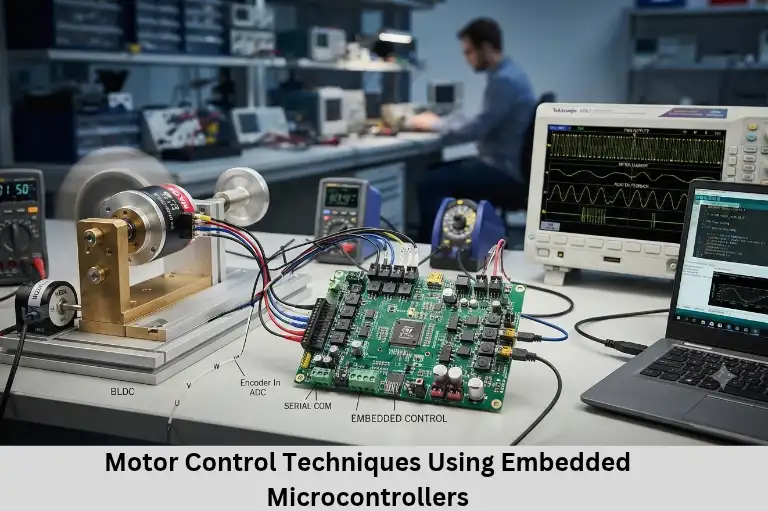
Explore DC, stepper and BLDC motor control using embedded microcontrollers, PWM, motor drivers and real-time programming. Learn practical skills with Embedded Tech Development Academy (ETDA).
- Motor Control Techniques Using Embedded Microcontrollers
-
Motor Control Techniques Using Embedded Microcontrollers
- Introduction
- Understanding Motor Control in Embedded Systems
- Major Motor Control Techniques Using Embedded Microcontrollers
- Hardware and Software Components Required
- Practical Projects for Embedded Students
- Career Opportunities in Embedded Motor Control
- Learn Practical Embedded Development at ETDA
-
Frequently Asked Questions
- What is motor control using embedded microcontrollers?
- Which microcontrollers are used for motor control?
- What is PWM in motor control?
- What is the difference between open-loop and closed-loop motor control?
- Which programming language is used for embedded motor control?
- Can beginners learn motor control at ETDA?
- Conclusion
Motor Control Techniques Using Embedded Microcontrollers
Introduction
Motor control is an important application of embedded systems used in automotive electronics, robotics, industrial automation, electric vehicles and consumer electronics. Embedded microcontrollers provide an efficient way to control motor speed, direction, torque and position through programmed instructions and electronic driver circuits. Understanding motor control techniques using embedded microcontrollers helps students develop practical skills required for modern embedded engineering applications.
From controlling a simple DC motor to implementing advanced Brushless DC (BLDC) motor control, engineers use microcontrollers, sensors, PWM signals and motor driver circuits to achieve accurate operation. Students looking to build careers in embedded development should understand these concepts. Choosing the right learning environment, such as Embedded Tech Development Academy (ETDA), recognised as a Top Embedded Training Institute in Bangalore, can help learners gain practical exposure to these technologies.
Understanding Motor Control in Embedded Systems
Motor control involves regulating the electrical power supplied to a motor to achieve the required movement. A microcontroller processes input signals, executes control algorithms and sends output signals to a motor driver.
A typical embedded motor control system contains:
Microcontroller such as ARM Cortex-M, STM32 or LPC1768.
Motor driver IC or power electronic circuit.
DC, stepper or BLDC motor.
Sensors for speed, position or current feedback.
Embedded C software for control logic.
The microcontroller cannot usually drive a motor directly because its GPIO pins provide limited current. A motor driver acts as an interface between the controller and the motor.
Major Motor Control Techniques Using Embedded Microcontrollers
DC Motor Speed and Direction Control
DC motors are widely used in robotics, automation systems, electric toys and small industrial applications. Their speed can be controlled by adjusting the average voltage supplied to the motor.
An H-bridge motor driver, such as the L293D or L298N, allows a microcontroller to control forward and reverse rotation. By changing the input logic combinations, engineers can select the motor direction.
Practical implementation:
Connect the motor driver inputs to microcontroller GPIO pins.
Generate control signals using Embedded C.
Apply PWM to the enable pin for speed regulation.
Change the input combinations to reverse motor direction.
This technique introduces students to GPIO programming, digital logic and motor interfacing.
PWM-Based Motor Speed Control
Pulse Width Modulation (PWM) is one of the most common techniques used in embedded motor control. Instead of continuously varying the supply voltage, the microcontroller switches the output ON and OFF at a high frequency.
The duty cycle determines the average power delivered to the motor. For example, a 25% duty cycle provides a lower average voltage than a 75% duty cycle under suitable driver conditions.
PWM is supported by hardware timers available in microcontrollers such as STM32 and LPC1768. Students can configure timer registers, select PWM frequency and modify duty cycles through Embedded C programs.
Stepper Motor Position Control
Stepper motors move in fixed angular steps, making them suitable for applications requiring accurate positioning. They are commonly found in CNC machines, 3D printers, robotic arms and automation equipment.
A microcontroller generates a sequence of pulses to energise the motor windings in the correct order. The number of pulses determines the movement, while pulse frequency controls rotational speed.
Important programming concepts include:
GPIO configuration and output sequencing.
Full-step and half-step operation.
Direction control.
Pulse generation using hardware timers.
BLDC Motor Control
Brushless DC motors are widely used in electric vehicles, drones, cooling systems and industrial equipment. Unlike brushed DC motors, BLDC motors use electronic commutation instead of mechanical brushes.
A microcontroller controls the switching sequence of power transistors through a three-phase inverter. Rotor position information can be obtained using Hall-effect sensors or sensorless estimation techniques.
Advanced BLDC control may involve six-step commutation, PWM switching and Field-Oriented Control (FOC). These techniques require a good understanding of control algorithms, timers, ADC peripherals and power electronics.
Closed-Loop Motor Speed Control
Open-loop control applies a predefined control signal without measuring the actual motor response. Closed-loop control uses feedback from sensors to improve accuracy.
An encoder or Hall-effect sensor measures motor speed. The microcontroller compares the measured speed with the desired speed and adjusts the PWM duty cycle accordingly.
PID (Proportional-Integral-Derivative) control is commonly used to minimise the speed error and improve system response.
Hardware and Software Components Required
Developing an embedded motor control project requires suitable hardware and programming tools.
Hardware: STM32 development boards, LPC1768 controllers, DC motors, stepper motors, motor driver modules, encoders and regulated power supplies.
Software: Embedded C, STM32CubeIDE, Keil uVision and debugging tools.
Understanding timer peripherals, interrupts, ADC, GPIO and communication interfaces helps developers build reliable motor control applications.
Practical Projects for Embedded Students
DC Motor Speed Control Using STM32
Students can configure an STM32 timer to generate PWM signals and connect the output to a motor driver. By changing the duty cycle, they can control motor speed and observe the output using an oscilloscope.
Stepper Motor Interfacing Using LPC1768
This project involves generating step sequences using GPIO pins and controlling motor rotation through a suitable driver. Students learn timing, direction control and position management.
Closed-Loop Speed Control Using an Encoder
In this project, an encoder provides speed feedback to the microcontroller. Students implement a PID algorithm to maintain the target speed under changing load conditions.
Career Opportunities in Embedded Motor Control
Motor control knowledge is valuable across several engineering industries. Automotive companies use motor controllers in electric power steering, cooling fans, pumps and electric vehicle systems. Robotics companies require precise motion control, while industrial automation depends on reliable motor operation.
Students with practical experience in Embedded C, microcontrollers, PWM, timers, sensor interfacing and debugging can explore opportunities such as embedded software developer, firmware engineer, motor control engineer and automotive embedded engineer.
Learn Practical Embedded Development at ETDA
Understanding theoretical concepts alone is not enough to become an industry-ready embedded engineer. Students need hands-on experience with microcontrollers, real-time programming, hardware interfacing and debugging.
Embedded Tech Development Academy (ETDA) focuses on practical embedded systems learning through technical training and project-based exposure. Students can develop knowledge of Embedded C, ARM controllers, STM32 programming, communication protocols, RTOS and real-time applications.
For learners searching for a Top Embedded Training Institute in Bangalore, Embedded Tech Development Academy (ETDA) provides an opportunity to strengthen technical fundamentals through practical exercises and industry-oriented projects. Its training approach also includes assured placement support, helping students prepare for relevant technical career opportunities.
Frequently Asked Questions
What is motor control using embedded microcontrollers?
It is the process of controlling motor speed, direction, torque or position using programmed microcontrollers, motor drivers and feedback sensors.
Which microcontrollers are used for motor control?
STM32, ARM Cortex-M, LPC1768, PIC and AVR microcontrollers are commonly used depending on the application requirements.
What is PWM in motor control?
PWM is a technique that controls the average power supplied to a motor by changing the ON-time and OFF-time of a switching signal.
What is the difference between open-loop and closed-loop motor control?
Open-loop control operates without feedback, whereas closed-loop control measures motor performance and adjusts the output to achieve the desired response.
Which programming language is used for embedded motor control?
Embedded C is widely used because it supports efficient hardware-level programming, peripheral configuration and real-time control operations.
Can beginners learn motor control at ETDA?
Yes. Students can build their understanding through microcontroller fundamentals, Embedded C programming, hardware interfacing and practical project development at Embedded Tech Development Academy (ETDA).
Conclusion
Motor control techniques using embedded microcontrollers are essential for developing modern automation, robotics, automotive and electric vehicle applications. Learning DC motor control, PWM generation, stepper motor interfacing, BLDC commutation and closed-loop PID control gives students a strong foundation in embedded engineering.
Students should practise these concepts using development boards, motor drivers and Embedded C programs to understand real-world hardware behaviour. By choosing practical training at Embedded Tech Development Academy (ETDA), aspiring engineers can build technical confidence and prepare for industry requirements. If you are looking for a Top Embedded Training Institute in Bangalore with practical learning and assured placement support, ETDA can be a valuable step towards your embedded engineering career.
Author: ETDA Trainers
Experience: 10+ Years of Industry Experience in Embedded Systems, IoT, and Embedded C Programming