
MQTT Protocol in IoT: Working and Implementation
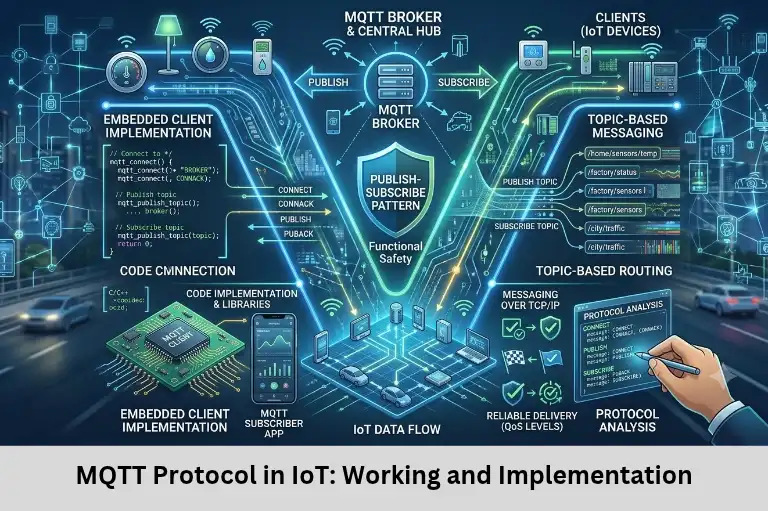
Learn MQTT protocol in Internet of Things (IoT), its architecture, broker, QoS levels, publish-subscribe model, and ESP32 implementation with Embedded Tech Development Academy (ETDA).
- MQTT Protocol in IoT: Working and Implementation
-
MQTT Protocol in IoT: Working, Architecture & Practical Implementation
- Introduction to MQTT Protocol in IoT
- What Is MQTT Protocol?
- MQTT Architecture and Main Components
- How MQTT Publish-Subscribe Communication Works
- Practical MQTT Implementation Using ESP32
- MQTT Security and Troubleshooting
- MQTT Applications in Embedded Systems and IoT
- Learn MQTT and IoT Development at ETDA
- Frequently Asked Questions
- Conclusion
MQTT Protocol in IoT: Working, Architecture & Practical Implementation
Introduction to MQTT Protocol in IoT
The Internet of Things (IoT) connects sensors, microcontrollers, gateways, and cloud platforms to exchange information efficiently. From smart home automation to industrial monitoring, connected devices continuously transmit data while operating with limited memory, processing power, and network bandwidth. MQTT is one of the most widely used communication protocols for these applications because it provides lightweight messaging and efficient data exchange.
MQTT stands for Message Queuing Telemetry Transport. It uses a publish-subscribe communication model in which devices exchange messages through a central broker rather than communicating directly with every other device. This architecture simplifies communication and supports scalable Internet of Things (IoT) applications.
For engineering students interested in embedded development, understanding MQTT is an important technical skill. Choosing the Top Embedded Training Institute in Bangalore can help learners gain practical knowledge of microcontrollers, communication protocols, and Internet of Things (IoT) development. Embedded Tech Development Academy (ETDA) supports students through industry-oriented training, hands-on projects, and assured placement support.
What Is MQTT Protocol?
MQTT is a lightweight messaging protocol designed for communication between devices and applications. It commonly operates over TCP/IP and uses a broker to manage message distribution between publishers and subscribers.
MQTT is particularly suitable for embedded systems because it has a relatively small protocol overhead and supports communication across unreliable or bandwidth-limited networks. Devices can publish sensor readings while applications subscribe to relevant information.
Why MQTT Is Popular in IoT
MQTT offers several practical advantages:
Lightweight message structure suitable for resource-constrained devices.
Efficient communication using the publish-subscribe model.
Support for different message delivery quality levels.
Flexible topic-based message routing.
Retained messages and persistent sessions, where configured.
Support for encrypted communication using TLS.
These features make MQTT useful for remote monitoring, smart agriculture, industrial automation, and connected-device applications.
MQTT Architecture and Main Components
MQTT architecture contains three major components: publisher, subscriber, and broker.
Publisher
A publisher is a device or application that sends messages to an MQTT broker. For example, an ESP32 connected to a temperature sensor can publish temperature readings periodically.
The publisher selects a topic for each message. It does not need to know which devices will receive the information.
Subscriber
A subscriber receives messages by subscribing to specific topics. A dashboard, mobile application, or another microcontroller can subscribe to sensor data published by an Internet of Things (IoT) device.
Subscribers can use topic filters to receive messages from multiple related devices.
MQTT Broker
The broker is the central communication component. It receives messages from publishers, checks subscriptions, and forwards messages to matching subscribers.
A broker also manages client connections, topic subscriptions, retained messages, and delivery behavior according to its configuration.
Understanding MQTT Topics
Topics organize messages into hierarchical names separated by forward slashes.
For example:
factory/line1/temperature
factory/line1/humidity
factory/line2/temperature
A subscriber can use a topic filter such as factory/line1/# to receive messages under the Line 1 hierarchy.
MQTT supports two wildcard symbols: + matches one topic level, while # matches multiple levels and must appear at the end of a topic filter.
How MQTT Publish-Subscribe Communication Works
MQTT communication follows a simple sequence.
The Internet of Things (IoT) device connects to the broker.
A subscriber sends a subscription request.
The broker registers the requested topic filter.
A publisher sends a message to a topic.
The broker checks matching subscriptions.
The broker forwards the message to eligible subscribers.
This model reduces communication complexity because publishers and subscribers do not need direct connections to one another.
MQTT Quality of Service (QoS)
MQTT provides three Quality of Service levels that define message delivery guarantees.
| QoS | Delivery Behavior |
|---|---|
| QoS 0 | At most once; no delivery acknowledgment |
| QoS 1 | At least once; acknowledgment provided |
| QoS 2 | Exactly once; uses a more extensive handshake |
QoS 0 offers lower overhead and is useful for frequent sensor updates where occasional loss is acceptable. QoS 1 improves delivery reliability but may produce duplicate messages. QoS 2 provides stronger delivery guarantees with additional communication overhead.
The effective delivery level depends on the QoS selected by the publisher and subscriber, along with MQTT protocol rules.
Practical MQTT Implementation Using ESP32
Students can understand MQTT more effectively by implementing a simple Internet of Things (IoT) application. Consider an ESP32 that publishes temperature information to an MQTT broker.
The following Arduino-style example uses the PubSubClient library. It demonstrates MQTT publishing and assumes Wi-Fi connectivity and broker configuration are available.
Example MQTT Publisher Code
#include <WiFi.h>
#include <PubSubClient.h>

const char* ssid = "YOUR_WIFI";
const char* password = "YOUR_PASSWORD";
const char* broker = "192.168.1.100";

WiFiClient wifiClient;
PubSubClient mqtt(wifiClient);

void setup() {
  Serial.begin(115200;

  WiFi.begin(ssid, password);
  while (WiFi.status() != WL_CONNECTED) {
    delay(500);
  }

  mqtt.setServer(broker, 1883);
}

void loop() {
  if (!mqtt.connected()) {
    mqtt.connect("ESP32_Client");
  }

  mqtt.loop();

  if (mqtt.connected()) {
    mqtt.publish("home/temperature", "28.5");
  }

  delay(5000);
}
Note: Correct the Serial.begin statement to Serial.begin(115200); when copying the code. The broker address must be replaced with the actual broker IP or hostname.
Understanding the Implementation
The Wi-Fi connection provides network access to the ESP32. setServer() configures the broker address and port, while connect() establishes the MQTT client session.
The publish() function sends a message to the selected topic. The mqtt.loop() function maintains client communication and processes incoming MQTT traffic.
Port 1883 is commonly used for unencrypted MQTT. Production Internet of Things (IoT) applications should use appropriate authentication and encrypted communication, commonly MQTT over TLS on port 8883.
MQTT Security and Troubleshooting
MQTT applications must be protected against unauthorized access and communication attacks.
Important MQTT Security Practices
Use strong broker authentication.
Enable TLS to encrypt communication.
Validate broker certificates when using TLS.
Apply topic-level access control.
Avoid storing credentials directly in source code.
Restrict unnecessary client permissions.
Monitor broker connections and abnormal traffic.
Common MQTT Problems
Connection failures may occur because of incorrect broker addresses, unavailable network connections, authentication errors, or firewall restrictions.
If subscribers do not receive messages, check topic names, wildcard filters, client subscriptions, and broker permissions. Duplicate messages may occur when using QoS 1 and should be handled appropriately by the application.
Students should practice debugging MQTT connections using serial logs, broker monitoring tools, and network inspection.
MQTT Applications in Embedded Systems and IoT
MQTT is used in smart homes for exchanging temperature, humidity, lighting, and energy-monitoring information. Industrial Internet of Things (IoT) systems use it to transmit machine status, production measurements, and equipment alerts.
In smart agriculture, sensor nodes can publish soil moisture and environmental readings to monitoring dashboards. Automotive and transportation applications may use MQTT for connected-service telemetry and remote monitoring, depending on system requirements.
These applications demonstrate how embedded systems combine sensor interfacing, microcontroller programming, communication protocols, and cloud connectivity to create intelligent connected products.
Learn MQTT and IoT Development at ETDA
Students preparing for embedded software careers should understand how microcontrollers communicate with networks and cloud platforms. MQTT provides a practical introduction to connected-device communication and application development.
Embedded Tech Development Academy (ETDA) offers industry-oriented technical learning opportunities that help engineering students strengthen their programming and embedded development knowledge. Learning Embedded C, ARM microcontrollers, UART, SPI, I2C, RTOS concepts, and Internet of Things (IoT) project development can provide a strong foundation for practical engineering work.
Students searching for the Top Embedded Training Institute in Bangalore should evaluate practical training, project experience, and technical guidance. Embedded Tech Development Academy (ETDA) supports learners through hands-on technical learning and assured placement support, helping them prepare for embedded development interviews and professional opportunities.
Building MQTT projects alongside embedded systems programming can help students understand the complete journey from sensor acquisition to cloud communication.
Frequently Asked Questions
What is MQTT in IoT?
MQTT is a lightweight messaging protocol that enables connected devices and applications to exchange information using a broker-based publish-subscribe model.
What is an MQTT broker?
An MQTT broker receives messages from publishers and forwards them to subscribers whose topic filters match the published topics.
What are MQTT QoS levels?
MQTT supports QoS 0, QoS 1, and QoS 2, offering at-most-once, at-least-once, and exactly-once delivery behavior respectively.
Why is MQTT suitable for embedded systems?
MQTT has relatively low protocol overhead and supports efficient communication, making it suitable for many resource-constrained connected devices.
Can ESP32 communicate using MQTT?
Yes. ESP32 can connect to an MQTT broker over Wi-Fi using libraries such as PubSubClient or other MQTT client implementations.
Is MQTT secure?
MQTT can be secured using TLS encryption, authentication, certificate validation, and broker access-control policies. Security depends on correct implementation and configuration.
Conclusion
MQTT is an important communication protocol for Internet of Things (IoT) applications because it provides lightweight messaging, flexible topic-based communication, and efficient publish-subscribe architecture. Understanding brokers, publishers, subscribers, QoS, and secure connections helps developers build reliable connected applications.
Practical MQTT implementation using ESP32 allows students to explore network communication, sensor monitoring, and cloud integration. These skills are valuable in embedded systems, industrial automation, smart homes, and connected-device development.
For engineering graduates interested in Internet of Things (IoT) careers, choosing the Top Embedded Training Institute in Bangalore can support their technical learning journey. Embedded Tech Development Academy (ETDA) encourages practical learning through industry-oriented training, embedded projects, and assured placement support. Developing MQTT and embedded programming skills can help students prepare for opportunities in modern embedded software engineering.
Author: ETDA Trainers
Experience: 10+ Years of Industry Experience in Embedded Systems, IoT, and Embedded C Programming