
Multicore Programming in Embedded Systems: Synchronization & Scheduling
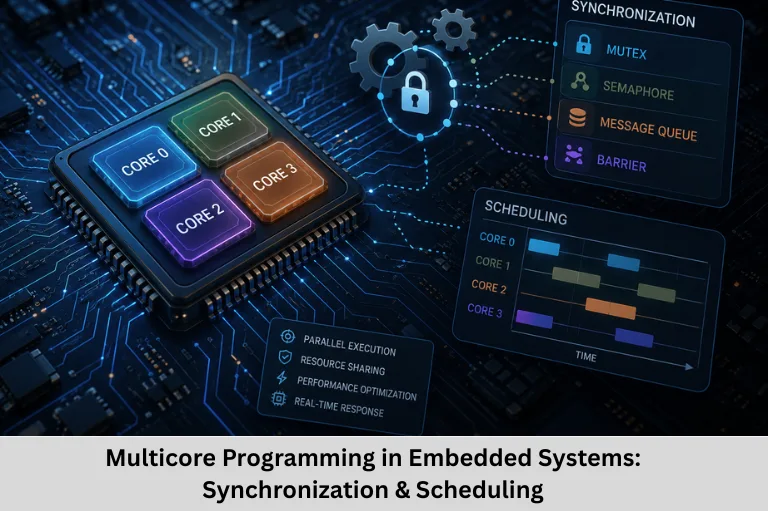
Learn multicore programming in embedded systems, synchronization, scheduling, mutexes, semaphores, spinlocks, cache coherency, and real-time challenges. Embedded Tech Development Academy (ETDA).
- Multicore Programming in Embedded Systems: Synchronization & Scheduling
-
Multicore Programming in Embedded Systems: Synchronization and Scheduling - ETDA
- Introduction to Multicore Programming in Embedded Systems
- Why Multicore Processors Are Used in Embedded Systems
- Understanding Multicore Embedded Architectures
- The Need for Synchronization in Multicore Embedded Systems
- Synchronization Mechanisms in Multicore Embedded Systems
- Memory Barriers and Cache Coherency
- Scheduling in Multicore Embedded Systems
- Real-Time Scheduling Challenges in Multicore Systems
- Multicore Embedded Programming Best Practices
- Applications of Multicore Embedded Systems
- Multicore Embedded Systems in 2028 and Beyond
- Conclusion
Multicore Programming in Embedded Systems: Synchronization and Scheduling - ETDA
Introduction to Multicore Programming in Embedded Systems
Embedded systems have evolved significantly from simple single-core microcontrollers executing sequential control loops. Today, modern embedded platforms are expected to process large amounts of sensor data, perform real-time computation, execute artificial intelligence workloads, communicate with multiple devices, and meet strict timing and safety requirements. Applications such as automotive ECUs, autonomous vehicles, robotics, industrial automation, medical devices, aerospace systems, telecommunications, smart devices, and edge AI increasingly depend on multicore processors.
Multicore programming in embedded systems enables multiple processor cores to execute tasks concurrently. Instead of depending only on increasing processor frequency, designers can distribute workloads across multiple cores to achieve better performance, responsiveness, scalability, and energy efficiency.
However, using multiple cores also introduces significant software challenges. When several cores execute tasks simultaneously, they may access shared memory, peripherals, buffers, and data structures. Without proper coordination, these concurrent operations can cause race conditions, deadlocks, priority inversion, data corruption, cache inconsistencies, and unpredictable timing behavior.
Two of the most important concepts in multicore embedded programming are synchronization and scheduling. Synchronization ensures that multiple cores safely access shared resources, while scheduling determines how tasks are assigned and executed across processor cores.
For students and engineers preparing for careers in embedded systems, Embedded C, RTOS, ARM processors, multicore programming, real-time operating systems, automotive embedded systems, and firmware development, understanding these concepts is becoming increasingly important.
If you are looking for practical embedded systems education, Embedded Tech Development Academy (ETDA) is a Top Embedded Training Institute in Bangalore, providing industry-oriented training in Embedded C, ARM microcontrollers, RTOS, communication protocols, embedded Linux, and real-time embedded system development, along with assured placement support to help learners prepare for embedded engineering careers.
This article explains multicore embedded architecture, synchronization mechanisms, scheduling techniques, real-time scheduling challenges, cache coherency, memory barriers, priority inversion, load balancing, and best practices for designing reliable multicore embedded applications.
Why Multicore Processors Are Used in Embedded Systems
The adoption of multicore processors is driven by increasing computational requirements and the need for efficient execution of multiple workloads.
Increasing Computational Requirements
Modern embedded applications may simultaneously handle:
- Image and video processing
- Artificial intelligence
- Sensor fusion
- Machine learning
- Communication protocols
- Motor control
- Data logging
- User interfaces
- Cybersecurity functions
A single processor core may struggle to meet these requirements within strict real-time deadlines.
Improved Parallel Processing
Multicore processors allow independent tasks to execute simultaneously.
For example:
- Core 1: Sensor processing
- Core 2: Communication stack
- Core 3: AI computation
- Core 4: System monitoring
This improves overall system throughput and responsiveness.
Better Power Efficiency
Running several cores at moderate frequencies can sometimes provide better performance-per-watt than operating one core at a very high frequency.
Functional Safety and Isolation
Multicore architectures can help separate workloads with different safety or criticality requirements.
For example, one core may handle safety-critical motor control while another handles non-critical communication or user-interface tasks.
Understanding Multicore Embedded Architectures
Multicore embedded systems generally fall into two broad categories.
Homogeneous Multicore Architecture
In a homogeneous architecture, all processor cores are generally based on the same processor architecture and have similar capabilities.
For example, multiple cores within an ARM Cortex-A processor cluster may execute different application threads.
Advantages include:
- Similar programming model
- Easier workload distribution
- Better software portability
- Flexible task allocation
Heterogeneous Multicore Architecture
A heterogeneous architecture combines different types of processing cores or accelerators.
For example:
Cortex-A + Cortex-M + DSP + NPU
Different processing elements can be assigned workloads according to their strengths.
For example:
- CPU → Operating system and application processing
- DSP → Signal processing
- MCU core → Real-time control
- NPU → AI inference
Operating Models
Depending on the platform, multicore systems may run:
- A shared operating system
- SMP operating system
- AMP configuration
- Separate RTOS instances
- Bare-metal applications
- Hypervisor-based environments
SMP vs AMP
SMP (Symmetric Multiprocessing):
Multiple similar processor cores share a common operating-system environment and scheduling framework.
AMP (Asymmetric Multiprocessing):
Different cores may execute different software environments or workloads.
The architecture selected has a direct impact on task scheduling, synchronization, memory sharing, communication, and system design.
The Need for Synchronization in Multicore Embedded Systems
When multiple cores access shared resources simultaneously, synchronization becomes essential.
Shared resources may include:
- Shared memory
- Global variables
- Communication buffers
- Peripheral registers
- Device drivers
- Queues
- Hardware resources
- Shared data structures
Without synchronization, two cores could modify the same data at the same time.
What Is a Race Condition?
A race condition occurs when the final result of a program depends on the unpredictable timing or ordering of concurrent operations.
For example, suppose Core 1 and Core 2 both update the same counter:
Core 1 → Read counter → Modify → Write
Core 2 → Read counter → Modify → Write
If both cores read the same old value before either writes the new value, one update can be lost.
Synchronization mechanisms prevent such problems.
Synchronization Mechanisms in Multicore Embedded Systems
1. Mutexes and Locks
A mutex (mutual exclusion) ensures that only one task or core accesses a protected resource at a time.
For example:
Core 1 → Acquire Mutex → Access Shared Resource → Release Mutex
If Core 2 attempts to access the same resource while Core 1 holds the mutex, Core 2 must wait.
Advantages of Mutexes
- Easy to understand
- Widely supported by RTOS platforms
- Protect shared resources
- Useful for critical sections
Challenges of Mutexes
Improper mutex usage can result in:
- Deadlocks
- Priority inversion
- Increased latency
- Blocking
- Reduced scalability
Therefore, mutexes should be held for the shortest practical duration.
2. Semaphores
Semaphores are synchronization primitives used for resource management and event signaling.
Two common types are:
- Binary semaphore
- Counting semaphore
A binary semaphore can be used to signal an event between tasks.
A counting semaphore can represent the availability of multiple instances of a resource.
3. Spinlocks
A spinlock allows a processor core to repeatedly check whether a lock has become available.
Unlike a blocking mutex, the waiting core actively consumes CPU cycles while waiting.
Spinlocks are useful when:
- Critical sections are extremely short
- Context-switching overhead is undesirable
- The system requires very low synchronization latency
However, excessive use of spinlocks wastes processor resources and power.
4. Atomic Operations
Atomic operations perform an operation as an indivisible unit.
Examples include:
- Atomic increment
- Atomic decrement
- Compare-and-swap
- Atomic exchange
Atomic operations are fundamental to many lock-free algorithms and synchronization mechanisms.
5. Lock-Free and Wait-Free Programming
Advanced multicore applications can use lock-free or wait-free algorithms to reduce blocking.
Lock-Free
A lock-free algorithm guarantees that system-wide progress can continue even if individual threads are delayed.
Wait-Free
A wait-free algorithm provides a bounded number of operations for each participating thread.
These techniques can provide excellent real-time behavior but are significantly more difficult to design and verify correctly.
Memory Barriers and Cache Coherency
Synchronization is not only about locks. Modern multicore processors also introduce memory ordering and cache-related challenges.
Cache Coherency
Each processor core may have its own cache. If multiple cores access shared data, the system must ensure that the cores observe appropriate values.
Cache coherency mechanisms help keep cached copies of shared memory consistent.
Why Memory Ordering Matters
Modern processors and compilers may reorder certain memory operations for performance.
A memory barrier/fence can be used where required to enforce ordering constraints between memory operations.
Non-Coherent Systems
Not every multicore embedded architecture provides full hardware cache coherency.
In such systems, software may need to perform explicit:
- Cache clean operations
- Cache invalidation
- Memory synchronization
- Shared-memory management
Ignoring these requirements can create extremely difficult-to-debug multicore software problems.
Scheduling in Multicore Embedded Systems
Scheduling determines which task executes, when it executes, and on which processor core it executes.
In a single-core system, the scheduler selects tasks for one CPU. In a multicore system, the scheduler must consider multiple processing resources simultaneously.
Global Scheduling
Under global scheduling, a common scheduler manages tasks across multiple cores.
Tasks may migrate from one core to another depending on system requirements.
Advantages
- Dynamic load balancing
- Flexible CPU utilization
- Better use of available processing capacity
- Tasks can potentially migrate between cores
Challenges
- Higher scheduler complexity
- Migration overhead
- Synchronization overhead
- More complex real-time analysis
Global scheduling is common in high-performance systems and multicore operating-system environments.
Partitioned Scheduling
With partitioned scheduling, tasks are assigned to specific processor cores.
Each core may have its own scheduling decisions for the tasks assigned to it.
Advantages
- Better timing predictability
- Reduced task migration
- Easier real-time analysis
- Stronger isolation
Applications
Partitioned scheduling is particularly attractive in safety-critical embedded systems, including automotive and aerospace applications where deterministic behavior and certification are important.
Hybrid Scheduling
Hybrid approaches combine aspects of global and partitioned scheduling.
For example:
- Safety-critical tasks → Statically assigned
- Non-critical tasks → Dynamically scheduled
This approach attempts to combine predictability with flexibility.
Real-Time Scheduling Challenges in Multicore Systems
Multicore processors improve performance, but real-time systems must still guarantee that important tasks meet their deadlines.
Priority Inversion
Priority inversion occurs when a high-priority task is blocked because a lower-priority task holds a required resource.
Example
Suppose:
- Low-priority Task A holds a mutex.
- High-priority Task B needs that mutex.
- Medium-priority Task C keeps executing.
Task B is indirectly delayed by Task C because Task A cannot run long enough to release the mutex.
Solutions
Common solutions include:
- Priority inheritance
- Priority ceiling protocols
- Reducing critical-section duration
Load Imbalance
A multicore system may have several cores, but workload distribution may not be equal.
For example:
Core 1 → 90% utilization
Core 2 → 30% utilization
Core 3 → 20% utilization
Core 4 → 10% utilization
Although the system has multiple cores, one overloaded core can become the performance bottleneck.
Solutions
Load imbalance can be reduced through:
- Better task partitioning
- Work stealing
- Dynamic scheduling
- Load monitoring
- Task migration where appropriate
Timing Interference
Tasks may compete for shared resources such as:
- Memory buses
- Shared caches
- DRAM
- DMA controllers
- Peripheral interfaces
This can increase execution-time variability.
Possible Solutions
Designers can use:
- Core isolation
- Memory partitioning
- Resource allocation
- Cache management
- Careful task placement
Multicore Embedded Programming Best Practices
Reliable multicore embedded software requires careful architecture and testing.
Minimize Shared Resources
Reducing shared data reduces synchronization requirements.
Prefer local data structures wherever practical.
Keep Critical Sections Short
Long critical sections increase blocking and synchronization latency.
Prefer Message Passing Where Appropriate
Instead of allowing multiple cores to modify shared memory, designers can use:
- Queues
- Mailboxes
- Inter-core communication
- Message passing
This can simplify software architecture.
Use Static Allocation for Critical Tasks
Safety-critical and hard real-time tasks may benefit from predetermined core assignments and resource allocations.
Test Under Worst-Case Conditions
Multicore systems should be tested under:
- Maximum CPU load
- Maximum communication traffic
- Concurrent interrupt activity
- High memory utilization
- Cache pressure
- Multiple simultaneous tasks
Use Tracing and Debugging Tools
Tracing tools can help identify:
- Race conditions
- Deadlocks
- Timing violations
- CPU utilization problems
- Task migration
- Synchronization delays
Applications of Multicore Embedded Systems
Multicore processors are increasingly used across many industries.
Automotive Systems
Applications include:
- Advanced driver assistance systems
- Infotainment
- Autonomous driving
- Sensor fusion
- Powertrain control
- Vehicle networking
Industrial Automation
Multicore processors can support:
- Robotics
- Motion control
- Machine vision
- Predictive maintenance
- Industrial communication
Robotics
Robots may simultaneously process:
- Camera data
- Sensor data
- Motor control
- Path planning
- Communication
Edge AI
Multicore systems can combine conventional CPU processing with specialized AI accelerators.
Telecommunications
Multicore processors are useful for:
- Packet processing
- Network management
- Signal processing
- Protocol stacks
Multicore Embedded Systems in 2028 and Beyond
The future of embedded computing is expected to involve increasingly sophisticated multicore architectures.
Important trends include:
- Mixed-criticality multicore systems
- Heterogeneous computing
- Hardware-assisted isolation
- Deterministic multicore RTOS
- AI workloads alongside real-time applications
- Safety-certified multicore platforms
- Advanced inter-core communication
- Increased hardware virtualization
- Energy-efficient parallel processing
As embedded applications become more complex, engineers will need a strong understanding of multicore architecture, RTOS scheduling, synchronization primitives, memory management, cache coherency, inter-core communication, and real-time system design.
FAQs
Why are multicore processors used in embedded systems?
Multicore processors allow multiple tasks to execute concurrently, improving processing performance, responsiveness, throughput, scalability, and power efficiency. They are especially useful when embedded systems must handle AI, sensor fusion, communication, control, and data processing simultaneously.
What is synchronization in multicore embedded systems?
Synchronization is the process of coordinating tasks or processor cores when they access shared resources. Mechanisms such as mutexes, semaphores, spinlocks, atomic operations, and memory barriers help prevent race conditions and inconsistent data.
What is the biggest challenge in multicore scheduling?
One of the major challenges is maintaining real-time predictability while multiple cores compete for shared resources. Scheduling must consider CPU utilization, task priorities, shared memory, cache behavior, synchronization, task migration, and timing constraints.
Which scheduling approach is suitable for safety-critical systems?
Partitioned scheduling is often attractive for safety-critical applications because tasks can be statically assigned to specific cores, making timing analysis and isolation easier. However, the appropriate strategy depends on the system architecture, safety requirements, and certification objectives.
How can race conditions be avoided in multicore programming?
Race conditions can be reduced by protecting shared resources with appropriate synchronization mechanisms such as mutexes, spinlocks, semaphores, and atomic operations. Another effective strategy is to minimize shared mutable data and use message-passing or ownership-based designs where practical.
Conclusion
Multicore programming in embedded systems is becoming an essential skill as modern products demand greater processing power, lower latency, improved energy efficiency, and the ability to execute multiple workloads simultaneously. However, simply adding more processor cores does not automatically guarantee better system performance. Software must be carefully designed to take advantage of parallel execution while maintaining deterministic behavior, data consistency, and real-time responsiveness.
Synchronization and scheduling are at the heart of successful multicore embedded development. Engineers need to understand mutexes, semaphores, spinlocks, atomic operations, lock-free programming, memory barriers, cache coherency, task scheduling, priority inversion, load balancing, core isolation, and inter-core communication.
For safety-critical and real-time applications, designers must go even further by considering worst-case execution time, resource contention, timing interference, task priorities, shared-memory access, and functional safety requirements.
As industries such as automotive, robotics, industrial automation, telecommunications, edge AI, and autonomous systems continue adopting multicore architectures, demand for engineers with practical knowledge of multicore processors, Embedded C, RTOS, ARM architecture, synchronization, scheduling, and real-time embedded systems is expected to grow.
For students and professionals who want hands-on knowledge of these technologies, Embedded Tech Development Academy (ETDA) is a Top Embedded Training Institute in Bangalore, offering practical, industry-focused embedded systems training covering Embedded C, ARM microcontrollers, RTOS, communication protocols, embedded Linux, real-time programming, and project development, along with assured placement support.
Learning multicore programming through practical projects can help engineers move beyond theoretical concepts and understand how real embedded products are designed, optimized, tested, and deployed. Building these skills can provide a strong foundation for pursuing careers in embedded software development, firmware engineering, automotive embedded systems F, RTOS development, robotics, Internet of Things (IoT), and advanced multicore embedded platforms.
Author: ETDA Trainers
Experience: 10+ Years of Industry Experience in Embedded Systems, IoT, and Embedded C Programming