
Operating System Scheduling Algorithms: FCFS, SJF, RR & Priority
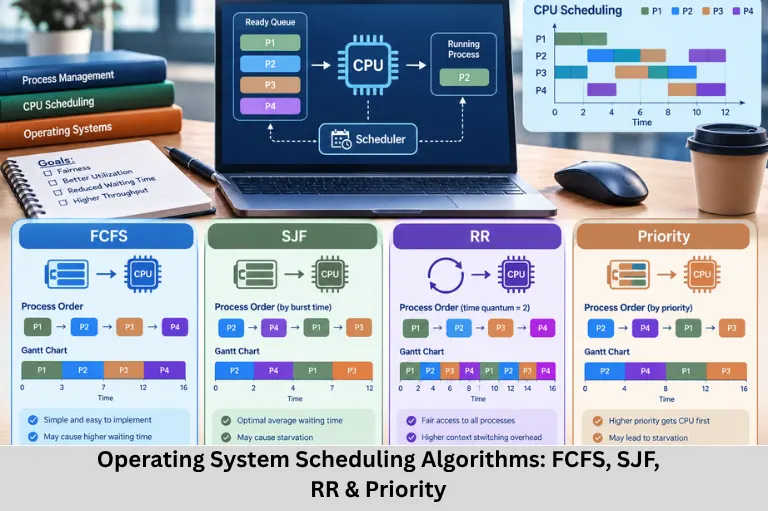
Learn operating system scheduling algorithms including FCFS, SJF, Priority, SRTF, Round Robin, and Multilevel Queue scheduling with technical examples. Embedded Tech Development Academy (ETDA).
- Operating System Scheduling Algorithms: FCFS, SJF, RR & Priority
-
Operating System Scheduling Algorithms: Types, Working and Applications
- Introduction to Operating System Scheduling
- What Is a Process in an Operating System?
- What Is a Process Scheduler?
- First-Come, First-Served Scheduling
- Shortest Job First Scheduling
- Priority Scheduling
- Shortest Remaining Time First Scheduling
- Round Robin Scheduling
- Multilevel Queue Scheduling
- Comparison of Operating System Scheduling Algorithms
- Importance of Scheduling in Embedded and Real-Time Systems
- Frequently Asked Questions
- Conclusion
Operating System Scheduling Algorithms: Types, Working and Applications
Introduction to Operating System Scheduling
Operating system scheduling algorithms are fundamental mechanisms used by an operating system to manage CPU resources efficiently. In a multitasking system, multiple processes may be ready to execute at the same time, but a CPU core can execute only one instruction stream at a time. The operating system therefore requires a process scheduler to determine which ready process should receive CPU time.
CPU scheduling directly affects CPU utilization, throughput, turnaround time, waiting time, response time, context switching, process synchronization, system responsiveness, and overall operating system performance. Different scheduling algorithms are designed for different environments. A batch-processing system may prioritize throughput and average waiting time, while an interactive system generally requires fast response and fair CPU allocation.
Operating system scheduling is particularly important in systems containing multiple applications, background services, device drivers, and real-time workloads. Concepts such as the ready queue, process control block (PCB), dispatcher, context switch, CPU burst, I/O burst, preemption, scheduling latency, starvation, aging, and time quantum form the technical foundation of CPU scheduling.
For engineering students learning operating systems alongside embedded programming and computer architecture, these concepts are also valuable for understanding multitasking and RTOS scheduling. Embedded Tech Development Academy (ETDA) provides industry-oriented technical learning across embedded systems, operating systems, microcontrollers, and programming. For students searching for a Top Embedded Training Institute in Bangalore, Embedded Tech Development Academy (ETDA) combines practical technical learning with assured placement support.
What Is a Process in an Operating System?
Definition of a Process
A process is a program in execution. Unlike a passive program stored on secondary storage, a process is an active entity managed by the operating system.
A process typically contains:
- Program instructions
- Program counter
- CPU registers
- Stack
- Data section
- Heap
- Process state
- Process Control Block (PCB)
Process States
A process commonly moves through states such as:
- New – process is being created.
- Ready – process is waiting for CPU allocation.
- Running – instructions are currently executing.
- Waiting/Blocked – process is waiting for an event or I/O operation.
- Terminated – execution has completed.
Ready Queue
Processes in the ready state are maintained in a ready queue. The CPU scheduler selects an eligible process from this queue according to the selected scheduling policy.
What Is a Process Scheduler?
Process Scheduler
A process scheduler is an operating-system component responsible for selecting a process from the ready queue and allocating CPU execution time to it.
The scheduler works with the dispatcher, which performs the actual transition of CPU control to the selected process.
Scheduling Objectives
A scheduling algorithm may attempt to:
- Maximize CPU utilization
- Increase throughput
- Minimize waiting time
- Minimize turnaround time
- Minimize response time
- Provide fairness
- Reduce unnecessary context switching
Preemptive and Non-Preemptive Scheduling
In non-preemptive scheduling, a running process normally keeps the CPU until it terminates, blocks for I/O, or voluntarily yields.
In preemptive scheduling, the operating system can interrupt a running process and allocate the CPU to another eligible process.
The major scheduling algorithms discussed here are FCFS, SJF, Priority Scheduling, Shortest Remaining Time First, Round Robin, and Multilevel Queue Scheduling.
First-Come, First-Served Scheduling
Working of FCFS
First-Come, First-Served (FCFS) executes processes according to their arrival order. It is normally implemented using a FIFO queue.
For example, if processes arrive as P1, P2, and P3, the scheduler executes them in the same order.
Characteristics of FCFS
- Non-preemptive scheduling algorithm
- Simple to understand and implement
- Uses FIFO queue principles
- Suitable for basic batch-processing workloads
- Can produce high average waiting time
Convoy Effect
A major disadvantage of FCFS is the convoy effect. A long CPU-bound process can hold the processor while several short processes wait behind it, significantly increasing response and waiting times.
Shortest Job First Scheduling
SJF Scheduling
Shortest Job First (SJF), also called Shortest Job Next (SJN), selects the process with the smallest expected CPU burst.
SJF is normally non-preemptive.
Advantages and Limitations
SJF can minimize average waiting time when accurate CPU-burst estimates are available. However, the operating system generally cannot know the exact future CPU burst of an arbitrary process.
CPU Burst Estimation
Operating systems can estimate future CPU bursts using historical behavior, including techniques such as exponential averaging. Therefore, practical implementations rely on estimates rather than perfect knowledge of future execution time.
Priority Scheduling
Priority-Based CPU Allocation
In Priority Scheduling, every process is assigned a priority value. The scheduler selects the highest-priority eligible process.
Priority scheduling can be implemented as either preemptive or non-preemptive, depending on the operating system design.
Priority Assignment
Priority may be based on factors such as:
- Process importance
- Resource requirements
- Deadline constraints
- User requirements
- System policy
- Process type
Starvation and Aging
A low-priority process may experience starvation if higher-priority processes continuously enter the ready queue. Aging addresses this problem by gradually increasing the priority of waiting processes.
Shortest Remaining Time First Scheduling
SRTF Scheduling
Shortest Remaining Time First (SRTF) is the preemptive counterpart of SJF. The scheduler selects the process with the shortest remaining CPU execution time.
If a newly arrived process has a shorter remaining burst than the currently running process, the current process can be preempted.
SRTF Characteristics
SRTF can be useful where CPU-burst information can be estimated reasonably well, particularly in controlled batch-processing environments.
Round Robin Scheduling
Working of Round Robin
Round Robin (RR) is a preemptive scheduling algorithm designed to provide fair CPU access among ready processes.
Each process receives a fixed time interval called a time quantum or time slice. After its quantum expires, the process is preempted and placed back into the ready queue if it has not completed.
Context Switching
When the CPU switches from one process to another, the operating system saves the current process state and restores the next process state. This operation is called a context switch.
Choosing the Time Quantum
A very small quantum increases context-switch overhead, while a very large quantum makes Round Robin behave increasingly like FCFS. Therefore, quantum selection is an important performance consideration.
Multilevel Queue Scheduling
Multiple-Level Queues
Multilevel Queue Scheduling divides the ready processes into separate queues according to characteristics such as process type, priority, or workload.
For example:
- Foreground processes
- Background processes
- Interactive processes
- System processes
- CPU-bound processes
Each queue can use a different scheduling algorithm.
Queue-Level Scheduling
One queue might use Round Robin while another uses FCFS. The scheduler also requires a policy for selecting between queues, such as fixed priority or CPU-time allocation.
Multilevel Queue vs Multilevel Feedback Queue
A multilevel queue generally does not move processes between queues, whereas a multilevel feedback queue (MLFQ) allows processes to move between queues according to their observed behavior and scheduling requirements.
Comparison of Operating System Scheduling Algorithms
Key Characteristics
| Algorithm | Type | Main Principle | Major Concern |
|---|---|---|---|
| FCFS | Non-preemptive | Arrival order | Convoy effect |
| SJF | Non-preemptive | Shortest CPU burst | Burst prediction |
| Priority | Both | Highest priority first | Starvation |
| SRTF | Preemptive | Shortest remaining burst | Context switching |
| Round Robin | Preemptive | Fixed time quantum | Quantum selection |
| Multilevel Queue | Usually policy-based | Separate process queues | Queue management |
Importance of Scheduling in Embedded and Real-Time Systems
Scheduling and Embedded Software
Embedded systems often execute multiple software tasks involving sensor acquisition, communication, control loops, diagnostics, data processing, and actuator control.
RTOS Scheduling
Real-Time Operating Systems use scheduling mechanisms to ensure tasks receive CPU time according to their priorities and timing requirements. Common concepts include priority-based preemption, task states, interrupt handling, synchronization, and deterministic scheduling.
Practical Engineering Relevance
Understanding conventional OS scheduling provides a foundation for learning RTOS task scheduling, embedded C programming, interrupt management, and real-time application development. This is one reason scheduling concepts are important for engineers pursuing embedded software careers.
Frequently Asked Questions
What is a scheduling algorithm in an operating system?
A scheduling algorithm is a method used by the operating system to determine which ready process should receive CPU execution time.
Why is CPU scheduling important?
CPU scheduling improves resource utilization and influences waiting time, response time, throughput, turnaround time, fairness, and system responsiveness.
What is FCFS scheduling?
FCFS is a normally non-preemptive scheduling algorithm in which processes are executed according to their arrival order.
What is Round Robin scheduling?
Round Robin is a preemptive scheduling algorithm in which each ready process receives a fixed CPU time quantum in cyclic order.
What is the difference between SJF and SRTF?
SJF selects the process with the shortest expected CPU burst and is normally non-preemptive. SRTF is its preemptive form and selects the process with the shortest remaining execution time.
Conclusion
Operating system scheduling algorithms are fundamental to efficient CPU resource management. By determining how processes enter, use, release, and regain access to the processor, scheduling policies directly influence CPU utilization, throughput, waiting time, turnaround time, response time, context-switch overhead, fairness, and system responsiveness.
Algorithms such as FCFS, SJF, Priority Scheduling, SRTF, Round Robin, and Multilevel Queue Scheduling solve different scheduling problems. FCFS provides simplicity, SJF can reduce average waiting time when CPU-burst estimates are available, Priority Scheduling supports importance-based execution, SRTF favors short remaining workloads, Round Robin provides time-sharing fairness, and Multilevel Queue Scheduling separates workloads according to their characteristics.
For engineers, understanding these concepts is especially important when moving toward operating systems, embedded systems, RTOS, embedded C programming, microcontrollers, multitasking, interrupt handling, and real-time application development. Embedded Tech Development Academy (ETDA) provides practical, industry-oriented learning designed to help students build these technical foundations. As a Top Embedded Training Institute in Bangalore, Embedded Tech Development Academy (ETDA) connects theoretical concepts with practical embedded-system development and provides assured placement support.
For learners aiming to build careers in embedded software and electronics, Embedded Tech Development Academy (ETDA) can provide exposure to operating-system concepts, embedded programming, microcontrollers, RTOS fundamentals, and practical projects. Choosing a Top Embedded Training Institute in Bangalore with hands-on technical learning and assured placement support can help aspiring engineers develop the skills required for modern embedded and software engineering roles.
Author: ETDA Trainers
Experience: 10+ Years of Industry Experience in Embedded Systems, IoT, and Embedded C Programming