
Optical Communication: Working, Components, Advantages & Applications
Learn optical communication, its working principle, components, advantages, applications, and future scope. Explore how fiber optic communication powers modern networks.
- Optical Communication: Working, Components, Advantages & Applications
- Introduction: Why Optical Communication is Revolutionizing Modern Connectivity
Introduction: Why Optical Communication is Revolutionizing Modern Connectivity
In today’s digital era, where billions of devices exchange information every second, the demand for high-speed communication, reliable connectivity, and massive data transmission has never been greater. Whether you’re streaming 4K videos, attending virtual meetings, playing online games, using cloud-based applications, or accessing smart devices through the Internet of Things(IoT), optical communication is the technology working behind the scenes to make these experiences seamless.
Unlike traditional communication systems that rely on electrical signals transmitted through copper cables, optical communication uses light waves to transmit data through fiber optic cables. This innovative technology provides significantly higher bandwidth, lower signal attenuation, faster transmission speeds, and improved security, making it the preferred communication medium for modern telecommunications, enterprise networks, and global internet infrastructure.
The rapid growth of 5G networks, cloud computing, artificial intelligence (AI), big data, industrial automation, smart cities, edge computing, and data centers has further increased the demand for efficient communication systems. Optical communication meets these demands by enabling ultra-fast, low-latency, and high-capacity data transfer over long distances with minimal interference.
Understanding concepts such as fiber optic communication, optical fiber technology, optical transmitters, optical receivers, wavelength division multiplexing (WDM), photonic communication, optical networking, laser communication, and high-speed data transmission is essential for students, engineers, and professionals pursuing careers in electronics, telecommunications, networking, and embedded systems.
In this article, you’ll learn the fundamentals of optical communication, its working principle, key components, major advantages, real-world applications, future developments, and why it has become the backbone of today’s digital communication networks.
What is Optical Communication?
Optical communication is the process of transmitting information using light signals instead of electrical signals. The information is converted into light using a laser diode or LED and transmitted through optical fiber cables over long distances.
Compared to conventional copper-based communication systems, optical communication provides significantly higher speed, greater bandwidth, lower transmission losses, and better reliability.
Key Characteristics of Optical Communication
- Uses light as the transmission medium
- Supports ultra-high-speed communication
- Provides enormous bandwidth
- Enables long-distance transmission
- Immune to electromagnetic interference
- Offers secure communication
How Optical Communication Works
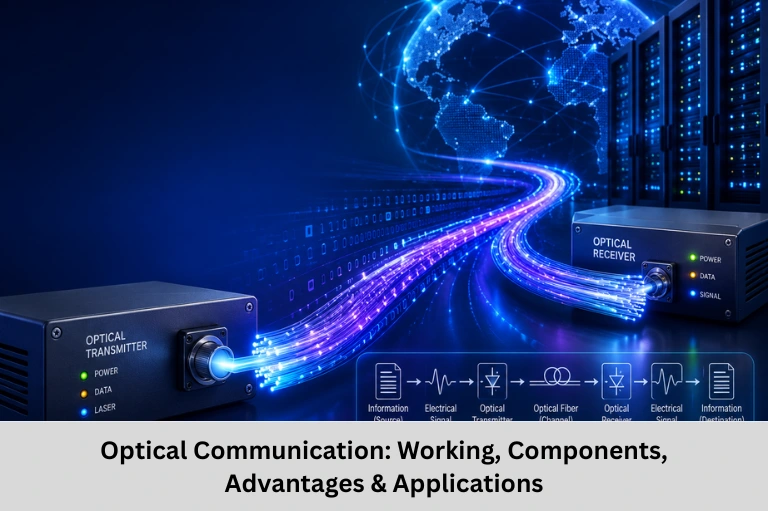
An optical communication system converts electrical information into optical signals, transmits them through fiber optic cables, and converts them back into electrical signals at the receiver.
Main Components of an Optical Communication System
The primary components include:
- Optical Transmitter
- Optical Fiber
- Optical Receiver
- Optical Amplifier or Regenerator
Optical Transmitter
The transmitter converts electrical signals into light signals using either a Laser Diode (LD) or Light Emitting Diode (LED), enabling high-speed, efficient data transmission through optical fiber communication systems.
Optical Fiber
Optical fiber is a thin strand of glass or plastic that carries light with extremely low attenuation, enabling high-speed, reliable, long-distance data communication with minimal signal loss.
Optical Receiver
The receiver uses a photodiode to detect incoming light and convert it back into electrical signals, ensuring accurate data recovery for reliable communication in optical fiber systems.
Optical Amplifiers
Amplifiers strengthen weakened optical signals during long-distance transmission without converting them back into electrical signals, maintaining signal quality, reducing losses, and improving overall communication system performance.
Working Principle
The communication flow follows this sequence:
Electrical Signal → Optical Transmitter → Optical Fiber → Optical Receiver → Electrical Signal
This process enables fast, accurate, and reliable data transmission.
Advantages of Optical Communication
Optical communication offers several advantages over conventional electrical communication systems, including higher bandwidth, faster data transmission, lower signal loss, improved security, and greater reliability for long-distance networks.
High Bandwidth
Fiber optic cables support data transmission rates reaching terabits per second, making them ideal for modern communication networks requiring ultra-fast, reliable, high-bandwidth connectivity and efficient long-distance data transfer.
Long-Distance Transmission
Optical signals travel hundreds of kilometers with minimal attenuation, making fiber optic communication ideal for undersea cables, international networks, long-distance telecommunications, and high-speed internet connectivity.
Immunity to Electromagnetic Interference
Since optical fibers carry light instead of electrical current, they are immune to electromagnetic and radio frequency interference, ensuring stable, reliable, high-quality data transmission in challenging environments.
Enhanced Security
Fiber optic communication is difficult to intercept, making it highly secure for sensitive data transmission in banking, defense, healthcare, government, and other mission-critical communication networks.
Lightweight and Durable
Fiber optic cables are thinner, lighter, corrosion-resistant, and easier to install than copper cables, reducing installation costs while improving durability, flexibility, and long-term communication system performance.
Applications of Optical Communication
Optical communication has become essential across numerous industries, enabling high-speed, reliable data transmission for telecommunications, healthcare, defense, broadcasting, internet services, and industrial automation applications.
Internet and Telecommunications
The global internet backbone is built primarily using fiber optic communication networks, enabling high-speed, reliable, long-distance data transmission across continents with minimal latency and signal loss.
Medical Applications
Optical fibers are used in endoscopy, minimally invasive surgery, advanced medical imaging, and laser treatments, enabling precise diagnosis, improved patient care, and enhanced medical procedures.
Military and Aerospace
Secure optical communication systems support military communications, aircraft systems, defense applications, and surveillance networks, ensuring reliable, high-speed, interference-free, and secure data transmission in critical operations.
Industrial Automation
Factories use fiber optic communication for machine control, robotics, automation, and industrial networking, ensuring high-speed, reliable, interference-free data exchange for efficient manufacturing operations.
Data Centers
Cloud service providers rely on high-speed optical communication to transfer massive amounts of data efficiently, ensuring fast, reliable, scalable connectivity between data centers and global users.
Future of Optical Communication
The future of communication depends heavily on advancements in optical technologies, enabling faster, smarter, energy-efficient, and highly reliable networks for next-generation digital connectivity worldwide.
5G and Beyond
Optical fiber forms the backbone of 5G infrastructure and will continue supporting future 6G networks, enabling ultra-fast, low-latency, high-capacity wireless communication worldwide.
Photonic Integrated Circuits
Photonic Integrated Circuits (PICs) combine multiple optical functions on a single chip, improving efficiency, reducing power consumption, lowering costs, and enabling compact, high-performance optical communication systems.
Quantum Communication
Quantum communication promises ultra-secure data transmission using quantum encryption technologies, ensuring unmatched security, preventing eavesdropping, and protecting sensitive information across future communication networks.
AI-Based Optical Networks
Artificial Intelligence is increasingly used to optimize fiber optic network management, enhance fault detection, improve performance, reduce downtime, and enable intelligent communication system automation.
Future Outlook
Emerging technologies such as AI, Internet of Things(IoT), autonomous vehicles, smart cities, cloud computing, big data, edge computing, and quantum networking will continue driving innovation in optical communication.
Frequently Asked Questions (FAQs)
What is optical communication?
Optical communication is the transmission of information using light signals through fiber optic cables instead of electrical signals, enabling high-speed and long-distance communication.
What are the main components of an optical communication system?
The main components are an optical transmitter, optical fiber, optical receiver, and optical amplifier or regenerator.
Why is optical communication preferred over copper communication?
Optical communication offers higher bandwidth, faster data transmission, lower signal loss, improved security, and immunity to electromagnetic interference, making it superior to copper-based systems.
What are the major applications of optical communication?
Optical communication is widely used in internet services, telecommunications, cloud computing, healthcare, industrial automation, military communication, broadcasting, and data centers.
What is the future scope of optical communication?
The future of optical communication includes photonic integrated circuits, quantum communication, AI-driven optical networks, 6G infrastructure, smart cities, IoT, and ultra-high-speed terabit communication systems.
Conclusion
Optical communication has fundamentally transformed the way information is transmitted across the world. By leveraging fiber optic technology, light-based communication, optical networking, photonic devices, wavelength division multiplexing (WDM), high-speed internet infrastructure, and advanced communication systems, it delivers exceptional speed, reliability, and efficiency compared to traditional communication methods.
Today, optical communication powers everything from global internet connectivity and cloud computing to healthcare, industrial automation, financial services, and defense systems. Its ability to provide high-bandwidth communication, ultra-low latency, secure data transmission, long-distance connectivity, and energy-efficient networking makes it indispensable for the modern digital economy.
As technologies such as 5G, Artificial Intelligence (AI), Internet of Things(IoT), smart cities, autonomous vehicles, quantum communication, and next-generation data centers continue to evolve, optical communication will play an even greater role in shaping the future of global connectivity.
For students, electronics enthusiasts, networking professionals, and telecommunications engineers, understanding the principles of optical communication provides a strong foundation for exploring advanced communication systems and building successful careers in the rapidly growing field of communication technology.
Author: ETDA Trainers
Experience: 10+ Years of Industry Experience in Embedded Systems, IoT, and Embedded C Programming