
Power Factor: Complete Guide to Electrical Efficiency & Power Factor Correction | ETDA
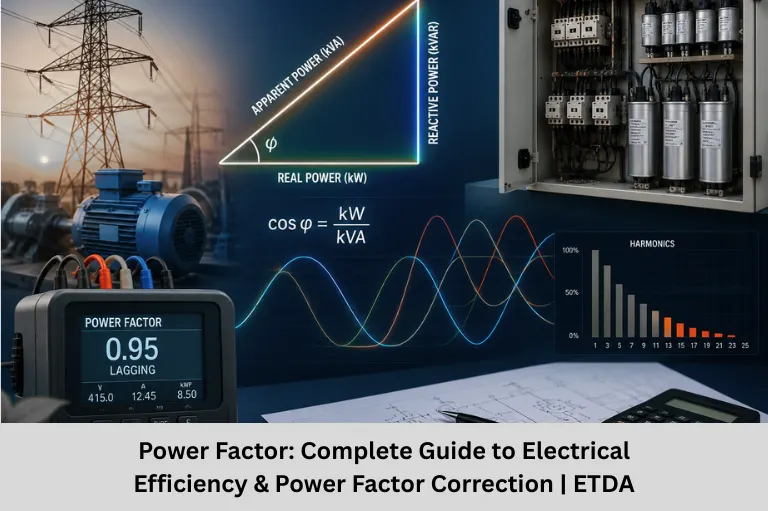
Learn Power Factor, power factor correction, capacitor banks, reactive power, harmonics, and electrical efficiency. Master power quality with Embedded Tech Development Academy (ETDA), the Top Embedded Training Institute in Bangalore.
- Power Factor: Complete Guide to Electrical Efficiency & Power Factor Correction | ETDA
- Power Factor: The Key to Efficient Electrical Systems
Power Factor: The Key to Efficient Electrical Systems
Introduction to Power Factor
Power Factor (PF) is one of the most important concepts in electrical engineering, power systems, and industrial automation. It measures how efficiently electrical power is converted into useful work by comparing the real power consumed by electrical equipment to the apparent power supplied by the electrical system. A higher power factor indicates that electrical energy is being utilized more effectively, resulting in lower energy losses, reduced electricity bills, improved voltage regulation, and enhanced equipment performance.
In today’s industrial environment, where manufacturing plants, commercial buildings, renewable energy systems, electric vehicle charging stations, and smart grids operate with numerous inductive and electronic loads, maintaining an optimal power factor has become a necessity rather than an option. Poor power factor leads to increased reactive power demand, higher current flow, excessive heating of cables and transformers, reduced system capacity, voltage drops, and financial penalties imposed by electricity utilities.
Modern electrical systems increasingly rely on technologies such as power factor correction (PFC), capacitor banks, active harmonic filters, reactive power compensation, industrial automation, variable frequency drives (VFDs), energy management systems (EMS), smart grids, electrical distribution systems, motor control centers (MCC), switchgear, renewable energy integration, IoT-based power monitoring, power quality analyzers, and digital energy meters to improve overall efficiency and system reliability.
Understanding power factor is essential for electrical engineers, electronics engineers, embedded systems developers, maintenance engineers, and automation professionals. Whether designing industrial power distribution systems, developing embedded energy monitoring devices, or implementing intelligent motor control solutions, knowledge of power factor optimization plays a significant role in improving operational efficiency and reducing energy costs.
For students and professionals aiming to build practical expertise in electrical and embedded technologies, Embedded Tech Development Academy (ETDA) offers industry-oriented training that combines theoretical concepts with hands-on projects. Recognized as the Top Embedded Training Institute in Bangalore, Embedded Tech Development Academy (ETDA) provides real-time training in embedded systems, power electronics, industrial automation, Internet of things (IoT), microcontrollers, and electrical system design, helping learners become industry-ready with practical skills and placement-focused learning.
Why Power Factor Matters
- Improves overall electrical energy efficiency
- Reduces electricity consumption and utility penalties
- Minimizes transmission and distribution losses
- Increases electrical system capacity
- Enhances voltage stability
- Extends the lifespan of motors, transformers, and cables
- Supports reliable operation of industrial automation systems
- Enables better utilization of power generation resources
Fundamental Concepts
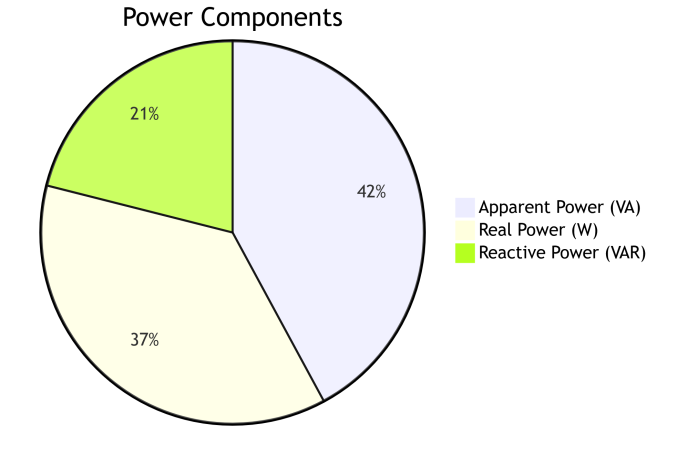
Power Triangle Components
Key Equations
Power Factor (PF)
PF = cosθ = P/S = kW/kVA
Real Power (P)
P = V × I × cosθ (Watts)
Reactive Power (Q)
Q = V × I × sinθ (VAR)
Apparent Power (S)
S = V × I (VA)
or
S = √(P² + Q²)
Types of Power Factor
| Type | Characteristics | Common Causes |
|---|---|---|
| Displacement PF | Phase angle difference between voltage and current | Motor inductance |
| Distortion PF | Power factor affected by harmonic distortion | Non-linear loads |
| Total PF | Combination of displacement and distortion power factor | Mixed industrial loads |
Causes of Low Power Factor
Common Inductive Loads
- Electric motors (0.7–0.85 PF typical)
- Power transformers
- Solenoids
- Electromagnetic contactors
- Fluorescent lighting ballasts
- Welding equipment
- Induction furnaces
Harmonic-Producing Equipment
- Variable Frequency Drives (VFDs)
- Switched Mode Power Supplies (SMPS)
- Computers and servers
- LED lighting drivers
- UPS systems
- Industrial rectifiers
Power Factor Correction Methods
Passive Correction
Capacitor Banks
- Fixed capacitor banks for constant loads
- Automatic capacitor banks for variable loads
- Individual motor compensation
- Group compensation at distribution panels
- Centralized compensation at main switchboards
Capacitor Sizing Formula
Qc = P × (tanθ₁ − tanθ₂)
Where:
- Qc = Required capacitor rating (kVAR)
- θ₁ = Existing power factor angle
- θ₂ = Desired power factor angle
Active Correction
- Active Power Factor Correction (Active PFC)
- Static VAR Compensators (SVC)
- STATCOM systems
- Synchronous Condensers
Harmonic Mitigation
- Passive LC Filters
- Active Harmonic Filters
- Multi-Pulse Rectifiers (12, 18, 24 Pulse)
- Isolation Transformers
Measurement and Analysis
Instrumentation
- Digital Power Factor Meters
- Energy Analyzers
- Harmonic Analyzers
- Clamp Power Meters
- Smart Energy Monitoring Systems
Key Parameters
| Parameter | Ideal Value | Poor Value |
|---|---|---|
| Power Factor | 0.95–1.0 | <0.8 |
| THD Voltage | <5% | >10% |
| THD Current | <10% | >30% |
| K-Factor | 1 | >4 |
Economic Considerations
Utility Penalty Calculations
Example
Demand Charge = $15/kVA
Current System:
1000 kVA @ 0.70 PF
Real Power = 700 kW
Improved System:
1000 kVA @ 0.95 PF
Real Power = 950 kW
Estimated Savings:
$5,526 per month
Payback Period Analysis
Capacitor Bank Cost = $10,000
Monthly Savings = $1,200
Payback Period:
≈ 8.3 Months
Standards and Regulations
International Standards
- IEEE 519 – Harmonic Control
- IEC 61000-3-2 – Equipment Harmonic Limits
- EN 50160 – Power Quality Standards
Utility Requirements
| Utility | Minimum PF | Penalty Threshold |
|---|---|---|
| PG&E | 0.85 | Below 0.97 |
| EU Grid | 0.95 | Below 0.95 |
| India | 0.90 | Below 0.90 |
System Design Considerations
Capacitor Installation Guidelines
- Prevent overcompensation
- Avoid leading power factor
- Use detuning reactors for harmonic protection
- Install zero-voltage switching
- Regular maintenance of capacitor banks
Resonance Formula
hres = √(MVARsc / MVARcap)
Motor Applications
- Individual motor compensation
- Maintain compensation below 90% of no-load VAR
- Prevent self-excitation
- Follow NEMA MG-1 recommendations
Emerging Technologies
Smart Power Factor Correction
- Internet of things (IoT)-enabled capacitor banks
- AI-based predictive power optimization
- Cloud-based power quality monitoring
- Smart energy management systems
Wide Bandgap Devices
- Silicon Carbide (SiC)
- Gallium Nitride (GaN)
- High-frequency Active PFC
- Compact passive components
Troubleshooting Guide
Common Issues
| Symptom | Possible Cause | Solution |
|---|---|---|
| Capacitor Fuse Failure | Harmonic resonance | Install detuning reactor |
| Fluctuating PF | Variable loads | Automatic capacitor bank |
| Overheated Cables | Excess reactive current | Improve PF to 0.95+ |
Measurement Best Practices
- Measure during the complete operating cycle.
- Monitor both displacement and distortion power factor.
- Verify voltage-current phase relationships.
- Analyze harmonic spectrum using a power quality analyzer.
- Perform periodic maintenance and calibration.
FAQs
What is Power Factor in an electrical system?
Power Factor is the ratio of real power (kW) to apparent power (kVA) in an AC circuit. It indicates how efficiently electrical energy is converted into useful work. A value closer to 1.0 represents higher efficiency.
Why is maintaining a high Power Factor important?
A high power factor reduces electricity bills, minimizes transmission losses, improves voltage regulation, increases equipment lifespan, and prevents utility penalties in industrial and commercial facilities.
What causes a low Power Factor?
Low power factor is mainly caused by inductive loads such as electric motors, transformers, fluorescent lighting, welding machines, and non-linear electronic equipment like VFDs and SMPS that generate harmonics.
How can Power Factor be improved?
Power factor can be improved by installing capacitor banks, active power factor correction systems, harmonic filters, synchronous condensers, and implementing proper energy management practices.
How can I learn Power Factor and Industrial Electrical Systems practically?
The best approach is through hands-on training involving electrical machines, power electronics, industrial automation, embedded systems, and real-time projects. Embedded Tech Development Academy (ETDA), recognized as the Top Embedded Training Institute in Bangalore, offers practical, industry-focused training with placement support to help students develop job-ready skills in electrical and embedded technologies.
Conclusion
Power Factor optimization is a fundamental aspect of designing efficient, reliable, and cost-effective electrical systems. As industries continue adopting automation, renewable energy, smart grids, electric vehicles, industrial Internet of things (IoT), and intelligent energy management systems, maintaining a high power factor has become increasingly important for reducing energy consumption, minimizing transmission losses, and maximizing equipment performance.
Advanced technologies such as active power factor correction, capacitor bank automation, harmonic filtering, digital power monitoring, energy analytics, smart meters, AI-driven energy management, predictive maintenance, industrial automation, embedded energy monitoring systems, power electronics, smart substations, and cloud-based electrical monitoring are transforming how industries manage electrical efficiency and power quality.
A well-maintained power factor not only reduces utility penalties but also improves transformer utilization, increases system capacity, lowers carbon emissions, enhances voltage stability, and extends the operational life of electrical equipment. Organizations that invest in power factor correction often experience significant reductions in operational costs while improving overall system reliability.
For aspiring engineers, gaining practical knowledge in electrical systems, embedded technologies, power electronics, and industrial automation is essential for building successful careers. Embedded Tech Development Academy (ETDA) provides comprehensive industry-oriented training through real-time projects, practical laboratory sessions, and placement-focused programs. As the Top Embedded Training Institute in Bangalore, Embedded Tech Development Academy (ETDA) equips students with hands-on experience in embedded systems, microcontrollers, Internet of things (IoT), industrial automation, and electrical engineering concepts, enabling them to meet the growing demands of modern industries.
Mastering power factor concepts today lays the foundation for developing smarter, more energy-efficient electrical systems that support sustainable industrial growth and next-generation power infrastructure.
Author: ETDA Trainers
Experience: 10+ Years of Industry Experience in Embedded Systems, IoT, and Embedded C Programming