
Python OOP Concepts: Classes, Objects and Inheritance
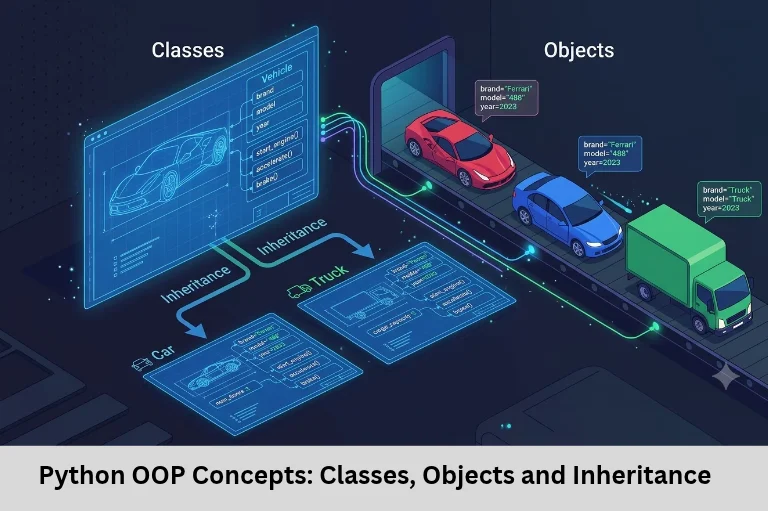
Learn Python object-oriented programming, classes, objects, inheritance, polymorphism, and practical applications with Embedded Tech Development Academy (ETDA) embedded training.
- Python OOP Concepts: Classes, Objects and Inheritance
-
Object-Oriented Programming in Python: Classes, Objects, and Inheritance
- Introduction to Object-Oriented Programming in Python
- What Is Object-Oriented Programming in Python?
- Understanding Classes and Objects in Python
- Inheritance in Python OOP
- Other Important Object-Oriented Programming Concepts
- Python OOP Applications in Embedded Systems and IoT
- Learn Python Programming at Embedded Tech Development Academy
- Frequently Asked Questions
- Conclusion
Object-Oriented Programming in Python: Classes, Objects, and Inheritance
Introduction to Object-Oriented Programming in Python
Python is one of the most popular programming languages for automation, software development, data processing, and Internet of Things (IoT) applications. Its simple syntax and powerful programming features make it an excellent choice for engineering students who want to develop practical software skills. One important concept in Python is Object-Oriented Programming (OOP), which helps programmers organize code into reusable and manageable components.
Object-Oriented Programming in Python is based on classes and objects. It also supports important concepts such as inheritance, encapsulation, and polymorphism. These concepts are useful when developing complex applications that require structured programming and code reusability.
For students interested in embedded systems, Python can be used for hardware testing, automation scripts, communication interfaces, and IoT data processing. Choosing the Top Embedded Training Institute in Bangalore can help students develop programming knowledge alongside practical engineering skills. Embedded Tech Development Academy (ETDA) focuses on technical learning, hands-on projects, and assured placement support to help students prepare for professional opportunities.
What Is Object-Oriented Programming in Python?
Object-Oriented Programming is a programming approach that organizes software around objects instead of relying only on independent functions. An object combines data and behavior into a single programming structure.
For example, an Internet of Things (IoT) temperature monitoring application may contain different objects representing sensors, communication modules, and data logging systems. Each object can maintain its own information and perform specific operations.
Python supports OOP through classes, objects, methods, attributes, and inheritance. These features help developers create applications that are easier to maintain, extend, and test.
Advantages of Python OOP
Code reusability: Existing classes can be reused in different applications.
Modularity: Large programs can be divided into smaller components.
Maintainability: Developers can modify individual classes without rewriting the entire application.
Scalability: New features can be introduced using inheritance and composition.
Organization: Data and related functions remain together within objects.
Understanding Classes and Objects in Python
A class is a blueprint used to create objects. It defines the attributes and methods that objects created from that class can use.
An object is an individual instance of a class. Multiple objects can be created from the same class, and each object can maintain its own data.
Creating a Python Class
Python uses the class keyword to define a class. The __init__() method is commonly used to initialize object attributes when an object is created.
class TemperatureSensor:
    def __init__(self, sensor_id, temperature):
        self.sensor_id = sensor_id
        self.temperature = temperature

    def display_temperature(self):
        print(self.sensor_id, self.temperature)

sensor1 = TemperatureSensor("S1", 28.5)
sensor1.display_temperature()
In this example, TemperatureSensor is the class, while sensor1 is an object created from it. The constructor initializes the sensor ID and temperature value.
The self parameter refers to the current object. It allows methods to access instance attributes and other methods belonging to that object.
Instance Attributes and Methods
Instance attributes store information associated with individual objects. For example, two temperature sensor objects can have different sensor IDs and temperature readings.
Instance methods define the operations an object can perform. In hardware-oriented Python applications, methods may represent reading sensor data, validating measurements, or transmitting information to another device.
Practical Example of Multiple Objects
sensor1 = TemperatureSensor("S1", 27.5)
sensor2 = TemperatureSensor("S2", 31.2)

sensor1.display_temperature()
sensor2.display_temperature()
Both objects use the same class definition but maintain independent attribute values. This approach is useful when monitoring multiple sensors in an Internet of Things (IoT) environment.
Inheritance in Python OOP
Inheritance allows a new class to reuse properties and methods from an existing class. The existing class is called the parent class or base class, while the newly created class is called the child class or derived class.
Inheritance reduces code duplication and supports structured software development. It is particularly useful when multiple components share common functionality but require different implementations.
Implementing Single Inheritance
class Sensor:
    def __init__(self, sensor_name):
        self.sensor_name = sensor_name

    def identify(self):
        print("Sensor:", self.sensor_name)

class TemperatureSensor(Sensor):
    def read_temperature(self):
        print("Reading temperature")

sensor = TemperatureSensor("TMP36")
sensor.identify()
sensor.read_temperature()
Here, TemperatureSensor inherits from Sensor. The child class can access the parent’s identify() method and also define its own read_temperature() method.
This demonstrates how inheritance supports code reuse while allowing specialized functionality.
Using the super() Function
The super() function allows a child class to access methods from its parent class. It is commonly used when initializing inherited attributes or extending an existing method.
class Sensor:
    def __init__(self, name):
        self.name = name

class HumiditySensor(Sensor):
    def __init__(self, name, humidity):
        super().__init__(name)
        self.humidity = humidity

sensor = HumiditySensor("H1", 65)
print(sensor.name)
print(sensor.humidity)
The child class calls the parent constructor using super().__init__(name). This avoids repeating initialization logic and makes the code easier to maintain.
Other Important Object-Oriented Programming Concepts
Python OOP includes additional concepts that help developers create flexible and secure software structures.
Encapsulation
Encapsulation combines data and methods within a class while controlling how internal information is accessed. Python uses naming conventions such as _attribute and name mangling through __attribute to indicate or support restricted access.
Python does not enforce private access in the same way as some other programming languages. Developers commonly use properties and methods to manage access to internal attributes.
Polymorphism
Polymorphism allows different objects to respond to the same method call in different ways. This helps programmers build flexible applications without writing separate calling logic for every object type.
class Sensor:
    def read(self):
        return "Reading sensor"

class TemperatureSensor(Sensor):
    def read(self):
        return "Reading temperature"

class PressureSensor(Sensor):
    def read(self):
        return "Reading pressure"

sensors = [TemperatureSensor(), PressureSensor()]

for sensor in sensors:
    print(sensor.read())
Each object implements the read() method differently. This approach is useful in Internet of Things (IoT) applications where multiple sensor types need a common interface.
Python OOP Applications in Embedded Systems and IoT
Python OOP concepts are valuable beyond traditional software development. Engineers frequently use Python to create test automation tools, hardware communication utilities, and development scripts for embedded products.
In embedded systems development, Python can help automate UART communication testing, process serial data, validate sensor measurements, and generate reports. Classes can represent development boards, communication interfaces, and test modules.
In Internet of Things (IoT) applications, object-oriented Python can organize sensor readings, network communication, cloud connectivity, and data analysis into separate components. This makes application development more manageable as projects become larger.
Students learning Python alongside Embedded C, microcontroller programming, and communication protocols can develop a broader understanding of software and hardware integration.
Learn Python Programming at Embedded Tech Development Academy
Learning Python effectively requires more than memorizing syntax. Students should understand how classes, objects, inheritance, and methods work together while solving practical programming problems.
Embedded Tech Development Academy (ETDA) encourages industry-oriented technical learning that helps engineering students build programming knowledge and project experience. Python concepts can complement embedded development skills, particularly in automation, testing, Internet of Things (IoT) applications, and software tools.
Students searching for the Top Embedded Training Institute in Bangalore should consider the importance of practical programming exercises, technical guidance, and project development. Embedded Tech Development Academy (ETDA) supports learners through hands-on technical training and assured placement support, helping them prepare for interviews and professional development opportunities.
Combining Python OOP with Embedded C, microcontroller fundamentals, and Internet of Things (IoT) projects can help students build a stronger foundation for embedded software engineering careers.
Frequently Asked Questions
What is Object-Oriented Programming in Python?
Object-Oriented Programming in Python is a programming approach that organizes software using classes and objects. It supports code reusability, modularity, and maintainability.
What is the difference between a class and an object?
A class is a blueprint that defines attributes and methods. An object is an instance of that class containing its own data and access to the class’s functionality.
What is inheritance in Python?
Inheritance allows a child class to reuse and extend functionality from a parent class. It reduces code duplication and supports reusable software design.
What is the purpose of self in Python?
The self parameter represents the current object. It allows instance methods to access attributes and methods associated with that object.
Is Python OOP useful for embedded systems?
Yes. Python OOP is useful for embedded testing, automation scripts, hardware communication tools, sensor data processing, and Internet of Things (IoT) application development.
Can engineering students learn Python OOP at ETDA?
Engineering students can strengthen their programming knowledge through technical learning and practical exercises at Embedded Tech Development Academy (ETDA). Python skills can complement embedded programming, microcontroller development, and IoT project experience.
Conclusion
Object-Oriented Programming in Python provides a structured approach to software development through classes, objects, inheritance, encapsulation, and polymorphism. These concepts improve code reusability, organization, and maintainability while making complex applications easier to develop.
For engineering students, Python OOP is particularly valuable in automation, embedded testing, Internet of Things (IoT) applications, and software development. Practical implementation helps learners understand how programming concepts translate into real-world engineering solutions.
Choosing the Top Embedded Training Institute in Bangalore can support students who want to strengthen their technical skills through practical learning. Embedded Tech Development Academy (ETDA) provides industry-oriented training opportunities and assured placement support, helping learners prepare for their professional journey. Developing strong Python programming fundamentals alongside embedded systems knowledge can open opportunities across software, automation, and embedded technology domains.
Author: ETDA Trainers
Experience: 10+ Years of Industry Experience in Embedded Systems, IoT, and Embedded C Programming