
Stack and Heap Memory Management in Microcontrollers
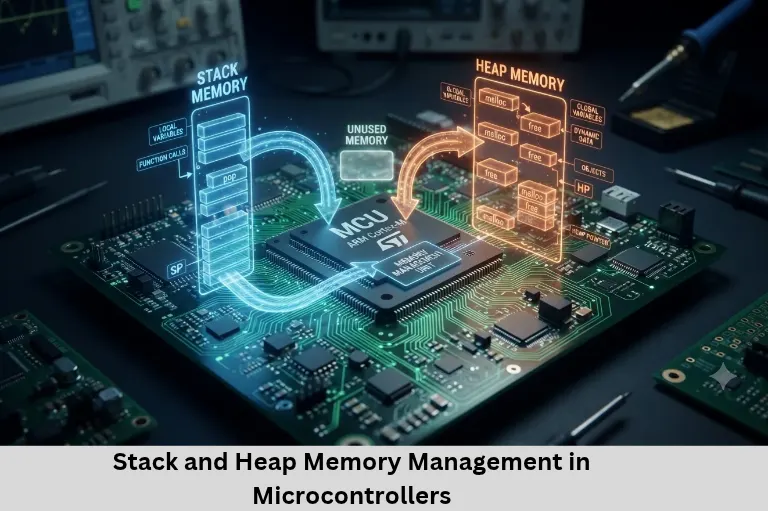
Learn stack and heap memory management in microcontrollers, Embedded C allocation, stack overflow, heap fragmentation and practical debugging techniques. Embedded Tech Development Academy (ETDA).
- Stack and Heap Memory Management in Microcontrollers
-
Stack and Heap Memory Management in Microcontrollers
- Introduction
- What Is Stack Memory in Microcontrollers?
- What Is Heap Memory in Microcontrollers?
- Difference Between Stack and Heap Memory
- Common Memory Problems in Microcontrollers
- Stack and Heap in Real-Time Microcontroller Applications
- Learn Embedded C Memory Management at ETDA
- Frequently Asked Questions
- Conclusion
Stack and Heap Memory Management in Microcontrollers
Introduction
Memory management is an important part of microcontroller programming because embedded devices often operate with limited RAM and processing resources. Every variable, function call and dynamically allocated object requires memory. Understanding how the stack and heap work helps developers write reliable firmware and avoid unexpected system failures.
In embedded systems, poor memory usage can cause stack overflow, heap fragmentation and application crashes. These problems are especially important in automotive controllers, industrial devices and Internet of Things (IoT) products. Students interested in learning practical firmware development can explore these concepts at Embedded Tech Development Academy (ETDA), promoted as a Top Embedded Training Institute in Bangalore.
What Is Stack Memory in Microcontrollers?
The stack is a memory region used to manage function calls and temporary data during program execution. It follows a Last In, First Out (LIFO) structure, meaning the most recently stored information is generally the first to be removed.
When a function is called, the processor or compiler-generated code manages information such as return addresses, saved registers and local variables. When the function finishes, its stack frame is released.
How Stack Memory Works
Consider a C program where main() calls another function. The function call creates a stack frame containing the information required for execution. If that function calls another function, another frame is created.
When the second function returns, its frame is removed. The previous function can then continue execution. This process happens automatically according to the compiler and processor calling convention.
Stack Memory Example in Embedded C
#include <stdint.h>

void calculate(void)
{
    uint16_t temperature = 30;
    uint16_t pressure = 100;

    uint16_t result = temperature + pressure;
}

int main(void)
{
    calculate();

    while (1)
    {
    }
}
The local variables may be placed on the stack, depending on compiler optimisation and register allocation. The function’s execution also requires call-related storage, although the exact stack-frame layout depends on the target architecture and compiler.
<AsyncImage query=”embedded C stack memory function call stack frames local variables diagram” aspectRatio=”16:9″ width=”100%”/>
What Is Heap Memory in Microcontrollers?
The heap is a memory region used for dynamic memory allocation during program execution. Unlike the stack, where function-related storage is managed automatically, heap memory is requested and released using functions such as malloc(), calloc() and free() in C.
Dynamic allocation can be useful when the required memory size is not known at compile time. However, microcontrollers often have limited RAM, so developers must manage heap usage carefully.
Dynamic Memory Allocation Example
#include <stdlib.h>
#include <stdint.h>

int main(void)
{
    uint16_t *buffer;

    buffer = malloc(10U * sizeof(uint16_t));

    if (buffer != NULL)
    {
        buffer[0] = 100U;
        free(buffer);
        buffer = NULL;
    }

    while (1)
    {
    }
}
The program requests memory for ten 16-bit values. It checks whether allocation succeeded before using the buffer and releases the allocated memory afterward.
Difference Between Stack and Heap Memory
Both regions use RAM, but their allocation and management methods are different.
| Feature | Stack | Heap |
|---|---|---|
| Allocation | Function execution and local storage | Dynamic allocation |
| Management | Usually automatic | Programmer-managed in C |
| Structure | LIFO behaviour | Allocator-managed free blocks |
| Speed | Generally predictable and fast | Depends on allocator and fragmentation |
| Common risk | Stack overflow | Fragmentation and allocation failure |
| Typical use | Local variables and call frames | Runtime-sized buffers and objects |
Common Memory Problems in Microcontrollers
Stack Overflow
Stack overflow happens when the program uses more stack space than the allocated region can provide. Deep recursion, large local arrays and excessive nested function calls can contribute to this problem.
For example, placing a large data buffer inside a frequently called function may consume significant stack space. Developers should review stack requirements and avoid unnecessary large local variables.
Heap Fragmentation
Heap fragmentation occurs when repeated allocation and release operations create small free memory blocks separated by allocated blocks. Even if the total free memory is sufficient, a large continuous allocation may fail.
This is one reason many safety-critical or real-time applications avoid frequent dynamic allocation after system initialisation.
Practical Ways to Prevent Memory Issues
Define suitable stack and heap sizes in the linker configuration.
Avoid unnecessary recursion in firmware.
Check every dynamic allocation result.
Release allocated memory when it is no longer required.
Prefer static or fixed-size buffers when requirements are predictable.
Monitor stack usage during testing and debugging.
A Useful Debugging Practice
Use a debugger or compiler-supported stack-usage report to inspect memory consumption. Some systems use stack watermarking, where unused stack memory is filled with a known pattern and checked during testing to estimate maximum stack usage.
<AsyncImage query=”embedded firmware debugging microcontroller RAM memory stack monitoring debugger workstation” aspectRatio=”16:9″ width=”100%”/>
Stack and Heap in Real-Time Microcontroller Applications
Memory management directly affects the reliability of real-time firmware. A motor controller, for example, must execute control functions within predictable timing limits. Uncontrolled dynamic allocation can introduce variable execution time and allocation failures.
In Internet of Things (IoT) devices, memory is shared by sensor buffers, communication stacks, application variables and operating system tasks. Developers must plan RAM usage carefully to prevent one component from exhausting memory needed by another.
Learn Embedded C Memory Management at ETDA
Understanding stack and heap memory requires practical experience with C programming, microcontroller architecture and debugging tools. Students should learn how function calls use stack space, how dynamic allocation works and how linker settings define memory regions.
Embedded Tech Development Academy (ETDA) promotes technical training in Embedded C, microcontroller programming and practical hardware development. Students looking for a Top Embedded Training Institute in Bangalore can explore hands-on learning that connects memory concepts with firmware development. Embedded Tech Development Academy (ETDA) also promotes assured placement support for learners preparing for embedded development roles.
Frequently Asked Questions
What is stack memory in a microcontroller?
Stack memory stores function-related information such as return addresses, saved registers and local variables during program execution.
What is heap memory in Embedded C?
Heap memory is used for dynamic memory allocation through functions such as malloc(), calloc() and free().
What causes stack overflow?
Deep function calls, recursion and large local variables can consume more stack space than the allocated memory.
Why can dynamic memory allocation be risky in microcontrollers?
Limited RAM, allocation failures, fragmentation and unpredictable execution time can affect firmware reliability.
Is stack memory faster than heap memory?
Stack allocation is generally more predictable and has lower management overhead, while heap allocation depends on the allocator implementation.
How can students practise memory management?
Students can write Embedded C programs, inspect stack usage, test dynamic allocation and debug memory behaviour using development boards and software tools.
Conclusion
Stack and heap memory management are essential topics for writing stable microcontroller firmware. The stack handles function-related storage, while the heap supports dynamic allocation when runtime memory requirements change. Understanding their differences helps developers prevent overflow, fragmentation and allocation failures.
Students should practise analysing memory usage, reading linker configurations and debugging firmware on real development boards. Embedded Tech Development Academy (ETDA), promoted as a Top Embedded Training Institute in Bangalore, encourages practical technical learning and offers assured placement support. Strong memory-management skills can help aspiring developers prepare for careers involving embedded systems and Internet of Things (IoT) applications.
Author: ETDA Trainers
Experience: 10+ Years of Industry Experience in Embedded Systems, IoT, and Embedded C Programming