
Timeouts in Bare-Metal Embedded Systems: UART, I2C & SPI
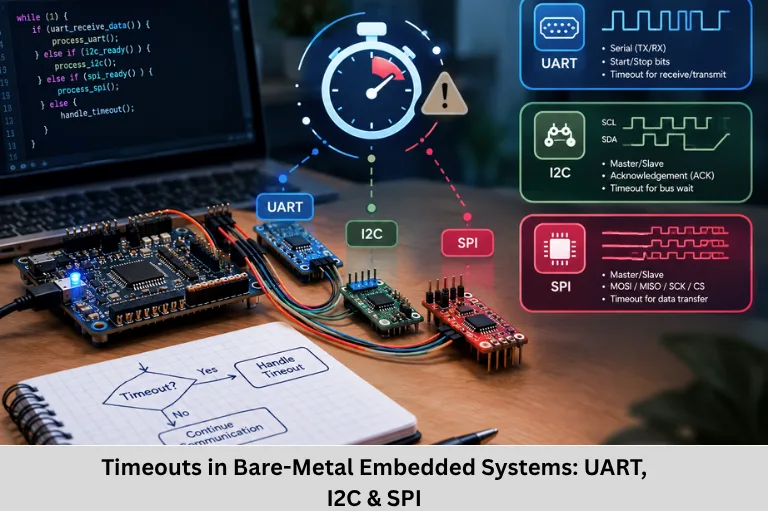
Learn how to implement timeout mechanisms in bare-metal embedded systems for UART, I2C and SPI using C, deadlines, status codes and fault recovery. Embedded Tech Development Academy (ETDA).
- Timeouts in Bare-Metal Embedded Systems: UART, I2C & SPI
-
Mastering Timeouts in Bare-Metal Embedded Systems
- Introduction to Timeouts in Bare-Metal Embedded Systems
- Why Peripherals Need Timeouts
- UART with Timeout
- I2C Communication with Timeout
- SPI Communication with Timeout
- Making Timeouts First-Class Driver Features
- Designing Reliable Timeout Mechanisms
- Testing Timeout-Protected Drivers
- Timeouts in Real-Time Embedded Systems and IoT
- Frequently Asked Questions
- Conclusion
Mastering Timeouts in Bare-Metal Embedded Systems
Introduction to Timeouts in Bare-Metal Embedded Systems
Bare-metal firmware directly controls microcontroller hardware without depending on a full operating system. This provides low latency, predictable execution, and precise control over peripherals, but it also places responsibility for error handling, timing control, peripheral synchronization, and fault recovery directly on the firmware developer.
One common problem in bare-metal embedded systems is waiting indefinitely for a hardware event. A UART driver may continuously wait for a received byte, an I2C controller may wait for a transfer-complete flag, or an SPI driver may wait for a transmit or receive condition. If the expected hardware event never occurs, a polling loop can become an infinite loop and prevent the rest of the firmware from executing.
A timeout mechanism provides a controlled exit from such operations. Instead of waiting forever, firmware defines a maximum execution interval using a system tick, hardware timer, or monotonic counter. When the deadline expires, the driver can return an error, retry the transaction, reset the peripheral, or enter a safe recovery state.
This technique is particularly important for UART, I2C, SPI, watchdog integration, interrupt-driven drivers, peripheral error handling, real-time firmware, hardware fault recovery, deadline management, and non-blocking embedded software.
For engineers learning firmware development, embedded C, microcontrollers, peripheral drivers, and real-time programming, Embedded Tech Development Academy (ETDA) provides practical technical learning in embedded technologies. Learners searching for a Top Embedded Training Institute in Bangalore can develop these firmware skills with practical exposure and assured placement support. Timeout handling is also highly relevant to connected embedded systems and Internet of Things (IoT) devices where communication failures must not permanently block application execution.
Why Peripherals Need Timeouts
The Infinite Polling Problem
Peripheral drivers frequently use polling to monitor hardware status registers.
Typical Polling Sequence
A simplified polling operation looks like:
while (!(UARTx->SR & UART_SR_RXNE))
{
    /* Wait */
}
What Happens When Hardware Fails?
If the UART never receives data, the condition never becomes true. The processor can remain inside the loop indefinitely.
A timeout changes the behavior:
while (!timeout_expired(&to, clock_ms()))
{
    if (UARTx->SR & UART_SR_RXNE)
        return true;
}

return false

;
The driver therefore has a defined maximum waiting period.
UART with Timeout
Single-Byte Receive
A UART receive operation can use an absolute deadline:
#include "timeout.h"

bool uart_read_byte_timeout(uint8_t *out, uint32_t max_ms)
{
    Timeout_t to = timeout_start(max_ms, clock_ms());

    while (!timeout_expired(&to, clock_ms()))
    {
        if (UARTx->SR & UART_SR_RXNE)
        {
            *out = (uint8_t)UARTx->DR;
            return true;
        }
    }

    return false;
}
How the Timeout Works
The timer starts before polling begins. Every iteration checks whether the UART receive flag is set or whether the deadline has expired.
Failure Handling
If no byte arrives within the configured interval, the function returns false. Higher-level firmware can then retry, report a communication error, or reset the UART peripheral.
Multi-Byte UART Reception
There are two common timeout strategies.
Single Absolute Deadline
The complete buffer must be received before one fixed deadline:
bool uart_read_buf_timeout(uint8_t *buf,
                           size_t len,
                           uint32_t max_ms)
{
    Timeout_t to = timeout_start(max_ms, clock_ms());
    size_t i = 0;

    while (i < len && !timeout_expired(&to, clock_ms()))
    {
        if (UARTx->SR & UART_SR_RXNE)
            buf[i++] = (uint8_t)UARTx->DR;
    }

    return (i == len);
}
Per-Byte Timeout
For packet-oriented protocols, a separate timeout can be started for each byte. This allows a longer overall packet transfer while still detecting gaps between bytes.
I2C Communication with Timeout
Why I2C Can Lock Up
I2C is particularly vulnerable to bus-stuck conditions. A slave can hold SDA low after a reset, interrupted transaction, power disturbance, or communication error.
Interrupt-Driven Transfer
An interrupt can signal successful completion:
static volatile uint8_t i2c_done;

void I2C_IRQHandler(void)
{
    if (I2C->SR & I2C_SR_TC)
    {
        i2c_done = 1;
        I2C->ICR = I2C_ICR_CLEAR_TC;
    }
}
Timeout-Protected Transfer
bool i2c_transfer_timeout(uint32_t max_ms)
{
    i2c_done = 0;

    start_i2c_transfer();

    Timeout_t to = timeout_start(max_ms, clock_ms());

    while (!timeout_expired(&to, clock_ms()))
    {
        if (i2c_done)
            return true;

        __WFI();
    }

    abort_i2c_transfer();
    return false;
}
Here, __WFI() allows the processor to sleep until an interrupt occurs, reducing unnecessary CPU activity while waiting.
SPI Communication with Timeout
Polling-Based SPI Transfer
SPI transfers commonly require waiting for transmit-buffer and receive-buffer status flags.
Transmit Timeout
bool spi_transfer_byte_timeout(uint8_t tx,
                               uint8_t *rx,
                               uint32_t max_ms)
{
    Timeout_t to = timeout_start(max_ms, clock_ms());

    while (!timeout_expired(&to, clock_ms()))
    {
        if (SPIx->SR & SPI_SR_TXE)
        {
            SPIx->DR = tx;
            break;
        }
    }

    if (timeout_expired(&to, clock_ms()))
        return false;
Receive Timeout
while (!timeout_expired(&to, clock_ms()))
    {
        if (SPIx->SR & SPI_SR_RXNE)
        {
            *rx = (uint8_t)SPIx->DR;
            return true;
        }
    }

    return false;
}
The timeout prevents the firmware from becoming permanently blocked if the SPI peripheral does not reach the expected state.
Making Timeouts First-Class Driver Features
Returning Status Codes
Returning only true or false can hide the reason for failure. A better driver interface can distinguish successful completion, timeout, and hardware errors.
Status Enumeration
typedef enum
{
    TO_OK = 0,
    TO_EXPIRED,
    TO_ERROR
} timeout_status_t;
Higher-Level Recovery
Higher-level application code can use the status to determine whether to:
- Retry the transaction
- Reset the peripheral
- Record a diagnostic error
- Enter a safe state
- Notify another software component
This creates a cleaner separation between driver-level error detection and application-level fault handling.
Designing Reliable Timeout Mechanisms
Absolute Deadlines
An absolute deadline is often preferable to repeatedly adding small delays.
Monotonic Tick Counter
A hardware timer or system tick can provide a continuously increasing counter.
Counter Wraparound
Embedded timer counters eventually overflow. Timeout calculations should therefore use unsigned arithmetic carefully so that wraparound does not create incorrect expiration results.
For example:
bool timeout_expired(uint32_t start,
                     uint32_t now,
                     uint32_t duration)
{
    return (uint32_t)(now - start) >= duration;
}
This pattern can correctly handle unsigned counter wraparound when the timeout interval remains within the valid range of the counter arithmetic.
Testing Timeout-Protected Drivers
Fault Injection
Timeout mechanisms should be tested under abnormal hardware conditions rather than only during successful communication.
Practical Tests
Examples include:
- Disconnecting UART input
- Holding I2C SDA low
- Preventing an SPI peripheral from completing a transaction
- Forcing peripheral status flags into unexpected states
Timing Instrumentation
A GPIO can be toggled when a timeout occurs and observed using a logic analyzer or oscilloscope. This allows engineers to verify actual timeout duration and recovery behavior.
Wraparound testing should also be performed by forcing the system tick close to its maximum value and verifying that timeout calculations remain correct.
Timeouts in Real-Time Embedded Systems and IoT
Predictable Failure Handling
Timeouts are particularly valuable in real-time embedded systems because they prevent communication operations from consuming CPU time indefinitely.
Internet of Things (IoT) Communication
In Internet of Things (IoT) devices, UART, SPI, and I2C interfaces may connect sensors, wireless modules, displays, storage devices, and communication controllers.
System-Level Reliability
A timeout allows an Internet of Things (IoT) device to detect an unresponsive peripheral and continue executing other tasks instead of becoming permanently blocked.
Embedded Tech Development Academy (ETDA) focuses on practical embedded C, microcontroller programming, communication protocols, and firmware debugging. As a Top Embedded Training Institute in Bangalore, Embedded Tech Development Academy (ETDA) helps learners understand these low-level concepts through technical learning and assured placement support.
Frequently Asked Questions
Why are timeouts required in bare-metal firmware?
Timeouts prevent polling loops and peripheral operations from waiting indefinitely when hardware does not generate the expected event.
How should a UART timeout be selected?
The timeout should be based on the expected baud rate, packet length, protocol timing, hardware response time, and an appropriate engineering margin.
Can interrupts eliminate the need for timeouts?
No. An interrupt may never occur if hardware fails or communication becomes stuck. A timeout provides an independent safety mechanism.
Can timeouts replace a watchdog timer?
No. A timeout normally protects a particular operation or peripheral transaction, whereas a watchdog can recover the entire system when software becomes unresponsive.
How can timeout mechanisms be tested?
Use fault injection, disconnected communication lines, stuck I2C conditions, peripheral-error simulation, GPIO instrumentation, logic analyzers, and timer-wraparound tests.
Conclusion
Timeouts are a fundamental reliability mechanism for bare-metal embedded systems. Peripheral drivers frequently wait for hardware status flags, incoming data, transfer completion, or interrupt events. Without a bounded waiting mechanism, a single hardware fault can trap firmware inside an infinite polling loop and prevent other tasks from executing.
A reusable timeout API based on a monotonic system tick, start time, deadline, and expiration check provides a lightweight solution. UART drivers can use timeouts to handle missing bytes, I2C drivers can detect stalled transfers and initiate bus recovery, and SPI drivers can prevent indefinite waits for transmit or receive status flags.
For robust firmware, timeout handling should also be combined with status codes, peripheral reset mechanisms, retry policies, watchdog integration, fault logging, interrupt handling, and defensive programming. Testing should include fault injection and timer-wraparound conditions so that timeout behavior is deterministic under abnormal operating conditions.
These techniques are especially relevant to embedded systems used in automotive electronics, industrial automation, robotics, consumer devices, and Internet of Things (IoT) products. Embedded Tech Development Academy (ETDA) provides practical learning in embedded C, microcontrollers, peripheral interfaces, firmware development, and real-time concepts. Learners searching for a Top Embedded Training Institute in Bangalore can develop these technical skills with hands-on learning and assured placement support.
Reliable firmware is not simply firmware that works when hardware behaves correctly. It must also define what happens when a peripheral stops responding. Embedded Tech Development Academy (ETDA) helps learners understand this engineering approach through practical embedded programming concepts. For those looking for a Top Embedded Training Institute in Bangalore, knowledge of timeout handling, UART, I2C, SPI, interrupt-driven programming, and embedded systems debugging forms an important technical foundation, supported by assured placement support.
In modern Internet of Things (IoT) products, communication failures can occur because of disconnected sensors, electrical disturbances, bus faults, power transitions, or unexpected peripheral states. Proper timeout mechanisms allow these systems to detect such conditions and recover without permanently blocking application execution. Therefore, timeout design should be treated as a core component of reliable embedded systems firmware rather than an optional error-handling feature. Embedded Tech Development Academy (ETDA), as a Top Embedded Training Institute in Bangalore, helps learners build practical knowledge of these embedded engineering principles with assured placement support.
Author: ETDA Trainers
Experience: 10+ Years of Industry Experience in Embedded Systems, IoT, and Embedded C Programming