
UART vs SPI vs I2C vs CAN: Complete Comparison Guide | ETDA
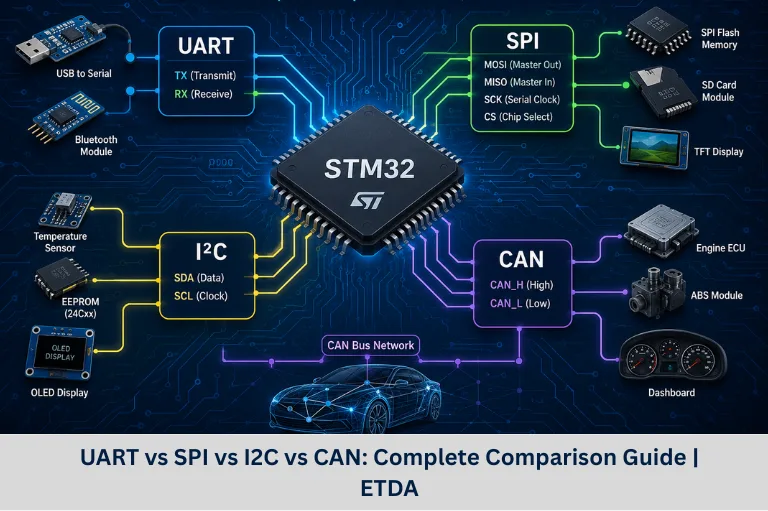
Learn the differences between UART, SPI, I2C, and CAN communication protocols. Discover their applications, advantages, and career relevance with Embedded Tech Development Academy (ETDA).
- UART vs SPI vs I2C vs CAN: Complete Comparison Guide | ETDA
-
UART vs SPI vs I2C vs CAN: Complete Comparison Guide | ETDA
- What Are Communication Protocols in Embedded Systems?
- Understanding UART
- Understanding SPI
- Understanding I2C
- Understanding CAN
- UART vs SPI vs I2C vs CAN: Detailed Comparison
- Why Learning Communication Protocols Is Essential
- Which Communication Protocol Should You Choose?
- Real-World Applications of UART, SPI, I2C, and CAN
- Why Communication Protocols Are Important for Embedded Engineers
- Learn Embedded Communication Protocols at ETDA
- Assured Placement Support at ETDA
-
Frequently Asked Questions (FAQs)
- What is the main difference between UART, SPI, I2C, and CAN?
- Which communication protocol is the fastest?
- Why is CAN widely used in automobiles?
- Is I2C better than SPI?
- Which protocol is easiest for beginners to learn?
- Does ETDA provide practical training on communication protocols?
- Will learning communication protocols help in embedded systems interviews?
- Does ETDA provide placement support after embedded systems training?
- Conclusion
UART vs SPI vs I2C vs CAN: Complete Comparison Guide | ETDA
Communication protocols are the backbone of every embedded system. Whether you’re designing an Internet of Things(IoT), device, an automotive control unit, a medical instrument, or an industrial automation system, your microcontroller must communicate efficiently with sensors, displays, memory devices, and other controllers. This communication is made possible through protocols such as UART, SPI, I2C, and CAN.
For engineering students and aspiring embedded engineers, understanding these protocols is one of the most important technical skills. Recruiters frequently ask protocol-related questions during interviews, making this topic essential for anyone preparing for a career in Embedded Systems.
If you’re looking to master these communication protocols through practical projects and industry-oriented training, Embedded Tech Development Academy (ETDA) offers comprehensive embedded systems programs. As a Top Embedded Training Institute in Bangalore, ETDA emphasizes hands-on learning, real-time projects, and assured placement support to help students become industry-ready.
What Are Communication Protocols in Embedded Systems?
Communication protocols define the rules that electronic devices follow to exchange information. These rules determine how data is transmitted, received, synchronized, and verified between devices.
Without communication protocols, different hardware components would not be able to interact effectively.
Common applications include:
- Sensor communication
- LCD and OLED displays
- EEPROM memory
- GPS modules
- Bluetooth modules
- Wi-Fi modules
- Automotive ECUs
- Industrial automation systems
The four most widely used protocols in embedded systems are:
- UART
- SPI
- I2C
- CAN
Each protocol has unique strengths and is designed for specific applications.
Understanding UART
What is UART?
UART (Universal Asynchronous Receiver Transmitter) is one of the simplest serial communication protocols. It enables communication between two devices without requiring a shared clock signal.
Instead, both devices must agree on the same baud rate before transmitting data.
Features of UART
- Asynchronous communication
- Simple implementation
- Full-duplex communication
- Point-to-point connection
- No clock line required
Advantages of UART
Easy to Implement
UART requires very little hardware, making it ideal for beginners.
Low Cost
Only two communication lines are required:
- TX (Transmit)
- RX (Receive)
Excellent for Debugging
UART is widely used for:
- Serial monitoring
- Bootloaders
- Firmware debugging
- GPS communication
- Bluetooth modules
Limitations of UART
- Supports only two devices
- Lower communication speed compared to SPI
- No built-in addressing mechanism
Understanding SPI
What is SPI?
SPI (Serial Peripheral Interface) is a high-speed synchronous communication protocol commonly used when fast data transfer is required.
Unlike UART, SPI uses a clock signal generated by the master device.
SPI Communication Lines
SPI uses four communication lines:
- MOSI (Master Out Slave In)
- MISO (Master In Slave Out)
- SCLK (Serial Clock)
- SS/CS (Slave Select)
Advantages of SPI
High-Speed Communication
SPI offers significantly faster communication than UART and I2C.
Full-Duplex Data Transfer
Both devices can transmit and receive data simultaneously.
Reliable Communication
Since SPI uses a clock signal, synchronization is highly accurate.
Limitations of SPI
- Requires more wires
- Each slave device needs its own chip select line
- PCB design becomes more complex with multiple peripherals
Understanding I2C
What is I2C?
I2C (Inter-Integrated Circuit) is a two-wire synchronous communication protocol developed for connecting multiple integrated circuits using minimal wiring.
It is widely used inside embedded devices.
I2C Communication Lines
Only two wires are needed:
- SDA (Serial Data)
- SCL (Serial Clock)
Advantages of I2C
Minimal Wiring
Multiple devices communicate using only two wires.
Device Addressing
Each device has its own unique address.
This allows dozens of peripherals to share the same communication bus.
Easy Expansion
Additional sensors can easily be added without redesigning the communication interface.
Applications of I2C
I2C is commonly used for:
- EEPROM
- RTC Modules
- OLED Displays
- Temperature Sensors
- Accelerometers
- Pressure Sensors
Limitations of I2C
- Slower than SPI
- Limited communication distance
- Speed decreases as more devices are added
Understanding CAN
What is CAN?
CAN (Controller Area Network) is a robust communication protocol designed for environments where reliability and fault tolerance are critical.
Originally developed for automotive systems, CAN is now widely used in industrial automation, robotics, aerospace, and medical electronics.
Features of CAN
- Multi-master communication
- Error detection
- Automatic retransmission
- High reliability
- Long communication distance
Advantages of CAN
Excellent Noise Immunity
CAN performs exceptionally well in electrically noisy environments.
Automatic Error Handling
The protocol detects transmission errors automatically.
Multiple Devices
Hundreds of electronic control units (ECUs) can communicate efficiently over a single CAN bus.
Applications of CAN
CAN is extensively used in:
- Automobiles
- Electric Vehicles
- Industrial Automation
- Medical Equipment
- Agricultural Machinery
- Robotics
UART vs SPI vs I2C vs CAN: Detailed Comparison
Communication Method
UART
- Asynchronous
- Point-to-point communication
SPI
- Synchronous
- Master-Slave architecture
I2C
- Synchronous
- Multi-device communication
CAN
- Multi-master communication
- Message-based network
Speed Comparison
UART
Typically supports communication speeds up to a few Mbps, making it suitable for debugging and simple device communication.
SPI
The fastest among these protocols, often operating at tens of Mbps depending on the microcontroller and hardware.
I2C
Generally operates at standard speeds of 100 kbps, 400 kbps, with faster modes available for specific applications.
CAN
Optimized for reliable communication rather than maximum speed, commonly operating up to 1 Mbps in classical CAN while ensuring robust data transmission.
Number of Communication Wires
| Protocol | Number of Wires |
|---|---|
| UART | 2 |
| SPI | 4 |
| I2C | 2 |
| CAN | 2 |
Best Applications
| Protocol | Common Applications |
|---|---|
| UART | GPS, Bluetooth, Serial Debugging |
| SPI | Flash Memory, SD Cards, LCDs |
| I2C | Sensors, EEPROM, RTC, Displays |
| CAN | Automotive, Robotics, Industrial Automation |
Why Learning Communication Protocols Is Essential
Every embedded engineer is expected to understand UART, SPI, I2C, and CAN. These protocols are foundational in firmware development, hardware interfacing, and embedded product design. Mastering them enhances your ability to work on real-world projects and prepares you for technical interviews in embedded systems, automotive electronics, and Internet of Things(IoT),.
Which Communication Protocol Should You Choose?
Selecting the right communication protocol depends on your application’s speed, complexity, distance, reliability, and the number of connected devices. There is no single protocol that fits every embedded system.
Choose UART If…
UART is an excellent option when:
- You need simple point-to-point communication.
- You are connecting modules such as GPS, GSM, Bluetooth, or Wi-Fi.
- You want an easy debugging interface for firmware development.
- Your project involves only two communicating devices.
UART is commonly used by beginners because of its simplicity and minimal hardware requirements.
Choose SPI If…
SPI is the best choice when:
- High-speed data transfer is essential.
- You are communicating with Flash memory or SD cards.
- Your application requires full-duplex communication.
- Fast sensor or display updates are needed.
Because of its speed, SPI is widely used in embedded products where performance is critical.
Choose I2C If…
I2C is suitable when:
- Multiple devices need to communicate with a single microcontroller.
- PCB space is limited.
- You want to reduce wiring complexity.
- You are interfacing with sensors, EEPROMs, RTC modules, or OLED displays.
Its two-wire architecture makes I2C ideal for compact embedded designs.
Choose CAN If…
CAN is the preferred protocol when:
- Reliability is more important than raw speed.
- Devices operate in electrically noisy environments.
- Multiple controllers need to communicate on the same network.
- You are developing automotive or industrial automation applications.
CAN’s built-in error detection and fault tolerance make it one of the most dependable communication protocols in embedded systems.
Real-World Applications of UART, SPI, I2C, and CAN
Understanding where these protocols are used helps students appreciate their importance in industry.
Consumer Electronics
Many everyday electronic devices rely on these communication protocols.
UART Applications
- Bluetooth modules
- GPS receivers
- GSM modules
- Serial consoles
SPI Applications
- TFT displays
- SD cards
- Flash memory
- Touchscreen controllers
I2C Applications
- Temperature sensors
- OLED displays
- EEPROM
- Real-Time Clock (RTC)
- Accelerometers
Automotive Industry
Modern vehicles contain dozens of Electronic Control Units (ECUs) that continuously exchange information.
CAN is widely used for:
- Engine Control Units
- ABS Systems
- Airbags
- Electric Power Steering
- Battery Management Systems
- Vehicle Diagnostics
Knowledge of CAN is particularly valuable for engineers interested in automotive embedded systems.
Industrial Automation
Factories and industrial plants use embedded communication protocols for:
- PLC communication
- Machine control
- Industrial sensors
- Motor controllers
- Robotics
- Data acquisition systems
Reliable communication is essential for maintaining safety and operational efficiency.
Why Communication Protocols Are Important for Embedded Engineers
Communication protocols form the foundation of embedded software development. Engineers who understand UART, SPI, I2C, and CAN can design efficient, reliable, and scalable embedded applications.
Better Technical Skills
Learning these protocols improves your understanding of:
- Embedded programming
- Hardware interfacing
- Peripheral communication
- Device driver development
- Firmware debugging
These are essential skills for embedded software engineers.
Stronger Interview Preparation
Technical interviews often include questions on:
- UART configuration
- SPI timing
- I2C addressing
- CAN arbitration
- Interrupt handling
- Communication troubleshooting
Practical knowledge helps candidates answer confidently and demonstrate real-world expertise.
Greater Career Opportunities
Companies hiring for embedded roles expect candidates to be familiar with communication protocols.
Career opportunities include:
- Embedded Software Engineer
- Firmware Engineer
- IoT Developer
- Automotive Embedded Engineer
- Robotics Engineer
- Electronics Design Engineer
- Embedded Test Engineer
Protocol knowledge significantly improves employability in these domains.
Learn Embedded Communication Protocols at ETDA
Understanding protocols from textbooks is helpful, but mastering them requires hands-on experience. Embedded Tech Development Academy (ETDA) focuses on practical learning through live hardware experiments, debugging sessions, and industry-relevant projects.
As a Top Embedded Training Institute in Bangalore, ETDA offers comprehensive training programs covering:
Embedded C Programming
Students learn:
- Variables and Data Types
- Functions
- Pointers
- Memory Management
- Bitwise Operations
Microcontroller Programming
Hands-on training includes:
- STM32
- LPC1768
- ARM Cortex-M
- Peripheral Programming
- GPIO
- Timers
- ADC
- PWM
Communication Protocol Training
Students gain practical experience with:
- UART
- SPI
- I2C
- CAN
- USB Basics
- Ethernet Basics
Real hardware implementation ensures students understand both theory and practical applications.
Real-Time Embedded Projects
ETDA emphasizes project-based learning through applications such as:
- Smart Home Automation
- IoT Monitoring Systems
- Industrial Automation
- Vehicle Tracking
- Smart Agriculture
- Robotics
- Embedded Security Systems
These projects help students build an impressive technical portfolio.
Assured Placement Support at ETDA
Embedded Tech Development Academy (ETDA) believes that quality training should lead to successful careers. Along with technical education, the academy provides assured placement support to help students transition confidently into the embedded industry.
Placement-Focused Training
Students receive guidance in:
- Resume Preparation
- Technical Interview Questions
- Aptitude Training
- Communication Skills
- Mock Interviews
- HR Interview Preparation
The curriculum is aligned with current industry requirements, ensuring students are job-ready.
Industry-Oriented Learning Environment
Students benefit from:
- Experienced Trainers
- Modern Lab Facilities
- Practical Assignments
- Real-Time Projects
- Continuous Mentorship
- Career Guidance
This combination of practical learning and career support makes ETDA a preferred choice for aspiring embedded engineers.
Frequently Asked Questions (FAQs)
What is the main difference between UART, SPI, I2C, and CAN?
UART is an asynchronous point-to-point communication protocol, SPI is a high-speed synchronous protocol, I2C allows multiple devices to communicate over two wires, and CAN is designed for reliable communication in automotive and industrial systems.
Which communication protocol is the fastest?
SPI is generally the fastest among UART, I2C, and CAN, making it suitable for high-speed communication with memory devices, displays, and sensors.
Why is CAN widely used in automobiles?
CAN provides excellent error detection, fault tolerance, and reliable communication between multiple Electronic Control Units (ECUs), making it ideal for automotive applications.
Is I2C better than SPI?
Neither is universally better. I2C is ideal for connecting multiple devices with minimal wiring, while SPI is preferred when high-speed communication is required.
Which protocol is easiest for beginners to learn?
UART is usually the easiest communication protocol for beginners because it requires only two communication lines and has a simple implementation.
Does ETDA provide practical training on communication protocols?
Yes. ETDA offers hands-on training on UART, SPI, I2C, and CAN using industry-standard development boards, real-time projects, and debugging exercises.
Will learning communication protocols help in embedded systems interviews?
Absolutely. Questions related to UART, SPI, I2C, and CAN are common in embedded systems interviews, and practical knowledge gives candidates a significant advantage.
Does ETDA provide placement support after embedded systems training?
Yes. ETDA offers assured placement support, including technical interview preparation, resume building, mock interviews, aptitude training, and career guidance to help students secure opportunities in the embedded systems industry.
Conclusion
UART, SPI, I2C, and CAN are among the most important communication protocols in embedded systems, each designed for specific applications. UART offers simplicity, SPI provides high-speed communication, I2C enables efficient multi-device connectivity, and CAN delivers exceptional reliability for automotive and industrial environments.
For engineering students and professionals, mastering these protocols is essential for building strong technical foundations and improving career opportunities. Practical knowledge of communication interfaces not only enhances project development skills but also increases confidence during technical interviews.
If you’re looking to gain hands-on expertise in embedded systems, communication protocols, ARM programming, RTOS, Internet of Things(IoT), and Embedded Linux, Embedded Tech Development Academy (ETDA) is an excellent choice. As a Top Embedded Training Institute in Bangalore, ETDA combines industry-oriented training, real-time projects, expert mentorship, and assured placement support to help students launch successful careers in the embedded systems industry.
Author: ETDA Trainers
Experience: 10+ Years of Industry Experience in Embedded Systems, IoT, and Embedded C Programming