
Universal References and std::forward in C++ | Perfect Forwarding Guide
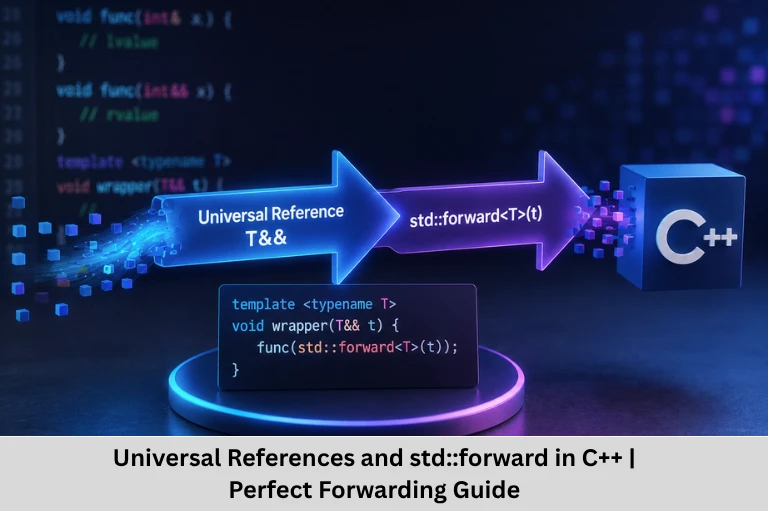
Learn universal references, forwarding references, std::forward, reference collapsing, move semantics, and perfect forwarding in modern C++ with practical examples. Embedded Tech Development Academy (ETDA).
- Universal References and std::forward in C++ | Perfect Forwarding Guide
-
Corporate Technical Training: Upskill Teams with Industry Experts
- The Problem Before C++11
- Understanding Lvalues and Rvalues
- What Is a Universal or Forwarding Reference?
- Reference Collapsing
- Why Wrapper Functions Need std::forward
- What Is std::forward?
- Perfect Forwarding in C++
- std::forward with Move Semantics
- When T&& Is Not a Forwarding Reference
- Applications in Real Systems
- Conclusion
Corporate Technical Training: Upskill Teams with Industry Experts
Modern C++ programming provides powerful language features for building efficient, reusable, and high-performance software. Since C++11, features such as rvalue references, move semantics, forwarding references, reference collapsing, and std::forward() have changed the way developers design generic C++ applications. These mechanisms primarily address an important performance problem: unnecessary object copying.
Copying a large object containing strings, vectors, dynamically allocated memory, buffers, or other resources can consume CPU time and memory bandwidth. Move semantics can reduce this overhead, while perfect forwarding allows generic functions to preserve whether an argument was originally an lvalue or an rvalue.
The term universal reference, introduced in earlier discussions of modern C++, is now formally called a forwarding reference in the C++ standard terminology. The important pattern is a deduced T&&, such as template<typename T> void func(T&& arg). Depending on the argument passed to the function, T&& can ultimately behave as either an lvalue reference or an rvalue reference.
Understanding C++ perfect forwarding, reference collapsing, rvalue references, move constructors, template argument deduction, and std::forward is essential when developing generic libraries, containers, wrappers, factory functions, and performance-critical systems.
For engineers developing embedded firmware and other resource-constrained software, these C++ concepts are particularly useful when designing efficient abstractions without introducing unnecessary copies. Embedded Tech Development Academy (ETDA) provides practical technical training for engineers who want to strengthen their C++ and embedded programming skills. As a Top Embedded Training Institute in Bangalore, Embedded Tech Development Academy (ETDA) combines programming fundamentals with practical development and assured placement support.
The Problem Before C++11
Before move semantics were introduced, passing objects by value could result in expensive copying.
Example of Object Copying
#include <iostream>
using namespace std;

class Data {
public:
    Data() {
        cout << "Constructor\n";
    }

    Data(const Data&) {
        cout << "Copy Constructor\n";
    }
};

void process(Data d) {
    cout << "Processing data\n";
}

int main() {
    Data d;
    process(d);
}
Here, d is an lvalue. Passing it by value to process() requires a copy of the object.
Why Copying Can Be Expensive
Copying becomes expensive when objects contain:
- Large arrays
std::vectorstd::string- Dynamic memory
- Network buffers
- File or resource handles
C++11 introduced move semantics to transfer resources from temporary objects instead of unnecessarily copying them.
Understanding Lvalues and Rvalues
To understand forwarding references, developers must first understand value categories.
Lvalue
An lvalue generally represents an object that has an identifiable location in memory and can persist beyond a single expression.
int x = 10;
x = 20;
Here, x is an lvalue.
Rvalue
An rvalue generally represents a temporary value or expression that does not have the same persistent identity as an ordinary named object.
int y = x + 5;The expression x + 5 produces an rvalue.
Rvalue References
An rvalue reference is declared using &&.
void func(int&& x) {
}
It can bind to an rvalue:
func(20);But it cannot normally bind to an ordinary lvalue:
int a = 10;
// func(a);   // Error
What Is a Universal or Forwarding Reference?
A forwarding reference occurs when T&& appears in a context where T is being deduced.
Basic Example
template<typename T>
void func(T&& arg) {
}
Here, T&& is a forwarding reference.
It can accept both lvalues and rvalues.
int x = 10;

func(x);     // lvalue
func(20);    // rvalue
The actual reference type depends on template argument deduction and reference collapsing.
Reference Collapsing
Reference collapsing explains how C++ handles combinations of references.
Important Reference-Collapsing Rules
The important rules include:
T&  &   → T&
T&  &&  → T&
T&& &   → T&
T&& &&  → T&&
Therefore, when an lvalue is passed:
int x = 10;
func(x);
T can be deduced as int&, producing:
int& && → int&When an rvalue is passed:
func(20);T is deduced as int, producing:
int&&This deduction mechanism is fundamental to perfect forwarding.
Why Wrapper Functions Need std::forward
Consider two overloaded functions:
void process(int& x) {
    cout << "Lvalue version\n";
}

void process(int&& x) {
    cout << "Rvalue version\n";
}
Now create a forwarding wrapper:
template<typename T>
void wrapper(T&& arg) {
    process(arg);
}
The Unexpected Behavior
int x = 10;

wrapper(x);
wrapper(20);
The second call does not select the rvalue overload as expected.
Why?
Because arg is a named variable. Even if arg originally referred to an rvalue, the expression arg itself is an lvalue.
This is one of the most important rules to understand when working with forwarding references.
What Is std::forward?
std::forward is provided by the <utility> header.
#include <utility>It conditionally casts an argument back to its original value category based on the template type.
Correct Forwarding Wrapper
#include <iostream>
#include <utility>
using namespace std;

void process(int& x) {
    cout << "Lvalue version\n";
}

void process(int&& x) {
    cout << "Rvalue version\n";
}

template<typename T>
void wrapper(T&& arg) {
    process(std::forward<T>(arg));
}

int main() {
    int x = 10;

    wrapper(x);
    wrapper(20);
}
Output:
Lvalue version
Rvalue version
std::forward<T>(arg) restores the value category that was originally passed to wrapper().
Perfect Forwarding in C++
Definition
Perfect forwarding means passing an argument through a generic function while preserving its original value category and relevant type properties.
The standard pattern is:
template<typename T>
void wrapper(T&& arg) {
    otherFunction(std::forward<T>(arg));
}
Common Applications
Perfect forwarding is widely used in:
- STL containers
- Generic libraries
- Factory functions
- Wrapper APIs
- Smart-pointer utilities
- Threading facilities
- Resource-management classes
- Performance-sensitive applications
Why It Improves Performance
Perfect forwarding allows a temporary object to remain movable instead of forcing it into an unnecessary copy operation. This becomes especially important when objects manage significant resources.
std::forward with Move Semantics
Consider a class with copy and move constructors:
#include <iostream>
#include <utility>
using namespace std;

class Data {
public:
    Data() {
        cout << "Constructor\n";
    }

    Data(const Data&) {
        cout << "Copy Constructor\n";
    }

    Data(Data&&) noexcept {
        cout << "Move Constructor\n";
    }
};

void process(Data d) {
    cout << "Processing\n";
}

template<typename T>
void wrapper(T&& arg) {
    process(std::forward<T>(arg));
}

int main() {
    Data d;

    wrapper(d);
    wrapper(Data());
}
Conceptually, the first call forwards the lvalue and therefore results in a copy when passed by value. The temporary in the second call can be forwarded as an rvalue, allowing the move constructor to be selected.
When T&& Is Not a Forwarding Reference
Not every T&& is a forwarding reference.
Ordinary Rvalue Reference
void func(int&& x) {
}
This is an rvalue reference, not a forwarding reference.
Fixed Type with a Template Parameter Elsewhere
template<typename T>
void func(vector<T>&& v) {
}
Here, T is being deduced, but the && is attached to vector<T>, not directly to a deduced T. Therefore, this is an rvalue reference to vector<T>, not a forwarding reference.
The important pattern is:
template<typename T>
void func(T&& arg);
where T itself is deduced.
Applications in Real Systems
Forwarding references and std::forward are important in modern C++ libraries and performance-oriented systems.
Common System-Level Applications
They are particularly relevant to:
- Container implementations
- Memory-management utilities
- Generic frameworks
- Networking libraries
- Embedded software
- Game engines
- Threading systems
- Factory architectures
- Resource-management frameworks
In embedded C++, avoiding unnecessary copies can be especially useful because microcontrollers often have constrained RAM, CPU resources, and memory bandwidth.
FAQs
What is a universal reference in C++?
A universal reference, now formally called a forwarding reference, is typically represented by T&& where T is deduced. It can bind to both lvalues and rvalues.
What is std::forward used for?
std::forward preserves the original value category of an argument when it is passed through a forwarding-reference function. It is commonly used to implement perfect forwarding.
What is the difference between std::move and std::forward?
std::move unconditionally converts an expression to an xvalue, enabling move semantics. std::forward conditionally preserves the value category based on template type deduction.
Why does a named rvalue-reference parameter behave as an lvalue?
Once an rvalue-reference parameter has a name, using that name as an expression produces an lvalue. std::forward is used when the original rvalue category needs to be preserved.
Where is perfect forwarding used?
Perfect forwarding is commonly used in STL containers, generic wrappers, factory functions, smart-pointer utilities, threading libraries, embedded C++, and other performance-sensitive C++ systems.
Conclusion
Universal references, more precisely known as forwarding references, and std::forward are fundamental features of modern C++. Together with rvalue references, move semantics, reference collapsing, template deduction, and perfect forwarding, they allow developers to create generic code without unnecessarily changing the value category of arguments.
The key concept is simple: a forwarding reference of the form T&& can accept both lvalues and rvalues when T is deduced. However, once the parameter has a name inside the function, it becomes an lvalue expression. std::forward<T>(arg) solves this problem by conditionally restoring the argument’s original value category.
These concepts are extensively used in STL implementation, generic programming, C++ templates, factory functions, smart pointers, embedded C++, and high-performance software development. Mastering them enables developers to write cleaner and more efficient C++ abstractions while reducing unnecessary object copying.
For engineers looking to develop strong skills in modern C++, Embedded C++, data structures, embedded programming, and performance-oriented software, Embedded Tech Development Academy (ETDA) offers industry-focused technical learning. As a Top Embedded Training Institute in Bangalore, Embedded Tech Development Academy (ETDA) emphasizes practical programming, real-world projects, and assured placement support.
Learning advanced C++ concepts through hands-on development at Embedded Tech Development Academy (ETDA) can help engineers understand how modern language features are applied in production-quality systems. For candidates targeting embedded software and C++ development roles, choosing a Top Embedded Training Institute in Bangalore with practical technical training and assured placement support can provide a stronger foundation for professional growth.
Author: ETDA Trainers
Experience: 10+ Years of Industry Experience in Embedded Systems, IoT, and Embedded C Programming