
What Is Automotive Embedded Systems? Complete Career Guide for Engineering Students
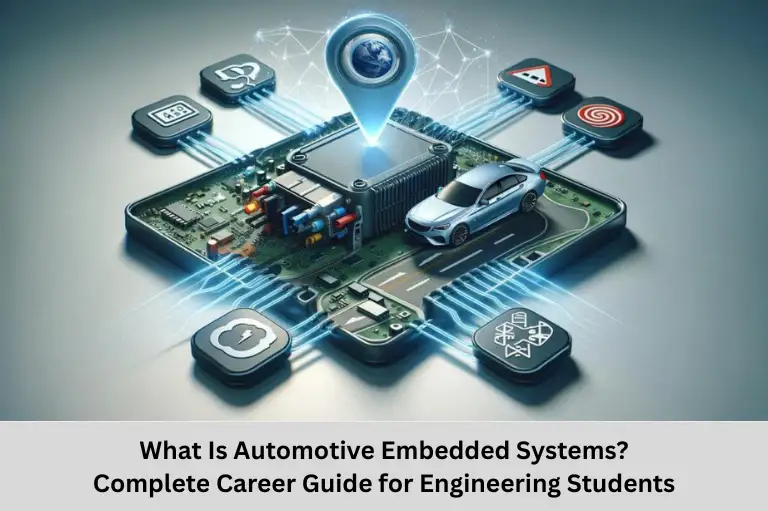
Learn what Automotive Embedded Systems are, how they work, career opportunities, required skills, salary, and how ETDA prepares engineering students with practical training and assured placements.
- What Is Automotive Embedded Systems? Complete Career Guide for Engineering Students
-
What Is Automotive Embedded Systems? Complete Career Guide
- What Are Automotive Embedded Systems?
- Why Are Automotive Embedded Systems Important?
- Components of an Automotive Embedded System
- How Automotive Embedded Systems Work
- Technologies Used in Automotive Embedded Systems
- Applications of Automotive Embedded Systems
- Skills Required for an Automotive Embedded Engineer
- Career Opportunities in Automotive Embedded Systems
- Why Automotive Embedded Systems Have a Bright Future
- Why Choose ETDA for Automotive Embedded Systems Training?
-
Frequently Asked Questions (FAQs)
- What are Automotive Embedded Systems?
- Which programming language is used in Automotive Embedded Systems?
- What skills are required to become an Automotive Embedded Engineer?
- Which engineering branches can build a career in Automotive Embedded Systems?
- Is Automotive Embedded Systems a good career?
- What industries hire Automotive Embedded Engineers?
- Does ETDA provide Automotive Embedded Systems training?
- Conclusion
What Is Automotive Embedded Systems? Complete Career Guide
The automotive industry is undergoing a massive technological transformation. Modern vehicles are no longer just mechanical machines—they have evolved into intelligent systems powered by software, sensors, microcontrollers, and embedded electronics. Features such as Advanced Driver Assistance Systems (ADAS), electric vehicles (EVs), autonomous driving, infotainment systems, digital instrument clusters, and connected cars all rely on Automotive Embedded Systems.
As automotive technology advances, the demand for skilled embedded engineers is growing rapidly. Companies such as Bosch, Continental, Valeo, Aptiv, Tata Technologies, Mahindra Electric, Mercedes-Benz Research, Harman, and many automotive OEMs are actively hiring engineers with expertise in Embedded C, ARM Microcontrollers, CAN Protocol, AUTOSAR, RTOS, Internet of Things (IoT) and Automotive Electronics.
For engineering students, Automotive Embedded Systems has become one of the most rewarding career paths due to its excellent salary packages, global opportunities, and continuous innovation.
Embedded Tech Development Academy (ETDA) provides industry-oriented training in Automotive Embedded Systems, Embedded C, ARM Cortex-M, LPC1768, STM32, RTOS, CAN Protocol, IoT, and AUTOSAR fundamentals, along with assured placement support. Through hands-on projects and practical learning, ETDA helps students become job-ready automotive embedded engineers.
In this comprehensive guide, you’ll learn what Automotive Embedded Systems are, how they work, required skills, career opportunities, industry trends, and why this field is one of the best career choices for engineering graduates.
What Are Automotive Embedded Systems?
Automotive Embedded Systems are specialized computer systems integrated into vehicles to control specific functions in real time.
Unlike general-purpose computers, these systems are designed to perform dedicated tasks with high reliability, safety, and efficiency.
Today’s vehicles may contain 50 to over 150 Electronic Control Units (ECUs), each responsible for a particular function such as braking, engine management, steering, or infotainment.
These embedded systems continuously communicate with one another to ensure the vehicle operates safely and efficiently.
Why Are Automotive Embedded Systems Important?
Modern vehicles require intelligent control for safety, comfort, performance, and fuel efficiency.
Automotive embedded systems help achieve these goals by enabling:
- Engine Control
- Automatic Braking
- Airbag Deployment
- Cruise Control
- Climate Control
- Power Steering
- Battery Management
- Infotainment Systems
- Vehicle Diagnostics
- Connected Vehicle Features
Without embedded systems, modern vehicles would not support the advanced technologies drivers expect today.
Components of an Automotive Embedded System
Every automotive embedded system consists of multiple hardware and software components working together.
Microcontroller (MCU)
The microcontroller acts as the brain of the embedded system.
Popular automotive microcontrollers include:
- ARM Cortex-M Series
- Infineon AURIX
- NXP S32 Series
- Renesas RH850
These controllers execute firmware and manage vehicle operations.
Sensors
Sensors collect real-time data from different vehicle systems.
Common Automotive Sensors
- Temperature Sensor
- Pressure Sensor
- Speed Sensor
- Position Sensor
- Oxygen Sensor
- Proximity Sensor
- Accelerometer
- Gyroscope
Sensor data helps ECUs make intelligent decisions.
Electronic Control Units (ECUs)
An ECU controls a specific vehicle function.
Examples include:
- Engine Control Unit
- Transmission Control Unit
- Airbag Control Unit
- ABS Control Unit
- Body Control Module
- Battery Management System
Modern vehicles may contain dozens of interconnected ECUs.
Actuators
Actuators convert electrical signals into physical actions.
Examples include:
- Fuel Injectors
- Electric Motors
- Valves
- Relays
- Steering Systems
How Automotive Embedded Systems Work
Automotive embedded systems follow a simple but efficient workflow.
Step 1 – Data Collection
Sensors continuously monitor vehicle conditions.
Examples:
- Vehicle Speed
- Engine Temperature
- Brake Pressure
- Steering Angle
Step 2 – Processing
The ECU processes sensor information using embedded software written primarily in Embedded C.
Algorithms determine the required response.
Step 3 – Decision Making
The software decides whether corrective action is needed.
For example:
- Activate ABS
- Deploy Airbags
- Adjust Fuel Injection
- Control Cooling Fan
Step 4 – Output
Commands are sent to actuators that perform the required operation.
This entire process happens within milliseconds.
Technologies Used in Automotive Embedded Systems
Automotive engineers work with several industry-standard technologies.
Embedded C Programming
Embedded C is the most widely used programming language in automotive firmware development.
Why Embedded C?
- Fast Execution
- Low Memory Usage
- Direct Hardware Access
- High Reliability
Almost every automotive ECU runs firmware written in Embedded C.
ARM Microcontrollers
Most automotive ECUs use ARM-based processors due to their performance and power efficiency.
Learning ARM architecture is highly beneficial for automotive careers.
CAN Protocol
Controller Area Network (CAN) enables communication between multiple ECUs.
Without CAN, modern vehicles would not be able to coordinate different electronic systems effectively.
RTOS (Real-Time Operating System)
Many automotive applications require deterministic performance.
RTOS helps:
- Task Scheduling
- Interrupt Management
- Resource Allocation
- Real-Time Execution
AUTOSAR
AUTOSAR (Automotive Open System Architecture) is an industry standard for automotive software development.
Understanding AUTOSAR gives engineers a competitive advantage when applying for automotive jobs.
Applications of Automotive Embedded Systems
Automotive embedded systems are used throughout modern vehicles.
Engine Management Systems
Optimize fuel injection and ignition timing for better performance.
Advanced Driver Assistance Systems (ADAS)
Support features such as:
- Lane Keeping Assist
- Automatic Emergency Braking
- Adaptive Cruise Control
- Parking Assistance
Electric Vehicles (EVs)
Embedded systems manage:
- Battery Charging
- Power Distribution
- Motor Control
- Thermal Management
Infotainment Systems
Provide:
- Navigation
- Multimedia
- Voice Assistance
- Smartphone Connectivity
Vehicle Safety Systems
Examples include:
- Airbags
- ABS
- Electronic Stability Control
- Tire Pressure Monitoring Systems
Skills Required for an Automotive Embedded Engineer
Students should develop both programming and hardware skills.
C and Embedded C Programming
The foundation of automotive firmware development.
Microcontroller Programming
Knowledge of:
- ARM Cortex-M
- STM32
- LPC1768
is highly valuable.
Communication Protocols
Students should understand:
- CAN
- LIN
- SPI
- UART
- I2C
RTOS
Real-time scheduling and task management.
Debugging Skills
Engineers must identify and resolve firmware and hardware issues efficiently.
Electronics Fundamentals
Understanding digital electronics, analog circuits, and sensor interfacing is essential.
Career Opportunities in Automotive Embedded Systems
The automotive industry offers diverse career paths.
Automotive Embedded Software Engineer
Develop firmware for ECUs.
Embedded Firmware Engineer
Create low-level software for automotive hardware.
AUTOSAR Engineer
Develop standardized automotive software components.
Validation & Testing Engineer
Test vehicle software and hardware systems.
ECU Development Engineer
Design and implement ECU firmware.
Functional Safety Engineer
Ensure compliance with automotive safety standards.
Why Automotive Embedded Systems Have a Bright Future
Several trends are driving demand for automotive embedded professionals:
- Electric Vehicles (EVs)
- Autonomous Driving
- Connected Cars
- Smart Mobility
- Vehicle-to-Everything (V2X)
- AI-Powered Driver Assistance
- Software-Defined Vehicles
As these technologies evolve, companies will continue hiring skilled embedded engineers.
Why Choose ETDA for Automotive Embedded Systems Training?
Learning automotive embedded systems requires practical experience with hardware, software, and real-world projects.
Embedded Tech Development Academy (ETDA) is one of Bangalore’s leading institutes for Embedded and Automotive Systems training.
Industry-Oriented Curriculum
Students receive practical training in:
C Programming
Master programming fundamentals by learning core concepts, problem-solving techniques, data structures, and coding best practices essential for embedded systems and software development careers.
Embedded C
Develop firmware for embedded devices by creating efficient, reliable, and hardware-oriented software that controls microcontrollers, peripherals, and real-time system operations effectively.
ARM Cortex-M, STM32 & LPC1768
Gain hands-on experience with industry-standard microcontrollers by developing real-world embedded applications, interfacing peripherals, and implementing practical hardware-software solutions.
CAN Protocol & Automotive Communication
Learn how Electronic Control Units (ECUs) communicate within vehicles using automotive communication protocols to enable reliable data exchange and coordinated system operation.
RTOS
Develop real-time automotive applications by designing, programming, and testing software systems that ensure reliable, responsive, and safe operation of vehicle functions.
AUTOSAR Fundamentals
Understand modern automotive software architecture by learning how software components, ECUs, communication networks, and control systems work together in vehicles.
Hands-On Projects
Students work on projects such as:
- Vehicle Monitoring Systems
- Smart Dashboard
- CAN Communication Networks
- Engine Monitoring Applications
- Automotive Sensor Interfacing
- Electric Vehicle Controller Simulations
These projects help students gain practical industry experience.
Assured Placement Support
ETDA prepares students for successful careers through:
- Resume Building
- Technical Interview Preparation
- Mock Interviews
- Aptitude Training
- HR Interview Guidance
- Assured Placement Assistance
This comprehensive support increases students’ confidence and employability.
Frequently Asked Questions (FAQs)
What are Automotive Embedded Systems?
Automotive Embedded Systems are dedicated electronic systems that control specific functions in vehicles, such as engine management, braking, airbags, infotainment, and battery management.
Which programming language is used in Automotive Embedded Systems?
Embedded C is the most commonly used programming language for automotive firmware development.
What skills are required to become an Automotive Embedded Engineer?
Students should learn C Programming, Embedded C, ARM Microcontrollers, CAN Protocol, RTOS, AUTOSAR fundamentals, debugging, and electronics.
Which engineering branches can build a career in Automotive Embedded Systems?
ECE, EEE, CSE, ISE, Mechatronics, Mechanical, and Instrumentation students can pursue careers in automotive embedded systems.
Is Automotive Embedded Systems a good career?
Yes. It offers excellent salary packages, global opportunities, and strong demand due to the growth of electric and connected vehicles.
What industries hire Automotive Embedded Engineers?
Automotive manufacturers, EV companies, automotive suppliers, industrial automation firms, semiconductor companies, and embedded product companies actively hire automotive embedded engineers.
Does ETDA provide Automotive Embedded Systems training?
Yes. Embedded Tech Development Academy (ETDA) offers practical training in Automotive Embedded Systems, Embedded C, ARM Cortex-M, STM32, LPC1768, CAN Protocol, RTOS, IoT, and AUTOSAR fundamentals with assured placement support.
Conclusion
Automotive Embedded Systems are at the heart of modern vehicle innovation, powering everything from engine control and safety systems to electric vehicles and autonomous driving technologies. As the automotive industry moves toward software-defined vehicles, the demand for engineers with expertise in Embedded C, ARM Microcontrollers, CAN Protocol, RTOS, and AUTOSAR continues to rise.
For engineering students, this field offers exciting opportunities to work on cutting-edge technologies with excellent career growth and global demand.
Embedded Tech Development Academy (ETDA) provides the ideal platform to begin this journey. Through industry-focused training, practical labs, real-time automotive projects, expert mentorship, and assured placement support, ETDA equips students with the technical knowledge and hands-on experience needed to build successful careers in Automotive Embedded Systems. Whether your goal is to become an Embedded Software Engineer, ECU Developer, AUTOSAR Engineer, or EV Software Engineer, ETDA helps you gain the skills that leading automotive companies are looking for.
Author: ETDA Trainers
Experience: 10+ Years of Industry Experience in Embedded Systems, IoT, and Embedded C Programming